
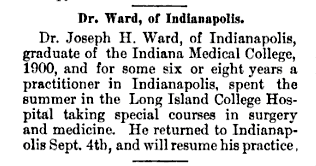
Indiana Medical Journal, volume 21, July 1902.
Indiana Medical Journal, volume 21, July 1902.
North Carolina, Wayne County } In the Superior Court Before A.T. Grady C.S.C.
A.A. Williams & R.J. Barnes }
vs } Complaint
John W. Moore & Isaiah Barnes }
The plaintiffs allege
1. That the plaintiffs and the defendants are tenants in common of a lot of land situate in the town of Fremont in said State and County adjoining the lands of W.R. Ballance & others bounded as follows:
Beginning at a stake in the centre of Sycamore Street below J.P. Hopewell’s lot and running the centre of said street 47 yards; then at right angles with said street nearly East to R.E. Cox and W.R. Ballance line; then nearly North with said line 47 yards to a stake thence nearly west to the beginning containing one half acre.
2. That the plaintiffs and the defendants are seized and possessed in fee simple of said lands as tenants in common in the following proportions to wit 1. A.A. Williams to one third part thereof 2. R.J. Barnes to one third part thereof 3. Isaiah Barnes to one sixth part thereof 4. John W. Moore to one sixth part thereof
3. That the defendants Isaiah Barnes and John W. Moore refuse to [illegible] with the plaintiffs in a petition for the sale of said lands for division.
4. That the plaintiffs desire to have partition of said land made amongst the plaintiffs and the defendants according to their respective rights and interests therein so that each party may hold his interest in severalty, but the number of the parties interested it is impossible that actual partition thereof can be made without serious injury to the parties interested
Wherefore the plaintiffs demand judgment
1. That the plaintiffs and the defendants be declared tenants in common in said lands
2. That an order issue for the sale of said lands on such terms as this Court shall deem reasonable and that the proceeds of such sale may be divided among the plaintiffs and the defendants according to their respective shares and interests in the said lands.
W.S.O’B.Robinson, Atty for plaintiffs
——
North Carolina, Wayne County } Superior Court Before the Clerk
A.A. Williams & R.J. Barnes
vs
Jno. W. Moore et als
The defendants Jno. W. Moore, Isaiah Barnes and R.J. Barnes, answering the petition herein say:
I. That paragraph I thereof is not true.
II. That paragraph II thereof is not true.
III. That paragraph III thereof is not true.
IV. That paragraph IV thereof is not true.
For a further defense defendants allege:
I. That on the [blank] day of 1888, the plaintiffs and defendants, together with Geo. Aldridge and Wm. Durden for the purpose of obtaining a school site for a free school in District No. 6 Colored, in Wayne County, which district had been in July 1888 created at the request of the said persons above-named, paid for the lot of land described in the petition and procured a conveyance thereof from R.E. Cox to themselves, it being the intent and purpose of all the parties thereto that the parties in said deed should hold the lot therein conveyed as trustees for the said district for use as a free school in the same, and that the said deed should be executed to them as said trustees.
2. That by the eventual mistake of the parties to said deed the same was executed by the said R.E. Cox to the parties individually and not as trustees.
Wherefore defendants pray that they be hence dismissed and that they receive their costs of plaintiff A.A. Williams and for such other and further relief is they may be entitled to.
Aycock & Daniels, Attys for Deft.
——
These undated pleadings do not exactly speak for themselves, but I hesitate to read into them something that’s not there. I don’t know how the suit turned out, but if the answer is credited, something like this happened: my great-great-grandfather John Aldridge‘s brother George and five others purchased a half-acre from R.E. Cox to be used for the erection of a school for Fremont’s African-American children. (That’s how it worked then — communities had to donate the land for schools to be built upon.) Through mistake and oversight, Cox made out the deed to the six men individually, rather than as trustees. Subsequently, Williams and R.J. Barnes, seeking to take advantage of the tenancy in common, sought to force a sale of the land — which was too small to divide — so that each owner could cash out his share.
Who were these folks?
Document found in School Records, Miscellaneous Records, Wayne County Records, North Carolina State Archives.
Lewis and Margaret Henderson were surely unlettered, and I suspect that most of their children were, too. I have only been able to find handwriting samples for two.
Caswell C. Henderson was the most worldly of the siblings, having migrated to New York City in his mid 20s, engaged in local politics, and secured a patronage job at the United Customs House while in his 30s. From his 1893 marriage certificate to Emma D. Bentley:

And from a letter he wrote in 1926 to his sister Sarah:
 Sarah Henderson Jacobs Silver was also literate, though her handwriting and grammar reveal the limits of her schooling. This signature appeared on the marriage license of her niece, Minnie Simmons Budd.

Most families grow exponentially, but Lewis and Mag’s descendants underwent a bit of a bottleneck in the third generation. Of their nine children, only two — Ann Elizabeth and Loudie — had children that survived to adulthood. Those two produced five children (barely, as one died at age 19) who reached majority. Of the five, I have only found the signature of one. Jesse “Jack” Henderson, Loudie’s son, affixed his name to his Social Security application in 1936:

Adam T. Artis was illiterate. Though a smart and successful man, he executed contracts with a shaky X and probably conducted much of his business on the basis of verbal agreements. Here, his mark on a receipt for goods purchased from him by the Confederate government in 1863:

There’s little evidence to show whether Adam’s wives could read and write, but it seems doubtful that the first three or four could. His granddaughter Pauline Artis Harris told me that education was important to him, however, and he hired a teacher to live on his farm and school his children. His efforts bore fruit. Below, the signatures of eight of Adam’s 26 or so children.
The signature of the oldest son, Cain Artis (1853-1917):

The signature of Louvicey Artis Aldridge (1865-1927) on the final account of her husband’s estate:

It is, perhaps not surprisingly, the shakiest of the bunch. Vicey was among Adam’s earlier children and likely came along before her father’s resources allowed for tutors. She was also a girl.
From the World War I draft registration card of Walter Scott Artis (1874-1951):

From the World War I draft registration card of William Marshall Artis (1875-1945):

From the World War I draft registration care of Jesse Artis (1878-1922):

Jesse used the alternate spelling “Artice,” which was rarely adopted by members of this family. Notice that somewhere between William and Jesse’s early schooling, cursive capital A’s shifted in style from a form very similar to a printed “A” to one like an oversized small “a.”
From the World War I draft registration card of Robert Elder Artis (1883-1934):

From the World War I draft registration of Columbus Estell Artis (1886-1973):

C.E.’s signature is interesting. This round, upright script, from 1917, is a relatively early version. Later, over the course of the hundreds of death certificates he signed as an undertaker, he developed a bold, right-leaning, immediately identifiable signature characterized by a bold slash through the “r” in Artis:

From the World War I draft registration card of June Scott Artis (1889-1973):

Though his letters are well-formed and decisive, the missing “S” in Scott suggests a man who signed his name from memory and did not write much.
From World War I draft registration card of Henry J.B. Artis (1892-1973):

From the Social Security application of Alphonso Pinkney Artis (1903-1976):
[I’ve got this somewhere. I just need to find it.]
My grandmother tells a story:
… Jay and I were supposed to clean the house on Saturday. You know, do the vacuuming and dusting and cleaning and everything. And then I would play, and we would play, and Grandma would say, “I’m gonna tell your mama. I’m gonna write your mama and tell your mama how you act.” She said, “I can’t write her right now ‘cause I’m nervous,’ you know.” Couldn’t write a lick. [I laugh.] Couldn’t read …. I don’t think she could read or write, but I know she couldn’t write. Bless her heart. She says, “I’m gonna tell your mammy on you. You see if I don’t. And, see, if I wont so nervous, I’d write her, but I’m too nervous” – couldn’t write any more than she could fly! [Laughs.]
Martha Miller McNeely, born into slavery in 1855, may not have been able to read or write, but her children signed their names in clear, firm hands that evidence both their early education and their easy familiarity with penmanship. Their father Henry, the literate son of a slaveowner, may have taught them rudiments, but they likely attended one of the small country schools that dotted rural Rowan County. (My grandmother said that her mother Carrie finished seventh grade and was supposed to have gone on to high school at Livingstone College, but the family used her school money to pay for an appendectomy for one of her sisters.) The document below is found in the estate file of Henry’s half-brother, Julius McNeely, who, unlike Henry, was not taught to read during slavery. Julius died without a wife or children, and Henry’s offspring were his sole legal heirs.

Signatures are often-overlooked scraps of information that yield not only obvious clues about literacy, but also subtleties like depth and quality of education and preferred names, spellings and pronunciations. They are also, in original documents, tangible traces of our forebears’ corporality — evidence that that they were once here.
——
Interview of Margaret C. Allen by Lisa Y. Henderson, all rights reserved. File of Jule McNeely, Rowan County, North Carolina Estate Files 1663-1979, https://familysearch.org. Original, North Carolina State Archives.
For the better part of a year, the doings of Jonah Williams‘ daughter Clarissa regularly made the society columns of the African-American Raleigh Gazette:

Raleigh Gazette, 30 January 1897.

Raleigh Gazette, 19 June 1897.
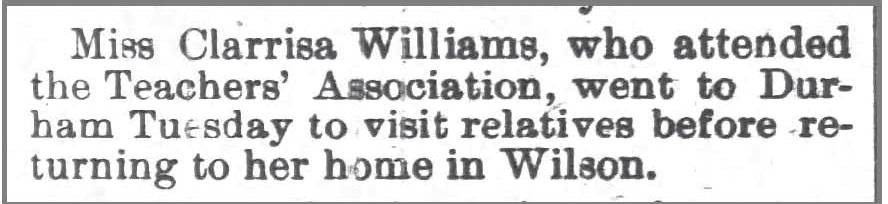
Raleigh Gazette, 26 June 1897.

Raleigh Gazette, 18 September 1897.
And then the paper folded.
More than 20 years passed before Clarissa next appeared in print. The “bright lady teacher” had fulfilled her promise and was elected principal of the Colored Graded School. Her tenure was not long, however. Clarissa Williams died of kidney disease on 26 October 1922, at the age of 51.

Wilson Daily Times, 24 September 1918.
Eons ago, one of the first documents I found related to my great-great-great-grandfather John Wilson McNeely‘s family was an 1828 obituary for his brother David C. McNeely, a student at Yale College.
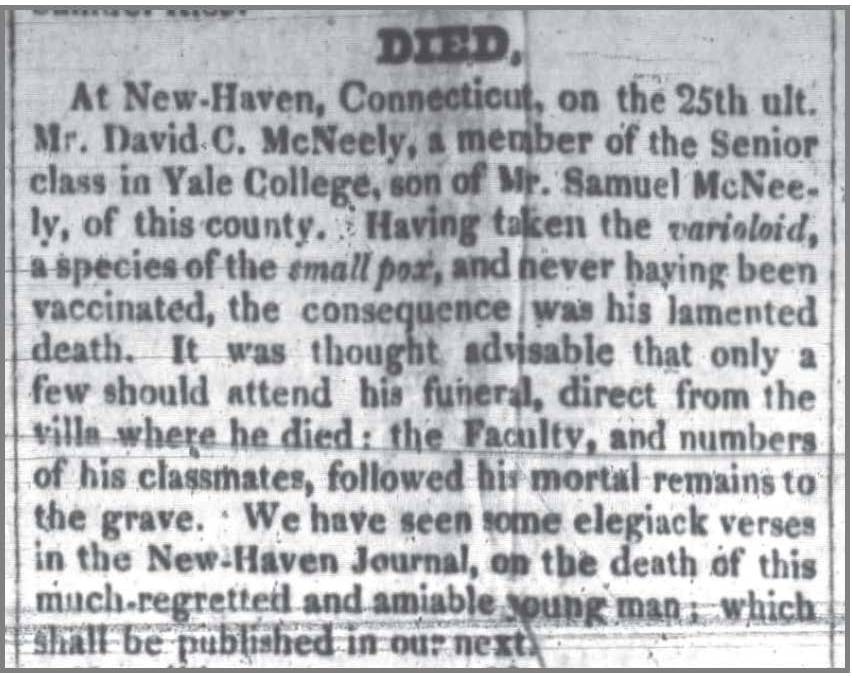
Western Carolinian, 22 April 1828.
Wow, I marveled. There could not have been many Scotch-Irishmen from the backwoods of Piedmont North Carolina studying at Yale at that time. What a terrible loss this must have been for John and his family. I entered David’s name into my Family Tree Maker tree alongside Samuel McNeely’s other children William and Acenith (or Acintha).
And then the other day, I found this:

Western Carolinian, 29 April 1828.
Oh. … Okay. … So all my sentiments hold — except the loss to John. David was not Samuel McNeely‘s son after all, but James McNeely’s.
If there was one James McNeely in Rowan County in the first quarter of the 19th century, there were a dozen, and I have been singularly unsuccessful at teasing apart and differentiating them. Evidence shows that Samuel and his son John W. had close relationships with several James. However, the will of Samuel’s father John McNeely (1724-1801) lists no heir named James, only John, Alexander and Samuel and their sister Ellinor McNeely Bell. It is past time that I pull together a chart or a list or a something that summarizes links I’ve found among these McNeelys and may reveal previously unnoticed clues.
Oscar Randall, son of George and Frances “Fannie” Aldridge Randall, appeared in The Crisis‘ annual round-up of recent college graduates.

“Civil Engineer, Oscar Randall, whose scholastic average is 87% for the 4 year term,” p. 140.
Allison, M.G., “The Year in Negro Education,” The Crisis, July 1920, volume 20, number 3.
In which the Indianapolis Freeman enlightens us regarding Joseph H. Ward‘s journey from Wilson, North Carolina, to Naptown:

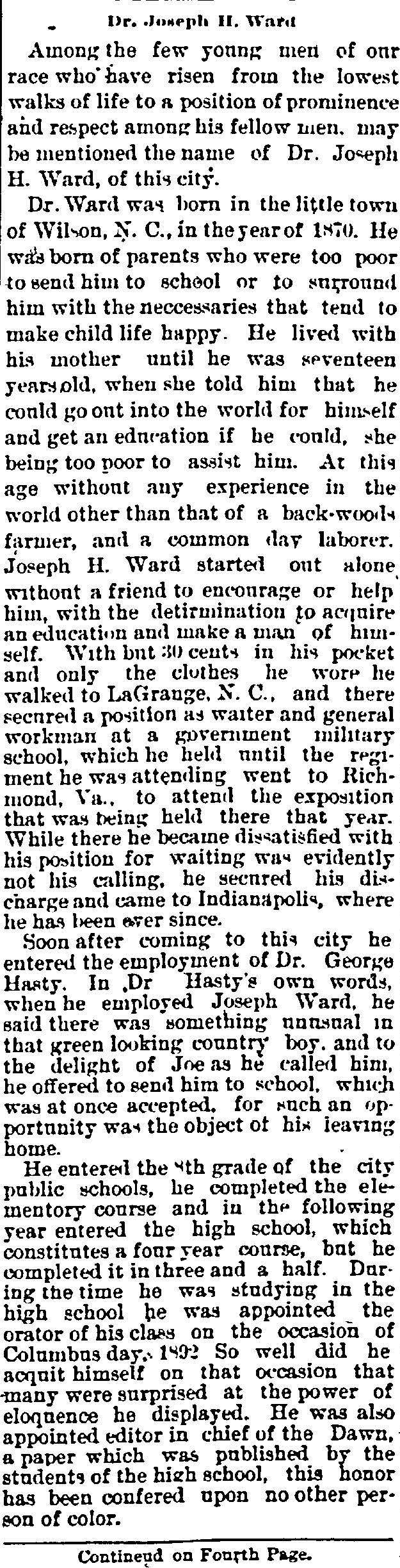
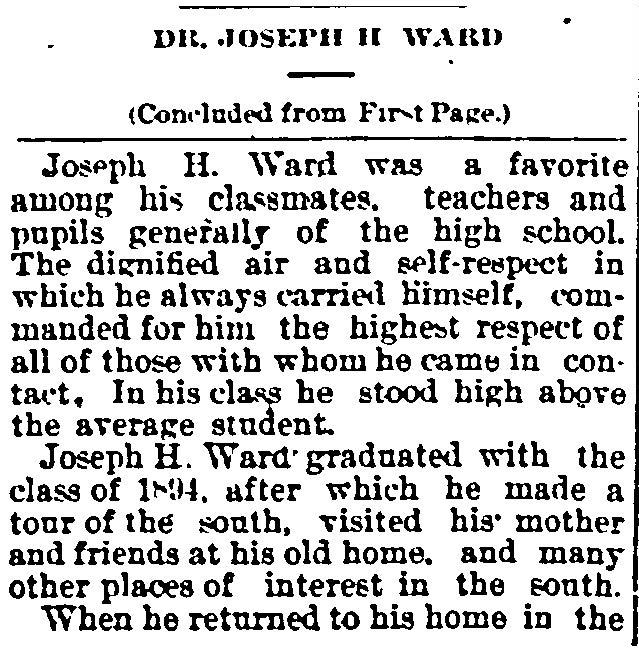

Indianapolis Freeman, 22 July 1899.
A few notes:
A running list of pioneers in education among my maternal and paternal kin.
Cain D. Sauls, Tuskegee Institute?
Henry E. Hagans, Howard University, prep.; Shaw University, BA 1890.
William S. Hagans, Howard University, prep. 1889; college division, 1893; BA, law department, 1898.
Julia B. Morton Hagans, Howard University, Normal School, 1888.
Mack D. Coley, Hampton Institute, prep. 1890; Lincoln University, BA 1895.
Joseph H. Ward, Physico-Medical College, MD 1897; Indiana Medical College, MD 1900.
Vera L. Baker Holt, Scotia Seminary; Freedmen’s Hospital Training School, 1902.
Diana A. Adams Artis, Saint Agnes Hospital Training School, circa 1913.
Golar Colvert Bradshaw, Saint Augustine’s School, prep., circa 1913.
Harriet Colvert, Saint Agnes Hospital Training School; Good Samaritan Hospital Nursing School, 1915.
J. Thomas Aldridge [Aldrich], Shaw University, prep., BS ’17; Meharry Medical College, MD ’20.
Benjamin A. Harris Sr., Tuskegee Institute ’17.
Worth A. Williams, Biddle University [Johnson C. Smith University], prep., BS ’17; Howard University Dental College, ’21.
Hugh Jennings Williams, Biddle University, prep. (died 1913).
Oscar Randall, University of Illinois, BS Civil Engineering ’20.
Marion Allen Lomans, Saint Pauls College?
Arnetta Randall, Howard University, BA ’25.
Mary Louise Colvert Renwick.
Lena P. Jeffress Allen, Hampton Institute, prep., Ed. ’28; Virginia Union University.
Charles C. Coley, Howard University, BS ’30.
J. Maxwell Allen, Virginia Theological Seminary & College, BA; Howard University Dental College, ’34.
Margaret Colvert Allen, Hampton Institute, prep. ’30; Winston-Salem Teacher’s College, ’31.
John C. Allen Jr., Hampton Institute ’30.
Erskine G. Roberts, Northeastern University, Massachusetts Institute of Technology, BS, MS ’32.
Mary Roena Ward Roberts, Tuskegee Institute; University of Denver, BA ’34.
Irvin L. McCaine, Howard University, BS ’34; DDS, ’38?
William N. Hagans, Howard University; Virginia State College, BA ’35.
Frances McCampbell Hagans, Virginia State College, BA ’35.
Frances Sykes Goodman, Bennett College, BA ’35.
Leon M. Braswell Sr., Lincoln University, BS; Meharry Medical College, MD ’36.
Nita Allen Meyers Wilkerson, Hampton Institute, Nursing School, 1930s.
Leroy T. Barnes, University of Pennsylvania, BS ’39, MD ’43.
Frederick R. Randall, Howard University, BS ’42; Howard University Medical School, MD, 1940s.
Leland Newsome, Johnson C. Smith University, BA 1940s.
Azzalee Mallette Hines, Fayetteville State Teachers College, 1944.
Eugene Derricotte, University of Michigan, BS ’48.
 Scuffalong: Genealogy.