Enslaved People, Maternal Kin, North Carolina, Other Documents

Requiem for Peter and Flora.

Working on my DNA Definites Neill piece sparked an idea for a running post. Sort of my own Book of Negroes. A list of (1) enslaved family members and (2) the enslaved people owned by my family members. I thought briefly about who might make the list, then relegated the idea to “to do.” And then last night —

Well, Illbedamn.

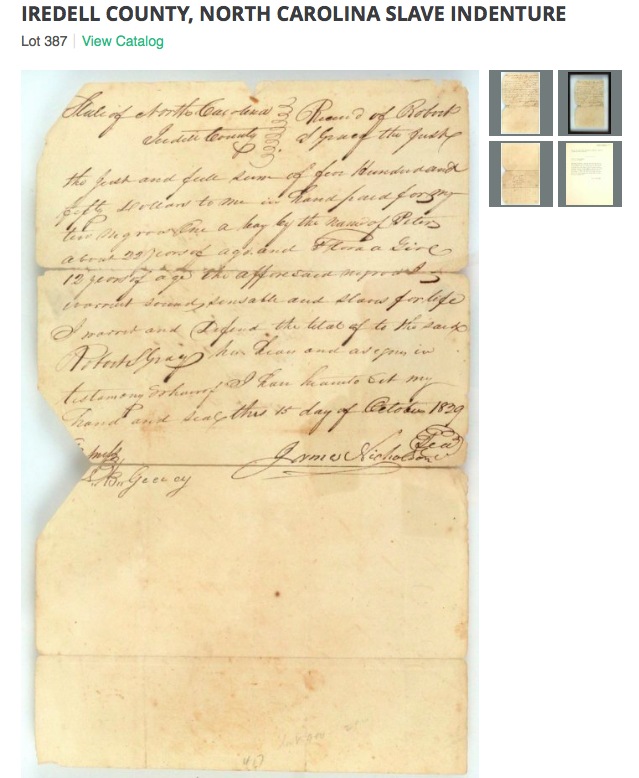
I ran an idle Google search for “Iredell County slavery.” At the top of the third page of results, I ran up on this: a bill of sale for two slaves, Peter, aged 22, and Flora, aged 12, sold by my great-great-great-great-great-grandfather James Nicholson to Robert S. Gray on 15 October 1829.

Screen Shot 2015-01-18 at 8.55.30 PM

Lot 387. Yes. This document was included in a list of items in an on-line estate auction conducted November 16, 2014. I am two months too late. The bill of sale sold. And probably for more than Robert Gray paid for Peter and Flora.

And so I got up this morning and started my Book of Negroes. The format is eluding me, but I’m compiling the entries. The ancestors have called, and I’m answering.

Image posted by Butterscotch Auction Gallery, Bedford, New York, liveauctioneers.com.


Standard
DNA, Maternal Kin, North Carolina

DNA Definites, no. 18: Neill.

As I moaned about in November, I lost most of my deep DNA matches when Ancestry rolled out its “new and improved” test analyses, mostly in lines that branch above my great-great-great-grandfather Thomas Allison Nicholson. Imagine my joy, then, when I recently noticed two new matches whose family trees indicated descent from James and Agnes Ann Falls Snoddy Neill of Iredell County, North Carolina. James and Agnes’ daughter Elizabeth Neill married Theophilus Allison (1754-1805) and gave birth to Mary Allison (1792-1857). Mary Allison Nicholson was Thomas A. Nicholson’s mother.

The first match, T.S., is their great-great-great-great-great-great-grandson. I contacted L.P., who administers T.S.’ account, and learned that he is her maternal uncle and is a cousin of J.W., my other Neill/Falls match. T.S. is my fifth cousin, three times removed. L.P. and J.W. are my sixth cousins, twice removed.

——

State of North Carolina, Iredell County

In the name of God Amen,

I James Neill of Said County being in a sick & low condition but thanks be unto God being at this time in perfect mind & memory do make this my last will & Testament. & first I recommend my [obscured] unto God who gave it me & my body I recommend to the Dust to be buried at the discretion of my Exr. In a Christian & decent manner. & as touching my worldly Substance that I am now possessed of I give & bequeath as followeth (viz)

After all my lawfull debts is paid I leave unto my daughter Sarah ten shillings

& unto my Daughter Hannah I leave ten shillings also

& unto my son Wm. I leave & bequeath the land he lives on

& unto James Holmes my son in law & Each of the bodily Heirs of my daughter Mary now deceased I leave to each five shillings

And unto my son Archibald I leave ten Shillings

And unto my son James I leave & bequeath the plantation he now lives on being a part of the Tract of land my son Wm. now lives on

& unto my daugter Elizabeth I give ten Shillings

& unto my son Robert I give & bequeath the land I now live on includeing my new entry Joining my ould Samuel Neills, Andrew Ramseys, & James Patterson, lands together with the residue of my Personal Estate Except what I give & bequeath unto my beloved Wife which is as follows (viz) I leave unto her a mare called Short her saddle & bridle her bead & furniture a third of my houshold furniture a third of my Dwelling house if necissary for her accommodation the above movable property to be at her disposal at her death Together with a good & honourable maintainance to be given her by my said son Robert during her natural life Also I leave unto her my negro wench Luce & the one half of my cattle to be eaquel in value with my son Roberts half the whole of which is to be at her disposal at her death.

And Lastly I do hereby constitute & appoint my beloved Wife & my son Robert to be the Executors of this my last will And Testament And I do in the presence of the subscribeing Witnesses publishing & Decclareing this & no other to be my last Will & Testament In witness whereof I have hereunto set my hand & Seal this 22d Day of June 1793

/s/ James Kerr, John Falls Jurat     James X Neill {seal}

Will of James Neill, Will Book 1, page 154. Iredell County, North Carolina Probate Records 1735-1970, familysearch.org.

——

August 23rd, 1793 Iredell County State of North Carolina. In the name of God Amen I Agness Neill of the State & County aforesaid being in a Sick & poure State of health but being Sound in mind & Memory I do will & Bequeath to my son Andrew Snoddy, one feather bead the one I have for my own use with all the furniture belonging to the same also three Puter Dishes Six plates Six Basons five porringers one large Metal pots one small Do. Item I Bequeath to my Daughter Elizabeth Alison, Wife of Theophilus Alison, my Chest & all my body Cloas, also the mare willed to me at my Husbands death, Mare named Short, also Six Head of Sheep I do Give & bequeath to my son James Neill, one Cow & Calf, & one year old heifer, also my Table & four Chares & one Smothing Iron, Also I do bequeath to my son Robert Neill the Loom & What tacklings there is belonging to the Sd. Loom & one Smoothing Iron Item I Do leave & Bequeath to my grand Daughter Agness Alison, Daughter of Theophilus & Elizabeth Alison one feather Bead, & all the furniture belonging to the same as known by The white cotton tick with one Copper Tea Cittle.

I do also leave to my grand Daughter Agness Neill, Daughter to my son Robert & Margaret Neill, one feather bed, & furniture it is a striped Tick the remainder of my Stock to be Sold & Eaquell Divided among my three sons & Daughter Andrew Snoddy Jas. & Robt. Neill & Elizabeth Alison. I Do request them to give me a decent Buring to be paid out of that part of the Stock which to be Sold. I do also give & bequeath to my son Andrew Snoddy Six yards of thick cloth which I now have.

I make this my last will & Testament & do my son in law Theophilus Alison to be my Executor in Witness whereof I have set my hand & Seal this 23rd Day of August A.D. 1793 Test

Thomas Allison Junior, Samuel Wilson Jurat   Agness X Neill {seal}

Will of Agness Neill, Will Book 1, page 153. Iredell County, North Carolina Probate Records 1735-1970, familysearch.org.

——

In the name of God Amen, Theophilus Allison of the County of Iredell in the State of North Carolina being very sick and weak in body But of Perfect mind and Memory thanks be unto God calling unto the mortality of My Body and Knowing it is appointed for all men all to die do make and ordain this my last will and Testament that is to say Principally and first of all I give and command my Soul into the hand of almighty God that give it and my Body I recommend to the Earth to be Buryed in decent Christian Burial at the discretion of my Executors and as touching such worldly Estate wherewith it has pleased God to bless me in this life I give devise and dispose of the same in the following manner and form first I give and bequeath to my dearly Beloved wife my Negro Woman named Soose and her child Esther my mare named Short and saddle and Bridle her Bed and furniture and all the dresser Furniture and Six head of Cattle of her own picking also six sheep of her own Choosing the one half of the Kitchen Furniture to be hers and hers for ever also I give to my well beloved Daughter Nancy Allison Peggy Allison Mary Allison Elizabeth Allison and Daely Simonton Allison and my well beloved Jefferson Theophilus Allison an Equal divide of the remainder of my property (Excepting my Land) to be given to them as Mary Becomes of age the plantation I now live on I allow my Executors to dispose of at any time if they think Best Before my son Jefferson Theophilus Allison come of age and make Good Titles and the price thereof to be my sons Jefferson Theophilus Also my Tennessee Land I allow to be equally divided among my wife and children I allow for the support of the family & use of the place my sorrel Mare called Magay and her year old filly and the horse called Tobby and wagon and four pair of Gears and all other Plantation Tolls & all the Hogs and as many of my cattle as my Executors shall Think necessary and the remainder of both Horses and Cattle to do to public sale. I also allow my Executors to keep upon the plantation the rest of my Negroes not willed but if they my Executors should at any time think Better to hire or sell one or more of my Negroes to do it and make good rights all other property not mentioned if needed for the use of the family to be kept, but if not needed to be sold and I do by these presents constitute appoint and ordain my trusty friends Elizabeth Allison my wife Richard Allison my brother and Joseph Kerr my brother in law Executors of this my last will and Testament and do by these presents revoke and disavow and disalow all other former Testaments will Legacies bequests and Executors by me in any wise before named willed or bequeathed, ratifying and confirming this and no other to be my last will and Testament in witness whereof I have hereunto set my hand and seal this the seventeenth day of November, in the year of our Lord one Thousand Eight hundred and five signed seal published pronounced and declared in presents of us –

John Knox

Robert Knox       Jurat                 /s/ Theophilus Allison

Jherrod Stroud

Will of Theophilus Allison, Will Book 2, page 44. Iredell County, North Carolina Probate Records 1735-1970, familysearch.org.

Standard
Agriculture, Land, Maternal Kin, Newspaper Articles, North Carolina

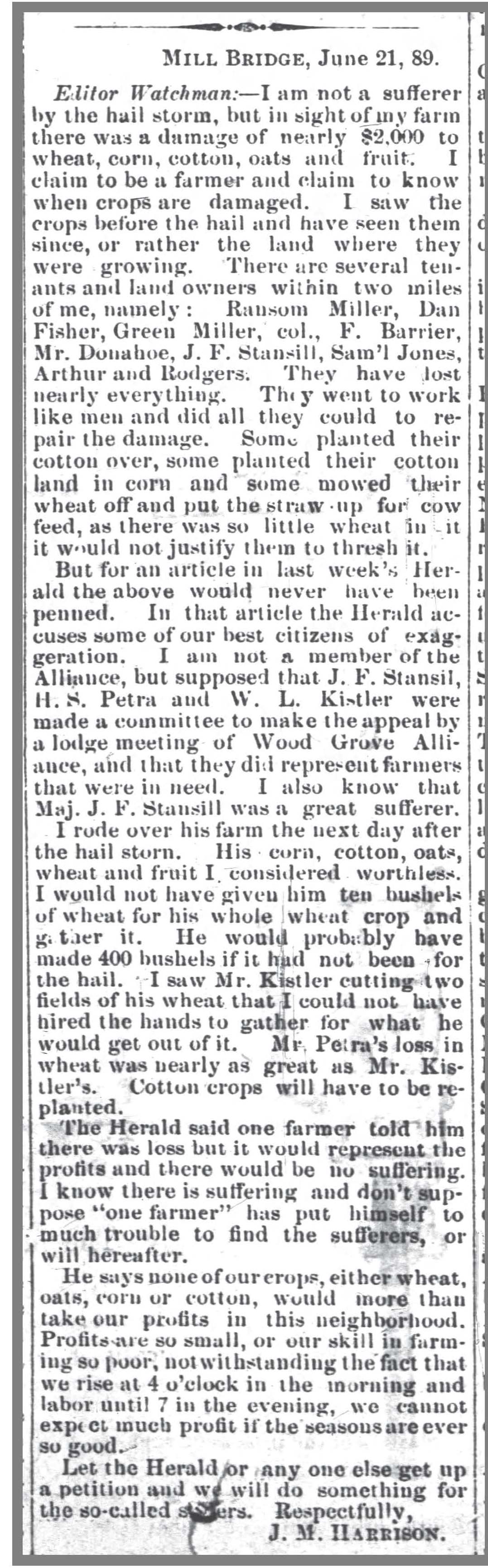
A sufferer by the hailstorm.

Carolina_Watchman_6_27_1889_hailstorm_ransom_miller

Carolina Watchman, 27 June 1889.

The Ransom Miller named above may not have been not “my” Ransom, but a white man. However, “Green Miller, col.” was definitely my great-great-grandmother Martha Miller McNeely‘s brother-in-law, husband of her sister Grace Adeline Miller Miller.

Two days earlier, a Winston-Salem newspaper had also posted an appeal for help for Rowan County’s devastated farmers.

WS_Progressive_Farmer_6_25_1889_appeal

Winston-Salem Progressive Farmer, 25 June 1889.

When it came down to it, however, despite having “lost nearly everything,” Green Miller somehow failed to benefit from the Wood Grove Alliance’s appeal.

Carolina_Watchman_7_11_1889_Wood_Grove_Alliance

Carolina Watchman, 11 July 1889.


Standard
Births Deaths Marriages, Maternal Kin, North Carolina

Ida Colvert Stockton … Stockton.

My great-grandfather, Lon W. Colvert, had four half-sisters — Selma, Ida May, Lillie and Henrietta. Selma died of “exhaustion from severe burns” when my grandmother was 8 years old. Ida May and Lillie remained in Statesville all their long lives. My grandmother of course knew them, but there is a disconnect somewhere in there that I can’t quite pinpoint. Why were there no extended Colvert relatives at our early family reunions (when many were still alive), as there were extended McNeely kin? Why didn’t my mother know her grandfather’s people? It is perhaps as simple as my grandmother and her sisters being closer to their mother’s large family in childhood, especially given their father’s relatively early death. Over the years — my grandmother left Statesville for good in 1932 — these patterns persisted, solidified and were passed down. Perhaps. It seems odd to me though. Lon’s sisters were roughly the same age as his oldest set of children, and Ida May’s oldest children were roughly the same age as Lon’s youngest. The families lived in close proximity in south Statesville. What was up….?

I have blogged quite a bit about Henrietta Colvert — the aunt my grandmother knew best — who was one of North Carolina’s early African-American registered nurses. I have tracked Henrietta across the arc of her career, which happened to unfold in my hometown of Wilson, North Carolina, almost 200 miles east of Statesville. She left Wilson sometime after World War II, and I have intermittent glimpses of her whereabouts prior to her death in Roanoke, Virginia, in 1980. What of the other sisters though? I’ll start with Ida May.

Though John W. Colvert and Myra Hampton began their relationship in the late 1880s, they did not marry until 1905. Ida, their first child, was born about 1887, and three more daughters followed in short order. None of the family, however — not John, not Addie, nor their girls — are found in the 1900 census.

A lot happened in the next decade though. The 1910 census of Statesville, Iredell County, at 214 Garfield Street, shows Ida M. Stockton, a 25 (actually, 23ish) year-old widow with one of three children living sharing a household with her brother-in-law Eugene Stockton, 37 and married, her brother-in-law Jesse Stockton, and her son John, 1.  Ida was a laundress, Eugene a tobacco roller at a tobacco factory, and Jesse, an odd job laborer.  This arrangement would not ordinarily raise eyebrows, but — widow?  Wasn’t Eugene Stockton Ida’s husband??? Why is he listed as her brother-in-law?  The birth certificates of all her children, including John, list Eugene as their father. Had Ida previously been married to one of Eugene’s brothers? (Census and death records identify several, including Arthur (born circa 1875), Fred (1885), Jakey (1887), Jesse Lee (1889), and David (1891).) If so, I have not found evidence of a license. And if not Ida, to whom was Eugene married in 1910?

That last question turns out to be pretty easily answered. On 24 June 1903, Eugene Stockton, son of Henry and Alice Stockton, married Ella Cowan, daughter of Peter and Clementine Cowan in Iredell County. I have found no evidence that the couple had any children. In the spring of 1912, their divorce suit, styled Eugene Stockton vs. Ella Stockton, was listed several times in the court calendar published in the Statesville Sentinel. By 1918, when Eugene registered for the World War I draft, he listed his sister Gertrude Stockton as his next of kin.

Ida’s children were John Walker Stockton (1910), Lillie Mae Stockton (1911), Sarah Eliza Stockton (1912), Alonzo Pinkney Stockton (1917),  Winnifred Josephine Stockton (1919), and Eugene A. Stockton (1924). As noted above, the birth certificates of all list Eugene as their father. (In sooth, though, all the children except Eugene had delayed birth certificates, i.e. certificates registered well after the birth of the child in question.)

Nothing had changed by time the enumerator arrived to record the 1920 census. At 214 Garfield Street in Statesville, Eugene Stockton, 46, is listed as the head of a household that included his sister Flossie Tomlin, 23, grandchild Annie L., 5 months, sister-in-law Ida M. Stockton, 33, and grandchildren Lilly M., Sarah E., Alonzo P., and Winnifred.  Eugene was employed as a tobacco factory laborer, Flossie as a teacher, and Ida as a laundress. Who made this up? The census taker, or a self-conscious Ida May? She is still listed as Eugene’s in-law, despite their apparent decade-long relationship, and Lillie, Sarah, Alonzo and Winnifred are identified as his grandchildren.  Eugene’s sister Florence “Flossie” Stockton Tomlin, was married to Harvey Golar Tomlin, who was the half-brother (on the maternal side) of Ida Mae’s half-brother (on the paternal side) Lon W. Colvert.  Accordingly, Annie L. Tomlin was Eugene’s niece, not his granddaughter. (In a separate listing in 1920, in Statesville’s “suburbs”: Jessie Stockton, 28, sister Flossie Tomlin, 25, niece Anna L. Tomlin, 4 months, and brother-in-law Havey Tomlin.)

Finally, as her mother’s had been, Ida May’s steadfastness was rewarded.  On 8 July 1922, Eugene Stockton, 49, son of Henry and Adley Stockton, and Ida May Stockton, 35, daughter of John and Adeline Colvert, were married by Z.A. Dockery, M.G., at “Eugene’s house” before Bessie Abernathy and E.A. Abernathy.

In the 1930 census, the family at last is listed openly: Eugene Stockton, 57, wife Ida M., 45, and children John, 20, Lily M., 18, Sara, 17, Alonzo, 12, Winifred, 11, and Eugene Jr., 6.

STOCKTON -- Eugene&Ida Stockton

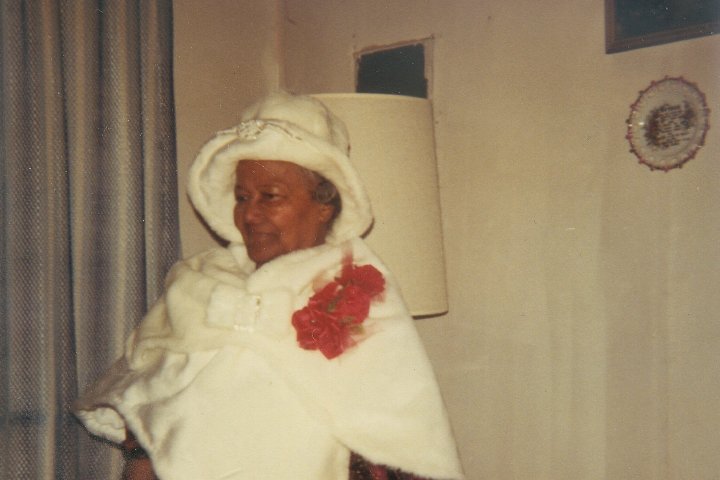
Eugene and Ida May C. Stockton, probably the early 1940s.

Eugene Stockton died 26 February 1944 in Statesville. Ida May Colvert Stockton Stockton outlived him by more than 20 years. On 23 August 1967, she passed away a week after suffering a stroke.
Sville_R_amp_L_8_26_1967_IM_Stockton_obit

Statesville Record & Landmark, 26 August 1967.

Photo courtesy of A. S. Barton.

Standard
Enslaved People, Land, Maternal Kin, North Carolina

38 acres.

So, I found this deed today on the Iredell County Register of Deeds’ site:

Screen Shot 2015-01-03 at 11.07.21 AM

A number of things strike me:

  • John Walker Colvert never registered a deed for this or any other property. Neither did his father Walker Colvert.
  • The property bordered that of John Greenberry “J.G.” Colvert, a son of William I. Colvert, who had been Walker and John Walker’s master.
  • “For further description and title, see deed of G.W. Mullis to G.B. Morgan. Also see will of Walker Colvert — Will Book 6 at page 483.” George W. Mullis was the father of Daniel A. Mullis, one of the witnesses to Walker’s will.
  • Though the deed was not registered until 1904, Mullis sold the 38 acres for $250 to Gabriel B. Morgan on 2 April 1863. Lying in the northeast corner of the Richardson tract on Hunting Creek, the parcel was bounded as follows: “Beginning at a hickory thence South (58) fifty-eight poles to a stone thence near south [sic] a conditional line 114 (one hundred & fourteen) poles to two oaks near a branch, then north to Beatys line thence East with said line to the beginning containing thirty eight acres more or less….” (Deed Book 30, page 234)
  • In the 1870 census, Walker reported owning $100 of real property. It is not clear when he bought the 38 acres, presumably from Morgan.  He is listed in Union Grove township, just west of Eagle Mills township in Iredell County. His close neighbor is Beeson Baty, presumably of the “Beaty’s line” named in the deed.
  • Walker made his will in 1901; it was probated in 1905. Walker’s widow Rebecca was his primary beneficiary, but everything passed to John after her death in 1915.
  • As an aside, Walker and Rebecca’s daughter Elvira married Richard Morgan, son of Richard Madison and Hilda Morgan, in 1874. Had Richard and his mother belonged to G.B. Morgan?
  • P.P. mentioned that D.A. Mullis lived in the vicinity of Mullis Road and Zion Liberty Road. I’ve marked that intersection with the left-most arrow on the map below. As the deed described, this area is near Hunting Creek, which crawls across the middle of the image, and is at the eastern edge of Union Grove township. The second arrow marks the point at which I photographed the creek from the Eagle Mills Road bridge. The third points in the direction of Nicholson Mill. As the crow flies, the map depicts an area no more than a couple of miles wide.

Screen Shot 2015-01-04 at 1.56.36 PM


Standard
Maternal Kin, North Carolina, Paternal Kin

Blog blessings.

  • On October 23, I blogged about connecting with D.J., a descendant of my great-great-great-grandparents Adam T. Artis and Robert and Mary Eliza Balkcum Aldridge via Lillie Bell Artis Thompson McDaniel Pridgen (1891-1935). A month and a half later, quite separately, I heard from P.M. via this blog. P.M. is also descended from Lillie Bell, though from her marriage to Celebus Thompson. (D.J. is from her second marriage, to McDaniel Whitley.) To my surprise, P.M.’s great-grandmother, Lillie Bell’s daughter Genetta Thompson, married Phillip Elmer Coley, a grandson of Winnie Coley. In her short life, Lillie Belle had twelve or so children. Many migrated north to New York and New Jersey, though, and I had not been able to trace them forward. So glad Scuffalong is bridging that gap!

Genetta Thompson Coley

Genetta Thompson Coley.

  • Just after Christmas, P.P. commented on “All of my possessions to have and to hold,” which featured by great-great-great-grandfather Walker Colvert‘s will. She identified Daniel Mullis, one of the witnesses to the document, as her ancestor. P.P. not only lives in the Eagle Mills area, she’s an avid genealogist and local history buff, she’s my cousin! Her great-grandmother Rebecca Ann Nicholson Barnard was a sister of my great-great-great-grandfather James Lee Nicholson. P.P. has a lifetime of knowledge about northeastern Iredell County and has volunteered to help me in any way possible. Two things she’s already shared: (1) The Welch-Nicholson house didn’t just fall down from age and neglect. It was torched by hooligans out on arson spree. This was back, probably, in the 1980s, not very long after the house achieved historic register status. (2) “Cowles” is pronounced COLES.
  • Around the same time I heard from P.P., I received a message from P.W. She’d been talking to her grandmother about family history, jotted down some names, Googled them, and immediately found “Where we lived: 114 West Lee Street.” To my amazement, she is a descendant of Madie Taylor Barnes, who migrated to New York City during the Great Depression and lost touch with her North Carolina family. I’m looking forward to talking to P.W.’s grandmother soon.
  • And then today: M.S. left a comment noting that her great-great-great-grandfather baptized my great-great-great-grandfather James L. Nicholson in 1842, and she’s a descendant of John A. Colvert, an owner of my great-great-great-grandfather Walker Colvert!

Photo courtesy of Patricia Smith Muhammad.

Standard
Maternal Kin, Paternal Kin

Do not be lulled.

“This place of the unrepresentable, the unknowable, and, in the language of Toni Morrison, the ‘unspeakable,’ is where the slave lives. It is where a slave woman named Doll Shoeboots lived until her old age. Unlike Harriet Jacobs, though, who told her unknowable story in her own words, Doll did not write. A record of Doll’s interior life, her ruminations and fleeting thoughts, might reveal something of her world to us. But like millions of other slave women, Doll left nothing behind that attests to her character, her strategies and ideologies, the quality of her days and years. The available sources on Doll’s life are a reflection of that life itself — limited, ambiguous, and fragmented.

To write about Doll, then, is to pay tribute to her life, a life that would otherwise be lost to history. But do not be lulled. To write about Doll is also a wholly inadequate exercise. For every scrap about her past that I have scavenged and reconstructed here might just as well have been captured by a chapter of blank, white pages. …

Thus Tiya Miles limns the dilemma that, in collusion with bone-laziness, thwarts my attempts to put written order and sense to my family’s stories. What justice do mere names and dates and scraps of record and wispy memory do to the fullness of these long lives, each lived in the same jam-packed 24-hour increments that you and I experience?

[Miles’ work, Ties That Bind: The Story of an Afro-Cherokee Family in Slavery and Freedom, explores the relationship of Doll, her Cherokee husband, and their descendants — yes, there are a few of you who have legitimate claim to being part-Indian — and the interweaving pulls and tugs of family and race.]

——

I wrote this passage a couple of years ago.  I began Scuppernong: Genealogy last year as a compromise with paralysis, a way to pay small tribute rather than none at all. Along the way to 500+ posts and nearly 33,000 views, I have broken through brick walls, been a resource for other questers, met new kin, and connected with an amazing community of genealogists. My small tributes, shallow and incomplete as they may be, thus return reward beyond measure.

Standard
Maternal Kin, Oral History

Christmas crazy.

In which my mother’s mother reminisces about Christmas with my grandfather and Santa Claus innocence lost:

How did you all celebrate Christmas? Did you get a tree and all that or what did you do?

Ohhh, Daddy was Christmas crazy. He was Christmas crazy, honey. He would buy everything in the world he could afford. And fruitcake. We would make fruitcake. He would help me stir ‘em and cook ‘em, and one time we made some and it didn’t look dark like fruitcake usually is, and I said I wonder why … He said, “Well, I tell you what, let’s put some cocoa in it to make it dark.” [Laughs.] And he used to stir ‘em for me, stir the cake for me and beat the eggs. The batter. He was a better cook than I was. He really taught me to cook.

What about Christmas when you were a child? When you were little?

We had nice Christmases. Walker and Golar and Mat were older than we were, and they used to have to pass through our room some kind of way to get to the front. When they’d come home, when they’d come in the back porch, they would have to pass through that room. And I was a big girl and should have had more sense. But they passed through there, and — I thought Santa Claus brought oranges and apples and everything else. And they thought that we were asleep. They came through our room for something, and they thought that we were asleep, and my brother said, “Did you bring the oranges out the car?” And I mean it just upset me so bad, I didn’t know what in the world to do because I thought Santa Claus was in the morning and everything else. “Did you get the oranges out the car?” Boy, that took care of my Christmas. I don’t know how old I was either, but it never excited me anymore after that. And we used to give gifts – everybody got a gift. I mean, it wouldn’t be anything. A pair of socks or something, but we would wrap all the gifts and things. And our bedroom had a grate in it. You know what a grate is?

Like in the floor?

No, no, no. In the fireplace. It had a grate and invariably we would fire this grate for New Year’s during the holidays, you know. And when Mama and Golar would go – why they had to go all the way to town at the last, you know. Now, it gets dark now. They didn’t stay all that long, but I would be so frightened. I would just be so frightened while they were gone. And we used to have to always have oyster stew on New Year’s night, and that’s what we used to be waiting for. For Mama to come back and bring the oysters for the stew, and the oysters were clean before we went to bed.

——

No photos or other artifacts exist from my mother’s or grandmother’s childhood Christmases. Plenty do from mine, however, including these fine verses:

996086_10151875262788527_351515647_n

Merry Christmas!

Interviews of Margaret C. Allen by Lisa Y. Henderson; all rights reserved.

Standard
Maternal Kin, Photographs, Virginia

Remembering Julia Allen Maclin.

I found this photo on the Newport News Public Library’s website. Posted in material related to the Virginiana Collection, the picture is captioned: “Junior Class of 1923 stands before the renovated Huntington High School on 18th Street.”

africanAmerican_1

I am fairly certain that the woman I encircled is my great-aunt Julia Allen Maclin, who was born 109 years ago today. I know that this terribly grainy side shot is her:

IMG_4954

Happy birthday, Aunt Julia.

Standard
Maternal Kin, North Carolina, Oral History, Photographs

Remembering Launie Mae Colvert Jones.

My maternal grandmother’s youngest sister, Launie Mae, would have turned 104 today.

Here she is, not long, I think, after she moved to Bayonne, New Jersey, around 1930. She met Georgia-born Isaiah James Jones, married, and reared seven children in Jersey City.

Launie Colvert 002

And here, a photo taken at the first Colvert-McNeely family reunion in 1978. Sweet and funny, this is how I best remember her.

Launie Colvert 001

Launie Colvert Jones (20 December 1910-2 August 1997)

Standard