

King’s Weekly (Greenville NC), 6 March 1900.
Cousin Cain D. Sauls, grocer, merchant, farmer and all-around businessman, suffered a blow in 1900.
King’s Weekly (Greenville NC), 6 March 1900.
Cousin Cain D. Sauls, grocer, merchant, farmer and all-around businessman, suffered a blow in 1900.
David Sloan Aldridge is the mystery brother. Born about 1858, he was Robert and Mary Eliza Balkcum Aldridge‘s fourth son and fifth child and appears with them in the Wayne County censuses of 1860, 1870 and 1880. By 1896, David, also called Sloan, had married Lillie Uzzell, though no license has been found. The couple filed three deeds for real estate purchases in Goldsboro and Grantham township in the late 1890s. In 1900, David and Lillie (called Dilley in the census) are listed in Goldsboro, and he received his share of his father’s estate in 1902. And then he disappeared.
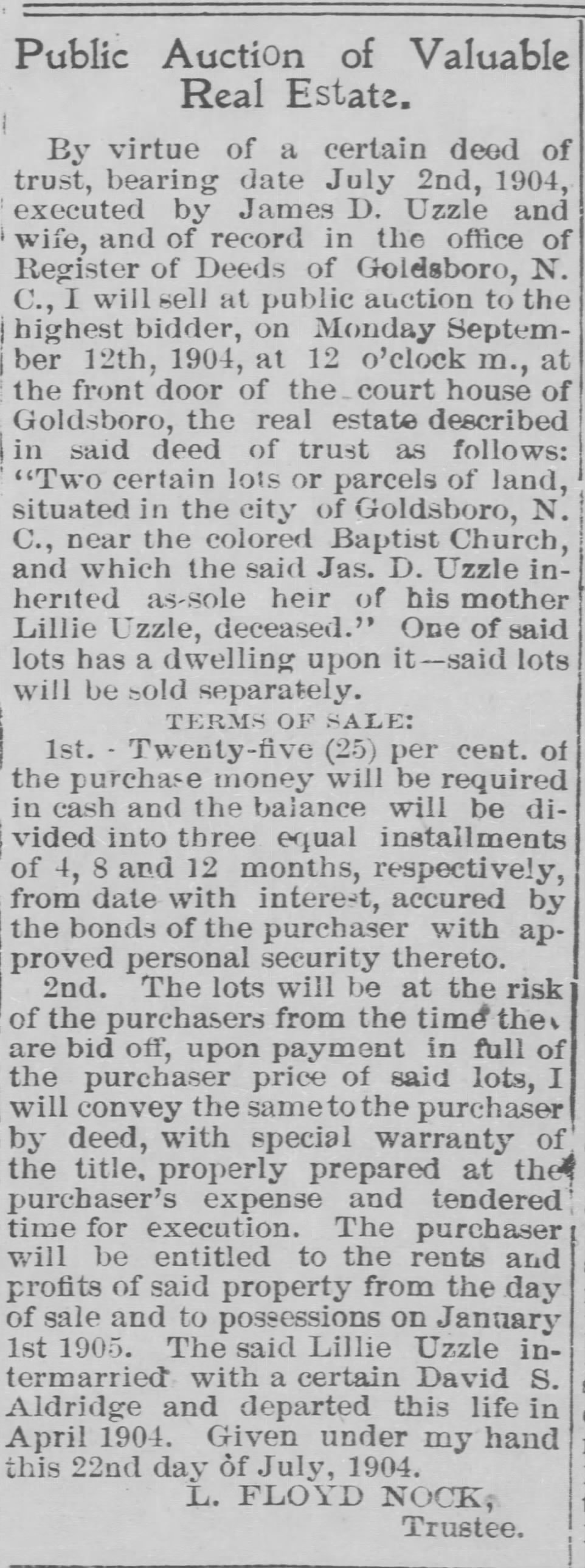
Goldsboro Weekly Argus, 1 September 1904.
I have not found David S. Aldridge in the 1910 census or after. Until I found this article last night, I had no record of him beyond Robert Aldridge’s estate settlement. The lots offered at auction were jointly purchased by David and his wife. In 1904, after his wife’s death, David sold his share in the property to Lillie Uzzell’s sole heir, her adult son, and, after this notice was published, disappears from the record again.
In December 1920, five of Wilson, North Carolina’s leading African-American citizens executed a certificate of incorporation to establish the Commercial Bank of Wilson. The bank was necessary, they asserted, “to promote thrift and economy,” “to encourage agriculture and industrial enterprises,” and “to place in circulation money otherwise unavailable.” Farmer, realtor and businessman Samuel H. Vick; barber William H. Hines; school principal J. James D. Reid; funeral home operator and businessman Camillus L. Darden and physician Frank S. Hargraves — the unquestioned cream of east Wilson‘s crop — each invested in 100 shares of bank stock and, after filing the document, set about designating a president (Hines) and board of directors (J.R. Rosser, Isaac A. Shade, Cain D. Sauls, Charles S. Thomas, R.A. Worlds, John Lucas, C.S. McBrayer, J.O. Mitchell, Lee Pierce, Alfred Robinson and Judge D. Reid), and a cashier (G.W.C. Brown).
Attached to the filing are three pages listing the names of all the bank’s investors and providing information about their net worth and occupation. Most of more than 150 shareholders — overwhelmingly African-American men — lived in Wilson or Wilson County, but adjoining counties like Wayne, Greene and Johnston were represented, as well as more far-flung cities like Durham and Elizabeth City, North Carolina. They were farmers and contractors, merchants and ministers, teachers and barbers, with estimated worths ranging from $300 to $50,000.


At least two of my relatives were among the bank’s investors. C.D. Sauls of Greene County, whose connection through Daniel Artis I chronicled here, was a bank officer, and his cousin Columbus E. Artis, who owned and operated a funeral business in Wilson, bought five shares.
 Hill’s Directory of Wilson, North Carolina, 1922.
Newspapers reported the bank’s opening excitedly.

Wilmington (NC) Morning Star, 18 November 1920.

Elizabeth City The Independent, 25 February 1921.
 Elizabeth City The Independent, 4 March 1921.
In the 1921-1922 issue of The Negro Year Book: An Annual Encyclopedia of the Negro, Monroe N. Work, editor, Commercial Bank of Wilson was listed as one of only eight black banks in the state of North Carolina, which trailed only Virginia (13) and Georgia (9) in the number of such institutions. [Sidenote: one of Virginia’s was Crown Savings Bank of Newport News, for which my great-grandfather John C. Allen served as board member.]
Alas, things fell apart. After a fire in the vault destroyed records, the State launched a criminal investigation that resulted in the closing of the bank on 4 September 1929 and the indictments of vice-president (and chief promoter) J.D. Reid and cashier H.S. Stanbank on charges of embezzlement, forgery and deceptive banking practices. As reported in the 22 February 1930 issue of the Pittsburgh Courier, the courtroom was daily packed with victimized depositors and shareholders, all of whom bore an “intense feeling of resentment against the accused….” Both were convicted and sentenced to five-year prison terms — at hard labor — but released after two years.

Burlington Daily Times-News, 22 December 1931.
As I’ve mentioned, for reasons unclear, my grandmother was close to her father’s first cousins, sisters Fannie Aldridge Randolph of Philadelphia, Pennsylvania, and Mamie Aldridge Abrams Rochelle of Union, South Carolina. Among my grandmother’s papers, I found cards and notes from Cousin Mamie, including this one sent in early 1980:

And here’s the article itself:


Pittsburgh Courier, 7 December 1929.
Wardenur Houser Jones wasn’t the only talented cousin in north Jersey. In 1929, Ardeanur Smith performed at Jersey City’s Saint Mark’s AME Zion Church before Oscar DePriest, United States Congressman from Illinois from 1929 to 1935.
I’ve been pulling together a descendant chart for Daniel Artis. In part, I want to keep the names straight and, in part, I’m trying to see if I’m related to any of the other Edwardses, Saulses or Artises I grew up with. Tonight I Googled some random names from this family and up popped this, published just three days ago in Kinston.com, the on-line version of the Kinston Free Press. Andrew Sauls’ father was Isaac Sauls, son of Isaac Sauls, son of Prior Ann Artis Sauls Thompson, daughter of Daniel Artis, brother of my great-great-great-great-grandmother Vicey Artis Williams.
[Update, 7 March 2014: I emailed the Free Press journalist and two days later — yesterday — got a call from Andrew Sauls himself! He lives on land his grandfather bought in 1920 (plus 400 more); confirmed that the Artis Town sign is gone; knew M.’s grandfather, “Cousin Booker T.,” well; and promised to show me around Sauls-Edwards-Artis territory next time I’m home! — LYH]
Despite the collapse of Reconstruction, African-Americans continued to participate in Wayne County’s political life through the end of the 19th century. Mathew W. Aldridge, in particular, was active in local governance, as announced in eastern North Carolina newspapers:
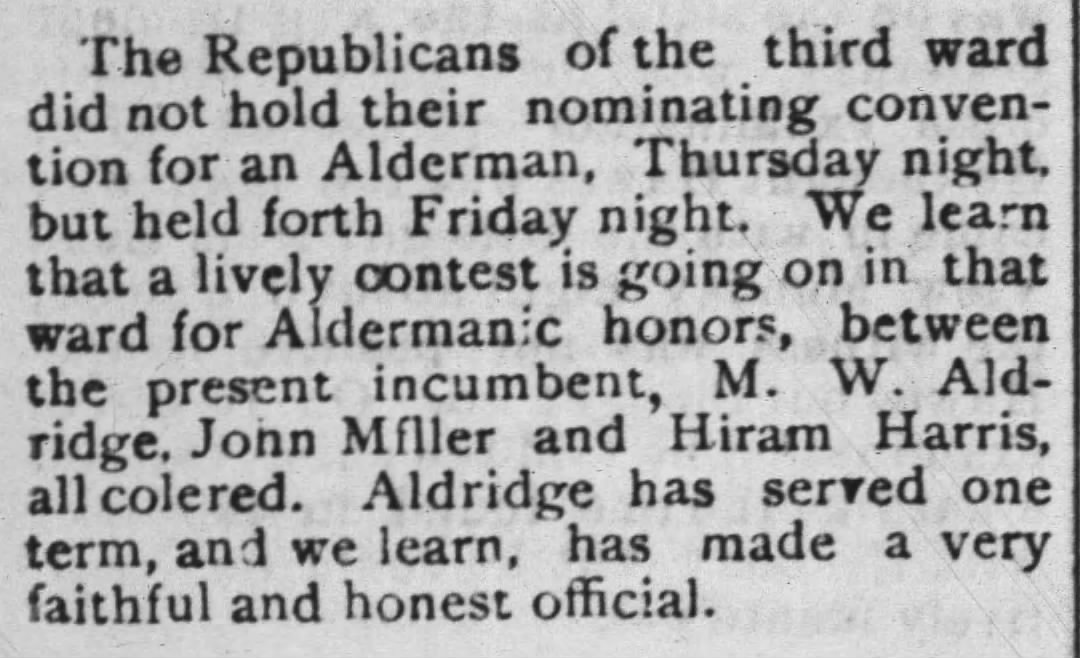
Wilmington Messenger, 27 April 1889.

Goldsboro Headlight, 1 May 1889.

Goldsboro Headlight, 8 May 1889.

Wilmington Messenger, 8 May 1889.
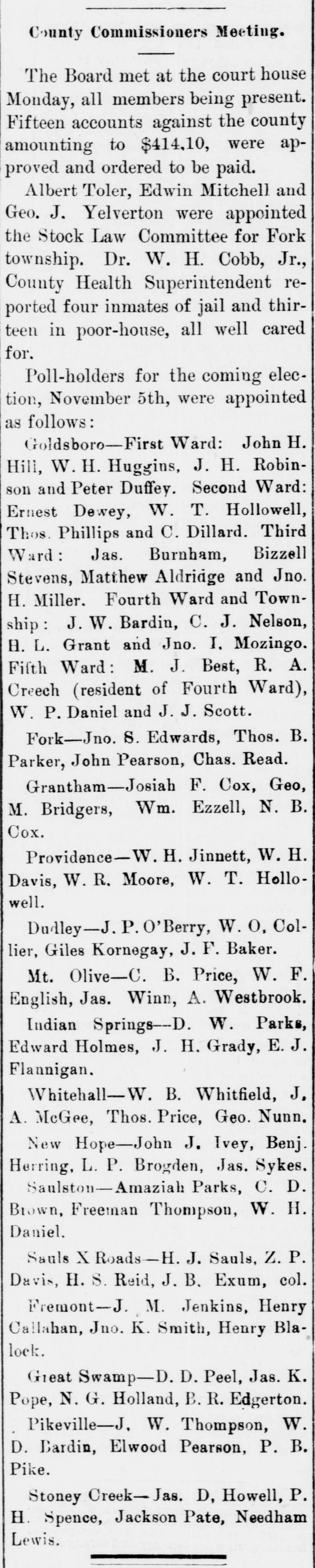
Goldsboro Headlight, 8 October 1890.
Other notables: C[larence] Dillard (Presbyterian minister who arrived in Goldsboro in 1884, later principal of “colored school”); Bizzell Stevens (also a minister; like William S. Hagans, married into the Burnett family, a prominent free family of color in the antebellum era; later a postal clerk at Goldsboro post office); John Frank “J.F.” Baker (postmaster at the Dudley post office; married Mary Ann Aldridge, daughter of J. Matthew Aldridge; murdered); James Winn; and Henry S. “H.S.” Reid (son of Washington and Penninah Reid; member of large prominent free family of color.)
None of us knows the details of the arrangements, or the impact on their willing and unwilling participants, but it is clear that Napoleon Hagans had a messy personal life. His oldest child, William Coley, was born about 1860 to Winnie Coley, an enslaved woman who lived on the nearby farm of John Coley. Winnie had several additional children, fathered by Coley himself and by Napoleon’s brother-in-law Adam T. Artis. Around 1867 — no license has been found — Napoleon married Apsilla “Appie” Ward, born in 1849 to Sarah Ward, an enslaved woman, and her owner, David G. W. Ward, a wealthy physician living in northwest Greene County. Napoleon poured his ambition and wealth into his and Appie’s sons, Henry Edward (born 1868) and William Scarlett (born 1869). Both attended Howard University and settled into comfortable, distinguished livelihoods in farming, education and real estate.
Though Napoleon’s youngest was denied these advantages, he was arguably the most successful of all the sons. Joseph Henry Ward was born 4 August 1870 in Wilson, North Carolina. (Or Wilson County, in any case.) His mother, Mittie Roena Ward, was Appie Ward Hagans’ twin. (Identical, it is said.) And Napoleon Hagans’ sister-in-law. I know nothing at all of her early years. In 1879, Mitty Finch (Finch? why?) married Virginia native Algernon Vaughn in Wilson. In 1880, the family’s household included Mittie’s mother, Sarah Darden; her husband Algie, a farm laborer; Mittie, a cook; and children Joseph, 8, Sarah, 6, and Macinda, 5 months.
By 1890, Joseph had struck out on his own and for reasons unknown landed in Indianapolis, Indiana. There, he went to work for a physician who would set him on his own path to a medical degree. Joseph’s half-sister Sarah married William Moody in Wilson in 1892 and, by the dawn of the new century, the Moodys and Mittie Vaughn were living in Washington DC. Soon after Mittie joined Joe Ward in Indianapolis, reverted to her maiden name (though keeping the title “Mrs.”), and began a peripatetic life that saw her in and out of the households of her children.
The Indianapolis Recorder, an African-American news weekly, kept close tabs on the mother of one of the city’s most illustrious residents:
Mrs. Mittie Ward, mother of Dr. J.H. Ward will leave today for Washington, D.C., to spend the winter with her daughter, Mrs. Sarah Moody. Her youngest daughter will remain in the city with her brother Dr. Ward. [12 December 1903]
Ward-Artis. On Wednesday June 22, at high noon the wedding of Miss Minerva Ward, the daughter of Mrs. Mittie Ward and sister of one of our prominent physicians Dr. Joseph H. Ward, and Mr. Dillard Artis, of Marion, will be celebrated in the presence of the immediate family and a few intimate friends. Rev. Morris Lewis assisted by Rev. T.A. Smythe will perform the ceremony. They will leave at 5 p.m. for Marion, where a wedding reception will be given from 8 to 11 p.m., at 920 S. Boot street, the home of the groom. The bride is well and favorably known in our city’s best circles and is a favorite in the younger social set. The groom is a prominent cement contractor of Marion and a highly respected citizen, owning a great deal of property, which he has accumulated by his industry and business tact. They will be at home at 920 S. Boot street, Marion. [18 June 1910]
Mrs. Minerva Ward Artis of Marion, spent the holidays with her mother, Mrs. Mittie Ward, of the city. [31 December 1910]
Mrs. Dillard Artis of Marion, was in the city a few days this week. Mrs. Artis is visiting her brother, Dr. J.H. Ward and her mother, Mrs. Mittie Ward. [18 February 1911]
Dr. J. Ward of Indianapolis and Master Joseph were guests of his mother Mrs. Mittie Ward and sister Mrs. S.D. Artis of S. Boots street Wednesday. [19 August 1911]
Mrs. Mittie Ward of Indianapolis, who has been the guest of her daughter for the past week Mrs. S.D. Artis returned home Saturday and on December 5, will leave for Washington, D.C. to spend the winter with her daughter. [2 December 1911]
Dr. J.H. Ward of Indianapolis was called to this city [Marion, Indiana] the first part of this week to attend the bedside of his mother, Mrs. Mittie Ward, who is ill at the home of her daughter, Mrs. S.D. Artis, in South Boots street. [25 November 1916]
Mittie Ward died of stroke in Washington, DC, in 1924. She was visiting her elder daughter Sarah Ward Moody and planning to travel to see the younger.

Pittsburgh Courier, 19 April 1924.
Needham Kennedy — Mathew W. Aldridge‘s father-in-law — just gets more and more interesting.

New Berne Weekly Journal, 17 January 1884.
and
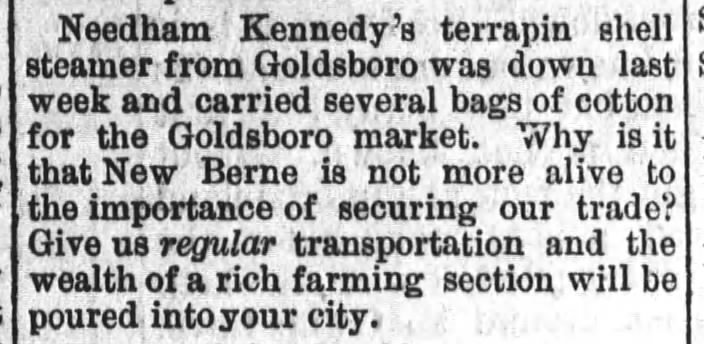
New Bern Daily Journal, 9 April 1884.
How did this man, enslaved until 1865, own a steamer plying the Neuse River from Goldsboro down to New Bern??? And why has he left so little trace in the record? I’m on the hunt.
Here’s an article from a Raleigh newspaper announcing the Rough and Ready‘s arrival in North Carolina:

Star, 8 December 1847.
Stay tuned.
The horrifying account of a farm accident that befell Doctor Simmons, oldest son of Montraville and Annie Henderson Simmons.

Logansport Daily Pharos, 16 August 1905.
Dock Simmons survived his terrible burns, but bad luck dogged him, and in 1917 he suffered another agonizing injury. Though I have not found his death certificate, evidence indicates that — despite all this — Dock lived into the 1940s.
 Scuffalong: Genealogy.