Business, North Carolina, Other Documents, Paternal Kin

That is the promise I made my father.

The tenth in an occasional series excerpting testimony from the transcript of the trial in J.F. Coley v. Tom Artis, Wayne County Superior Court, November 1908.

W.S. HAGANS recalled by Referee.

I testified that I told Tom that I wouldn’t sell this land to anybody who wouldn’t make the same agreement on which he had been living on the land, that is the promise I made to my father in his presence. I requested Mr. Coley to carry out this agreement. Mr. Coley said he would let the Defendant stay as long as the Defendant could let him. I considered it the same promise I made my father. I told him what rent the old man was paying. He didn’t agree to let him stay for the same rent. Said he would raise it. Said he would let him stay as long as he would protect him, and give him good crops.

CROSS EXAMINED.

The conversation was before the delivery of the deed to Coley. I remember the occasion when Henry Reid and I were together, we talked with Tom about the land. Reid was on my buggy one day, and we met the Defendant. The Defendant wanted me to sell him this 30 acres of land, and I told him that I would prefer selling it all together. He wanted to purchase the property from me in the presence of H.S. Reid. That tract that Coley gave mortgage on was additional security, was worth 4 or $5000. That was the 60 acre tract. (Coley mortgaged.) He gave me notes due for January of next year, and the January following. I have traded those notes. (Plaintiff objects.) Artis stated to me when he came to my house that it would be to my advantage to sell to Mr. Coley, in preference to Mr. Cook, on account of Mr. Coley would not only take the two pieces, the 30 and the 24 acre lot, but would also take the 9 3/4 acre lot, and that he wanted me to let him have it, on the grounds stated yesterday, Mr. Cook being disagreeable etc.

CROSS EXAMINED.

I think I told all these reasons yesterday; I am repeating this because my lawyer asked me. I just didn’t think about the Henry Reid statement. I told my lawyer. I said I would not let anyone have the property, until they had made me the same promise I made my father in presence of Defendant. Mr. Coley also agreed to it. I didn’t say it because I wasn’t asked. I told Mr. Cook that he must let the old man stay there. Mr. Cook said that he had no desire whatever of removing the Defendant. I told Mr. Cook that I heard that he wanted to move his son-in-law up there, and I feared that on that account he would interfere with the Defendant. Mr. Cook said his son-in-law was very well situated on another place, belonging to him, Cook.

What did it take to call a white man “disagreeable” in open court in 1909?

Standard
Births Deaths Marriages, North Carolina, Other Documents, Paternal Kin

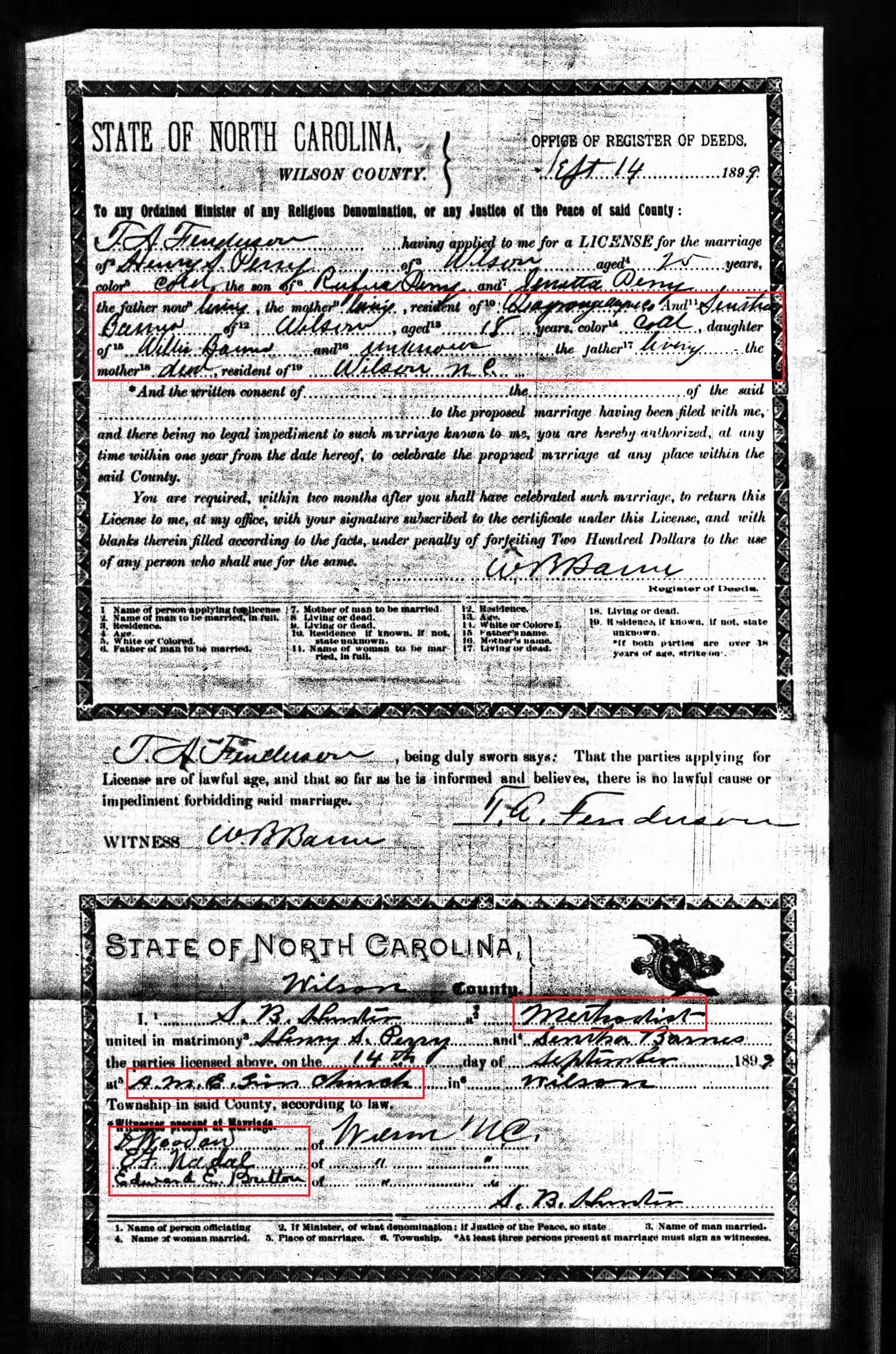
United in matrimony: Barnes.

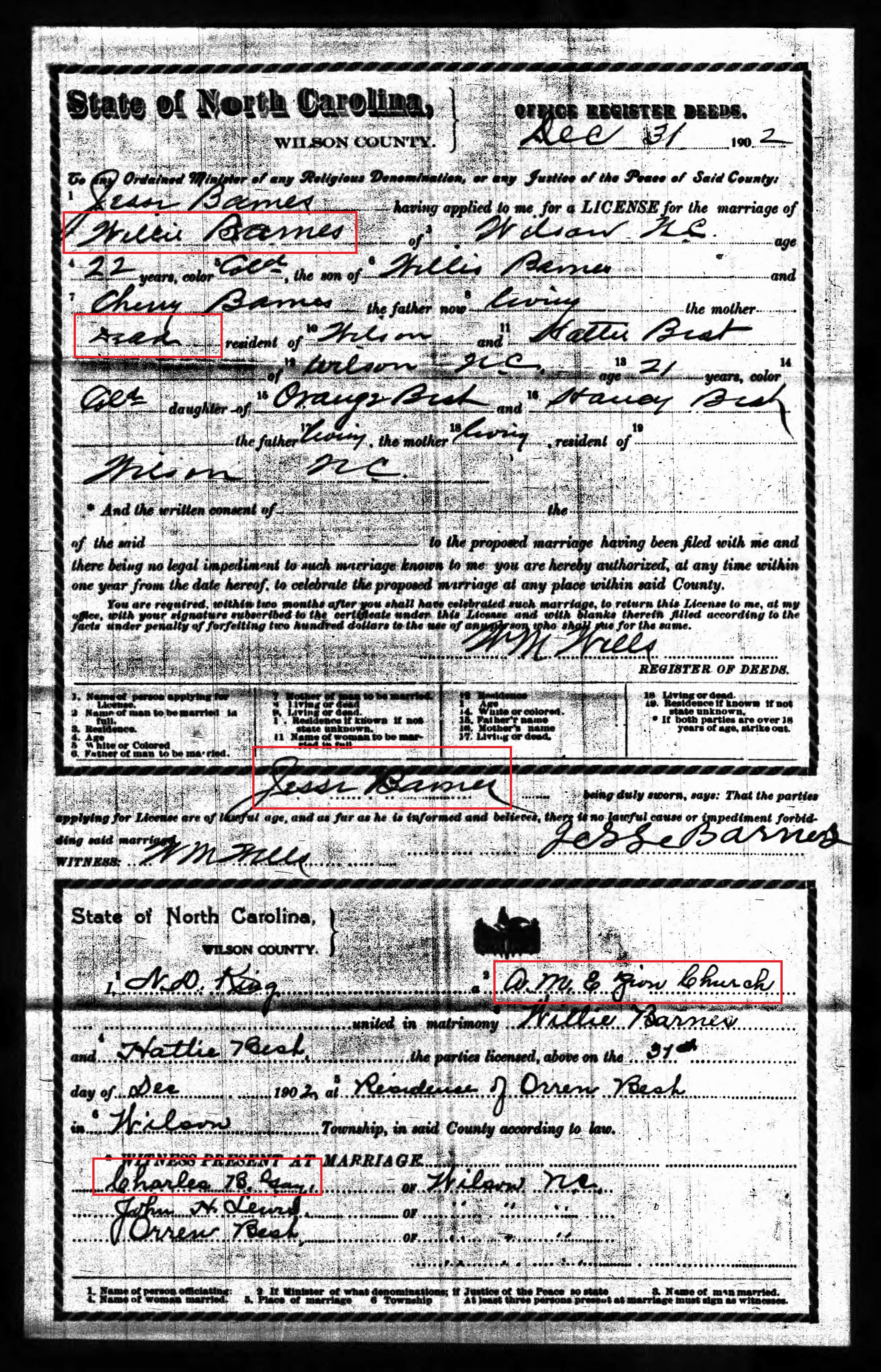
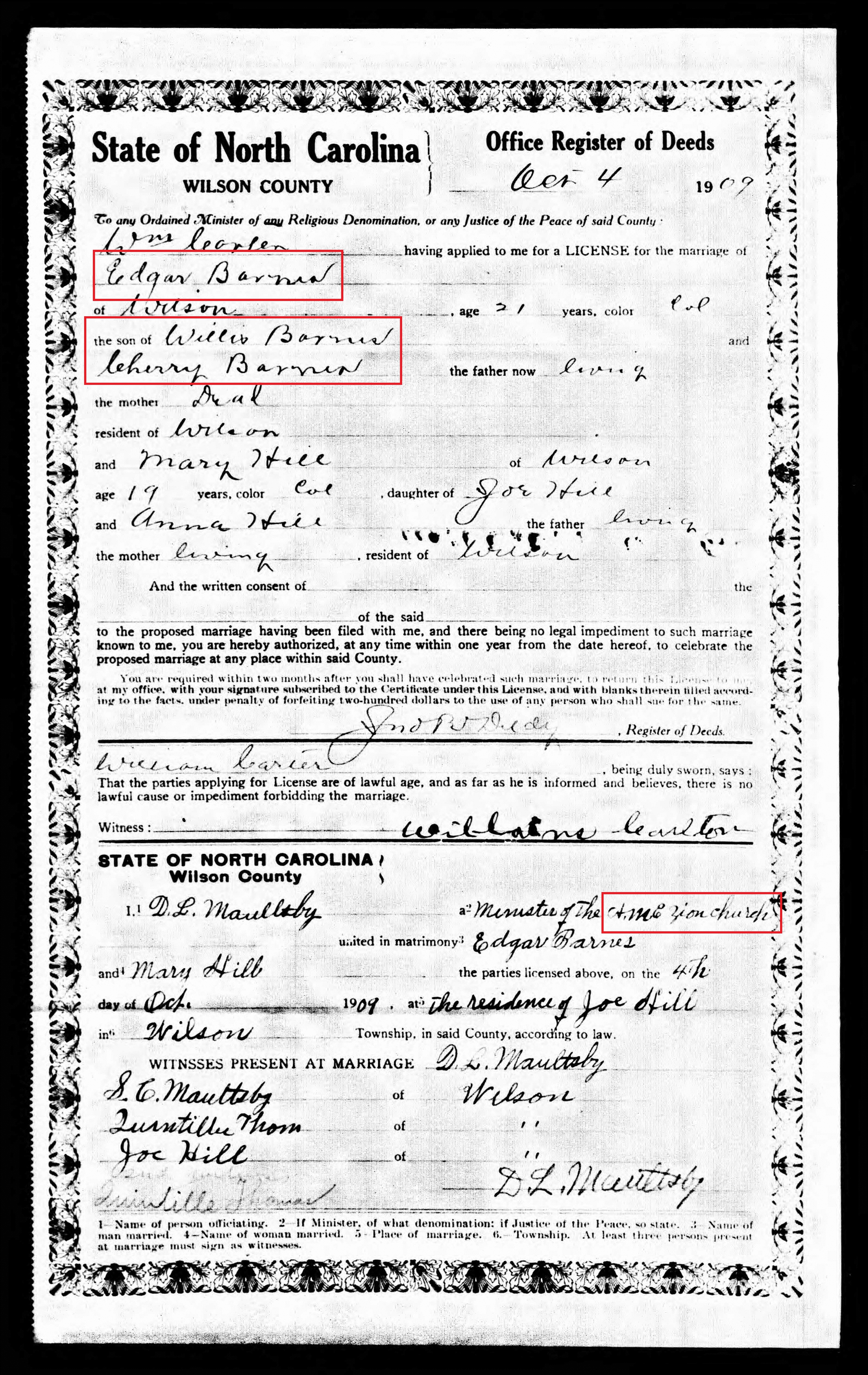
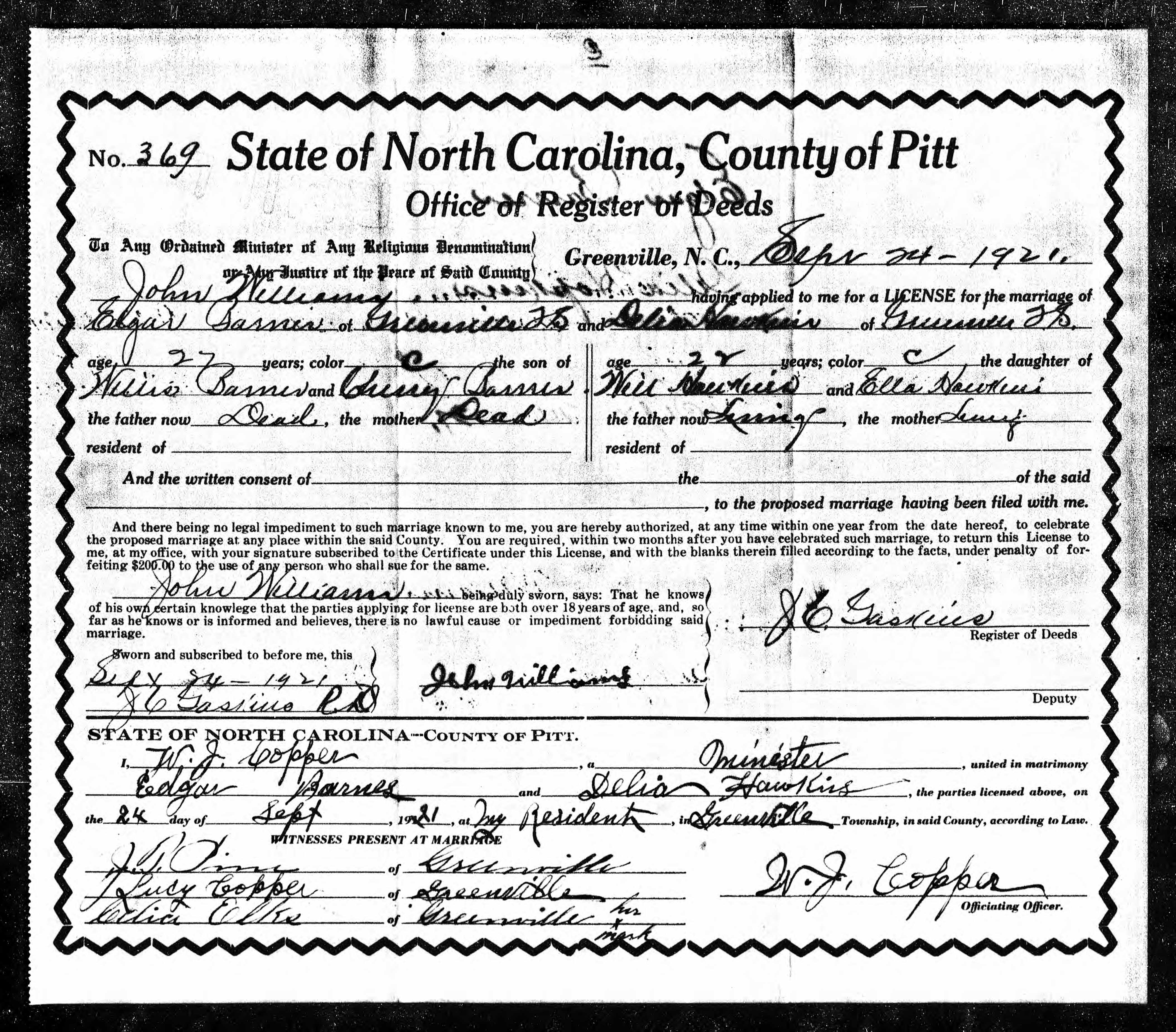
Willis and Cherry Barnes had seven children (or six, if oldest daughter Rachel was actually Wesley’s stepchild.)   What do  their marriage licenses reveal?
42091_343637-00772

  • I’ve long had a copy of this license. Jesse Barnes, born about 1868, was the second of Willis and Cherry’s sons. His elder brother Wesley married his sister-in-law, Ella Mercer.
  • Jesse and Mary Mag married in a Missionary Baptist church. (The spelling here is an accurate reflection of local pronunciation.)
  • The official witnesses were Jesse’s brothers Wesley and Ned Barnes.

42091_343637-01048

  • Early in life, Edward Barnes went by his formal first name, but by 1900 he is inevitably referred to as “Ned.” He passed this name on to his son, who in turn begat three more generations of Ned Barneses, the youngest of whom is still living.
  • Louisa Gay was the daughter of Samuel and Alice Bryant Gay. Her brother Albert Gay married Jesse A. Jacobs Jr.’s daughter Annie Bell.
  • Samuel H. Vick was a heavy hitter in black Wilson.
  • Was Spencer Barnes a relative? He does not appear near these Barneses in early census records, and those records and his marriage license seem to indicate that he was orphaned.

42091_343637-01482

  • Mary Barnes was Willis and Cherry’s younger daughter.  Assuming it’s accurate, her marriage license helps narrow the range of Cherry Barnes’ death from 1880-1897 (the latter is the year Willis remarried) to 1893-1897.
  • Whoa!!! Is this verification of Hugh B. Johnston’s hunch that Willis Barnes belonged to General Joshua Barnes? Did Willis’ family remain on the general’s former plantation, perhaps as tenant farmers, more than 30 years after Emancipation? If not, why marry there?
  • Small world moment: Duplin County-born barber and brickmason George Gaston, who lived north of Wilson in Elm City, was the great-grandfather of M.R.L., one of my childhood friends.

42091_343638-01183

  • This marriage was reported in the Wilson Daily Times. Prior to finding the article, I had not known of Willis and Cherry’s youngest child.
  • A slight clarification for Cherry’s possible death date — 1893-1899.

42091_343639-00339

  • I do not at all understand why I haven’t seen this license before. William “Willie” Barnes was the youngest of Willis and Cherry’s sons.
  • Hattie Best’s family had roots in Greene County, but were well-known in Wilson.
  • This wedding took place at Orren Best’s home, but was conducted by the pastor of the A.M.E. Zion church at which Cintha Barnes married.
  • Witness Charles B. Gay was the brother-in-law of Willie’s brother Ned Barnes.

42091_343640-01119

  • At last, a mystery solved. In the 1880 census of Wilson township, Wilson County, Willis Barnes’ household includes wife Cherry, step-daughter Rachel Battle, children Wesley, Jesse, Ned, Eddie, Mary and Willey, and niece Ellen Battle (whom I have not been able to identify further.) That Ned and Eddie had always confused me, as I knew that Ned’s real name was Edward. Was this a recording error? Well, no. Eddie was Edgar Barnes, whom I have never identified as a child of Willis and Cherry. (Also, note below how closely Willis Barnes and family lived to Joshua Barnes.)

1880 Barnes

  • Edgar and Mary Hill Barnes were also married at Saint John A.M.E. Zion.
  • The couple is recorded in the household of Mary’s parents in the 1910 census of the town of Wilson, Wilson County.
  • They were not married long. In 1917, Edgar registered for the World War I draft in Greenville, North Carolina. He described himself as single.
  • In 1921, he married Delia Hawkins in Greenville. They appear as a childless couple in the 1930 census of Greenville, North Carolina. Edgar reported working as a plasterer and Delia as a presser at Carolina Pressing Club.In 1940, they are in the same house at 1311 West 4th Street, owned and valued at $2000. I have not found North Carolina death certificates for them.

42091_342574-01262

Standard
Births Deaths Marriages, North Carolina, Other Documents, Paternal Kin

Aldridge marriages.

The first in a series* of posts mining the data found in North Carolina marriage licenses:

Aldridge Ashford Marr

  • Reka Aldridge‘s father George W. Aldridge was the brother of my great-great-great-grandfather John W. Aldridge.
  • Wayne County clerks sometimes listed mothers by maiden name, but more often didn’t. Dora was a Greene.
  • I don’t know what black Methodist churches were in Fremont in 1912, but R.R. Grant possibly served Salisbury AME Zion Church. The church is still active, but recently suffered a devastating fire. (Five minutes later: Or not. R.R. Grant appears regularly in the Journal of the North Carolina Annual Conference of the Methodist Episcopal Church, and the 1912 city directory for Fremont lists him as Methodist minister. In other words, he and his church were white. Were the Aldridges members? Did they sit in a designated pew? How did that work?)
  • Witness Eva Aldridge was the bride’s sister. William J. Boswell appears in the 1910 census of Nahunta township, Wayne County, as a married, 30 year-old house carpenter. Ezekiel B. Bailey, 23, white, appeared in his mother’s household in the same township.

42091_343599-00796

  • Robert and Mary Eliza Balkcum Aldridge‘s youngest sons, Robert Jr. and Joseph, married relatively late. Joseph Aldridge was 16 years older than his first wife, Lou Berta Manley.
  • Holiness Church.
  • Witness Johnnie Aldridge was Joseph’s nephew, son of John W. and Louvicey Artis Aldridge. W.M. Manley was Lou Berta’s father. “Robert Hob” was possibly Robert Hobbs, who appears in the 1910 census of Grantham township, Wayne County, as a 24 year-old farmer.

Aldridge Faircloth Marr

  • William Aldridge was the son of J. Matthew and Catherine Boseman (or Simmons?) Aldridge. His father died in 1868.
  • The ceremony took place at Edward Simmons, whose identity is not clear to me.
  • Richard Boseman was the son of James and Tempsey Locus Boseman. James Boseman appeared in the household of J. Matthew and Catherine Aldridge in the 1860 census of Buck Swamp, Wayne County. (James may have been Catherine’s brother.) Richard married Lillie Mae Aldridge, Matthew and Catherine’s daughter. Eddie Budd was the son of Haywood and Phereby Simmons Budd. There were several Bryant Simmonses, but this was likely the son (1831-1890) of James and Winnie Medlin Simmons.

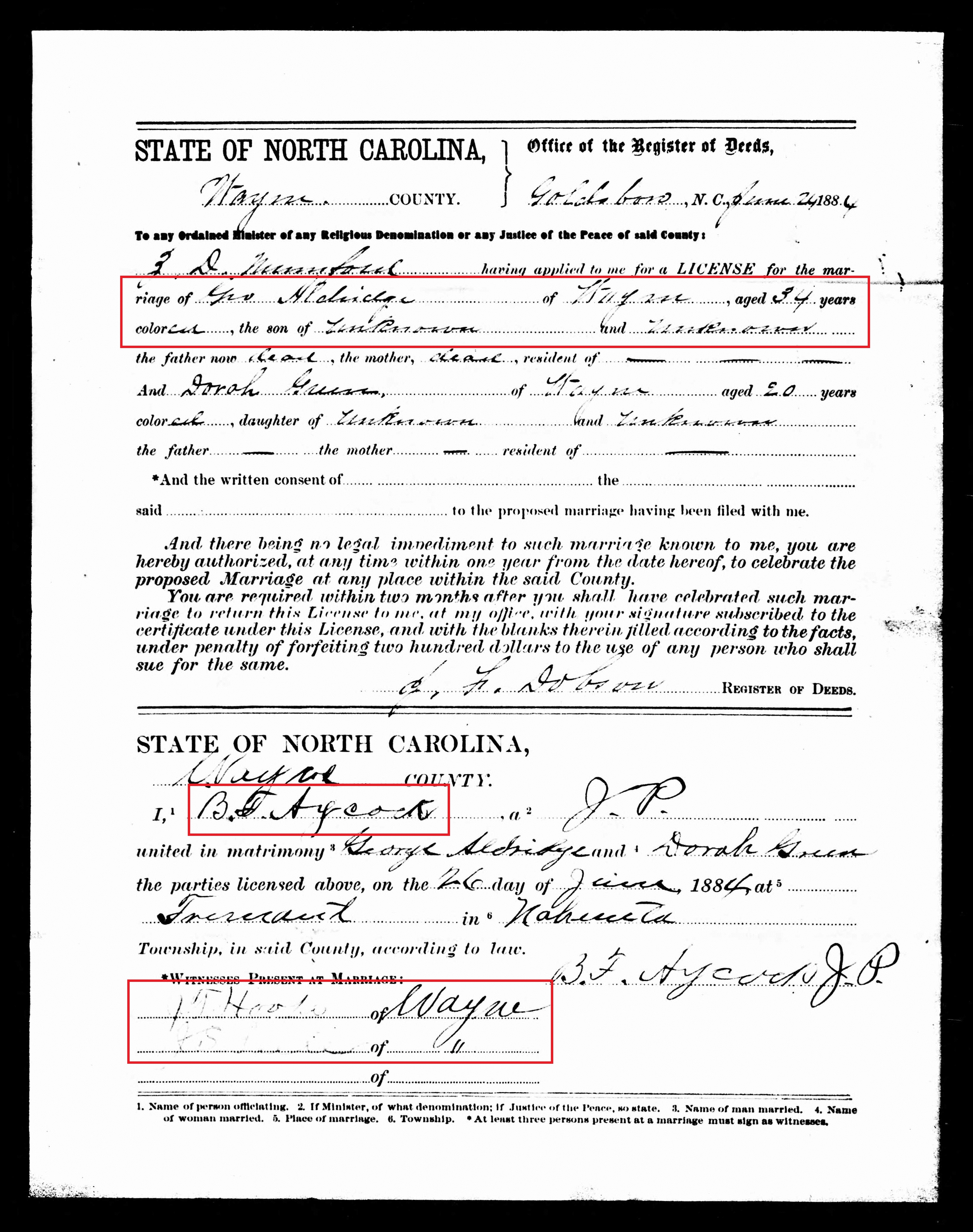
Aldridge Green Marr

  • Of course, George Aldridge knew full well who his mother and father were, and both were living when he married Dora Greene in 1884. I see this omission a lot. Laziness or “who cares?” by the Register of Deeds?
  • Benjamin F. Aycock was later elected as Republican state senator.
  • It’s difficult to read the names of the witnesses, but neither appears to be a known relative of George.

Aldridge Handly MArr

  • This is Robert Aldridge Jr.‘s second marriage. His first, to Ransy Pearsall, was in 1903.
  • Frank “F.B.” Daniels appears in the 1910 census of Goldsboro, Wayne County, as a 20 year-old white lawyer. George F. Vann appears in the 1910 census of Stony Creek township, Wayne County, as a white, 20 year-old farmer.

*Actually, this languished in the Draft queue for a few weeks, so it’s not first anymore.

Standard
Births Deaths Marriages, North Carolina, Other Documents, Paternal Kin

Small world.

42091_343641-00147

In midwinter of 1911, Primitive Baptist minister Jonah Williams made his way to the home of Stanford Holmes to preside over the marriage of Peter Barnes and Sinthia Pate.  Jonah was the brother of my great-great-great-grandfather, Adam T. Artis. Thirty-three year-old Peter was the son of Calvin and Celia Barnes. Thirteen years previously, Peter’s brother Redmond Barnes had married Jennette Best in Wilson County. Redmond and Jennette Barnes‘ daughter Edith Bell married Theodore Roosevelt Ellis in 1933, and their first son was Theodore Jr., who married my father’s sister in 1960.

Standard
Births Deaths Marriages, North Carolina, Other Documents, Paternal Kin

Widow? Or daughter?

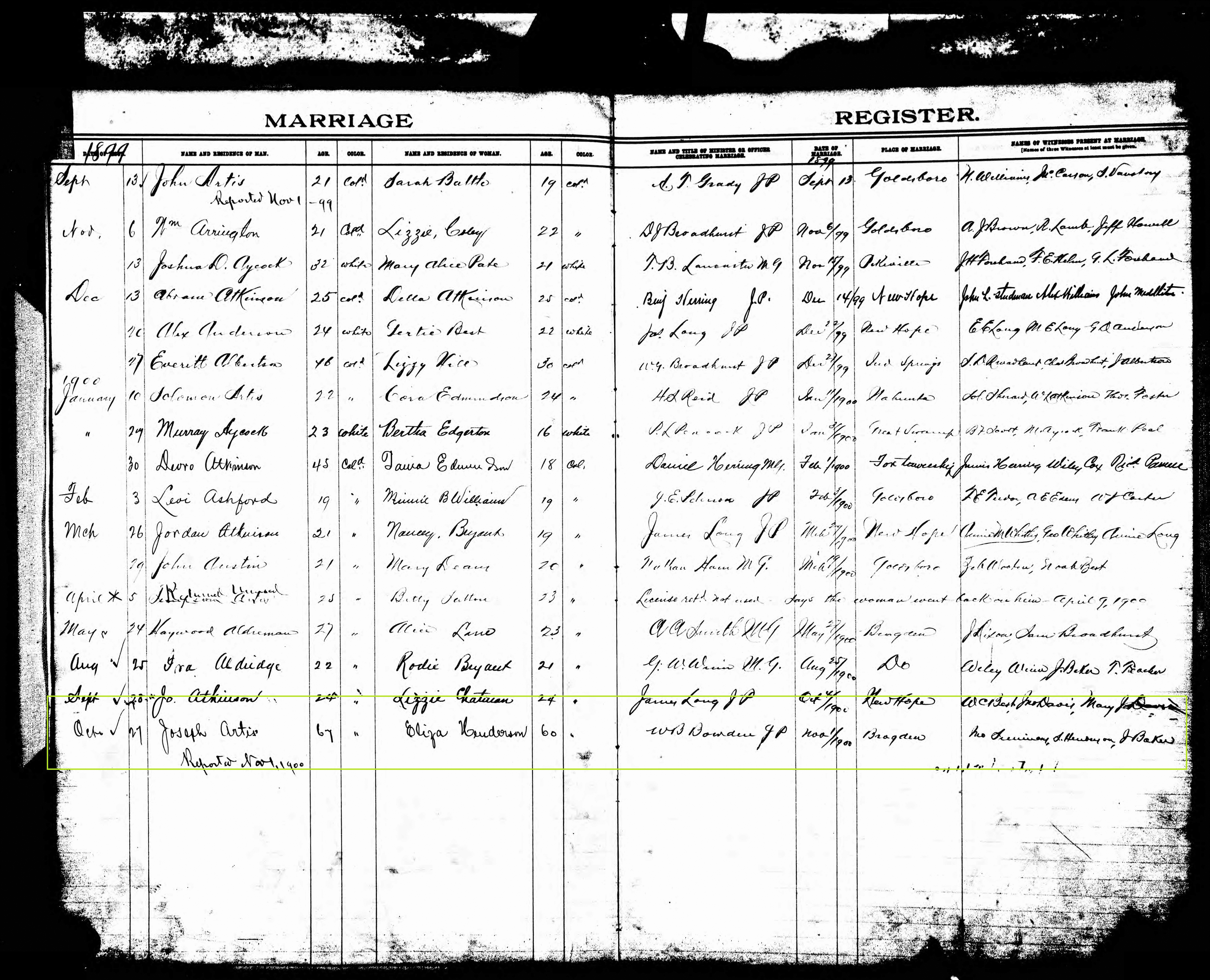
Who is this Eliza Henderson?

42091_343620-00077

Sixty years old, living in Brogden township (i.e. Dudley) in 1900?

Joseph Artis I readily find. He was born circa 1830 to Absalom and Clarky Artis in northwest Wayne County. He married Mary Ann (last name unknown), and they and their children appear together in the 1860, 1870 censuses of Buck Swamp, then Brogden, townships. I don’t find him at all in 1900.

Nor Eliza Henderson. My great-great-great-great-grandfather James Henderson‘s second wife was Eliza (or Louisa) Armwood Henderson. He died sometime between 1880 and 1900. Was this his widow remarrying? Only if the age given for this bride is off by five or ten years.

There’s another possibility, though it seems remote. James Henderson had four children with his first wife (or partner) in Onslow County. When he migrated to Sampson County in the 1850s, sons Lewis and James Henry came with him. Daughters Mary and Eliza seem not to have. Eliza was born about 1842. Is this her?

Standard
Births Deaths Marriages, North Carolina, Oral History, Paternal Kin

Mollie heads west. (And a legacy takes root.)

It never occurred to me to wonder “Why Greensboro?” We grew up regularly rolling 125 miles into the North Carolina Piedmont to visit my grandmother’s sister and the four nieces who lived nearby. Beyond my first cousins, their children were the closest kin we had in age, and we were always excited about a trip to see “Aint” Mamie Henderson Holt. It was not until I began interviewing Mother Dear in the 1990s that I learned that Aunt Mamie had not been the first Henderson to settle in Greensboro.

That pioneer had been Julia “Mollie” Henderson Hall Holt, daughter of James and Louisa Armwood Henderson, half-sister of Lewis Henderson, aunt of “Mama” Sarah Henderson Jacobs Silver.

An introduction: Aint Mollie didn’t have long hair, but it was nice. And curly. And it was thin. And she had that, she wasn’t real light-complected, she was kind of olive-colored. But she was a small-sized woman. She was tall, not like Mama. She wasn’t fat. And she seemed to be real nice.

Mollie was born about 1872 and appears (as “Julia”) in the 1880 census of Wayne County, North Carolina in her parents’ household. Only two years older than Sarah, they were more like sisters or cousins than aunt/niece. In 1889, Mollie married Alex Hall in Wayne County. The couples’ two daughters, Lula and Sadie, were born about 1891 and 1895, respectively, but I have found none of them in the 1900 census. At some point in those decades, Mollie left southern Wayne County, headed west. Before 1902 — and with or without Alex —  she was in Guilford County. There (or somewhere near there) on 24 June 1902, she met and married Walter Holt, born about 1875 in Alamance County to William and Margaret Isley Holt. (Julian, North Carolina, by the way, lies a couple of hundred feet inside southeast Guilford County from the Randolph County line. Traveling to Asheboro to marry was probably easier and more convenient than going to Greensboro. How and why Mollie went from rural Wayne County to this equally rural location remains a mystery.)

HENDERSON_--_Walter_Holt_&_Mollie_Henderson_Marr_Rec

By 1910, Walter and Mollie and her daughters (known henceforth as Holts) were in Greensboro, living in the Wilmington Street home that my grandmother knew.

1910 HOlt
Here’s what my grandmother said:

And Bazel’s – Mamie’s Bazel, his uncle Walter Holt married Aint Mollie.   They didn’t never have no children, but she had two girls before they got married – Sadie and Julia [sic, Lula.] Yeah, them was the girls. Two girls. Sadie died. Julia, too, I believe. I think both of ‘ems dead. Sadie didn’t have no children of her own, but she raised a child. She took somebody’s child and raised. She had a husband, too. What was his name? I remember seeing him once or twice. I don’t believe Julia ever got married, I don’t think. At least she didn’t say nothing ‘bout it. They were older than me. And I think Mama said that Mollie was older than she was, but I reckon they was ‘long there together. Nancy was older than both of them, and A’nt Ella was the youngest one. She and Mama always were together, ‘cause they all played “sisters.” But Sarah was really Mollie and Nancy and Ella’s neice. Their brother Lewis’ child.

Another time:

She had two daughters, Sadie and Julia. I think that’s what it was. Sadie’s the one stayed in the house on the corner from where we were staying, right there on Wilmington Street. The other one – where’d the other one stay? She was married and stayed in Virginia somewhere. Yeah, Julia. Sadie’s sister. Cousin Mollie, A’nt Molly’s daughter Julia. She had a daughter. Julia was light-complected, but she wasn’t real fair. She had a light complexion. And I didn’t know her husband. I don’t know if I ever seen him. But this child that she took and raised, I want to say took and raised up, she was real dark. They all left and come up to Virginia, I believe it was, Norfolk or somewhere. I know Sadie died in Greensboro, but…. A’nt Mollie, she died there, and I think her husband, I think he left. At least, he was running – he was a fireman on the train, that was his job. He was running between Winston-Salem and somewhere in, I don’t know…. Some part of Virginia or something. He was a tall, brown-skinned man. He was a nice-looking man.

Here is Sadie’s first marriage license. She married Ashley Whitfield of Johnston County in Greensboro a few months after the census above was taken. She used the maiden name Holt and noted that her birth father, Alex Hall, was dead. Her stepfather Walter Holt signed the license as a witness to the ceremony.

42091_333097-00561

In the 1920 census, Walter Holt, age 38, foreman for Southern Rail Road, headed a household that included wife Mollie, 39; nephews Bazel, 23, and William, 20; niece Novella, 18; a boarded named Mildred Smith; and “step daughter” Sadie Holt, who described herself as a widow. I have not found a death certificate for Ashley Whitfield. I did find this though:
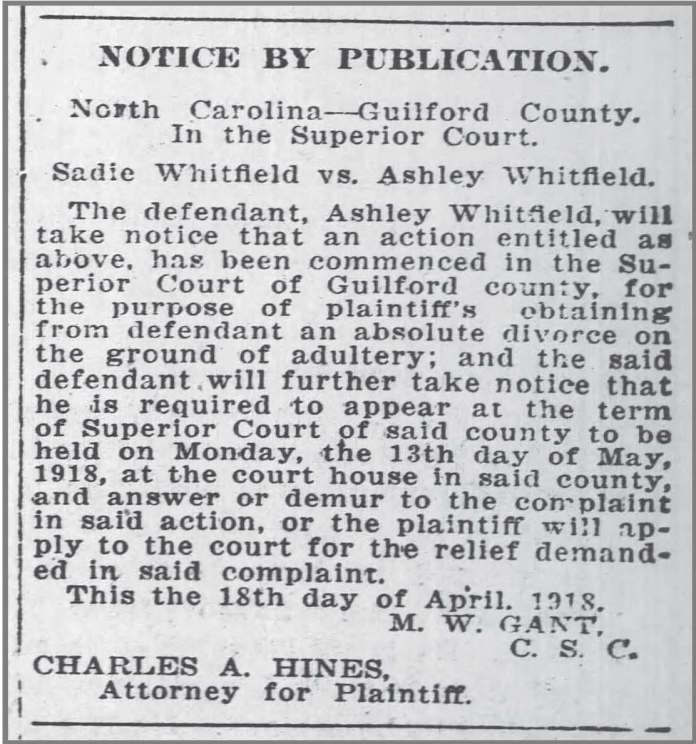
Gboro Patriot May 1918 Whitfield divorce

Greensboro Patriot, 16 May 1918.

Just over ten years after her first marriage — but having only aged four years — Sadie married Henry Farrow of Pittsboro. Again, she acknowledged her father Alex Hall, but used the surname Holt. (Never mind Whitfield.) Sister Lula Holt and a Jack Ross applied for the license, and Lula signed her name with an X, just as her mother had done. (Why hadn’t she gone to school?)

42091_333087-00841

Some time in the fall or winter of 1922, Mama Sarah left Jesse Jacobs. She and her girls Mamie and Hattie took a train from Wilson to Greensboro to live with Aint Mollie until they got settled. While Sarah worked in a small restaurant, my 12 year-old grandmother enrolled in a Greensboro elementary school. (It was the last stretch of formal education she would have.) In early February 1923, they finally got their own place. But Papa Jesse soon arrived in Greensboro to beg Mama back and, ill and struggling financially, she agreed to go. Aunt Mamie, however, had different plans.

Again, in my grandmother’s words:

We moved in this house, and we hadn’t been in there but ‘bout a week, and Mamie wouldn’t come. She stayed over there with Aint Mollie. And Sadie. And so when she come over one day, and Mama didn’t feel like going to the restaurant where she had over there, and so I sat there looking out the window, and I said, “Mama, here come Mamie with a suitcase.” And I’d went over to the house that day, too. And I thought it was, they played cards then. [Inaudible.] So I went over there to Sadie’s house, and so I said to ‘em, I said, “What, y’all having a party tonight?” And didn’t know Mamie was getting married that night. Mamie didn’t even tell me. And so they said, “Yeah, yeah. Yeah, we gon play some cards.” And they wanted to get rid of me. Because they hadn’t told us nothing ‘bout it. Sadie went with Mamie to the courthouse to get the license and everything, and so Mamie didn’t want to come back to Wilson ‘cause Papa wasn’t good to her.

And again:

So they all got married that night and that’s when Mamie come, the next day, with a suitcase. And I told Mama, “Hmm. Is that a suitcase?” And I believe Sadie was with her. Yeah. And so she come to get her clothes. And Mama told her that, “If you don’t go back, I’ll put the law on you and make you go back ‘cause you underage.” And that’s how come Mamie didn’t let her know nothing ‘bout nothing. And, now, she’d just met Bazel, and he told her, “Well, we’ll get married if you want to stay here. We’ll get married.” And so he married her. That night. But I didn’t know they was getting married that night, and so I fussed her out and, “How come you didn’t let me know where I could have stayed to the wedding? I wanted to see you get married.” “Well, it wont no wedding – we was just getting married! Getting that old piece of paper.”

And another time:

But Mamie was up to Sadie’s house, Aint Mollie’s daughter. She stayed up there, ‘cause they all stayed up there and played cards. And she hadn’t seen Bazel but two weeks before they got married. So I went over there that evening after something from the café where Mama was, and I told her that Mama wanted her to come home. So she said, “Well, I’ll be over there tomorrow.” And so the house was all clean, Sadie’s house was all cleaned up, and tables sitting all around the room. Well, they played cards all the time, so I didn’t think nothing ‘bout it, and so they had to wait ‘til I left so Mamie and Bazel could get married. Went and got the license and everything. And didn’t tell me a word about it. And they were getting married that night. So I come on home. I run all the way from over there to Bragg Street. And come home. Didn’t think nothing about it. And so Mama, she didn’t go to the café, the people she had working in there, they was gon open up the café. ‘Cause it wasn’t nowhere but right down the street there, from ‘round the corner. So I stayed there with Mama fixing some breakfast. And so she said she wasn’t hungry, but I said she need to eat something. Well, anyway, she ate a little bit. And I looked out the window, and Mamie was coming with a suitcase. And I said to Mama, “Mamie’s coming up, and she’s got a suitcase! I wonder where she’s going.” Didn’t know she was coming to get her clothes. So she came on in, and she told Mama that she had got married last night and was coming to get her clothes. And Mama told her she ought not to let her have them. “You didn’t tell me nothing ‘bout it. If you was gon get married, and you’d a told me, [you could have] got married and had a little social or something.” And Mama was mad with her because she got married. So Mamie just got her clothes. Some of ‘em. And crammed ‘em in a suitcase and went back over …. 

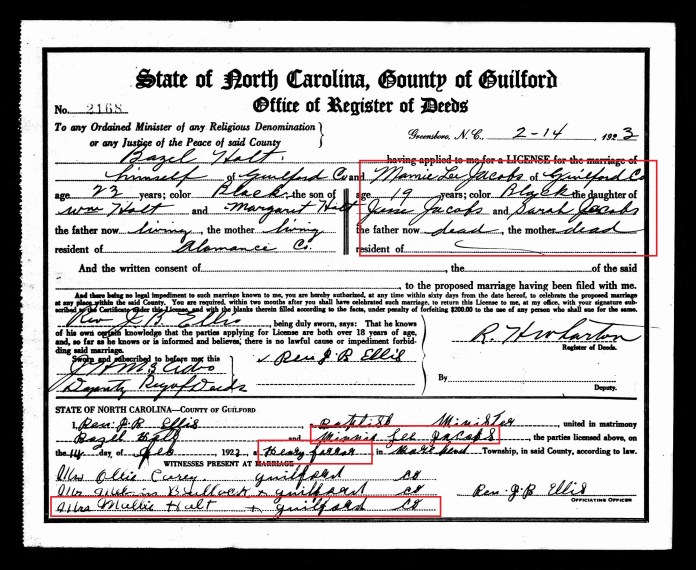
Here’s the license. And, look, sure enough, the marriage took place at Henry (and Sadie) Farrow’s house. And even Aunt Mollie was there, for she is listed an an official witness. Mamie was not 19. She was 15 and, indeed, underage. And Jesse and Sarah Jacobs were not, of course, Mamie’s parents, but her great-aunt and -uncle. (When she reported her mother dead, was Aunt Mamie thinking of Bessie, or convincing the register of deeds that she was free to marry of her own volition?)
42091_333089-00605

Mother Dear returned to Wilson with Sarah and Jesse Jacobs, and Aunt Mamie remained in Greensboro with her new husband, who was Mollie Holt’s nephew by marriage. And that’s how she got there — and stayed.

My last sighting of Mollie Henderson Hall Holt is in the 1928 Greensboro city directory. (The “c” is for “colored.”):

Screen Shot 2015-06-15 at 10.22.24 PM

The following year, Sadie Hall Holt Whitfield Farrow died of tuberculosis. She was 38 years old. (Not 29.) Walter Holt was the informant on her death certificate and named himself as her father. Otherwise, he correctly identified her birthplace as Mount Olive (in Wayne County), her mother’s maiden name as Henderson, and her mother’s birthplace as Clinton (or, in any case, Sampson County.) I strongly suspect that Mollie was dead by then, but I have not found evidence.

Sadie DC

By 1929, Aunt Mamie’s three oldest children had been born. The Holt branch of the Henderson family had taken root in Greensboro.  It still flourishes there, but also in New Jersey and New York and Pennsylvania and Georgia and Texas.

Interviews of Hattie Henderson Ricks by Lisa Y. Henderson; all rights reserved.

Standard
Births Deaths Marriages, North Carolina, Other Documents, Paternal Kin

Doctor slain.

Screen Shot 2015-06-13 at 4.08.37 PM

March 1968. I was not quite four. I had a baby sister who’d just come through a terrible bout with meningitis. My world was 1400 and 1401 Carolina Street and kindergarten and, at the outer edges, my grandmothers’ houses in Newport News and Philadelphia. In six months, I’d be gazing adoringly at “beautiful singer-actress” Diahann Carroll on a black and white small-screen. Right then, though, if you’d said, “Your great-grandfather died,” I would have looked at you blankly. If you’d said, “Mother Dear’s daddy died,” I might have creased my forehead, sad for her. But I didn’t know my great-grandfather. Didn’t know I had one. And had I picked up this Jet, which was delivered to our house, and been able to read — which I couldn’t just then — this would not have resonated either:

Screen Shot 2015-06-07 at 10.17.20 PM

James Thomas Aldrich (born Aldridge) was killed 10 February 1968. After a funeral service in Saint Louis, his body was returned to North Carolina for a second service and burial in Dudley in the family cemetery he established.

Standard
Births Deaths Marriages, Maternal Kin, North Carolina

John McNeely vs. John McNeely.

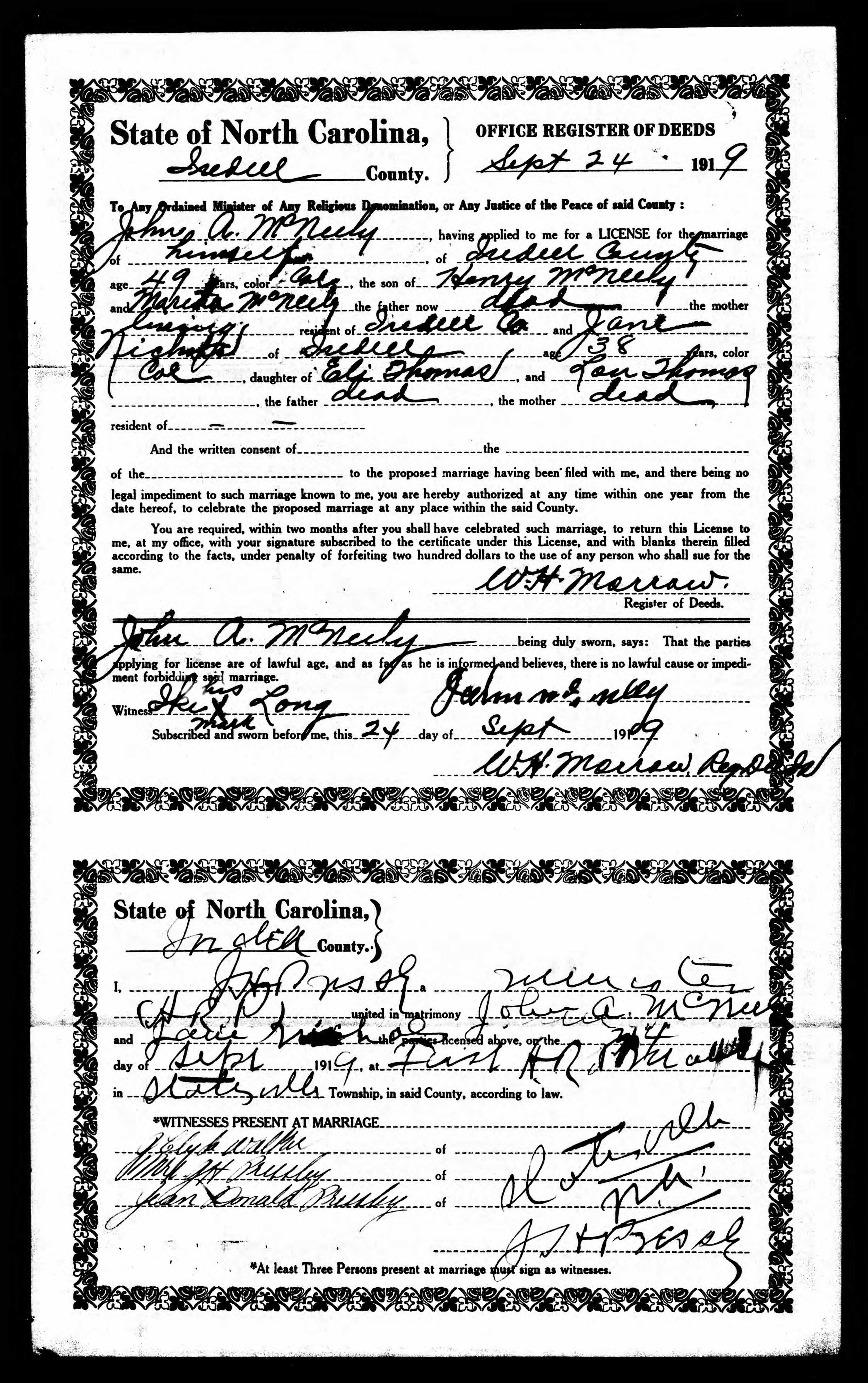
Okay, now I am genuinely perplexed. A couple of months ago, I wrote about finding my great-great-uncle John McNeely’s first wife, whom he married in 1899. I had just found a marriage license for John Alexander McNeely, colored, son of Henry and Martha McNeely of Iredell County, and Carry Armstrong. Prior to this, I had only known wife Laura Nesbit, whom he married in Statesville in 1912.

Screen Shot 2015-06-10 at 6.48.30 AM

I have not found John and Laura McNeely in the 1920 census, but in 1930 they and Laura’s daughter Marie shared a house with John’s sister and brother-in-law, Emma and Irving Houser, in Bayonne, New Jersey. In 1940, John and Laura and Marie and her husband James Watkins were living on West 19th Street in Bayonne. And when John died in 1947, his obituary noted that he was the beloved husband of Laura (Nesbitt.)

So yesterday when I found yet another marriage for John A. McNeely, son of Henry and Martha McNeely of Iredell County, I was flummoxed.

42091_334854-00956

Did John marry Laura, divorce (or otherwise leave) her, marry Jane Nichols, divorce her, then remarry Laura Nesbit? If so, where is the second marriage license for Laura? If not, who is this John McNeely? And who are the other Henry and Martha McNeely?

The only Henry and Martha McNeely in the 1900 census of North Carolina are my John’s parents, living in Statesville township. In 1880, they’re in Rowan County, and still the only couple with those names in the state. Henry died in 1906, before death certificates were kept, and Martha died in New Jersey. I have not found death certificates for any other Henry or Martha McNeely in Iredell.

As for John: John and Jane McNeely appear in the 1900 census of Statesville, my John McNeely does not. In the first decade of the century, a John McNeely pops up in the pages of the local paper for various misdeeds — shooting at a rival, having smallpox, fighting, slicing a man with a knife, shooting at a dog. I’d like to think that this is not my John, but there’s no clear way to know. And there’s no John McNeely at all in Iredell County in the 1910 census.

I’ll have to leave it here for now. I don’t have enough to know for certain whether John McNeely and John Alexander McNeely were the same man.

UPDATE, 19 June 2015: Is this a clue to the identity of John A. McNeely?

Screen Shot 2015-06-19 at 8.36.03 AM

This Henry McNeely is not my great-great-grandfather Henry McNeely. He’s his nephew. Henry’s father John Rufus McNeely was, I believe, the half-brother of my Henry. Unfortunately, this Henry was born about 1863, and John A. McNeely was born about 1870. I don’t believe this Henry and Martha were the couple named on John A. McNeely’s marriage licenses.

UPDATE, 21 June 2015: Then there’s this.

Screen Shot 2015-06-21 at 4.37.00 PM

This is from the marriage license of my John McNeely’s brother, William Luther McNeely, who married Mary Belle Woods in 1906 at Statesville’s Associate Reform Presbyterian Church. My great-grandparents Lon and Carrie McNeely Colvert wed there the same year. Is it just coincidence that John Alexander McNeely was also married by Rev. J.H. Pressly in this church?

Standard
North Carolina, Paternal Kin, Photographs, Vocation

Leaves post.

Screen Shot 2015-06-07 at 10.19.22 PM

Jet magazine, 28 September 1961.

 Jet magazine was founded in 1951. In 1955, its graphic coverage of Emmett Till’s murder catapulted its readership, and the magazine became known for chronicling the Civil Rights Movement. All this came swaddled in heavy layers of Negro firsts, Negro Hollywood,  and general Negro bougie news. I’m sure my grandmother was reading Jet — and probably subscribing to it — by 1961. What did she think when she saw her father, whom she only met once, lauded in its pages?

Standard
Births Deaths Marriages, North Carolina, Other Documents, Paternal Kin, Photographs

Nuptials discovered. (And a little Misinformation Monday, no. 11.)

My grandmother’s birthday was Saturday, June 6. It would have been her 105th. My cousin D.D., her sister’s great-granddaughter, sent me a photo of a photo via text message — Mother Dear and her husband, Jonah Ricks, my step-grandfather. I’d never seen this particular image, but I recognized it as having been taken in Greensboro, North Carolina, at her niece L.’s wedding in 1963.

IMG_0532

… Or was it?

I found their marriage license today. So, first, I had to pick my jaw up. I knew they’d wed in August 1958, but had never been able to find a record in Wilson. Because they married in Guilford County. In Greensboro. I immediately thought about this little snapshot. This wasn’t taken in 1963! Mother Dear and Granddaddy Ricks had traveled to her sister’s for the ceremony, and this photo was taken on their wedding day. Why hadn’t I registered the boutonniere, the corsage, the beringed left hand held high?

Then I got around to looking at the rest of the license.

Ricks Henderson

First, there’s the matter of my grandmother’s name. In that era, legal names were somewhat fluid, and changing them did not necessarily involve legal drama. Bessie Henderson bore my grandmother before North Carolina required birth certificates. Bessie named the baby Hattie Mae and gave her her last name. Bessie died less than a year later, and little Hattie went to live with her great-aunt and Uncle, Sarah and Jesse Jacobs. She called them Mama and Papa and became known as Hattie Jacobs. Only after Sarah’s death in 1938 did my grandmother learn that she had never been formally adopted. (And as a consequence, she was forced out of the house on Elba Street by Jesse Jacobs’ children.) She immediately changed her name to Hattie Mae Henderson. I was surprised then to see her name listed as “Hattie Jacobs Henderson” some 20 years after she dropped the appellation.

Mother Dear also listed Jesse and Sarah Jacobs as her parents on the license. Here is an example of the way documents may reflect social and familial realities, rather than legal or genetic ones. Curiously, though, there is a hint to Mother Dear’s paternity in the license, though inexplicably placed. Mama Sarah was born Sarah Daisy Henderson. Her first husband was Jesse Jacobs and her second Joseph Silver. She was not an Aldridge. But my grandmother’s birth father was. Why did my grandmother report Sarah’s name this way? Maybe Mr. Ricks gave the information and got his facts twisted?

Last, the witnesses. I recognize James Beasley — he married my cousin Doris Holt — but who were the others? Friends of my great-aunt Mamie Henderson Holt, perhaps?

Standard