Births Deaths Marriages, Maternal Kin, Oral History, Photographs

Mildred Wardenur Houser Jones.

Wardenur was a pianist, and played an organ for WOR radio station in Jersey City.  In Jersey somewhere.  Honey, she was — girl, she could play the piano.  And she played this organ, you know, they would have plays and have organ music, and she did that for them.  She could play.  And when I was up there one time, I went with her to take her piano lessons, and the lady said, ah, “What – you do play the piano or organ?”  I said, “No, ma’am, I don’t….”  Look like she looked at me like she thought I was about the worst she had ever seen.  [Laughs.] And her father made her take piano lessons. And the teacher graded her, and if she got anything below a B, her father would punish her severely.  But, honey, she could play a piano and organ.  She was good.

But she took TB and died.

Image

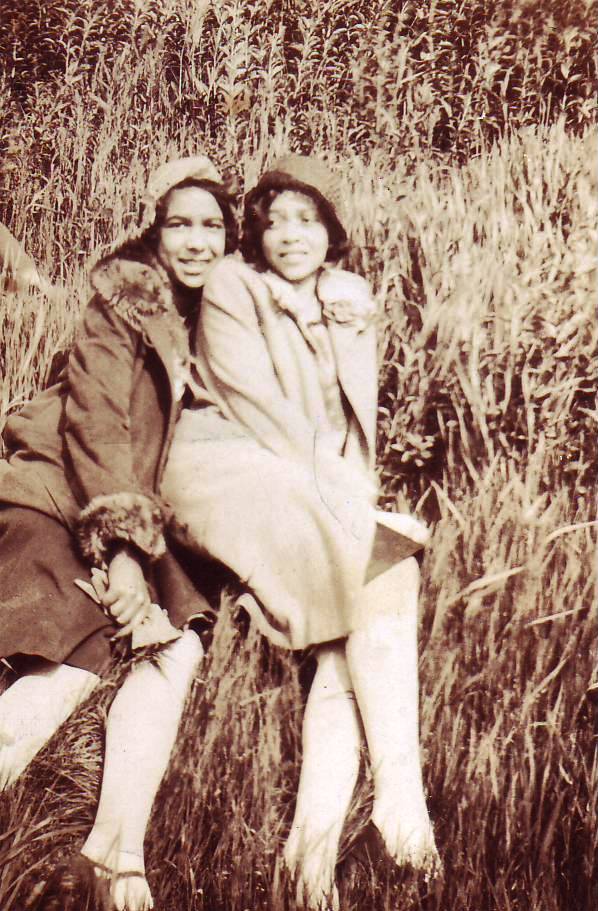
She was lovely — Wardenur. She was about 15 here, palling about with my grandmother, her older cousin, vying for the attention of the college boys mooning about them that summer in Bayonne.

Image

New York Age, 21 June 1930.

Wardenur graduated from the Lee Music School a couple of summers later and in February 1931 finished Bayonne High School.  A few years after that, her elopement was reported in the Age.

ImageNew York Age, 16 March 1935. 

Happy times did not last long. Wardenur contracted tuberculosis, the disease that had killed her aunt Elethea and beloved cousin Jay, and spent her last months in a sanatorium.  A short notice appeared in the 20 September 1941 issue of the Bayonne Times:

JONES – Mildred (nee Houser), of 421 Avenue C, on September 18, 1941, devoted wife of Willard Jones and beloved daughter of Irving and Emma Houser and sister of Henry and Irving Houser Jr.  Reposing at Wallace Temple A.M.E. Zion Church from 9 p.m. Sunday until funeral services at 2 p.m. Monday, September 22.  “Murray’s Service.”

She was 28.

Image

——

P.S. The taskmaster piano teacher was probably the inimitable Miss L.A. Lee of 100 Kearney Avenue, Jersey City, who, according to the Age, opened her well-regarded music school in 1907.

Interview of Margaret C. Allen by Lisa Y. Henderson, all rights reserved. Photographs in collection of Lisa Y. Henderson.

Standard
Births Deaths Marriages, Maternal Kin, Newspaper Articles, North Carolina, Oral History, Vocation

Bill Bailey’s life and times.

My grandmother did not mince words when it came to her aunt’s husband. William James “Bill Bailey” Murdock was “trashy.” “We couldn’t stand him,” she said. “He did everything illegal and got away with it.” I laughed, and thought, “Oh, Grandma. Really?”

Well, yes.

Consider this:

bill bailey youth 7 14 03 Statesville Landmark, 14 July 1903.

He was born William Bailey in Iredell County, the son of Lela Bailey, black, and John T. Murdock, white, both teenagers. His stepfather was Floyd Murdock, and he eventually adopted the surname, but he was known as “Bill Bailey” all his infamous life. His mother was a cook, and it is likely that he gained his culinary skills at her side. In 1920, he lived on Washington Street in Statesville’s Rabbit Town section with Lela and his first wife Hattie, biding his time as a flour mill laborer.

Two years later, Bill and his roadhouse merited their first in a long line of write-ups in the local newspaper:

11 27 1922 Roadhouse

Statesville Landmark, 27 November 1922.

Three months later, in March 1923, Ethel Wallace was arrested for shooting her husband — and the husband of her husband’s girlfriend — at Bill Bailey’s Emporium. Before this matter was even tried, Bill himself was arraigned on a charge of assault with a deadly weapon against Howard Houston. It didn’t stick. In February 1924, however, Bill plead guilty to bootlegging, was fined $50 and given two years’ probation. In January 1926, he was arrested for bootlegging again.

In December 1927, Bill was acquitted of assault with a deadly weapon in the shooting of “a colored girl” named Veola Knox and of transporting and possessing liquor, but fined $50 for assaulting Jim Moore. Two years later, on the day after Christmas, someone “severely carved up” Alfred Hough, slashed his jugular, outside Bill Bailey’s.

In July 1931, Bill was charged with manufacturing and possessing “home brew” — a barrel and 18 cases worth — on his premises just beyond the southern Statesville city limits. In November 1932, Crawford Scott was shot in the shoulder just passing by the place.  In 1934, three men were arrested for liquor possession at Bill Bailey’s, and 1936 brought this:

10 1 36 Liquor

Statesville Landmark, 1 October 1936. 

Nothing stuck.  As the Depression wound down and the War picked up, Bill Bailey’s reputation shifted from gutbucket to speakeasy to wholesome purveyor of steaks and libations to Statesville’s white middle class. Shootings and cuttings disappeared from the pages of the Landmark to be replaced by jovial accounts of “delightful fried chicken suppers” at Bill’s “popular resort,” enjoyed by society ladies, sportsmen, company men, and civic boosters alike.

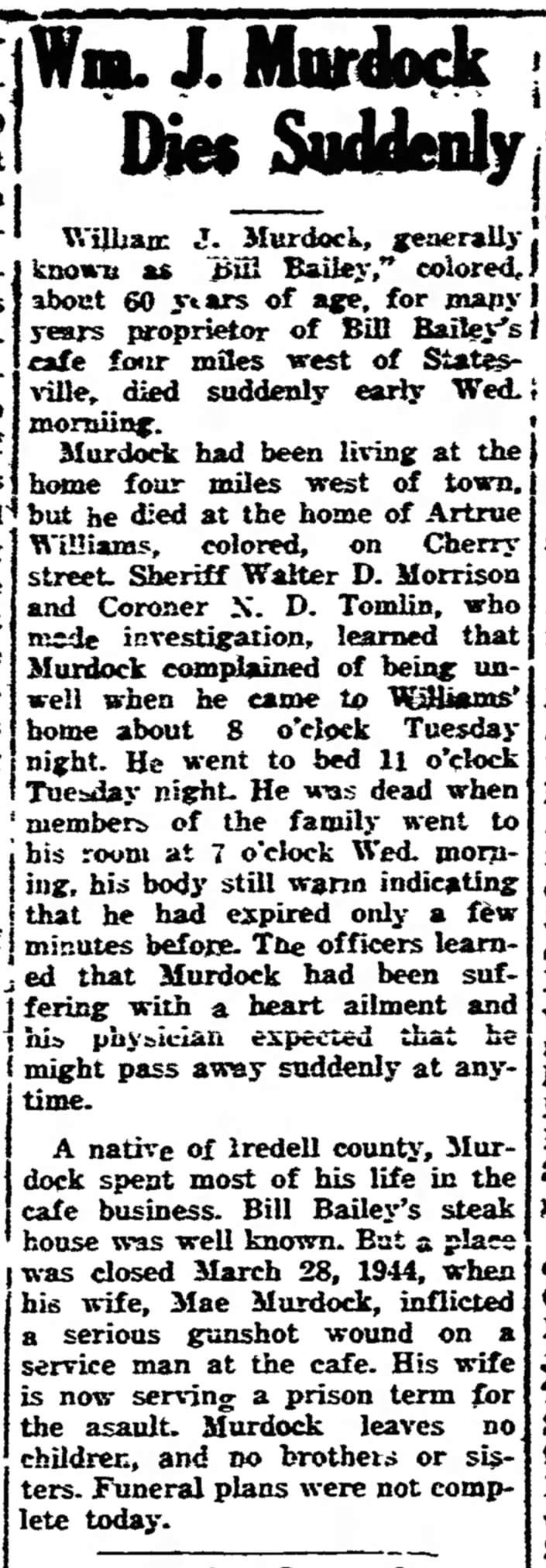
The bonhomie slammed to a halt on the night of March 28, 1944, when Bertha Hart “Aunt Bert” Murdock shot James Warren, a white serviceman out to celebrate leave with a juicy steak.  My mother’s cousin N. asserts that Bill and Bert thought that their clientele, not to mention his father’s relatives — who’d kept Bill out of prison during Prohibition and rewarded his good cooking with steady patronage — would stand by them. It did not happen.  The place shut down, and just over a year after wife’s conviction, Bill Bailey was dead.

Murdock died 12 6 1945 LandmarkStatesville Landmark, 6 December 1945.

Standard
Births Deaths Marriages, Migration, Newspaper Articles, North Carolina, Oral History, Paternal Kin, Virginia

We got strayed apart.

I was thinking about Cousin Tilithia when I was a little girl.  She had a restaurant large enough to work in and serve patrons.  It wasn’t real big, but they were serving patrons, and Mama carried me up there, and we spent the night there.  And whenever she’d come to Wilson she’d stay with us.  

Tilithia Godbold, she lived in Norfolk, and she married this man.  That wasn’t her children’s daddy.  King was her children’s daddy.  Godbold was the man she married later. He lived over in Rocky Mount, and he worked in the roundhouse or something.  I think he fixed the train, but he wasn’t the one on the train.  And Godbold, Tilithia’s husband, he stayed there in Rocky Mount.  ‘Cause Tilithia lived in Norfolk.  Her and her five or six girls or whatever it was, and she was running what they call the Strand Café.  And it was down on the first floor, and they lived up over it.  Go out there, and it was a sleeping compartment.  I was over there one time, and I remember it.  I think I was about seven or eight years old.  Went with Mama over there.  We was just running all over the place.  She had us waiting tables.  I wanted to wait tables. I was wondering, I asked Mama, “Well, why come we couldn’t have a place like that?”  And all that food!  Look like whatever the food was – I didn’t even know what it was ‘cause we ain’t never had none.  It was a whole lot of stuff, look like they had, I didn’t want it, but then I know it looked good, and we ate down there in the café.  

And another time Mama took me over there on the train to see her.  And it was right down in South Philadelphia where we went to their house.  Where they was staying.  And when I moved up here, her sister, she was telling me ‘bout how the children were there in Norfolk, her sister and all them.  I said, well, I could remember some of them, but I don’t remember what –  and I asked where some of the girls was.  Some of them in Norfolk and some of ‘em, one’s dead.  [Inaudible] the family.  We got strayed apart. 

——
My grandmother reminisced fondly of “Ta-LIE-a-thy” and her cafe, but was not entirely sure how they were related. Not long into my research, I discovered that Tilithia Brewington King Godbold Dabney was born 1878 to Joshua and Amelia Aldridge Brewington. She was, then, the first cousin of my grandmother’s father, J. Thomas Aldridge. Tilithia married Emanuel King in 1898 and, by 1910, the couple and their daughters Juanita, Elizabeth, Amelia, May Bell and Tilithia had settled in Norfolk, Virginia. Tilithia and Emanuel divorced and, by 1920, she was married to railroad fireman Walter Godbold and running her cafe. Her marriage to Godbold did not last, and the 1930 census found him back in Rocky Mount NC (described as divorced) and her still in Norfolk, holding herself out to be a widow while maintaining the little restaurant at 426 Brambleton Avenue.
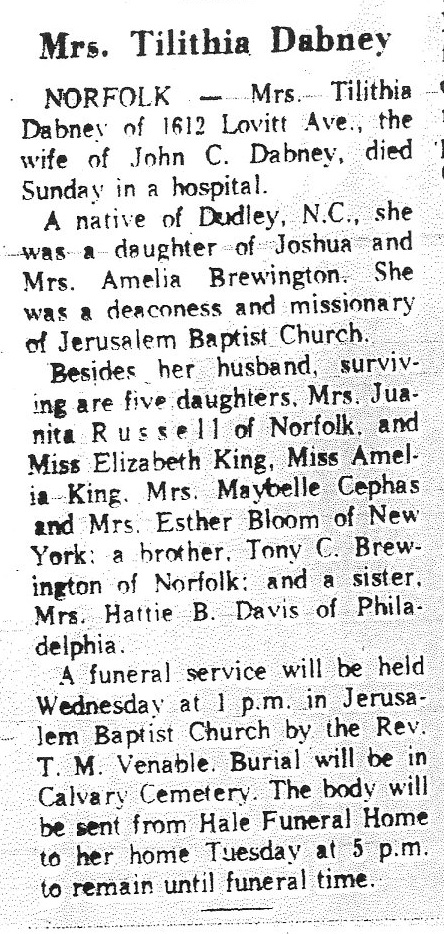
This was about all I could locate on Cousin Tilithia until 2009, when I met — genealogically speaking — B.J., a descendant of Tilithia’s sister Mattie Brewington Braswell (and my fourth cousin.)  Ours has been a most fecund collaboration, and it was she who discovered Tilithia’s obit and what had become of her daughters. My grandmother would have pleased to know that the branches of our family had found their way back from being “strayed apart.”

Image Virginian Pilot, 22 November 1965.

Interview of Hattie H. Ricks by Lisa Y. Henderson; all rights reserved.

Standard
Land, North Carolina, Oral History, Other Documents, Paternal Kin

Where we lived: 114 West Lee Street.

My parents were skeptical.

Me: Well, what about where, up, like, Lee Street.  There were some black people that lived up that way.

My father: Where?

Me: On the other side of the tracks.  Lee Street.

My mother: There were?

My father: I don’t know.

Me: Uh-huh. That’s where your grandparents lived. That’s where their house was.

Him: Lee Street?

Me: Mm-hmm. Right. Like if you come up – what was the name of that restaurant that everybody used to talk about? Golden Leaf? The Golden something –

Him: Okay.

Me: If you take that street, and you cross over the track, and you go left, and then you can — you know how it kind of splits or something?

Him: Yeah. Wont no black folk in there.

Me: Yeah, it was.

Him: Where?

Me: That’s where the Taylors lived. There was a little section.

Him: Oh, that was when — you talking ‘bout way back in the day.

——

Back in the day, indeed. On 11 February 1896, for $550, George D. Green and his wife Ella sold Mike Taylor a lot in the town of Wilson. Situated on a corner, the parcel fronted 143 feet on Pine Street and 83 feet on Lee. In the 1900 census of the town of Wilson, Wilson County, neither streets nor house numbers are listed, but it’s reasonable to assume that the Taylors — Mike, a drayman; his wife Rachel, who did washing; and their children “Rodgrick,” Maggie, Mattie, Maddie, Bertha E., and Hennie G. — were living there, and the 1908-1909 Wilson city directory lists Taylor, a driver, at 114 West Lee.

The 1910 census of Wilson paints a clearer picture of the little enclave in which the Taylors lived. Though he did not note house numbers, the censustaker inked “Lee St” along the edge of Sheet 27A of his survey of Enumeration District 116. The page records 50 residents, of whom 30, living in five consecutive households, were black. With the Taylors were the families of Jim and Annie Parrott, John and Cora Norfleet, John and Pattie Lassiter, Sam and Maggie “Ennicks” [Ennis], and Frank and Lizzie Bullock. The men worked a variety of jobs: a blacksmith, two odd jobs laborers, a gardener, a drayman. The women were cooks or laundresses.

The censustaker’s path is not clear. The Taylors were on the corner at 114 West Lee. According to the 1908-09 directory, the Bullocks were in the next block at 202 West Lee. The Ennises — Maggie was Mike and Rachel’s daughter — lived in the small house built on the back of the Taylor lot at 409 North Pine. In the 1912-13 city directory, Pattie Lassiter is listed at 200 West Lee, but John Norfleet was at 306 E. Barnes, on the other side of downtown. The Parrotts are found in neither directory. In any case, it is clear that these families formed a tiny cluster, and this cluster was unique in its surroundings. On the enumeration sheets before and after that listing the Taylors and their neighbors, the residents are overwhelmingly white.

For most of the 20th century, Wilson maintained a well-defined residential segregation pattern, with black neighborhoods confined to the east side of the Atlantic Coast Line (later Seaboard Coast Line, now CSX) railroad. Daniel Hill, a mile or so west of downtown, was the notable exception. For first quarter of the century, however, African-Americans claimed another tiny toehold, now forgotten, just west of the tracks at Pine and Lee.

Image

Sanborn map of Wilson NC, September 1913.

The 1913 Sanborn map, the earliest detailing the neighborhood, reveals a relatively large one-story frame house with an L-shaped porch wrapping around its west front corner. By time the 1922 Sanborn map was drawn, the city’s street numbering system had changed, and the address was now 108 West Lee.  The Taylors had also added a small porch to the back of the house.

Rachel and Mike Taylor remained at 108 West Lee until their deaths in 1925 and 1927. The address is now a vacant lot.

Standard
Births Deaths Marriages, Education, Maternal Kin, North Carolina, Oral History, Photographs

There she is.

Image

There she is.  That’s one of those dresses that Mama made for her to come to Hampton.  She came to Hampton a summer.  She stayed more than six weeks.  Must have stayed around eight or ten.  But anyway, she came here, and the things that she learned!  Oh, you would not believe.  All kind of things – artwork she could do.  Making baskets.  Oh, I don’t know what all.  That’s a blue taffeta dress with a white collar.  And you know we had a supervisor [Mary Charlton Holliday] who came to Statesville, and she particularly liked Golar, and she was a Hampton graduate, and she wanted Golar to go to Hampton so she could learn all this stuff.  All this artwork and everything.  And when she got ready, when Golar got ready to go, Mama had bought – this is a navy taffeta dress with a white collar.  And Mama had made all these dresses for her.  She had – this was a dressy dress.  And she had a pink dress, and she just, Mama just made her so many pretty things, you know.  And the, two or three nights before she was to go, to leave to go to Hampton, she broke down and cried.  Mama said, “What’s wrong?”  Said, “We’re gonna be, we’re gonna have your things ready.  You’re gonna be ready to go.”  And she said, “That’s not why I’m crying.”  She said, “I’m crying because Papa and Grandmama went to the bank and took out all of your money.”  Mama had paid into her Christmas savings account, and the bank just gave the money to Grandma and Papa, and that’s how they got her things together.  And she told Mama.  Ooooo

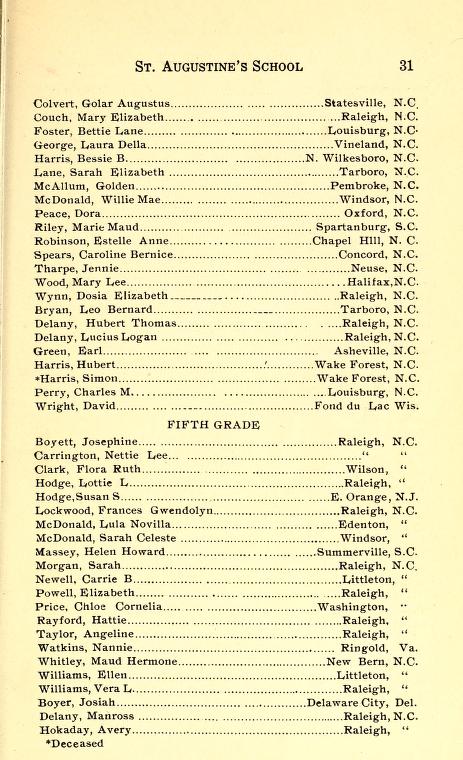
Golar Augusta Colvert was born in 1897 in Statesville, Iredell County, to Lon W. Colvert and his first wife, Josephine Dalton Colvert. She was about 9 years old when her widowed father married Carrie McNeely, and she grew close to her stepmother and adoring young half-siblings. When she was about 15, she enrolled at Saint Augustine’s College in Raleigh NC, where school catalogs show that she was a classmate of the Delany Sisters’ younger brothers.

annualcatalogueo18991914_0693

Annual Catalog of Saint Augustine’s School, 1913-1914.

In 1919, Golar married William Bradshaw, son of Guy and Josephine Bradshaw. Their son William Colvert Bradshaw was born in 1921 and daughter Frances Josephine in 1924. The little girl did not live to see two years. William worked in a furniture factory and Golar taught elementary school, and the family lived in a large frame house with a wrap-around porch on Washington Street in Statesville’s Wallacetown section.

In the summer of 1931, for reasons that are not at all clear, Golar traveled to Washington DC to undergo surgery.

Yeahhhh.  Went to Washington.  Had this operation and, ah, we got a letter from her.  Like, this afternoon, saying that she was all right, that they were gon take her stitches out, and she was coming home.  And she died that night.

GC Bradshaw 7 23 1931

Statesville Landmark, 23 July 1931.

Image

Statesville Landmark, 27 July 1931.

Interview of Margaret C. Allen by Lisa Y. Henderson; all rights reserved.

Standard
North Carolina, Oral History, Paternal Kin, Photographs

Going through the pea vines.

And David John, I don’t know what happened to him.  And his wife.  Well, now, David John come to Wilson and used to stay with us, and he worked in the factory.  So I don’t know whatever become of them folks down there.  And the girls that was all down there.  ‘Cause we went down there — me and Mamie went down there — and stayed with David John’s sister Estelle and worked in green tobacco.  And that’s where a mosquito bit me on my foot, and I scratched it, and, going through the pea vines, and the dew on ‘em, my foot swelled up so big I couldn’t walk on it.  And so Uncle ‘Lias, their daddy, brought me back home to Wilson.  Mamie stayed on down there, but I didn’t want to go back down there no more.

——

My grandmother’s reminiscences about Uncle ‘Lias (pronounced something like “LAH-iss”) were one of my early clues about the breadth of the Henderson family. I knew he was not her mother’s brother, or even her grandmother’s brother, and I was determined to find out exactly what the connection was. In fact, Elias Lewis Henderson was not an uncle at all, but a cousin. Born about 1880 in southern Wayne County, he was the oldest son of James Henry Henderson, who was the brother of my great-great-great-grandfather Lewis Henderson. (James Henry also named his youngest son Lewis Henderson after his brother.)Elias L Henderson

Elias married first Ella Moore. Their children were: David John (1901, married Amelia Artis), Mary Estelle (1903, married Theodore Rowe), twins Anna Bell (married Willie Johnson) and Mae Bell (1905), James Henry (1906, married Bessie Hagans), Myrtie Mae (1907), Olivia (1909, married James Raynor and [unknown] Whitaker), and Ira Junior (1911, married May Bell Bryant and Betty Ellis).  With his second wife, Sarah Edmundson, he had a son, Jazell Westly (1924, married Nancy).

Though my grandmother lost contact with David John and Mary Estelle, when she moved to Philadelphia in the late 1950s, she was reunited with their sister Anna Bell’s daughter Eunice Johnson Smith. Here, in the early ’60s, are Eunice’s daughter Wilma Smith, Eunice and my grandmother at a dinner at a Sheraton hotel in Philadelphia:

FB0068

Interview of Hattie H. Ricks by Lisa Y. Henderson, all rights reserved; photographs in the collection of Lisa Y. Henderson.

Standard
Maternal Kin, North Carolina, Oral History

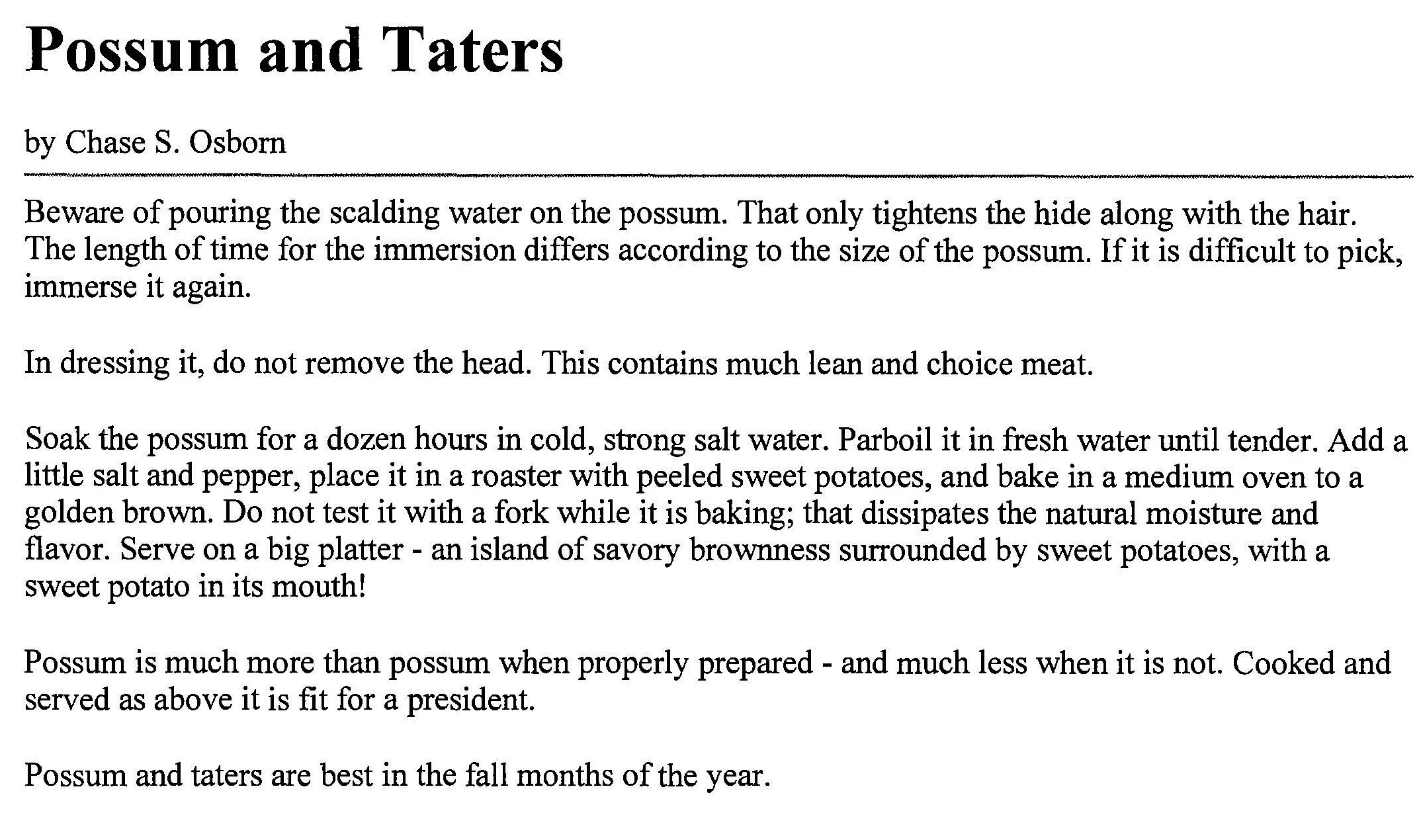
Possums and sweet potatoes.

My grandmother:  His mother used to cook possum. 

Me:  Used to cook possum?

My grandmother:  Oh, possum, honey.  They would cook those dern things.

Me:  Well, possum stew.  I guess I have heard of that.

My grandmother:  Naw.  They didn’t have no possum stew.  They’d bake this thing.

Me:  Awwww!

My grandmother:  And, look, wait a minute.  You know they’ve got big mouths.  Long mouths.  A possum.  And he’d put a sweet potato in the possum’s mouth.  [I laugh, hard.]  I don’t remember cooking one, but my grandmother sure used to cook ‘em.  And Papa cooked ‘em.  But I refused to cook ‘em.  Not me.  And you know these people when I came here ate muskrats?!

Possum_and_taters-1

It was Harriet Nicholson Hart who fixed such special dishes for her favorite son.

Interview of Margaret C. Allen by Lisa Y. Henderson; all rights reserved.

Standard
Births Deaths Marriages, Maternal Kin, Oral History, Photographs, Virginia

Mary Agnes Holmes Allen.

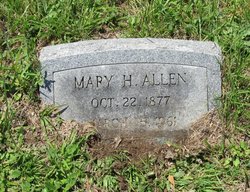
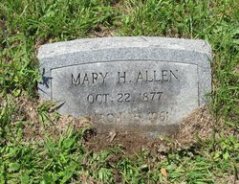
Her headstone is wrong. Mary Agnes Holmes was born October 15, 1877 — not October 22 — on the R.L. Adams’ plantation in Charles City County, Virginia. Her parents were tenant farmers there, and Agnes was one of a handful of Jasper and Matilda Holmes‘ children to survive to adulthood.

Agnes’ mother died when she was about 8 years old, and her father apparently did not remarry. Jasper Holmes was an ambitious man and managed to purchase several small plots of farmland upon which he supported his family in a degree of comfort. The Holmeses may have attended New Vine Baptist Church and, if so, that is likely where Agnes met John C. Allen.

There is an ugly story told about their marriage: John had quickly established himself as an eligible bachelor in Newport News’ East End, and his appeal was heightened — in the standards of the day — by his light skin and wavy hair. When he brought his new bride home shortly after Christmas 1900, his neighbors, peeking through curtains, were shocked to see a plain, broad-featured, brown-skinned woman step from the carriage. (Agnes herself was not immune to such prejudices, and her color-struck notions would reverberate among her offspring.)

Image

During the early years of her marriage, Agnes did “day’s work” as a housemaid. I did not know this. I had assumed that she was always a housewife, which is a reflection of my failure to understand just how my great-grandparents were able to achieve the middle-class respectability that marked their lives by the middle of the 20th century. (Not to mention how they maintained their dignity on the climb.)

Me:  Now, his mama didn’t ever work, did she?

My grandmother:  Who?  Indeed, she did work.

Me:  Like, outside the home?

My grandmother:  Yeah, during the late years, she didn’t, but she worked outside the home ‘cause she told me one time she walked across the bridge, ‘cross 25th Street bridge, and said it was snowing and ice, and the ice froze on the front of her coat.  And I never shall forget, she worked for a lady, and this lady had a small child.  And she asked her would she wash the child’s sweaters.  Sweaters that the baby had.  And she took and said, “Asking me to do all kinds of extra work like that,” and said, “You know what I did?”  Said, “I washed the sweater in hot water, and then I put it in cold water.  When I got through with it, it was ‘bout big as my fist.”  I said, “How can [whispering, inaudible.]”  And she knew it –

Cousin N: Was gon shrink up.

My grandmother:  And I said, “Oh, my God, that is awful!”  And it was.  Anyway, she told me that.  She said, “I washed it all right for her, and I put it in hot water, as hot as I could find, and then put it in cold water.  When I got through with it, couldn’t nothing wear it.”

By the time my mother and her siblings were children, Mary Agnes Allen had assumed the domestic role I’d always imagined her in — at home on Marshall Avenue, among Tiffany lamps and lace antimacassars, preparing roast beef to serve on Blue Willow china to a husband just home from this board meeting or that union affair. Her grandchildren speak of her ambivalently, aware of the casually cruel distinctions she drew among them, but unable to name any particular misdeed.

Me:  Well, was Mary Agnes mean to y’all or what?

My mother:  She was not to me, that I remember.  I don’t know what this was about.  Ahh … maybe it was that she was not friendly.  Maybe she wont like Grandma Carrie, joking and saying little funny stuff.  I don’t know.  I don’t know what it was.

Her grandchildren — at least, her son John’s offspring — felt that lack of warmth acutely. Though their 35th Street home was only a mile away from hers, Mary Agnes Allen does not feature much in the stories of their childhood. (Nor, frankly, does John Allen Sr.)  In her later years, she left Newport News to live with her daughter Edith Allen Anderson in Jetersville, Amelia County, Virginia. The photo below, I’m guessing, was taken shortly before her move. And seems to reveal a softer side.

Image

Mary Agnes Holmes Allen died March 15, 1961, just two months before my mother married in the sideyard at Marshall Avenue.  A brief obituary ran in the Daily Press on the 17th, noting that she was a member of Armenia Tent No. 104 and the Court of Calanthe. She was survived by three daughters, a son, a “foster son” (actually, her nephew), a sister, and, most curiously, “12 grandchildren and 10 great-grandchildren.” In fact, she had ten grands and no more than three great-grands.
Image

Interviews by Lisa Y. Henderson, all rights reserved.  Photographs in collection of Lisa Y. Henderson.

Standard
Births Deaths Marriages, Maternal Kin, Newspaper Articles, North Carolina, Oral History

Aunt Bert, as reported.

So, the conversation started with talk of Bill Bailey’s barbecue joint. Which was also a dance hall.  Which, though it was right up the road, was, as my grandmother put it, “strictly off-limits” to her and her sisters. “We couldn’t stand him,” she said, because “he did everything illegal and got away with it.” He had a great big stomach and was “trashy,” but his steaks pulled the best of Iredell County’s partying white folks.  And he was married to my grandmother’s Aunt Bert.

Me:  Now, she wound up … She shot somebody, or something, didn’t she?

My grandmother:  Yeah, she shot somebody.  She shot a white man.

My mother’s first cousin, N.:  What he do?  Slap her?  What did he do?  He did something to her.

My grandmother:  I don’t know what he did to her.  But maybe … seems like to me he kicked her.

N:  And she shot him.

My grandmother:  And she shot him.

N.: They had to take his leg off.

[Pause.]

Me:  Oh.  Well, good for Bert.

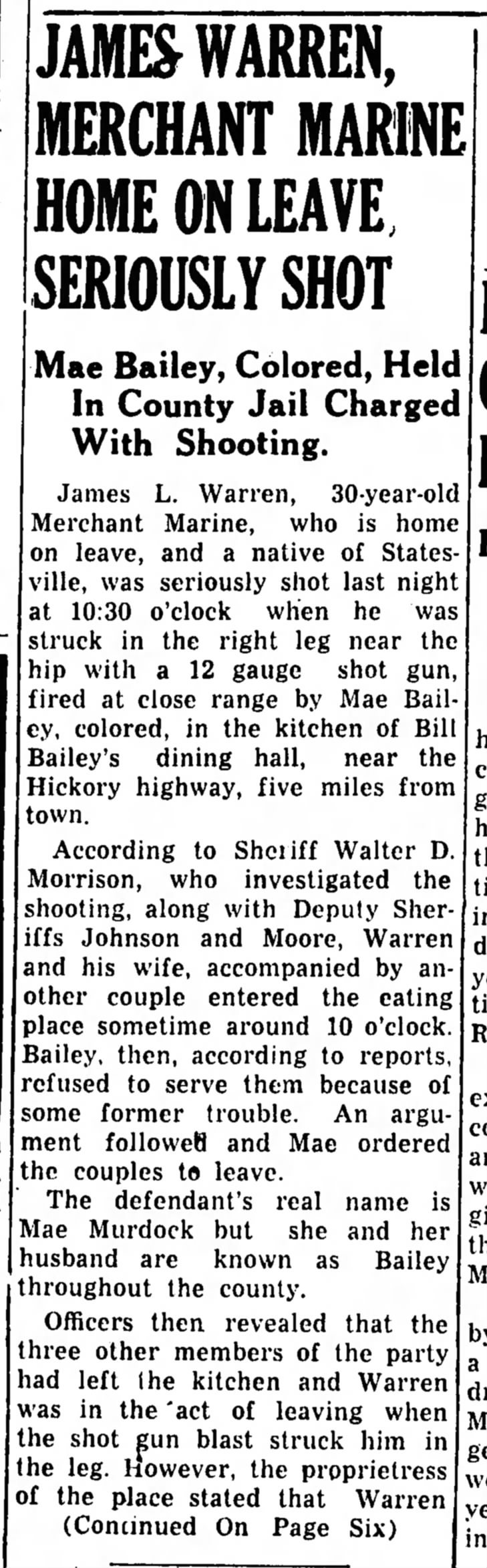
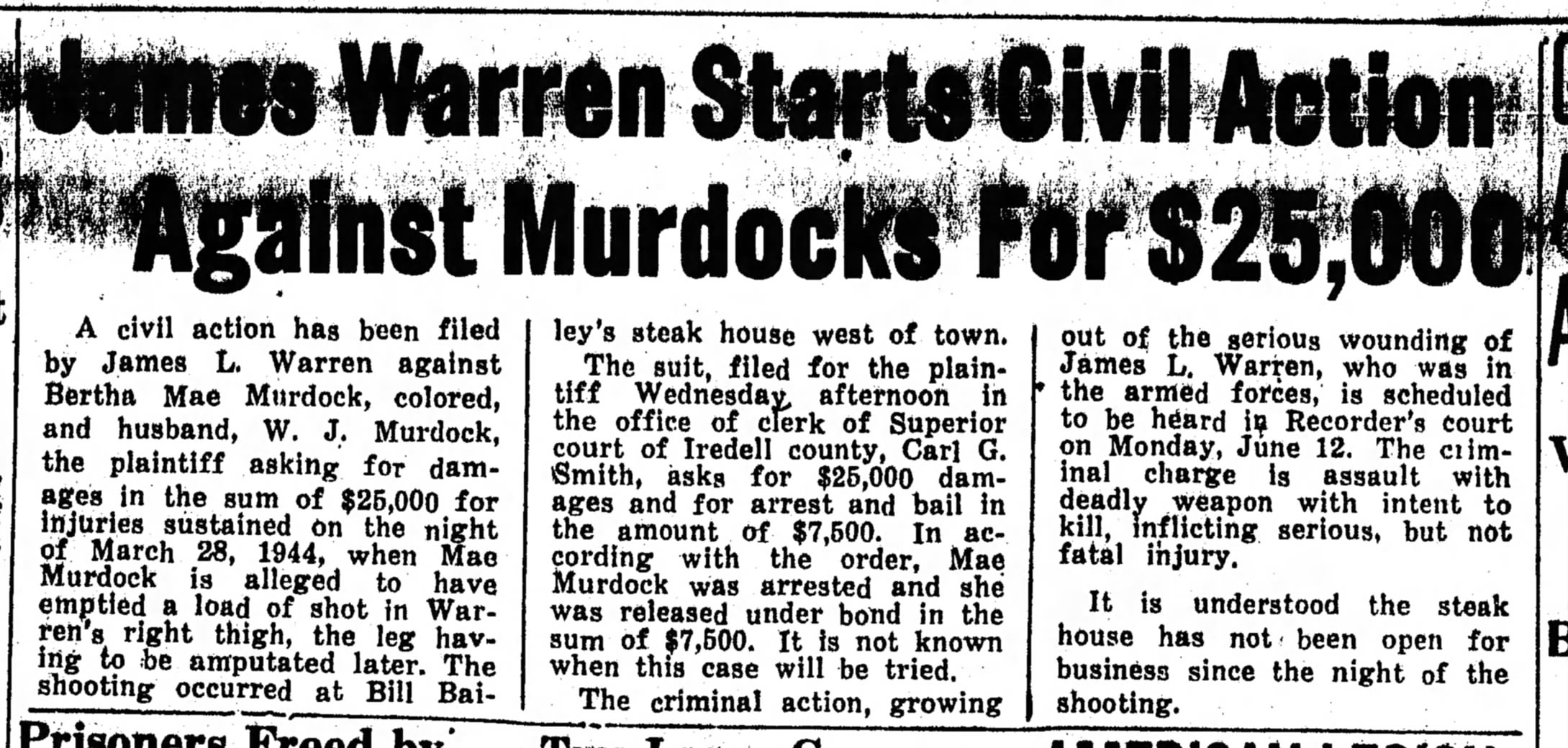
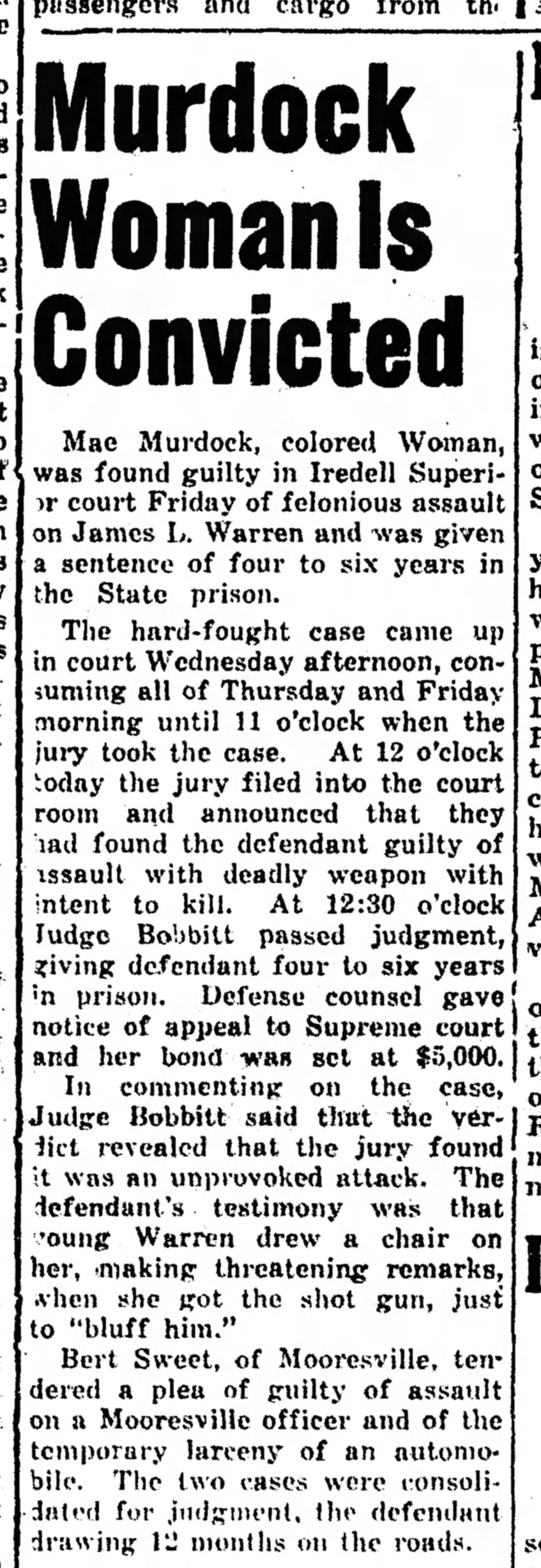
When I wrote about this before, I was looking for newspaper coverage of the incident, thinking that a black woman shooting a white man in North Carolina in 1944 had to have galvanized the public. Well, sure enough, the Statesville Record & Landmark covered every step of ensuing criminal trial, though in a considerably less salacious manner than I might have expected.  The headlines pretty much tell the tale:

James Warren, Merchant Marine Home on Leave, Seriously Shot. Mae Bailey, Colored, Held in County Jail Charged with Shooting. 29 March.

Warren Shot 3 29 44Warren shot contd

Warren Holding Own, But Will Not Be Out of Danger For Week.  30 March.

James Warren’s Leg Amputated.  3 April.

James L. Warren Is Better But Not Yet Out of Danger.  6 Apr.

Mae Bailey Freed from Jail Today, Hearing May 8th.  11 April.

May Postpone Murdock Trial.  29 April.

Warren Removed to the Naval Hospital at Portsmouth, Va.  1 May.

M. Murdock Trial Postponed Until Monday, June 12.  8 May.

James Warren Starts Civil Action Against Murdocks for $25,000.  11 May.

Murdock Civil Action 11 May 44 R and L

Mae Murdock Case Continued to August.  25 May.

Judge Bobbitt to Superior Court Preside August, Case of Mae (Bailey) Murdock Will Not Be Tried At This Term.  29 July 1944.

Murdock Trial Definitely Set For November 6, Warren is Able to Leave Hospital.  6 September.

Prosecuting Witness May Not Visit Scene of Shooting. 9 October.

Mae Murdock is Bound to Court Under $5000 Bond. 16 October.

Case Hinges on Warren’s Action Before Shooting, Testimony Rapidly Nearing Completion.  9 November.

Murdock Woman is Convicted. 13 November.

Conviction 13 Nov 1944

Murdock Case to Go to State Supreme Court.  14 November.

$25,000 Law Suit Against Murdock Woman Continued.  14 November.

Aunt Bert served her time at the state women’s prison in Raleigh and returned to Statesville after to pass her few remaining years.  She had  possessed considerable wealth after her father’s death in 1929, but lost much of it while she was away. My family maintains that William “Bill Bailey” Murdock had entrusted whites to help hide his shady assets, and they betrayed him after Bert shot one of their own.

Bert died in 1955. The Landmark ran her death notice without comment or reference to the incident for which she had been infamous just ten years earlier.

Bert Murdock Obit 26 May 1955 Record and Landmark


Interview of Margaret C. Allen by Lisa Y. Henderson; all rights reserved.


Standard
Births Deaths Marriages, Maternal Kin, Migration, Newspaper Articles, North Carolina, Oral History, Photographs

Finding J.T.

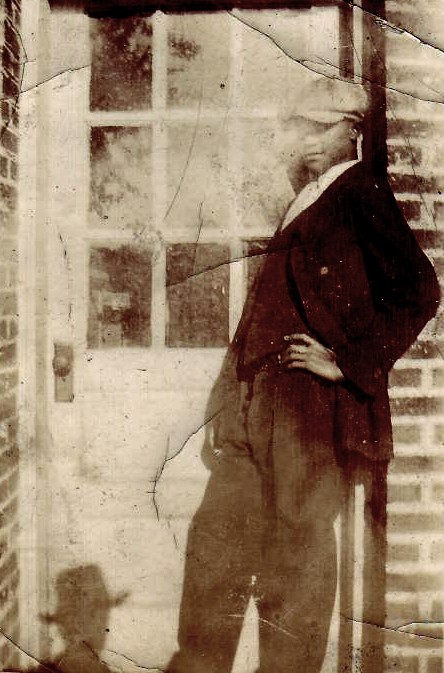
My grandmother’s favorite cousin was her Aunt Lethea’s son, “Jay” or “J.T.”:

My grandmother:  I had a cousin named Jay.  Aunt Lethea’s son.  She died and left three sons.  James –

Me:  Charles.

My grandmother:  Charles.  And Jay.

Me:  Okay.  J.T.

My grandmother:  Mm-hmm.  And Jay stayed with Aunt Min ‘cause Aunt Min reared him after Aunt Lethea died.  And he was at this same house with Aunt Minnie and Grandma.  Let’s see.  It was Aunt Min and Grandma and Uncle Luther and Jay and I.  We were all in the same house during the summer that I worked up there.  And Jay and I used to have a good time.  Oh, he was so nice.  He would, the first time I rode on a rollercoaster, he took me.  And we used to have a good time.  He was really nice.  He was a nice person.

McNEELY -- Jay McNeely in doorway

Jay had two brothers, William and Charles. In the 1910 census of Statesville, Iredell County, I found three boys, William, 5, James, 3, and Charlie McNeeley, 2, living in the household of Sam and Mary Steelman and described as their grandsons. I identified these children, correctly I believe, as Elethea McNeely‘s children.  I also guessed that Charlie Steelman, listed in the household, was their father.  If he was, he and Lethea never married. Instead, in 1920, she wed Archie Weaver, a man my grandmother spoke of with vitriol.

My grandmother: Jay’s daddy had TB, and he just gave it to them.  And his mother and Jay.  But he lived years and years and years after both of them died.

Me: The father did?  

My grandmother: [Inaudible] give them all this stuff.  Oh, I could not stand him. She was my special aunt because she had boys, and she didn’t have any girls.  And she just took me over her house, you know, and let me do things that girls did, you know. 

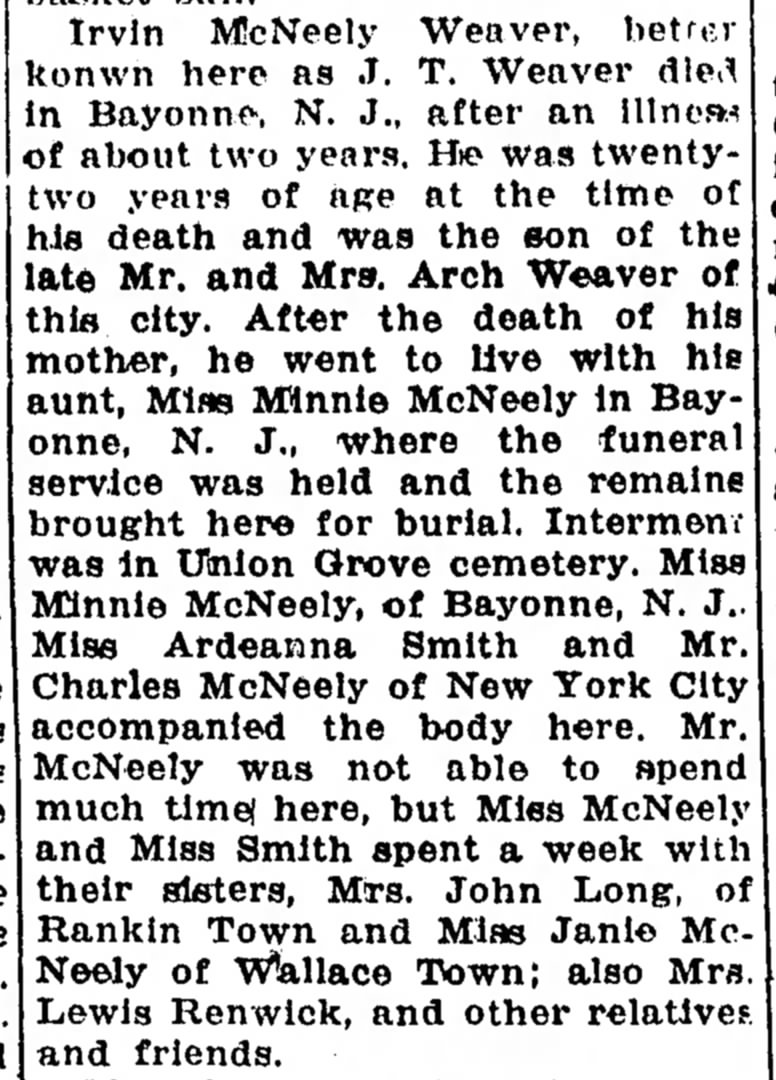
I was unable to find James McNeely, whom I believed to be “Jay,” in any other record. I knew Jay was reared by his aunt, Minnie McNeely, and died young of the same dread illness that killed his mother, but I was never able to find a trace of him. That changed last night, when I stumbled upon his death announcement in the 15 December 1933 issue of the Statesville Record & Landmark:

Image

As Grandma Carrie so memorably said, “Well, I’ll be damn.”  Here was J.T., as last. Not James McNeely — much younger, in fact — but Irvin McNeely Weaver. (The same “mysterious” Irving McNeely listed in the 1930 census in Martha McNeely‘s Bayonne household. He was described as her nephew, rather than her grandson, and I jotted in my notes: “Who is this???”) My grandmother was married and living in Newport News, Virginia, at the time of his death, and is not among his named survivors. Ardeanur Smith was his cousin, not his aunt, and Charles McNeely was his brother. Mrs. John Long was his aunt Lizzie McNeely Long, and Mrs. Lewis Renwick was his cousin Louise Colvert Renwick.

McNEELY -- McNeely Cousins

The first photo is Jay as a boy, perhaps around the time he moved to Bayonne. The second, taken in Bayonne circa 1928, shows Jay with his first cousins Ardeanur Smith, Margaret Colvert and Wardenur Houser, and an unknown girl seated in front. The last is Jay, alone, perhaps not long before he died.

McNEELY -- Jay McNeely near pole

——

This is just one of many, many times that I’ve found something that one or the other of my grandmothers would have been “tickled” to see. They both lived good, long lives — to 90 and 101 — but I would have kept them with me always if I could.

Interview of Margaret C. Allen by Lisa Y. Henderson; all rights reserved. Photos in the collection of Lisa Y. Henderson.

Standard