Education, Other Documents, Paternal Kin

Signature Saturday, no. 1: Adam Artis’ children.

Adam T. Artis was illiterate. Though a smart and successful man, he executed contracts with a shaky X and probably conducted much of his business on the basis of verbal agreements. Here, his mark on a receipt for goods purchased from him by the Confederate government in 1863:

Adam Artis mark

There’s little evidence to show whether Adam’s wives could read and write, but it seems doubtful that the first three or four could. His granddaughter Pauline Artis Harris told me that education was important to him, however, and he hired a teacher to live on his farm and school his children. His efforts bore fruit. Below, the signatures of eight of Adam’s 26 or so children.

The signature of the oldest son, Cain Artis (1853-1917):

Cain Artis Sig

The signature of Louvicey Artis Aldridge (1865-1927) on the final account of her husband’s estate:

Screen Shot 2014-12-05 at 5.15.29 PM

It is, perhaps not surprisingly, the shakiest of the bunch. Vicey was among Adam’s earlier children and likely came along before her father’s resources allowed for tutors. She was also a girl.

From the World War I draft registration card of Walter Scott Artis (1874-1951):

Screen Shot 2014-12-04 at 10.19.31 PM

From the World War I draft registration card of William Marshall Artis (1875-1945):

Screen Shot 2014-12-04 at 10.20.18 PM

From the World War I draft registration care of Jesse Artis (1878-1922):

Screen Shot 2014-12-04 at 10.21.39 PM

Jesse used the alternate spelling “Artice,” which was rarely adopted by members of this family. Notice that somewhere between William and Jesse’s early schooling, cursive capital A’s shifted in style from a form very similar to a printed “A” to one like an oversized small “a.”

From the World War I draft registration card of Robert Elder Artis (1883-1934):

Screen Shot 2014-12-04 at 10.22.22 PM

From the World War I draft registration of Columbus Estell Artis (1886-1973):

CE ARtis Sig

C.E.’s signature is interesting. This round, upright script, from 1917, is a relatively early version. Later, over the course of the hundreds of death certificates he signed as an undertaker, he developed a bold, right-leaning, immediately identifiable signature characterized by a bold slash through the “r” in Artis:

Screen Shot 2014-12-07 at 10.48.17 AM

From the World War I draft registration card of June Scott Artis (1889-1973):

Screen Shot 2014-12-04 at 10.23.21 PM

Though his letters are well-formed and decisive, the missing “S” in Scott suggests a man who signed his name from memory and did not write much.

From World War I draft registration card of Henry J.B. Artis (1892-1973):

Screen Shot 2014-12-04 at 10.26.43 PM

From the Social Security application of Alphonso Pinkney Artis (1903-1976):

[I’ve got this somewhere. I just need to find it.]

Standard
Agriculture, Free People of Color, Land, North Carolina, Other Documents, Paternal Kin

I never heard anything but “rent.”

The third in an occasional series excerpting testimony from the transcript of the trial in J.F. Coley v. Tom Artis, Wayne County Superior Court, November 1908. Paragraph breaks inserted for better readability.

Plaintiff introduces Jonah Reid who being duly sworn, testifies as follows:

I have heard Tom Artis say that he was going soon to pay his rent with cotton to [William S.] Hagans. I don’t know how often I have heard him speak of that, I have heard him say something about it several times when rent was due. I didn’t hear him say what lands. Some times he was cultivating the three pieces, sometimes the 30 acre piece. I am his son-in-law. I never lived with him. Live back of his house. Never heard him call it anything but rent cotton, not interest cotton. (Defendant objects.)

CROSS EXAMINED.

I told Hagans that I heard the old man say he was going to pay his rent, that was along in September, I think this past September. The only reason I told him was he asked me. He came by where I was working on the road. He asked me how long I had been in the family. I told him 16 years. He asked if I had ever heard anything but rent. I told him no. That’s why I told him. That’s all he asked me. Tom worked the three pieces, then afterwards the 30 acre piece. That’s all I remember Hagans said. I didn’t know there had been a suit about the land. Hadn’t had the suit yet. I said I didn’t like to say anything about my father-in-law. Hagans didn’t tell me that he Artis was claiming that he was paying interest. I just answered what he asked me. I told him I had never heard any thing but “Rents”.

——

Jonah Reid was married to Magnolia Artis (1871-1939), daughter of Thomas and Loumiza Artis Artis. Loumiza Artis was a sister of my great-great-great-grandfather Adam T. Artis. One of Adam Artis’ wives, Frances Seaberry, was William Hagans’ paternal aunt.


Standard
Births Deaths Marriages, Newspaper Articles, Paternal Kin, Photographs, Virginia

The most talked-about wedding.

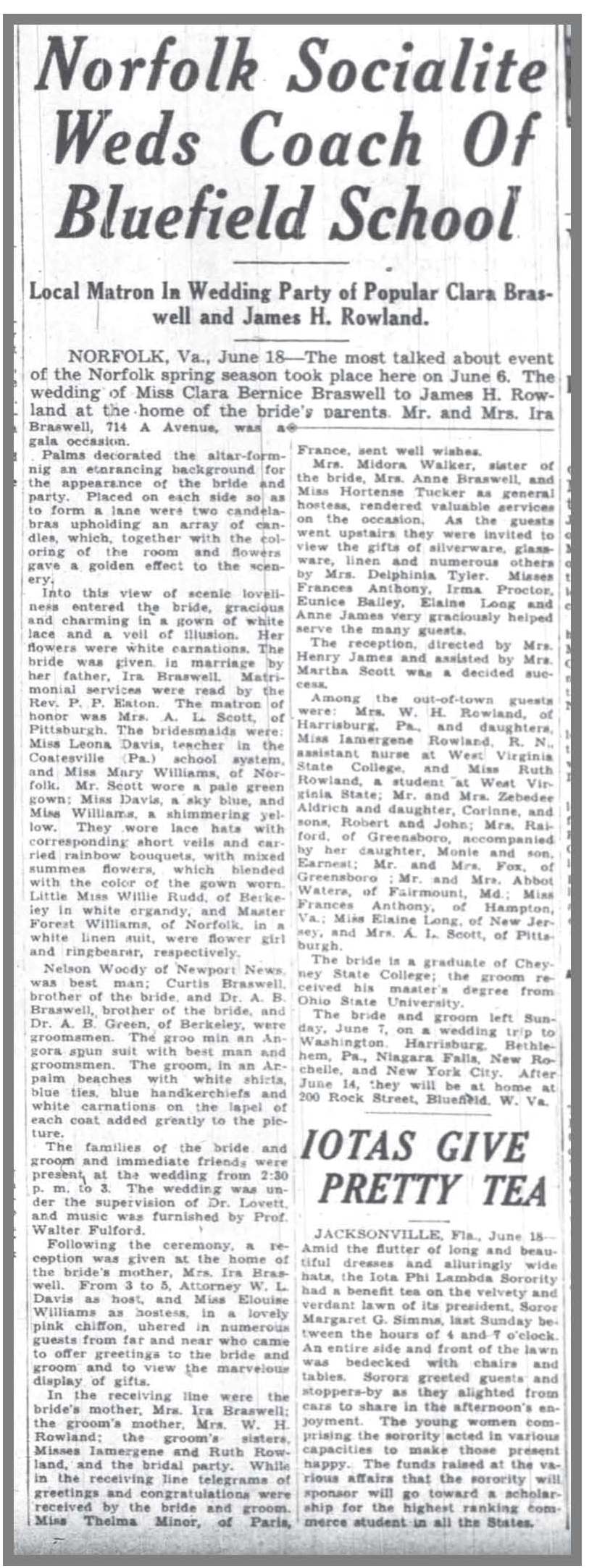
Pittsburgh Courier 6 20 1936 Clara Braswell wedding

Pittsburgh Courier, 20 June 1936.

Socialite Clara B. Braswell‘s mother, Mattie Amelia Brewington Braswell, was a daughter of Joshua L. and Amelia Aldridge Brewington. Just after 1900, Mattie migrated to Norfolk, Virginia, where she married her husband, who was also a Wayne County native.  Several of her siblings also made the move, including Tilithia Brewington King Godbold Dabney, much-beloved by my grandmother. Among the out-of-town guests noted at Clara’s nuptials were Mattie Braswell’s first cousin and his wife, Zebedee and Jennie Ridley Aldridge, with three of their children. The son of John W. and Louvicey Artis Aldridge, Zebedee had also migrated from Dudley, Wayne County, to rural Brunswick County, Virginia, in the first decade of the 20th century. Zebedee and Jenny traveled a hundred miles from their farm to attend his cousin’s gala wedding, touching evidence of enduring ties among Robert and Mary Eliza Balkcum Aldridge‘s descendants.

Zebedee & Jennie Aldridge

Zebedee and Jennie Aldridge, probably 1940s.

Photo courtesy of L.D. Hutchinson. Hat tip to B. Jones for the article.

Standard
Migration, North Carolina, Oral History, Paternal Kin

The bread was all mashed up.

I won’t say this one of my grandmother’s favorite stories. It was too painful to be favored. But it was a story she told me over and over, without prompting and with little variation. It tears me up to read it even now, nearly a hundred years after the events it memorializes. I imagine that frightened little girl, a near orphan, left with this relative and that, yearning for comfort from a great-aunt who generally offered little in the way of emotion, but who, to provide, went North for short stretches for the extra money she could make doing “day’s work” for white families. Theodore and the bread and the doorbell. My heart breaks.

——

And I went over to stay until – Mama was working. And so Edward, that was – Edward or Theodore? Theodore. It was Carrie’s, Papa’s daughter Carrie, like Annie Bell’s sister Carrie. That’s where I was staying, over to her house. And Mama was working and staying on the lot with the people, and I was supposed to stay with them while I was up there. Until Mama, I reckon ‘cause she was gon be making a little money to buy something with, but I don’t know what she said she wanted. So by her being one place and I was in another. And then when her son, Theodore – we went to the store to get a loaf of bread, and I went with him, I wanted to go with him. And he took me on down to the store, got the bread, then he give me the bread to hold, and there was a place in the sidewalk of dirt, where wasn’t paved, and he stopped there with some children and started shooting marbles in little space, that little square. So I walked on down the street, and we wont too far from the house, but I kept looking and trying to figure out what house we were in. They were all joined together. And I had seen him go up there and put a hand upside the thing, and I said, ‘Must be a bell up there.’ And I went up there and mashed that button, and the door didn’t come open. And so then I went back down the street to where Theodore was, and he was still shooting marbles. And so, I said, “You better come on, I’m tired of holding this bread.” And so he said, “Okay, okay.” And so then he stopped, and we come on up there, and the door was cracked open. The door was cracked open. So when we got there, I said, “The door was open. And you didn’t even have to mash the button up there.” Mash the button where was to the apartment where you live in? And they would mash the button back to open the door. But the door was already open. But I had mashed it, see? I didn’t know. So when Theodore and I went back up there, and we went in, and I had the bread, and the bread was all mashed up where I had held it so tight holding it. And so she fussed him out and whipped him on top of that, and I went to crying ‘cause I thought she was gon whip me, too, ‘cause it was both of us. And so I said, “I want to go home. I want to go to where Mama is.” They said, “Well, she’ll be over tomorrow.” And I don’t know if it was tomorrow or the next day or two after, but anyhow Mama come and got me, and I told her that I wanted to come home. And she said, “Well, I thought you was doing all right. What’s the matter with you and Carrie?” And I said, “She beat Theodore.” And I said we were at the store getting a loaf of bread, and so we stayed too long. He was shooting marbles, and I was holding the bread, and I had mashed the bread up, and I thought she was gon whip me ’cause I forgot about the bread, and I couldn’t get in the house to bring it to her. And when I mashed the button, the door didn’t come open. So then when Theodore and I came back, went on up there, and honey, she took her husband’s belt, one of his belts he had, and she whipped him, and I was crying, and I’m still crying. I said, I reckon that’s where I started crying ’cause every time I see somebody else cry …. So I told them I wanted to go home, and she said, “Well, Mama’s coming over tomorrow.” And so I stopped crying, but I thought Carrie was gon whip me, just like she whipped Theodore, and I was the one that mashed the bread. But I didn’t tell it. But she said we stayed out too long. Bread’s all mashed up, said, “Should have come on home.” She was fussing with him, and then she took the strap and hit him two or three licks with that, and I thought she was ton hit me, too. And so Mama came and got me and took me back over Frances’ house. So then she said she was going back South. And I was just happy to go back there.

——

They said, well, [inaudible] get some bread, went to the store. I didn’t know where the store was, but I was just going with him to the store, you know? I got the bread, he give me the bread to hold, while he was shooting marbles in that little space was out there. And come on back, and I went way to the house and mashed the button ‘cause I’d seen him mash it. Didn’t want to ask nobody nothing. I said, I didn’t know them peoples up there. So the door didn’t open, and I went on back to find him and get him to come home. And I had held that bread so much and turned it from one end to the other under my arm holding it, and mashed the bread up. So Carrie looked at him: “Well, where y’all been so long?” And then she got that strap, ‘bout this long and ‘bout this wide. And she hit him a lick or two with that, and said, “I sent you out there after some bread, and you went off and stayed and stayed and stayed.” And so when she was hitting him, I went crying. So I thought she was gon beat me, too. But she didn’t. She didn’t even try to chastise me or talk nice to me or nothing. It was just simply ‘cause I’d done mashed that bread up – I had the bread when I went up there, see. She wont thinking ‘bout me. But I didn’t think that, nothing about it until it was later. I said, ‘No wonder she was gon beat me.’ ‘Cause I had done mashed that bread all up holding it up in my arms and changing it from one arm to the other, waiting on him shooting marbles. But I didn’t tell on him. But she knew he was shooting marbles.

——

... Mama took me to New York and everywhere she’d go. I stayed with Frances and her husband and son, when Mama went up there to work. And so I stayed with Carrie first. That was Albert Gay’s mama’s sister. She had one son, Edward. And she sent us to the store to get a loaf of bread. I’ll never forget it. And in the sidewalk, it was a block out the sidewalk where was closed up. And it just had dirt in it, and we went to get that loaf of bread. He handed me the loaf of bread, and when we got to that block it was boys shooting marbles in that little square where it was dirt. And so I got tired of standing there waiting on him. And I went on up to the house. And had seen them where they go up there and pushed the button. And the door didn’t come open then, and I went on back to where Ed was. And stood there waiting ’til he come to go in the house. And when we got to the house, the door was open. So when we got upstairs to the apartment floor, Carrie commenced fussing with him about ‘Who’s that coming in there playing with that bell?’ and opening the door, or something, I started to say it was me, and then I — she talked so hateful, and she beat Theodore, ’cause he got the bread all mashed up, with the belt. So I went to crying. I cried and I cried. I wanted to go home. I wanted to go where Mama was, but Mama wasn’t supposed to come over there ’til the next day or a day or two after that. I don’t know where she was working. Except that she was doing some day’s work. ‘Cause day’s work was plentiful then. People would clean up. So Mama wanted [inaudible] carried me with her and left Mamie there with Papa and knowing, too, Papa didn’t like Mamie. So, anyway, I cried so, and Mama took me over to Frances’ house. That’s where Mama come, after they took me over to Frances.’ I don’t think either one of ’em had no phone at that time and … but anyway, she come on over and got me, and I told her I didn’t want to stay there no more, I wanted to go home. I said I wanted to go where she was. She said, “Well, you can’t go right now,” said, “I got a job to do.” She said, “Well, I’ll take you over to Frances’. So that’s when she took me over to Frances’ house, and Edward.

——

“Mama” Sarah Henderson Jacobs (1874-1938) reared my grandmother and her sister Mamie, her great-niece. Sarah’s husband, “Papa,” was Jesse A. Jacobs Jr. (1856-1926). Annie Bell Jacobs Gay and Carrie Jacobs Blackwell (1890-1963) were Jesse’s daughters by his first wife, and Theodore Blackwell (1908-??), not Edward, was Carrie’s son.  At the time this story took place, the Blackwells were probably living at 37 West 112th Street in Harlem, just north of Central Park. In 1920, this was an all-African-American, fifteen-family building in a block otherwise occupied by Russian Jewish immigrants. Frances Aldridge Cooper Newsome was my grandmother’s paternal aunt, sister of her father Thomas Aldridge. Edward Cooper was Frances’ son.

Interviews of Hattie H. Ricks by Lisa Y. Henderson; all rights reserved.

Standard
Agriculture, Land, North Carolina, Other Documents, Paternal Kin

I would be glad if you would wait a few days.

The second in an occasional series excerpting testimony from the transcript of the trial in J.F. Coley v. Tom Artis, Wayne County Superior Court, November 1908. Paragraph breaks inserted for better readability.

Plaintiff introduces H.S. REID who being duly sworn testifies as follows:

I know the Defendant Tom Artis. I had a conversation with him in reference to payment of cotton to [William S.] Hagans. This last fall I was on the road with Hagans and met Tom Artis carrying a bale of cotton. Heard conversation between Artis and Hagans. When we met in the road Tom said, “You are leaving home, and I have started to your house with a bale of lint cotton.” Hagans told Tom to carry it on as quick as he could, for he needed it about as bad as he ever saw anyone. He said that in a joking way. Hagans started off, and he said, “Hold on Captain!” He told him that he understood that he was going to sell the land down there. Hagans said yes, that it was for sale. Tom said, “I would be glad if you would wait a few days Captain, I think I can raise the money for that place, didn’t say what place just then. Hagans said he had rather sell it altogether. Tom said if he would give him a few days until he could see his boys, he thought he could raise the money for it all. Hagans said alright, it was all for sale. That was about the end of the conversation and we parted. Later then that one day, at Eureka, Artis asked me if I knew when Hagans would be out at his place. I told him about the day Hagans told me he would be out there. Artis said I wish I would deliver a message to Hagans for him, “ask him not to sell that place to Mr. Wright Cook. Said if he did, he would be out of house and home. He said he would rather Hagans sell it to Coley, for he thought he could get along better with Mr. Coley. I delivered the message to Hagans when he came out home. I think this is about the substance. That last conversation was a short while before the sale I think. Am not real sure when it was.

CROSS EXAMINED.

I told this conversation about Tom wanting Hagans to wait before he sold the land. I told several people, I don’t remember all. I am not able to tell. I think Hagans and I talked about Tom Wanting to buy the land. I am not positive. I heard Hagans say that the old man wanted to buy the land from him, as I remember. I think I told the lawyer about the first conversation.

HENRY S. REID recalled by Defendant.

I don’t know that on the occasion I met Tom Artis, that he forbid Hagans selling his land. It wasn’t mentioned that day. I have never admitted to Tom that he forbid Hagans selling that land.

Standard
Agriculture, North Carolina, Other Documents, Paternal Kin

Security for indebtedness.

Goldsboro, N.C. Sept 19, 1905. On the 1st day of Oct 1906 for value received, with interest from date until paid at 6 per cent, per annum, we, or either of us, promise to pay Bennett Live Stock Co. or order twenty seven 50/100 DOLLARS, for bal[illegible] 2 horse Hackney wagon years old which stands security for this note and remains their property till paid for. And as further security for said indebtedness I hereby sell and convey to ________ the following property, to-wit: ________________ with full power to close this lien as provided in Section 1800 of the Code. /s/ Napoleon Artis. Witness Don Scott.

——

Goldsboro, N.C. Octo 26, 1905. On the 10 day of Jany 1906 for value received, with interest from date until paid at 6 per cent, per annum, we, or either of us, promise to pay Edgerton & Edgerton or order One hundred & two DOLLARS, for One bay mare about 8 years old and said mare 9 years old which stands security for this note and remains their property till paid for. And as further security for said indebtedness I hereby sell and convey to ________ the following property, to-wit: It is understood that if $5.00 is paid in this note the balance is to stand until the 1st day of Octo 1906 with full power to close this lien as provided in Section 1800 of the Code. /s/ Robert E. Artis, June Scott Artis. Witness Walter Sasser.

——

Napoleon, Robert and June Scott were sons of Adam T. Artis. Napoleon’s mother was Frances Seaberry; his brothers’ was Amanda Aldridge.

From Lien Record Book 44, Register of Deeds Office, Wayne County Courthouse, Goldsboro NC.

Standard
Civil War, Enslaved People, North Carolina, Paternal Kin

Battle possibilities.

A few weeks ago, I ran across a reference to Joel Craig and Sharlene Baker’s As You May Never See Us Again: The Civil War Letters of George and Walter Battle, 4th North Carolina Infantry (2004). George and Walter were sons of Amos Johnston Battle, a prominent (and peripatetic) Baptist minister who spent his last years in Wilson County.  I wondered if the brothers mentioned any of the family’s slaves in their letters, so when I was at home I stopped by the Wilson County Public Library to skim their copy.

I found only a single reference to a Church, presumably enslaved, who was charged with delivering certain items to the letter writer. A footnote appended to the passage states: “The boy ‘Church’ has been referred to by some as one of the Battle’s [sic] slaves. Whether this is referring to the Raleigh Battle’s or the Wilson Battle’s is unclear. However, if the Rev. Battle did own slaves in the midst of the war it might mean that he was not the abolitionist as previously thought.”

Two things struck me: (1) given Hugh B. Johnston’s confident identification of Amos Battle as the owner of my ancestor Cherry, was his possession of slaves a question? (2) “abolitionist” is a mighty strong word to describe anybody coming out of Wilson County.

First, I did what I’ve apparently never bothered to do — check the 1850 and 1860 federal slave schedules for Amos J. Battle. He appears in neither, but his wife Margaret H. Battle is listed with 32 slaves in 1860. (Hugh Johnston noted that Amos Battle’s “wife owned a small farm north of Wilson not far from the Barnes plantation.”) She is not listed in the 1850 slave schedule, and the sudden acquisition of that many slaves suggested inheritance. After figuring out her maiden name (Margaret Hearne Parker) and father’s name (Weeks Parker) I went looking for estate records.

Sure enough, Weeks Parker died in January 1844 in Edgecombe County, leaving a widow and three children. (One predeceased him.) The 88 pages of his estate file span more than a decade, and Emancipation eventually intervened to prevent a final distribution. There was this, though, a listing of those slaves apportioned to daughter Margaret H. Battle and her children, apparently dating from the late 1850s:
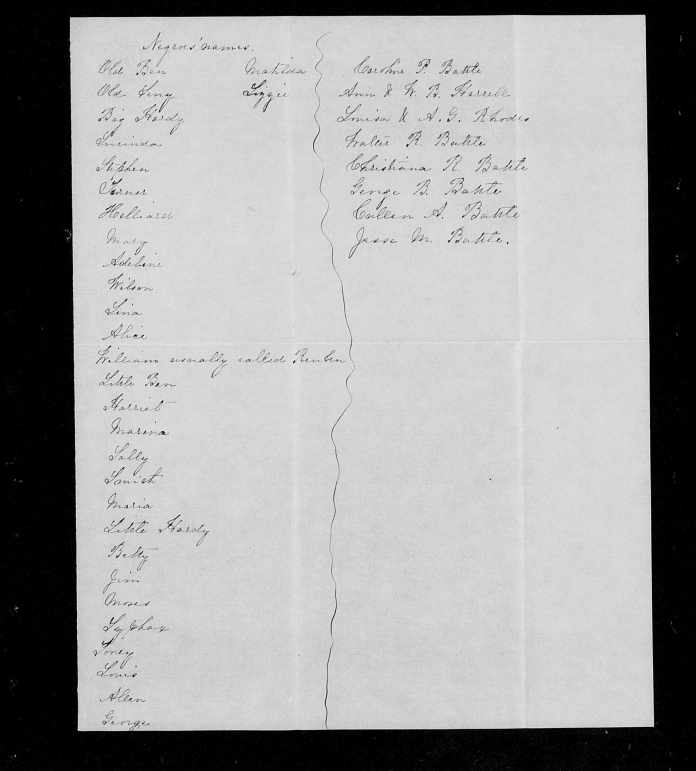
record-image-25

Old Ben, Old Seny, Big Hardy, Lucinda, Stephen, Turner, Hilliard, Mary, Adeline, William, Lena, Alice, William “usually called Reuben,” Little Ben, Harriet, Marina, Sally, Smith, Maria, Little Hardy, Betty, Jim, Moses, Syphax, Toney, Louis, Allen, George, Matilda, Lizzie. I was disappointed not to find a Cherry listed among them, but intrigued nonetheless. Would Weeks Parker’s will shed more light?

Yes. And no.

Weeks Parker executed his will on 31 July 1843. The document mentions his wife Sabra [Irwin Hearn]; son Simmons B. Parker; deceased son Dr. John H. Parker, who had migrated to Florida; and daughters Henrietta, wife of Benjamin Battle, and Margaret, wife of Amos J. Battle. [Benjamin Dossey Battle was Amos’ brother.]

Weeks designated son Simmons as his executor and trustee. He bequeathed certain slaves — Polly, Godwin, Old Ned, Winny, Hardy, Charlotte and her child Cintha, and Nelly —  to pass to Simmons after wife Sabra’s death, and mentioned that he had already given Simmons 14 slaves in a deed of gift. He also directed Simmons to sell the land and slaves in Florida inherited from son John’s estate. (And tweaked this last provision in a codicil.)

Weeks’ bequests to his daughters are curious though.  After Sabra’s death, Simmons was to hold in trust slaves Lucindy, Stephen, Turner, Lewis, George, Marina, Tony, Matilda, Caroline, William, Holly, Big Hardy, Ben, Cena, Moses, Syphax, Little Hardy, Jim, Lucy and Little Jim “for the sole and separate use and benefit of daughter Margaret H. Battle wife of Amos J. Battle during her natural life free from the management and control of her present or any future husband.”  Similarly, he directed that Simmons hold in trust after Sabra’s death slaves Barbara, Sarah, Luke, Ned, Sophia, Elick, Harrison, Milly, Jeffrey, Dorcas, Silas, Bill, Lou, Julia, Randal, Will and Abner for the benefit of daughter Henrietta Battle. Why the specific attempt to keep Amos Battle’s hands off his wife’s property? Was he in fact an abolitionist likely to try to free them? Or were Weeks’ concerns more prosaic?

Simmons and his mother went into court to have Weeks’ will admitted to probate, and the skirmishes began. The two sets of Battles teamed up to claim that they had not been notified prior to probate and that the will’s codicil had been made under undue influence. Simmons and the other trustees admitted that Battles may not have been given formal notice, but claimed that they knew anyway. They also charged Amos Battle with having taken a slave named Jim to Wilmington.  The Battles fired a second volley with a claim that Simmons was in “extreme bad health” and “great physical inability” and “utterly incapable of carrying out his duties” as a trustee. Simmons responded meekly, acknowledging that he had been shot in the chest many years before and had never recovered, a circumstance that sometimes completely debilitated him. He agreed to surrender his trusteeship. Nathan Matthewson, too, stepped down, and was replaced by Benjamin Oliver of Duplin County. In one of Oliver’s reports, he advised the court that he had sold for $600 a slave named Jim “in consequence of grossly bad behavior and general bad deportment.” The buyer was Wyatt Moye. With the funds received, Oliver then spent $500 to purchase Lilah from a Dr. Arrington. (She later gave birth to a son Charles.) In 1849, Oliver moved to Bladen County and resigned his trusteeship; Uriah Vaughan of Hertford County — where Margaret then lived — was appointed in his stead. In the mid-1850s, Margaret, Amos and their children moved to the town of Wilson, where Sabra Parker bought them a house and lot. In another plaintive petition for yet another trustee, submitted in September 1856, Margaret complained that she had no other property and that the family was “dependent on their own exertions for a support” as their trust fund was inadequate. The younger children were chiefly supported by Margaret’s “exertions” [she was an innkeeper], while the creditors of her husband Amos, “who is greatly embarrassed,” tried to take her earnings at every opportunity.

Another source shines light on the Battle family’s financial situation. In 1911, Amos and Margaret’s youngest son, Jesse Mercer Battle, published memoirs titled Tributes to my Father and Mother and Some Stories of My Life. In the chapter on his mother, he recalled that his “mother’s family lived in Wilson, N.C. We lived in a large house, and it was called ‘The Battle House.'” There, to her humiliation, his mother took in boarders and other passers-through to earn money for the family’s keep. His father, though “rich in lands and negroes,” gave away his wealth to the point that his younger sons’ educations were neglected. The chapter on Amos J. Battle goes further. Amid fifty hagiographic pages limning his father’s Christlike-ness, Jesse reveals that “his money, his lands, his negoes, his stocks, his bonds, his personal property of every description went as his free will offering to the Church as a whole, and to anyone of its members individually, or to those who were not members.” (This was not offered ironically, and there is no attempt to square Battle’s slaveholding with his Christian values.)

Ah. So. And therein lies the motive for Weeks Parker’s determined attempt to keep his wealth out of pious Amos Battle’s hands.

Jesse Battle’s memoir also provides a peek at the family’s slaves and demonstrates that the thirty or so inherited from Weeks did not define the extent of Margaret’s holdings. “Negroes were my companions,” he wrote. “I played with them, and spent my time with them all day, till I was about seven years old, when I was started to school. I knew my alphabet and how to read a little. This start on my way to an education was given to me by a good old colored woman I called Mammy. (Her name was Dinah.) … This good woman remained with our family till 1865, when the Civil War ended, when she left us and moved down to Greenville, N.C., where her husband, whose name was ‘Shade,’ lived. After the emancipation of the slaves she said that she could never enjoy her ‘freedom’ as long as she lived with her master and mistress.”  [Three cheers for Dinah!] Jesse elsewhere mentioned that Dinah had lived with the family at a farm called Walnut Hill, “about three miles from Wilson N.C., on the railroad toward Rocky Mount.”

In the end, I still don’t know if Hugh B. Johnston was correct about Cherry Battle Barnes’ ownership, but I have confirmed that Amos J. and Margaret Hearne Battle owned slaves and that some of those slaves worked on a farm just north of Wilson, not far from where Cherry lived at the time of the first post-Emancipation census.

Will Book F, Edgecombe County, North Carolina Probate Records, 1735-1970, familysearch.org; Estate of Weeks Parker (1844), Edgecombe County, North Carolina Estate Files, 1663-1979, familysearch.org; other sources as named.


Standard
Births Deaths Marriages, Enslaved People, Land, Maternal Kin, Newspaper Articles, Other Documents, Paternal Kin, Photographs, Virginia

The life of Joseph R. Holmes, radical.

I’ve written of Joseph R. Holmesdeath. What of his life? The details are sketchy and poorly documented. Nonetheless, here is what I know.

  • Joseph R. Holmes was born circa 1838, probably in Charlotte County, Virginia. His parents are listed as Payton and Nancy Holmes on his death certificate. I don’t know what the “R” stood for.
  • According to Luther Porter Jackson, Joseph had a brother named Watt. According to my great-aunt Julia Allen Holmes, he also had a brother named Jasper Holmes, born circa 1841, who was her grandfather.
  • The “Inventory and Appraisal of the Personal Estate of Capt. John H. Marshall,” filed in Charlotte in June 1857, lists 20 “Negroes,” including Joe, $600; Peyton, $900; and Nancy, $1000. There’s no Jasper. Nor are there any children bearing the names of Nancy’s younger children, some of whom who were born before 1857. Thus, though I’m tempted, I can’t draw any conclusions about whether these enslaved people are Joseph R. Holmes and his parents.
  • Joseph probably was last owned by John H. Marshall’s son, judge Hunter Holmes Marshall, whose plantation “Roxabel” was (and still is) located about five miles west of Charlotte Court House.
  • Joseph learned to read and write most likely as a child, as he exhibited a well-formed penmanship when in his mid-20s.
  • He was trained as a shoemaker or cobbler.  In Negro Office-Holders in Virginia 1865-1895, Luther Porter Jackson
    asserted that brother Watt was also a shoemaker and that Joseph was “hired out by his master to engage in shoemaking by traveling from plantation to plantation.”
  • However, according to “Shooting in Charlotte Court House,” published in volume VIII, number 2, of The Southsider quarterly, Joseph served as a butler for Marshall, then became a cobbler and opened a shop on the Kings Highway (now U.S. Route 360) near Dupree’s old store.
  • Some time around 1865, Joseph married Mary Clark, born about 1849 to Simon and Jina Clark of Charlotte County. The couple had at least four children: Payton (1865), Louisa (1866), Joseph (1867) and William H. Holmes (August 1868).
  • Tax records filed in Charlotte Court House for 1866 list Joseph R. Holmes in District #2 (T.M. Jones, revenue commissioner), paying one black poll tax, as well as taxes on four hogs valued at $5 and $20 worth of real property. I have not found a deed for this property.
  • In 1867, Joseph R. Holmes was elected to represent Charlotte and Halifax Counties at Virginia’s Constitutional Convention. In A List of the Officers and Members of the Virginia Constitutional Convention, Holmes is
    described:  “… Jos. R. Holmes. Colored. Shoemaker. Can read and write a little. Ignorant. Bad character.” [This comes from an unfortunately unattributed photocopy of a page from a scholarly journal. I’ll hunt down the source.]
  • Charlotte County tax records for 1867 show Joseph R. Holmes living at A.J. Johnson’s in District #2, paying only a black poll tax. (This seems to indicate that he was landless and working as either a sharecropper or tenant farmer.)
  • In 1867, he registered to vote at Clements’ in Charlotte Court House. (So did Watt Carter, who may have been Joseph’s stepfather.)
  • On 2 May 1868, Joseph Holmes purchased 11 1/2 acres in Charlotte County from A.J. Johnson for $92. The metes and bounds: “beginning at a corner on John R. Baileys on the Roanoke Valley Extension Rail Road marked as the plat (A) and thence along the Road South 15 W 22 poles to a corner at B. thence off the Road a New line S 70 E 17 poles to corner chestnut oak S 25 E 46 poles to pointers on John P. Dickersons line, thence his line N 55 E 44 poles to pointers on William H. Fulkers line thence N 57 W 80 poles to the beginning.”
  • An entry for August 1868 in the Charlotte County birth register shows a son William H. born to Mary and Joe Holmes. Joe’s occupation was listed as “radicalism.”
  • A letter Joseph wrote on 22 August 1868 is preserved among Freedmen’s Bureau records. In it, he requested of Thomas Leahey, Assistant Subassistant Commissioner at the Bureau’s office in Farmville, Virginia, that a school be established in the Keysville area. The plea was effective, and there’s a 24 November letter in the records from Leahey to Holmes enclosing vouchers for rent for the school, as well as triplicate leases for “Mrs. Jenkins'” signature. “I send them in your charge (believing you call to the D.O. daily) in order there may be no delay.”
  • An anonymous article in the 23 November 1868 Richmond Whig, signed “Roanoke,” reported a visit to Charlotte County and, among comments about African-Americans and politics, stated: “They seem to be realizing the fact that politics won’t fill their empty stomachs nor clothe their naked bodies, and those who have been idle during the summer and did not make hay while the sun shone, meet with no sympathy and are left out ‘in the cold.’ I passed by the shop of our former representative, ‘Hon.’ Joseph Holmes, a few days ago; he was busily at work pegging away at a pair of boots. I told him I thought he was much better at making a boot than a constitution; and as he was anxious to make a pair for me, I believe, he agreed with me.”
  • On 3 May 1869, Joseph was shot and killed in front of Charlotte County Courthouse by a group of men that included John M. Marshall, Griffin S. Marshall, William Boyd and M.C. Morris. The Marshalls were sons of his former master.
  • In the 1870 census of Walton, Charlotte County: Wat Carter, 70, wife Nancy, 70, and children Mary, 23, Liza, 17, and Wat, 16; plus Payton, 4, Louisa, 3, and Joseph Homes, 2, and Fannie Clark, 60. I strongly suspect that Nancy Carter was Joseph Holmes’ mother and Wat, his stepfather. The young children are clearly Joseph’s. Mary may have been his half-sister, but more likely was his widow.) The younger Wat is likely the “Watt” referred to L.P. Jackson’s book.
  • Joseph Holmes, age 12, son of Joe and Mary Holmes, died 11 March 1880 in Charlotte County.
  • H.C. Williamson’s Memoirs of a Statesman: Being an Account of the Events in the Career of a Mississippi Journalist-Legislator were published by descendant Fred Thompson (actor and failed Republican presidential candidate) in 1964. In reminiscing about his youth, Williamson wrote: “Among the bolder of this presumptuous class of Negroes in my native county was one named Joe Holmes, a saddle-colored shoe cobbler, who occupied a small hut on the side of the public road a few miles from our home. Holmes aspired to the office of representative in the State Legislature and insolently asserted his equality ‘with any white man.’ Feeling that he was protected in his new-found rights by his white allies, he denounced, in public harangues throughout the county, the men who had so lately been the masters and believed themselves secure in control of that government which they had constructed and hitherto maintained. Such a condition prevailing over all the Southern States prompted the organization and active operations of that secret society of native, white southern men known as the Ku Klux Klan, which proved to be the salvation of the remnant left of southern homes and southern civilization. I remember passing Holmes’ shop one dae day and seeing nailed to the door the picture of crossbones and skull (the sign of the Ku Klux Klan, as I afterwards learned). But this did not deter him in the least. A short time thereafter, he fell in the Court House door, pierced with a leaden messenger of death from an unknown source, as he was entering to make an inflammatory speech to a horde of Negroes assembled.”

Birth, death, marriage and court records at Charlotte County Courthouse, Charlotte Court House, Virginia; other records as noted. Thanks, as always, for the incalculably valuable assistance of Kathy Liston.

Standard