Newspaper Articles, Paternal Kin

A con man is back.

I was gobsmacked. My grandmother had a brother? A brother more than 40 years her junior? This is what my cousin’s former wife told me:

[In 2012,] a man called (and for the life of me I cannot find the slip of paper on which I wrote his name and phone number) and stated that he was the illegitimate child of Thomas Aldrich. He was trying to find out information about his family and for some reason he found me because of [my husband.] He was born in 1954 to Thomas. His mother was a young, Jewish nurse at the hospital in which Thomas practiced. Thomas was very generous and left a trust fund for his son. Therefore, when he was murdered, his son was provided for. His son currently owns 5 hotels around the country, one in Chicago, one in Los Angeles, but I cannot remember the others.

A welter of emotions overtook me. Wow. A long-lost great-uncle. A couple of times over the next eighteen months, I reached out to W. to prod her memory. In the meantime, I waited and hoped that Tom’s son would find me. Any Google search of my great-grandfather’s name will quickly link to me and my blogs, so I believed that there was a decent chance I’d hear from him. A couple of weeks ago, W. told me she’d remembered that the man’s name was Malcolm, but still could not recall more. The information was too thin for me to formulate a good search query, so I continued to wait.

And then, this week, W. emailed to say that she’d suddenly remembered this man’s last name, had looked him up, and had been stunned at what she found. There was a photo, which did not seem to match the “nearly white” appearance he’d ascribed to himself. (Did the segregated Homer G. Phillips Hospital even have white nurses?) But the clincher: Malcolm Aldrich, alias Malcolm Couch, alias a hundred other names and Social Security numbers, is a convicted felon many times over, a defendant in dozens of lawsuits, a specialist in real estate scams and schemes and general fraud. While I was waiting for a hit on my blog, Saint Louis television statement KVOM was reporting this scandalous news. And then this. Lord. And see this from 2009.

Well, damn.

It is certainly possible that Malcolm Aldrich, or Couch, or whatever, is both the son of James Thomas Aldrich [Aldridge] and a shady slickster. Either way, I’m keeping my distance.

Standard
Newspaper Articles, North Carolina, Paternal Kin

A splendid witness.

On 21 February 1903, pedestrians bustling about the streets of downtown Raleigh on a waning Saturday afternoon gazed in horror at a bleeding body crumpled in the middle of Fayetteville Street. Ernest Haywood, son of a prominent lawyer, had shot Ludlow Skinner, son of a well-known Baptist minister and “quiet and gentle as a woman,” in cold blood. (For the messy backstory, see here.) The crime, widely reported in newspapers across the state, captivated the public. Ned Barnes (1869-1912), son of Willis and Cherry Battle Barnes and brother of my great-grandmother Rachel B. Taylor, found himself thrust into the center of the months-long criminal court proceedings as the State’s star witness.

Only recently arrived in the capital, Ned was a drayman for the State Hospital, a ground-breaking psychiatric facility located just west of the city center. His duties that afternoon took him to the post office — and the very edge of the drama. Despite his evident efforts to stay out of white men’s business, he was drawn straight into the vortex.

Page_9

Sanborn Map of Raleigh, July 1903. The Post Office is the large blue building at lower right.

On 30 May 1903, the Raleigh Morning Post published Ned’s habeas corpus hearing testimony in its entirety. This serious matter required that the paper forgo the mocking dialect so often attributed to African-Americans of the era — regardless of their actual speech — and the transcript reveals an ideal witness,  straightforward, economical, willing to admit what he did not see. Ned’s language is respectful, but not obsequious. He does not take obsessive care with his “yes, sir” and “no, sir.” He answers only the question put before him and takes pains to deliver accuracy.

——

Evidence of Ned Barnes

“Examination of Ned Barnes by counsel for the defense:

Q: Ned, where did you live before you came to Raleigh?

A: Wilson, N.C.

Q: How long have you been in Raleigh?

A: About two years and a half.

Q: What is your business now?

A: Driving for the state hospital.

Q: Have you been in the employment of this institution since you came to Raleigh?

A: Yes, sir.

Q: Where were you on the afternoon of the difficulty between Messrs. Haywood and Skinner?

A: I was in the city here.

Q: Did you see it?

A: Yes sir.

Q: Tell about it in your own way. What you saw.

A: I had been up to the market taking some ladies to the market house and about four o’clock I started down to the post office to wait for the mail before going back. I drove down below the south end of the post office and turned my horse around. I placed the robe on this side and heard some one speak. I stood my carriage just above the north side of the steps near to the curbing. I saw Mr. Skinner strike Mr. Haywood on the right side of the face.

Q: How far away were you from them, just the width of the curbing?

A: Yes sir, right by the edge of the sidewalk, about 12 or 15 steps I reckon.

Q: Do you mean steps?

A: Yes sir, steps. It is wide across there.

Q: You mean just the width of the sidewalk from the little projection?

A: Yes sir.

Q: Did you hear what was said when you turned your carriage there?

A: No sir.

Q: Just as you turned your head you saw the blow?

A: Yes sir.

Q: What became of Mr. Haywood when stricken that way?

A: He staggered back against the curb which leads out from the post office and fell on his left hand, but recovered and went for his pistol and Mr. Skinner jumped back from him and raised his right hand in this position, and stopped and Mr. Haywood raised up and fired at him and Mr. Skinner wheeled and I never saw him any more.

Q: Was Mr. Skinner’s back to you on his side after he struck Mr. Haywood?

A: He seemed sideways to me.

Q: Which side was to you?

A: His right side was to me I think.

Q: Which side was towards Mr. Haywood?

A: His left side.

Q: You saw his left hand?

A: No sir, his right hand.

Q: He struck so that Mr. Haywood fell?

A: Yes sir.

Q: Did he raise his hand?

A: Yes sir.

Q: In that position Mr. Haywood fired the first shot?

A: Yes sir.

Q: He was standing this way?

A: Yes sir.

Q: How far away was Mr. Skinner from him when he fired the first shot?

A: About half way across the sidewalk.

Q: What did Mr. Skinner do when the first shot was fired?

A: He wheeled to go.

Q: Which way?

A: He wheeled this way and turned to go.

Q: After he turned to go what did he do, continue or stop?

A: I don’t know whether he stopped or not. I did not see him until I looked on my right hand side.

Q: You stayed in the carriage?

A: Yes sir.

Q: Why did you not see him after he turned to go?

A: He got behind my carriage.

Q: Which way was your horse’s face turned?

A: North towards the capitol.

Q: You say Mr. Skinner went behind your carriage?

A: Yes sir.

Q: Did you turn the carriage?

A: Yes.

Q: Where was he then?

A: He was in front of me going to the street car track.

Q: What did he do when the second shot was fired?

A: I did not see him, I was looking at Mr. Haywood.

Q: Was he off the sidewalk when the second shot was fired?

A: I don’t know I was looking at the man that had the pistol.

Q: Was it after the first or second shot that Mr. Skinner turned to go?

A: After the second shot.

Q: How far from the curbing was he?

A: About half way distant.

Q: That was after the second shot?

A: Yes sir.

Q: What part of him was at that time presented to Mr. Haywood?

A: His back was to him.

Q: After he got into the street?

A: Yes sir.

Q: Did you look at Mr. Skinner after he got into the street until he fell?

A: Yes sir.

Q: How did he go?

A: He crossed over the track then turned to his left and got to the low edge of the track and fell face first to the pavement.

Q: What became of Mr. Haywood?

A: He walked off the corner going to the Tucker building.

Q: Did you notice whether Mr. Haywood had his hat on?

A: He had it on when he passed from the sidewalk.

Q: At the time of the shooting, did he have it on then?

A: Yes sir, he got it on then.

Q: What do you mean by that, he got it on then?

A: It was knocked pretty near off and he gathered it up.

Q: Did you tell anybody about this occurrence?

A: No sir.

Q: How long was it before you told about it?

A: I did not make any atatement till I got to the asylum. Then I told Dr. Koy.

Q: Do you remember what you told him?

A: I told him I saw Mr. Skinner strike Mr. Haywood and I saw Mr. Haywood shoot him, and he didn’t ask me anything else.

Q: Did you tell any one else in town?

A: I told some one else, I don’t know who – this feller that runs the bar room, what is his name?

Q: Which bar do you mean?

A: Hamlet’s.

Q: You have told him since?

A: Yes sir, I told him.

Q: You did not tell him all the facts?

A: And I told another man, I don’t know who it is. I have seen him here.

Q: Was it Mr. Rogers?

A: No sir, it was a white man.

Q: What white man did you tell in town?

A: I don’t know his name, McDaniels or McDonald, I think.

Q: Where does he live?

A: Here in Raleigh.

Q: What is his business?

A: I don’t know, I see him around the Tucker building.

Q: Did you tell him you saw it?

A: He asked me what did you see, and I told him I did not care to make a statement. He said, “did you see Haywood shoot,” and I told him yes. I did not tell him anything else.

Q: Which Rogers did you tell?

A: He works in the Commercial building.

Q: What sort of a carriage did you have?

A: It was not exactly a carriage but was a one horse surrey.

Q: Did it have curtains on.

A: It had black curtains on.

Q: Were the side curtains off?

A: Yes sir.

Q: It was open except the back.

A: The front curtain was off I mean.

Q: It had the back curtain on.

A: The back curtain and the two back curtains.

Q: Just the width of the seat was closed?

A: Yes sir.

Q: All the others were open?

A: Yes sir.

Cross-examined by counsel for state:

Q: Where did your carriage enter Fayetteville street?

A: I came from the market to the post office.

Q: There you turned around?

A: Yes sir.

Q: How far did you come up the street before turning around?

A: Just to the end of the post office, up near the sidewalk, near the south steps.

Q: Did you turn your surrey towards the door of the court house?

A: Yes sir.

Q: Your horse’s head was where?

A: Towards the capitol.

Q: Where did you stop your horse?

A: Right there where I was.

Q: And where were you?

A: Sitting in the carriage.

Q: And where was the carriage?

A: Standing on the street.

Q: Near what part of the sidewalk?

A: Right at the edge of the sidewalk.

Q: Where was the location? Where was the horse standing?

A: Pretty near the post office building.

Q: Pretty near the front?

A: Yes sir.

Q: Near what part of the front?

A: The lower end of the south door.

Q: Where was the head of your horse?

A: Just above the lower steps of the post office.

Q: Just above the south steps?

A: Yes sir.

Q: So you had your back to the post office?

A: Yes sir.

Q: What first attracted your attention there?

A: I heard some one speak.

Q: Whom did you hear speak?

A: I don’t know which one, one of these men, I don’t know which one.

Q: Did you know Mr. Skinner?

A: I did not know him sir.

Q: Did you see him pass out of the post office building by your carriage?

A: No sir.

The following witnesses were called to prove the character of Ned Barnes, to-wit: R.G. Briggs, a manufacturer of Wilson [Ned had worked for him as a coachman]; F.W. Barnes, of Wilson; F.A. Woodard, of Wilson, former Congressman from that district; Walter Woodard, tobacco manufacturer of Wilson; Geo. D. Green, hardware merchant of Wilson; W.R. Crawford, steward of State Hospital, Raleigh.”

Three days later, in its summary of the proceedings, the Raleigh Farmer and Mechanic opined that Ned Barnes “made a splendid witness, and is an honest looking colored man, with a good face. The impression he made was excellent.”

——

The trial in State vs. Haywood unfolded in early fall. The first two weeks of October, crowds thronged the courthouse, the newspapermen among them jostling for prime spots to cover the action. Ned Barnes and other reprised their roles as witnesses, and a surprising verdict was rendered: Not Guilty.
BARNES -- Ned Barnes I

Ned Barnes, circa 1900.

No doubt relieved to move out of the glare of the spotlights trained on this notorious event, Ned returned to real life — his wife Louisa Gay Barnes; young children, Mattie (1895), Alice (1897), Ned Jr. (1900) and Howard (1902), and later Blonnie (1908) and Jerrel (1909); and work as a coachman. By 1910, however, he had given up driving, and the censustaker recorded his occupation as a porter at a club. Though a relatively young man, it is likely that his health had already begun to fail him. On the first day of December 1912, Ned Barnes drew a last breath and was released from the agony of acute uremia. He was 42 years old.

Photo courtesy of Katie C. Barnes.

Standard
Enslaved People, North Carolina, Paternal Kin

My Barneses.

Last night, I happened upon a fascinating newspaper source of information about Ned Barnes, brother (half-brother?) of my paternal great-grandmother, Rachel Barnes (or Battle) Taylor. Before I lay it out, though, a deeper introduction to the Barneses is in order.*

Willis Barnes and Cherry Battle registered their six-year cohabitation in Wilson County in 1866. The 1870 census found the family in Wilson township, Wilson County: farm laborer Willis Barnes, 30, wife Cherry, 25, and children Rachul, 7, West, 5, Jesse, 2, and Ned, 5 months. They remained in North Wilson township in the 1880 census: Willis Barnes, 42, wife Cherey, 40, “step-daughter” Rachel Battle, 17, Wesley, 15, Jesse, 13, Ned, 11, Eddie, 7, Mary, 4, and Willey Barnes, 1, plus niece Ellen Battle, 1.  [Very nearby were Hardy Battle, 58, and wife America Battle, 50. Relatives of Cherry?]

Cherry Battle Barnes died after 1880. In 1897, Willis married Fereby Barnes Artis, widow of Benjamin Artis. In the Wilson NC city directory of 1908-09, Willis is listed as a laborer living at 500 South Lodge. Two years later, he was living with his youngest daughter and her family. Willis Barnes died 15 September 1914 in Wilson, Wilson County. His death certificate notes that he was 73 years old, married and a farmer, and that he had been born in Nash County to Tony Eatman and Annie Eatman. Son Jesse Barnes was informant.

On 21 Sep 1882, H.G. Whitehead applied for a marriage license for Mike Taylor of Wilson, aged 20, colored, son of John [sic, his name was Green] Taylor and unknown mother, both living. [This makes no sense — mother is living, but unknown?] and Rachel Barnes of Wilson, age 19, colored, parents unknown, father dead, mother’s status not given. [No sense either, her parents were certainly known. The takeaway — the registrar was not very interested in the facts.]  On the same day, Louis Croom, Baptist minister, married Taylor and Barnes in Wilson before W.T. Battle and Edman Pool.  [Was W.T. Battle related to Rachel?  Is he the W. Turner Battle who married Louvina Knight in Wilson on 24 May 1875?]

Rachel and Mike Taylor had six children. Their first, and only son, Roderick, was born in 1883, followed by the improbably named Maggie (1885), Mattie (1887), and Madie (1888), then Bertha E. (1892) and Henrietta G. Taylor (1893). More about Rachel’s family elsewhere.

Wesley “West” Barnes married Ella Mercer on 4 June 1885 at her father Dempsey Mercer’s house in Wilson County. (The marriage license refers to him as “Sylvester” Barnes.) Wesley worked as a driver or drayman, and though he and Ella had at least seven children, I know the names only of five: Joseph Barnes (1885), Lucy Barnes Watson (1889-1959), Sylvester Barnes (1893-1936), Viola Barnes (1894-1943), and Charley Barnes (1896-??) West died of apoplexy in 1919.

Jesse Barnes married Ella Mercer’s sister Mary Mag Mercer on 1 April 1889. His brothers Wesley and Ned witnessed the ceremony. They had at least three children, Jesse Jr. (1890), Marnie (1892-1943), and Nettie (1895-1917). He died in 1916.

On 27 Oct 1891, J.T. Dean applied for a marriage license for Edward Barnes, 22, of Wilson, son of Willis and Cherry Barnes, and Louisa Gay, daughter of Samuel and Alice Gay.  The ceremony took place 29 Oct 1891 before J.W. Levy, AMEZ Church minister, at Samuel Gay’s.  Witnesses were S.H. Vick, Spencer Barnes, Thomas Davis. [This “Edward” is very definitely Ned Barnes, but the entry is confusing because the 1880 census shows Willis and Cherry with children Ned and Eddie (born about 1873). If there was an “Eddie,” he appears in no other records.] Ned worked as a coachman and around 1901 moved his family to Raleigh for better opportunities. Ned and Louisa Gay Barnes’ children included Mattie Radcliffe Barnes Hines (1895-1923), Alice Ida Barnes (1897-1969), Ned Barnes Jr. (1900), Howard Barnes (1902), Blonnie Barnes Zachary (1908-1932) and Jerrel Randolph Barnes (1909-1929). Ned died in Raleigh in 1912.

Mary Barnes is an enigmatic figure. She married first in Wilson County in 1893 to Pierce Barnes, son of Robert and Hannah Barnes, and then a man named Jones. She never had children of her own, but adopted her nephew, Robert Perry. She died almost 11 months to the day after her brother Wesley in 1919.

William “Willie” Barnes died of tuberculosis in 1917. It is not clear if he ever married or had children.

As detailed here, I believe Cherry Battle had one more child, daughter Lucinda “Cintha” Barnes. Cintha also died young, and her children were reared by her sisters.

 *Barnes is by far the most common surname in Wilson County. My cousin A.B. is descended from at least four separate Barnes lines, and any two given Barneses are more likely to be unrelated than not.

Standard
North Carolina, Paternal Kin, Photographs

A photo.

A nice surprise came in yesterday’s mail — a copy of another photo of Aint Nina Faison Kornegay Hardy, courtesy of J.M.B. A handwritten note on its back identifies the two boys leaning into her and the date, 18 September 1939 — 75 years ago today.

N_Aldridge_Hardy

Here you can clearly see her right leg and ankle swollen over the sides of her shoes, evidence of the chronic pain and debility she suffered. Lymphedema, perhaps. Or maybe chronic venous insufficiency. Conditions difficult to treat even now, and then impossible. Always, though, that sweet smile.

Standard
Education, Other Documents, Paternal Kin, Photographs

B.S. Civil Engineering.

Oscar Randall, son of George and Frances “Fannie” Aldridge Randall, appeared in The Crisis‘ annual round-up of recent college graduates.

Pages from The Crisis Volume 20 no 3 O Randall

“Civil Engineer, Oscar Randall, whose scholastic average is 87% for the 4 year term,” p. 140.

Allison, M.G., “The Year in Negro Education,” The Crisis, July 1920, volume 20, number 3.

Standard
Civil War, Free People of Color, Military, North Carolina, Other Documents, Paternal Kin

Daniel Artis, Union soldier?

Daniel Artis’ pension file arrived today, and I was puzzled. Was this either of “my” Daniels?

As detailed here, Daniel Artis, allegedly went to war as a body servant for Confederate officer Christopher C. Lane. There are two Daniel Artises. One was born about 1820 and would have been well into middle age when he trudged off to battle. On the other hand, his nephew Daniel Artis, Sylvania’s son, was born about 1843, and was in his prime when the Civil War erupted.

What does the file tell us? It’s a slim one, as pension application files go. Daniel’s request for assistance was rejected summarily, so there was no need to interview his neighbors and kin to corroborate his claims. Still, it is useful.

On 2 December 1901, the Board of Review received an application from DANIEL ARTIES, G 14 USCHA, and assigned it claim number 1277226. Milo B. Stevens & Company of Washington, D.C., a firm of attorneys specializing in pension claims, represented the old soldier. Daniel gave his address as P.O. Box 5, Greenville, Pitt Co., NC, and stated that he had enrolled in the Army in an unknown date in 1865 and been discharged on 11 December of the same year. Despite the Pitt County address, Artis granted Stevens power of attorney on a form sworn to in Wayne County — specifically, Eureka — in the presence of W.M. Exum and Philip Forte. I’m not clear on Exum’s identity, but Forte was a prominent African-American in the neighbor and himself a Union veteran.  Further, Forte’s daughter Hannah married Daniel’s cousin Walter S. Artis, son of Adam and Frances Seaberry Artis. Simon S. Strother, the notary public who stamped Daniel’s application, was executor of Adam T. Artis’ estate.) At some point, a commissioner requested “personal description and name of owner” from Artis, but the response — which would have included an assertion of his freeborn status — is not found.

IMG_7141

Daniel’s supporting declaration for invalid pension stated that he was 68 years old, that he had been discharged at Fort Macon, and that he was unable to support himself by manual labor due to “rheumatism in back and hip and piles and affected in the breast.” Daniel signed the document with an X.

And then the downer: “Rejection on the ground that the soldiers name is not borne on the rolls of Co G, 14th U.S.Col.H.A., as alleged, as shown by the report from the War Department.”

IMG_7165

So, which Daniel is this? Several clues help eliminate Daniel the elder. First, he was born circa 1820, well before Daniel the applicant. Second, Daniel the elder owned significant property in Greene County and is not known to have lived in either Wayne or Pitt Counties. Last, and this applies to either, if Daniel served Christopher C. Lane during his time as an officer in Company A, 3rd North Carolina Artillery from about 1861 till his death in 1864, is it likely that he would have trudged home from Georgia, turned around, gone to New Bern, and enlisted in the Colored Troops in 1865?

My money is on Daniel, son of Sylvania Artis and Guy Lane. Here’s the little I know about him:

In the 1850 census of Greene County, next to white farmer John Lane, Silvany Artess is listed with her children Daniel, Mitchell, Meriah, Gui, and Penny Artess. Ten years later, John Lane’s household included Dannel, Mike, Penney, Dyner, Juley, and Washington Artis, who probably were his apprentices.  Next door was 40 year-old Dannel Artis, the children’s uncle.  On the other side, their mother Sylvania Artis.

Around 1861, Daniel went to war with John Lane’s son Christopher and returned home in 1864.  Surely it is he, and not his 45 year-old uncle Daniel, that enlisted in the Union Army in 1865. His service was short-lived, and he apparently returned to Greene County after.

Guy Lane and Sylvania Artis formalized their marriage a year after he was emancipated, and by 1870 the family had moved several miles west into Nahunta district, Wayne County. There, Guy Lane and wife Silvania are shown in the census with children Daniel, Mike [Mitchell], Mariah, Guy, Penny, Dinah, Julie, Washington, and Alford.

In the 1880 census in Bull Doze [Bull Head] township, Greene County, Daniel Artis appears with his wife Eliza and children Emma D. and James W. I cannot find him in any census thereafter. However, if he is the Daniel Artis who applied for a Civil War pension, he was living in Wayne or Pitt County from 1900 until at least 1904. The notice below also seems to indicate that he was alive as late as 1905, when Dunk Lane and “Miss Dickerson” used his house as a place of assignation. This is the last evidence I have of Daniel Artis’ life.

Gboro_Weekly_Argus_8_1_1907 D Artis

Goldsboro Weekly Argus, 1 August 1907.

Standard
Births Deaths Marriages, Education, Migration, Newspaper Articles, North Carolina, Other Documents, Paternal Kin

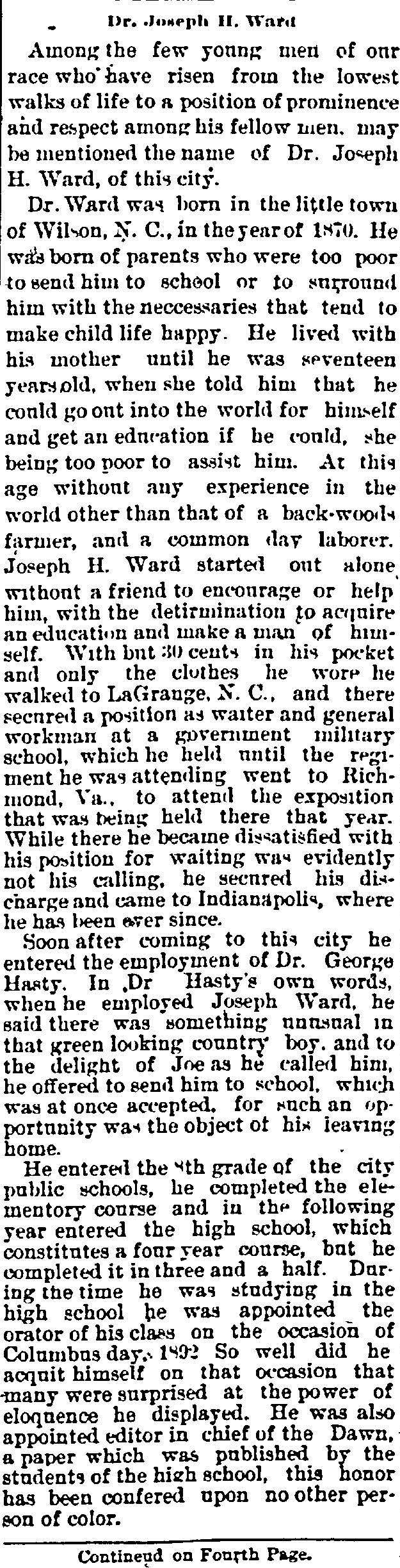
The rise of the Grand Chancellor; or “There was something unusual in that green looking country boy.”

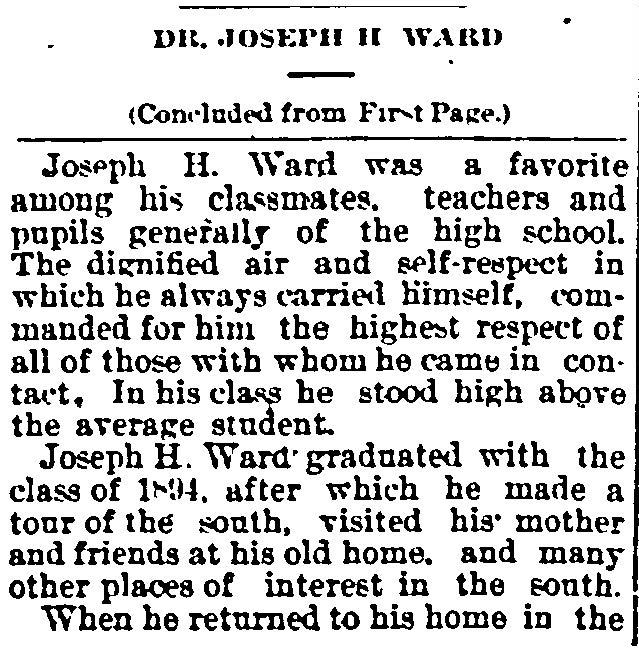
In which the Indianapolis Freeman enlightens us regarding Joseph H. Ward‘s journey from Wilson, North Carolina, to Naptown:

Joseph H Ward Grand Chancellor Ind Freeman 7 22 1899

Joseph Ward early years 7 22 1899 Ind Freeman_Page_1

Joseph Ward early years 7 22 1899 Ind Freeman_Page_2

Joseph Ward early years 7 22 1899 Ind Freeman_Page_3

Indianapolis Freeman, 22 July 1899.

A few notes:

  • Joseph Ward’s mother might have been too poor to send him to school, but his father Napoleon Hagans, had he chosen to acknowledge him, certainly could have, as he sent his “legitimate” sons to Howard University.
  • The school in LaGrange at which he worked was most likely Davis Military Academy:  “By 1880 a second school for boys … Davis Military Academy, was founded by Colonel Adam C. Davis. “School Town” became La Grange’s nickname as the military school would eventually have an enrollment of 300 students from every state and even some foreign countries. The school also had a band, the only cadet orchestra in the country during that time. The school prospered, but an outbreak of meningitis closed it in 1889.”
  • Dr. George Hasty was a founder of the Physio-Medical College of Indianapolis, which Joseph Ward later attended.
  • Joseph graduated from High School No. 1, later known as Shortridge, an integrated institution.
  • A “tour of the south”? Really?
  • Do student records exist from the Physio-Medical College? The school closed in 1909.
  • Joseph’s first wife was Mamie I. Brown, an Indiana-born teacher. The 20 October 1900 issue of the Indianapolis Recorder reported: “Mrs. Mamie Ward, through her attorney O.V. Royal, was granted a divorce from her husband, Dr. J.H. Ward, in the Superior Court no. 1, and her maiden name was restored. Both parties are well known in society circles.” Four years later, Joseph married Zella Locklear.
Standard
Education, Maternal Kin, Paternal Kin

Higher learning.

A running list of pioneers in education among my maternal and paternal kin.

Cain D. Sauls, Tuskegee Institute?

Henry E. Hagans, Howard University, prep.; Shaw University, BA 1890.

William S. Hagans, Howard University, prep. 1889; college division, 1893; BA, law department, 1898.

Julia B. Morton Hagans, Howard University, Normal School, 1888.

Mack D. Coley, Hampton Institute, prep. 1890; Lincoln University, BA 1895.

Joseph H. Ward, Physico-Medical College, MD 1897; Indiana Medical College, MD 1900.

Vera L. Baker Holt, Scotia Seminary; Freedmen’s Hospital Training School, 1902.

Diana A. Adams Artis, Saint Agnes Hospital Training School, circa 1913.

Golar Colvert Bradshaw, Saint Augustine’s School, prep., circa 1913.

Harriet Colvert, Saint Agnes Hospital Training School; Good Samaritan Hospital Nursing School, 1915.

J. Thomas Aldridge [Aldrich], Shaw University, prep., BS ’17; Meharry Medical College, MD ’20.

Benjamin A. Harris Sr., Tuskegee Institute ’17.

Worth A. Williams, Biddle University [Johnson C. Smith University], prep., BS ’17; Howard University Dental College, ’21.

Hugh Jennings Williams, Biddle University, prep. (died 1913).

Oscar Randall, University of Illinois, BS Civil Engineering ’20.

Marion Allen Lomans, Saint Pauls College?

Arnetta Randall, Howard University, BA ’25.

Mary Louise Colvert Renwick.

Lena P. Jeffress Allen, Hampton Institute, prep., Ed. ’28; Virginia Union University.

Charles C. Coley, Howard University, BS ’30.

J. Maxwell Allen, Virginia Theological Seminary & College, BA; Howard University Dental College, ’34.

Margaret Colvert Allen, Hampton Institute, prep. ’30; Winston-Salem Teacher’s College, ’31.

John C. Allen Jr., Hampton Institute ’30.

Erskine G. Roberts, Northeastern University, Massachusetts Institute of Technology, BS, MS ’32.

Mary Roena Ward Roberts, Tuskegee Institute; University of Denver, BA ’34.

Irvin L. McCaine, Howard University, BS ’34; DDS, ’38?

William N. Hagans, Howard University; Virginia State College, BA ’35.

Frances McCampbell Hagans, Virginia State College, BA ’35.

Frances Sykes Goodman, Bennett College, BA ’35.

Leon M. Braswell Sr., Lincoln University, BS; Meharry Medical College, MD ’36.

Nita Allen Meyers Wilkerson, Hampton Institute, Nursing School, 1930s.

Leroy T. Barnes, University of Pennsylvania, BS ’39, MD ’43.

Frederick R. Randall, Howard University, BS ’42; Howard University Medical School, MD, 1940s.

Leland Newsome, Johnson C. Smith University, BA 1940s.

Azzalee Mallette Hines, Fayetteville State Teachers College, 1944.

Eugene Derricotte, University of Michigan, BS ’48.

Standard
Education, Maternal Kin, Paternal Kin, Vocation

Registered nurses.

Many thanks to Renate Yarborough Sanders for bringing to my attention to “Early African American Registered Nurses in NC,” http://nursinghistory.appstate.edu/biographies/african-american-registered-nurses-nc-1903-1935. The page lists all known African-American nurses in the state, including my grandmother’s paternal aunt Henrietta Colvert and three other relatives.

The number presumably refers to the nurse’s license and the date to the date she was certified or registered. Henrietta Colvert was from Statesville, not Wilson, but moved to that eastern town by the early 1920s. I knew she trained at Saint Agnes, but was not aware that she also trained at Good Samaritan, a large African-American hospital in Charlotte.

#7794. Diana Ada Adams Artis. Wilson NC. October 13. Saint Agnes Hospital. 1926.

Diana Adams Artis was born in 1891 in Brooks County, Georgia. She married Columbus E. Artis, son of Adam T. and Amanda Aldridge Artis in 1914 in Washington DC, but later settled in Wilson. I assume that she worked at Mercy Hospital.

#7123. Henrietta Colvert. Wilson NC. April 15. Good Samaritan. 1925.

#11,104. Gwendolyn Sykes. Goldsboro NC. October 26. Lincoln Hospital. 1931.

Gwendolyn Sykes Carney, born 1909 in Goldsboro, North Carolina, was the daughter of William O’Berry Sykes and step-daughter of Gertrude Wynn Sykes.

Vera L. Baker. Graduate 1902, Freedmen’s Hospital, Washington DC. State Hospital, Goldsboro.

Vera L. Baker Holt, born 1879 in Dudley, North Carolina, was the daughter of John F. and Mary Ann Aldridge Baker.


Standard