
I wasn’t sure how I was going to get at it. GPS coordinates and satellite views showed the cemetery way back from the road on private property, without even a path to get to it. I took a chance, though, and pulled up in the driveway of the house closest to it. A wary, middle-aged white woman was settling an elderly woman into a car as I stepped out. I introduced myself and told her what I was looking for. “Goodness,” she said. “I remember a graveyard back up in the woods when I was child. You should ask my cousin J.”
Following her directions, I knocked on the house of a door perhaps a quarter-mile down Turner Swamp Road. J.S. answered with a quizzical, but friendly, greeting, and I repeated my quest. Minutes later, I was sitting in J.’s back room, waiting for him to change shoes and look for me some gloves and find the keys to his golf cart. We bounced along a farm path for several hundred yards, then followed the edge of the woods along a fallow field. Along the way, J. told me about his family’s long history on the land, and the small house and office, still standing, in which his forebears’ had lived. As we approached the final stretch, he cautioned me about the briers that we were going to have to fight through and pulled out some hand loppers to ease our path. The cemetery, he said, was there — in that bit of woods bulging out into the plowed-under field.

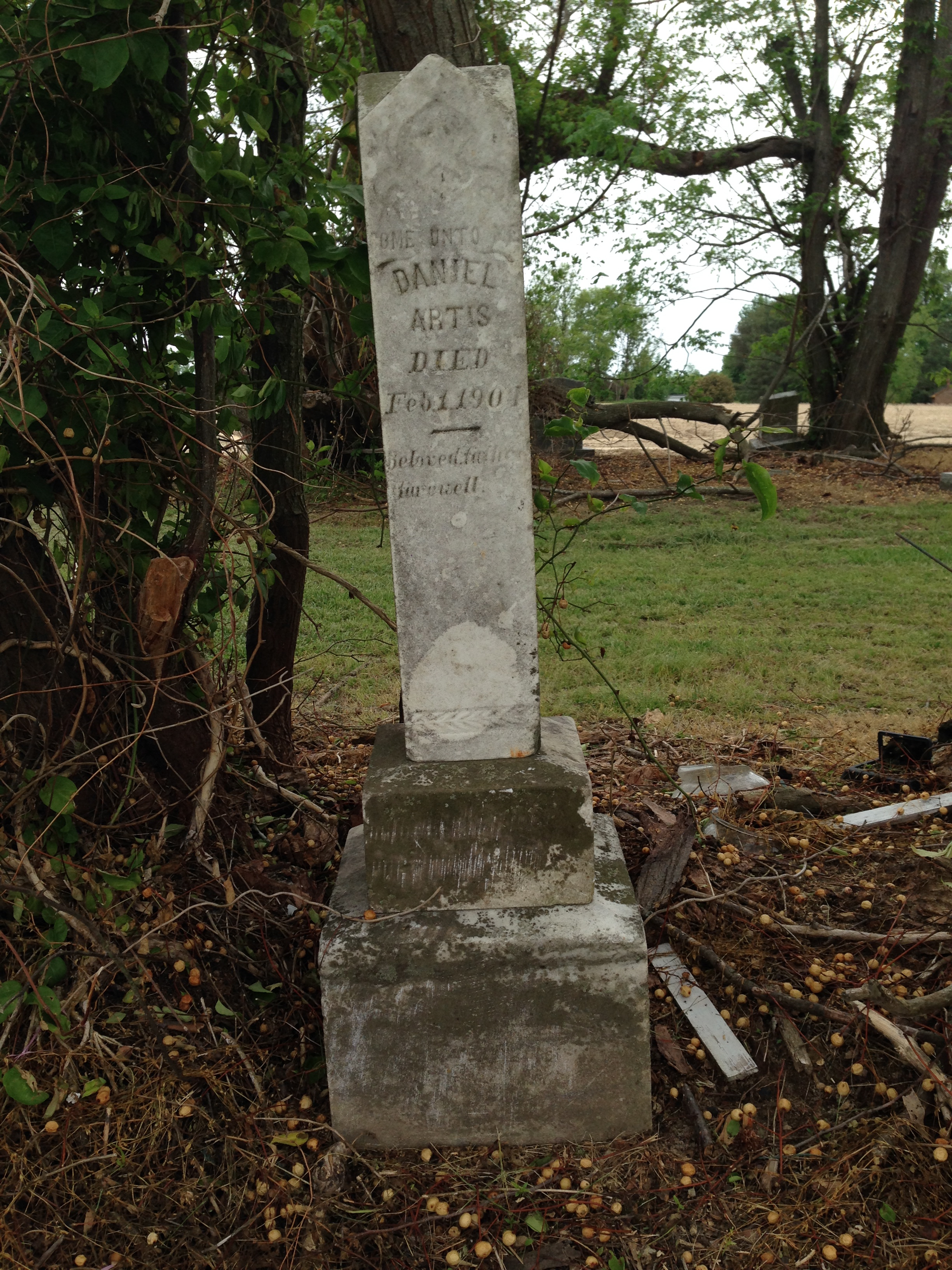
When they were children, J. and his cousins roamed these woods at play. Though only a few markers were now visible, he recalled dozens of graves on this hillock. Turner Swamp runs just on the other side of the tree line nearby. Without too much difficulty, we cut our way in and angled toward the the single incongruity in this overgrown copse — a low iron fence surrounding a clutch of headstones. I made for the tallest one, a stone finger pointing heavenward through the brush. At its base:

Elder Jonah Williams, brother of my great-great-great-grandfather Adam T. Artis.

At his side, wife Pleasant Battle Williams. And his children Clarissa, J.W. and Willie nearby.

In Glimpses of Wayne County, North Carolina: An Architectural History, authors Pezzoni and Smith note that the largely forgotten graveyard was believed to hold the remains of members of the Reid family. This is quite possibly true as Reids have lived in this area from the early 1800s to the present. As I followed J. through the brush and my eye grew accustomed to the contours of the ground beneath us, I could see evidence of thirty to forty graves, and there are likely many more. Had this been a church cemetery? Was Turner Swamp Baptist Church (or its predecessor) originally here, closer to the banks of the creek for which it is named? If this were once the Reid family’s graveyard — known 19th and early 20th century burial sites for this huge extended family are notably few — how had Jonah and his family come to be buried there?

I am indebted to J.S. for the warmth and generosity shown to a stranger who showed up unannounced at his doorstep on a chilly December day, asking about graveyards. I have been at the receiving end of many acts of kindness in my genealogical sleuthings, but his offer of time and interest and knowledge — and golfcart — are unparalleled. He has invited me back anytime, and I intend to take him up on the offer.






 Scuffalong: Genealogy.