Births Deaths Marriages, Oral History, Paternal Kin, Photographs

Remembering Nina F. Hardy.

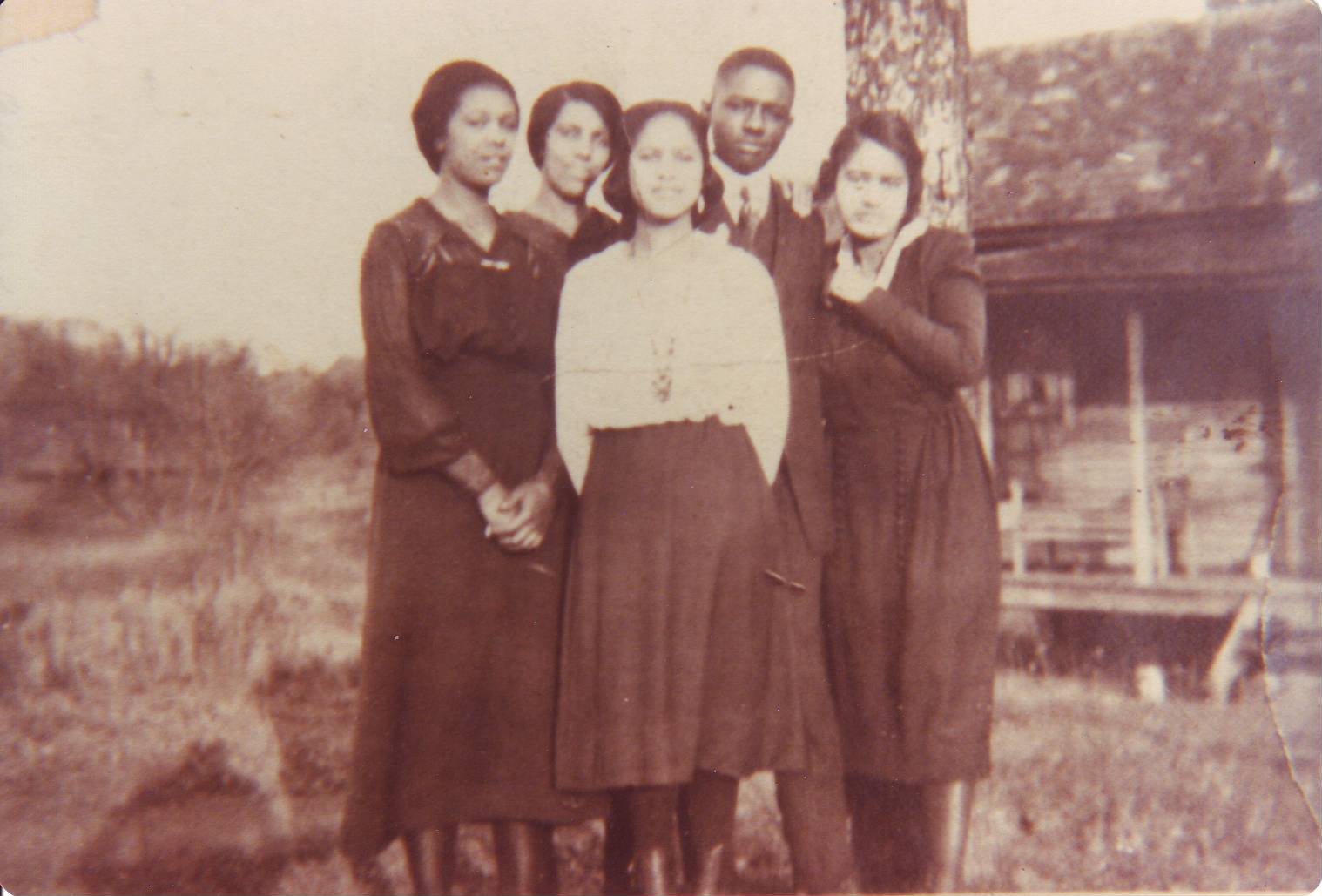
My parents married in 1961. When my mother arrived in Wilson shortly after, my father took her around to meet the elders who had not been able to travel to Virginia for the wedding. Along the way, they stopped at Dew’s Rest Home. As my mother stepped through the door, Aunt Nina threw up a cautionary hand: “Wait. You ain’t expecting, is you?” My mother, mortified: “No, ma’am!” “All right. ‘Cause it’s some uggggly folks in here!”

My paternal grandmother had a thousand stories about Nina — with a long I — Frances Faison Kornegay Hardy. Though she called her “aunt,” Nina in fact was her cousin. She was born March 15, 1882, probably in northern Duplin County, to John Henry Aldridge and Addie Faison. (John H. Aldridge, born 1844, was the son of John Mathew Aldridge, and first cousin of my grandmother’s grandfather, John W. Aldridge.)  She seems to have been married briefly to Joe Kornegay in 1899 in Wayne County, but I have not found her in the 1900 census. By 1910, she had made her way 40 or so miles north to Wilson and was boarding in the household of Jesse and Sarah Jacobs as “Nina Facin.” The census also shows a “Nina Facon” living and working as a servant in the household of Jeff Farrior in Wilson. Though described as white, this is almost surely Aunt Nina, who cooked and cleaned for the Farriors most of her working life. Though she and her husband lived just outside Wilson on what is now Highway 58, she was at home only on her days off.

Said my grandmother:

Aint Nina lived up over the Farrior house on Herring Avenue.  Herring’s Crossroads, whatever you call it.  And that’s where she come up there to live.  Well, the maid, as far as the help, or whoever, they stayed on the lot, where they’d have somewhere to sleep. So Aint Nina was living on Nash Road, way down there, and when we went to see her, me and Mamie would run down there five miles. She was working for Old Man Farrior then.  When she was living out in the country, she was working for white people, and so she went up to their house and cooked for them.  And when we’d go down to her house, she’d have to come from up there and cook when she get home.  So we would go and spend a day, but it would be more than likely be on her day off.  But when we had the horse and buggy, Mama drove out there once, and we went, I went with Papa with the wagon to where you grind corn to make meal, down to Silver Lake or whatever that place was down there.  Lord, them were the good old days.  

The Farriors, their back porch was closed in.  It had windows.  And had a marble floor in the back, and that stairway was on, where it was closed in on the back porch, you could go upstairs, and there was a room up there.  You couldn’t go from out of that room into the other part of the house.  You had to come back down them steps then go in the house.  And that’s where Aint Nina stayed.  I said, Lord, I wouldn’t want to have stayed up there.  And then something happen … She had to come down and go down the steps, go upstairs, I mean, and come out of the kitchen, and then go up them steps out on this porch in her room.  So she stayed up there.  Lord, I wouldn’t want to stay up there.  She get sick out there, she couldn’t get nobody.  I didn’t see no – I was up in there one time, and I went up there just to look around.  Well, she had a nice room, nice bed and chair and dresser and everything.  There was a whole set in the room where she was.  That was the only time I was up there. But I wouldn’t want to stay up there.

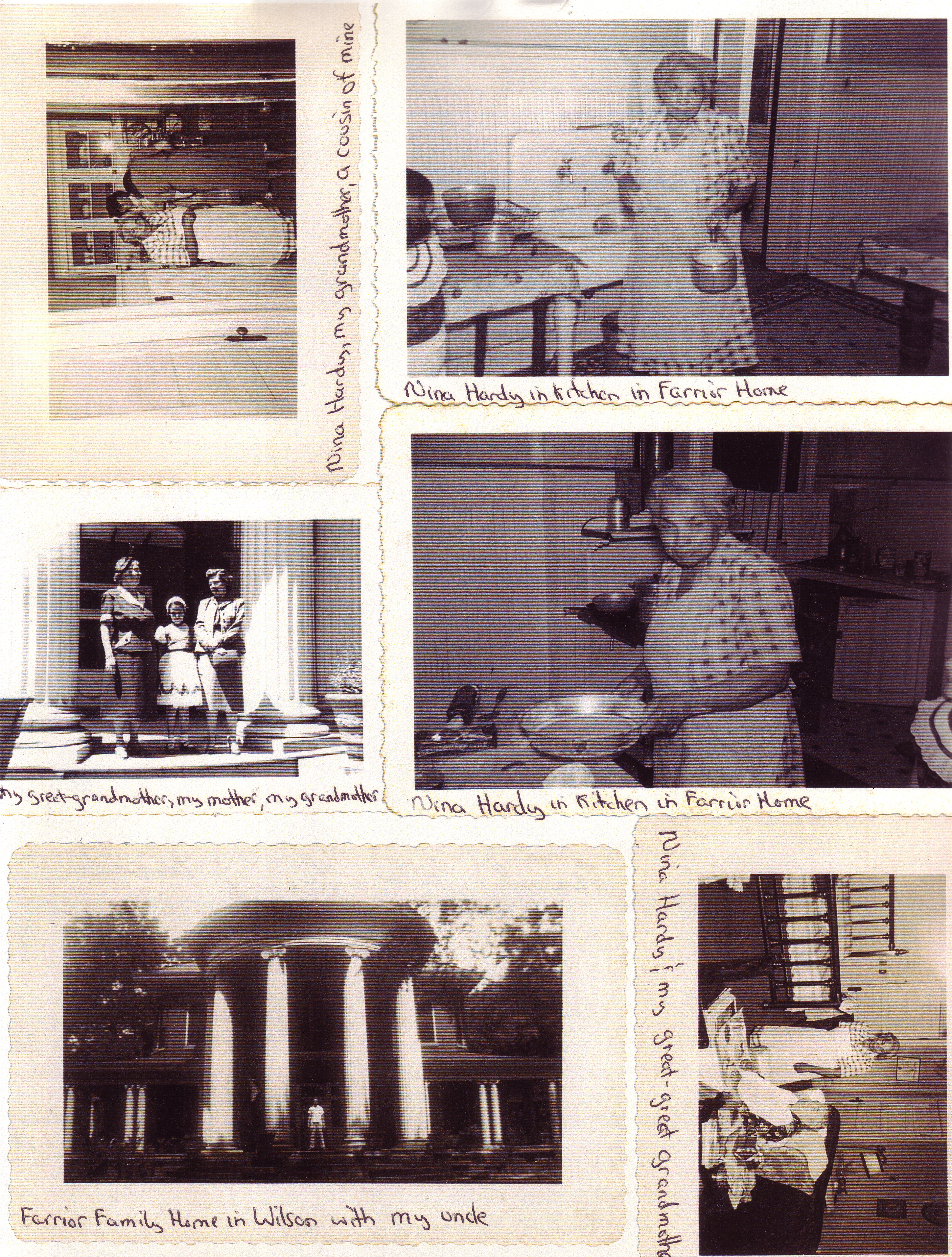
In 2004, J.M.B., a Farrior descendant, sent me copies of several photos of Aint Nina. My grandmother had described her (“She wasn’t real short.  But she was heavy built, and she had big limbs.  But she wasn’t that fat, but she just had big limbs and had a big face.”), and I had seen a couple of pictures of her before, like this one, taken in the mid-1950s with my uncle’s children:

Image

And this one,

IMG_0019

[There’s a photo booth shot that I can’t find right now. But I will.  UPDATE: I found it. 1/3/2016]

But these …
Scan10002

… these touch me. Nina at work. Nina in a kitchen with a floured pan, perhaps making biscuits, perhaps the dumplings my grandmother relished. Nina, her own legs aching, tending to whitefolks. The columned Farrior mansion, since torn down, with Nina’s little room tucked out of sight.

In 1917, Nina married Julius Hardy in Wilson township. It is likely their house that my grandmother and great-aunt visited out on Nash Road:

They had guinea chickens.  A car run over a chicken and killed it, and it kept going.  And we, me and Mamie, was going out there, and we picked up the chicken and carried it ‘round there.  And Aint Nina poured water and scald the chicken and picked it and cooked it, and we had the best time eating it.   Wont thinking ‘bout we was going out there to eat.  And so we come walking in there with that chicken, and she wanted to know, “Well, where’d you get that?”  “A car run over it, and we picked it up and brought it on over so you could cook it.”  And she said, “Yeah, it’s good.  A car just killed it?”  And it wasn’t too far from the house.  And I reckon it was one of her chickens anyhow.  Honey, she cooked that old stewed chicken, had to put pastry and vegetables in it.  Lord, we stayed out all that time, then had to come home from way out there.  But we was full. 

And her brother, his name was James Faison, lived across the street from her, and his wife, and I think the lady had been married before because they wasn’t his children.  It was two girls.  And he worked at the express, at the station.  The place was on that side, Nash Street station was over on this side.  Baggage used to come over there.  The baggage place where’d you take off the train.  That’s where you put it over on that side at that time.  And he was working over there.

Nina was a font of information about the family back in Dudley that my grandmother barely knew. Mama Sarah was impatient with questions about the past. Nina, on the other hand …

Mama never talked about her daughter Hattie.  But A’nt Nina, she would tell everything.  Mama got mad with her, said, “You always bringing up something.  You don’t know what you talking ’bout.”  So she’d go behind — Mama wouldn’t want her to tell things.  And she never did say, well, if she said, I wouldn’t have known him, but I never did ask her, who Hattie’s daddy was.  I figured he was white.  Because she looked — her hair and features, you know, white.

Even as she waited on others, Nina struggled with her health:

But she was kind of sickly, and I went up there for something.  See ‘bout her.  Carry her something.  And then when her leg was sore, and she come to stay with us.  Oh, she stayed with us a long time ‘cause she had to go to the doctor, had to be taken to the doctor with that leg.  That leg was still big.  But it was much bigger than the other one.  But it healed over.  But it was so knotty-looking, like it’d heal up and draw up in places, and it just looked so bad, and so she’d wear her dresses long.  But she had big feet!  Oooo, she had big feet.  With those big legs … And she was the one that Mama made Mamie iron her clothes on Sunday.  ‘Fore you even got to playing, had to get her clothes.  She was at Rocky Mount in the hospital with that leg.  They had operated on that leg and Mama would go every Sunday and take her clothes, bring her dirty clothes home and wash ‘em and bring them back to her.  So, Lord, we had a time with that.  And I looked at that big leg and just said, ‘Wooo….  What in the world is that?’  Looked like it just swelled up.  And I saw a lady right here in Philadelphia.  I had passed, and I seen her, and she had a great big leg.  And so by that woman having that big leg, I said, ‘Lord have mercy, I hope I don’t get that.  I wonder what’s wrong with it?  How come the swelling won’t go down in it?’  People don’t know what they’ll have to go through….  Yeah, ‘cause we went over there, and you didn’t have — it was an open sore, and it was always running.  She had to keep her foot up and had to keep the flies from on it, and so I said, well, finally it got better, but that leg healed up, it drawed up and you could tell where the sore was all on her leg.  And that leg was much bigger than the other one.  It took a long time to heal.  It was all healed up though before she died.

Image
In the photo above, taken in her last years at the rest home where she protected my young mother from a disastrous maternal impression, Nina smiles her same sweet smile despite ailing legs wrapped and swollen feet encased in split loafers.
N Hardy Death Cert
Aint Nina died 20 March 1969, just five days after her 86th birthday. Frances Sykes Goodman, granddaughter of Nina’s aunt Frances Aldridge Wynn, was the informant on her death certificate. She was buried in Rest Haven, Wilson’s black cemetery. (I’ve walked that graveyard and never seen her stone. Is her grave unmarked? If it is, and I can find it, it won’t be.)
Standard
Free People of Color, North Carolina, Other Documents, Paternal Kin, Photographs, Rights

Jurors and judges of election.

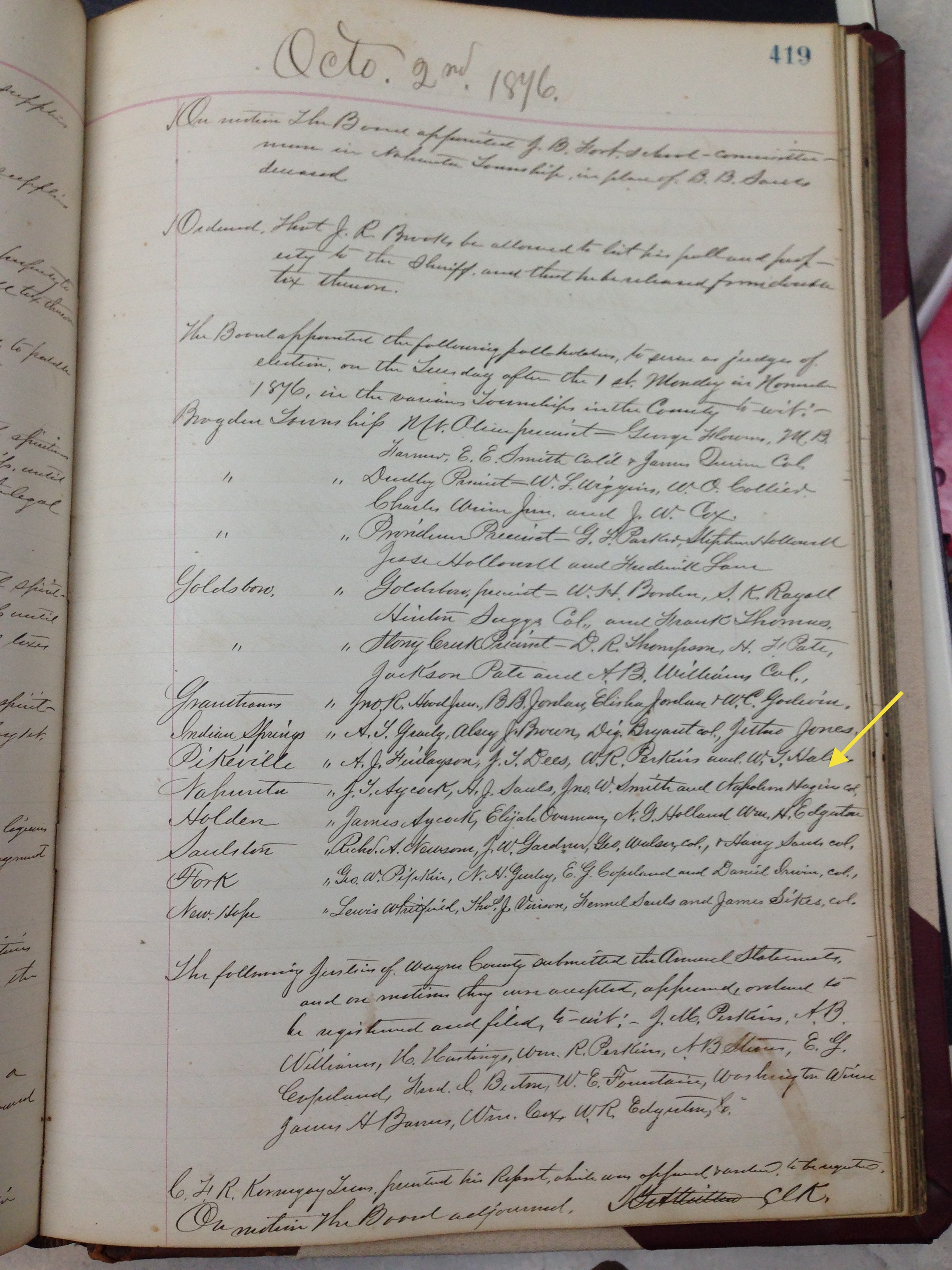
As tax-paying landowners, many African-American men in Wayne County, North Carolina, in the 1870s were called alongside white men to fulfill their civic duties. Here are two entries from Superior Court Minute Book 2:

ImageNapoleon Hagans of Nahunta township was appointed a judge of elections.

ImageMy great-great-great-grandfather Lewis Henderson drew jury duty for the first week of the next term of the superior court.

Superior Court Minute Book 2, Wayne County Register of Deeds Office, Goldsboro, North Carolina.

Standard
Enslaved People, Land, North Carolina, Other Documents, Photographs

Dr. Ward’s house. And me.

After my recent rediscovery of a Confederate map that revealed the locations of several plantations significant to my genealogical research, I began searching for more information about John Lane, Silas Bryant and David G.W. Ward‘s landholdings. Pretty quickly, I found a link to a copy of a nomination form for the National Register of Historic Places Inventory, submitted for the Ward-Applewhite-Thompson house near Stantonsburg, North Carolina. This Greek Revival house, dating back to about 1859, was owned and occupied by several of the area’s leading planters — including “country doctor” D.G.W. Ward, who purchased it in 1857 — and it and its outbuildings are little changed from their antebellum forms.

As I read the detailed architectural description of the house and its setting, a tiny kernel of recognition began to form in the back of my mind. A big, white, two-story house? Set well back from the road? Just outside Stantonsburg? Could it …?

I scoured the maps attached to the nomination form, trying to lay them over the current topography. State Road 1539 … that would be Sand Pit Road today …  just east of a fork in the road and just north of the Norfolk & Southern Railroad (which was not there in Ward’s time) … and there it is, just like I remember.

sand pit road

Yes. Like I remember.

I’ve BEEN in this house. Many times, though long ago.

Growing up, my sister and I were very close to my father’s sister’s daughters. Our local family was quite small, but my cousin’s father came from a big family with deep Wilson County roots. Her grandmother had nearly a dozen siblings — whom we also called “aunt” and “uncle” — and we were often invited to attend their family gatherings. I remember best the delectable Easter, Thanksgiving and Christmas dinners gathered around tables groaning with food, but there were also the annual 4th of July family reunions at Aunt Minnie’s out in the country near Stantonsburg. The Barneses were tenant farmers for an absentee landowner and rented his large two-story house. We’d pull off the road into a sandy circular drive and park under the trees alongside cars with New York and New Jersey plates. I vividly remember my cousin’s great-uncles and cousins tending a barbecue pit in which a split pig roasted, chickens strutting among them.  A screened side porch protected platter after platter of home-grown, home-cooked goodness.  My memories of the interior of the house are vague: a central staircase, two large front rooms, the kitchen in back. (The staircase I remember mostly because, carefully tending a tall glass of lemonade, I missed a riser and slid down their length, smacking my ribcage against the steps and knocking the wind out of myself.)

I couldn’t believe it. It is exciting enough to identify D.G.W. Ward’s house and find that it is still standing, but to realize that I knew the house at which Appie and Mittie Ward had lived and worked as the enslaved children of their own father was uncanny.

IMG_4960Ward-Applewhite-Thompson House today.

Photo taken by Lisa Y. Henderson, February 2014.

Standard
Births Deaths Marriages, Enslaved People, Free People of Color, North Carolina, Paternal Kin, Photographs

Family cemeteries, no. 9: Daniel Artis’ Edwardses.

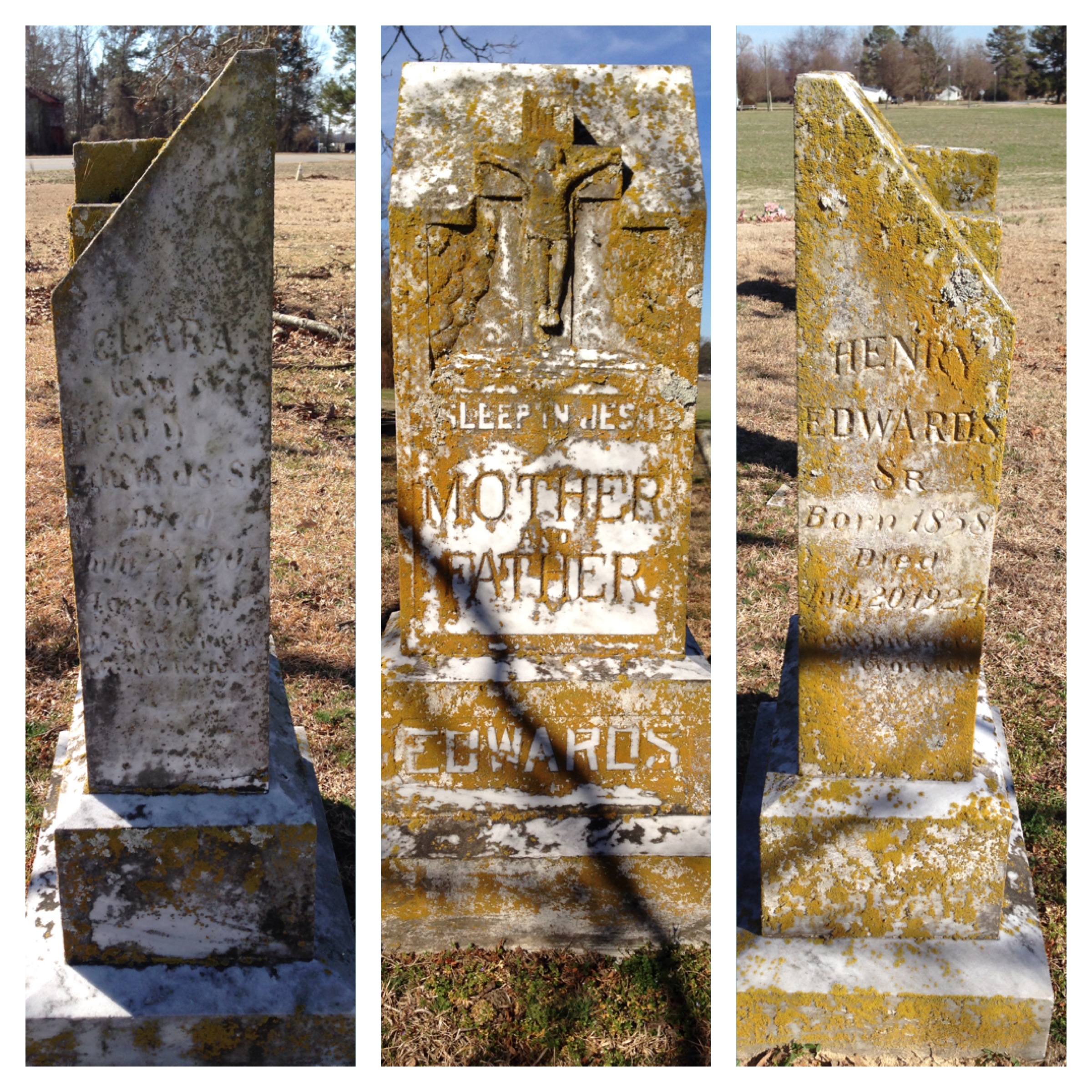
A right turn out of my parents’ neighborhood puts me onto Highway 58. Head southeast, cross the edge of Stantonsburg, over Contentnea Creek and the Greene County line, and, 13 miles from home, you reach Lane Road. Turn left, round the curve, and there, neatly marked and kept, is the Edwards cemetery. Here are buried Daniel Artis‘ daughter Clara, her husband Henry Edwards, and their descendants.

Image

Photo taken today, Lisa Y. Henderson.

Standard
Maternal Kin, North Carolina, Oral History, Photographs

A bird’s eye view.

The bird’s-eye view map of Statesville, North Carolina, drawn in 1907, reveals a number of features in Lon W. Colvert‘s landscape (click for a closer look):

statesville_1872_annotated

At #1: near the intersection of Centre Street, 109 East Broad Street, early site of Colvert’s barbershop. At #2: Center Street AME Zion Church. At #3: Southern Railway station, built in 1906. Colvert had an earlier shop in the Depot Hill area near the depot.  At #4: the railroad.  The Colverts’ house was adjacent to the railroad in Wallacetown, southeast of the station, as was that of his in-laws, Henry and Martha McNeely.

Below, the current tenant at 109 East Broad:

Image

Photo by Lisa Y. Henderson, December 2013.

Standard
Births Deaths Marriages, Maternal Kin, North Carolina, Oral History, Photographs, Virginia

Remembering Margaret Colvert Allen.

She gripped a balled handkerchief, or a tissue, in that hand almost always. You’d only notice that little finger, crooked up above the rest, when she made certain gestures, like smoothing her dress across her lap. It was a source of endless fascination when I was a child, and she would obliging turn her hand this way and that so we could get a closer look. Her pinkie finger, it was, curled permanently into a C-shape.

Here’s how it happened:

My grandmother:  Ooo, I had a lot of friends.  We had a lot of friends.  We could not visit people all in the neighborhood.  We could not go, the children came to our house.  You know, to play and all that kind of – to play ball.  We’d play ball in the evening, and they’d put me in the field because I couldn’t catch no ball on account of my finger.  [Laughs.]  I always had to go in the field.  Louise and Launie Mae were whizzes.  Louise was a terrible bad ball —  I mean, she could play some ball.  But Launie Mae was good, too.  But, honey, they’d put me out there way out there in the field where didn’t no – just as soon as I’d reach up to catch that ball that thing would knock it out.

Me:  Right. How did you hurt your finger?

My grandmother:  Ah, you know, they had windows that you’d put a stick under.

Me:  To prop them up?

My mother’s cousin: Didn’t have a sash.

My grandmother:  Yeah.  And I was in there playing and took that stick out there, and it broke something.  But anyway, Mama said she had gone to town.  That’s what they say when they went into Statesville.  And she said when she came back, Golar came out meeting her with me in her arms, and said she had on a little dress, and said she turned the dress up and blood was coming through the dress off me, you know, my finger and everything.  It scared her to death.  So they carried, she carried me to the doctor’s, and they put splints on to get it – it was broken, you know.  He put splints on.  But, see, I would pick ‘em off.

Me:  Just take it right off.

My grandmother:  Take ‘em off.  And take ‘em off.  And hold my hand like that.  [Balling her hand into a fist.]

Me:  Okay.  So that’s how it healed.  It healed closed.  How old were you then?  Real little?

My grandmother:  I guess I was little.  I don’t know how old I was.  Two, three.  I don’t know whether Launie Mae was there or not.  I know Louise was, but I don’t know ‘bout all of ‘em.  But, anyway, I was just big enough to crawl up to the window and pull the stick out.

I have many favored photos of my grandmother, and this is one of the last:

MCA

At home, in her easy chair, just back from church, with that little finger.

Remembering Margaret Colvert Allen (2 August 1908-11 February 2010).

Standard
Births Deaths Marriages, Maternal Kin, North Carolina, Photographs

Remembering Ardeanur Smith Hart.

She was the oldest of the McNeely grandchildren.

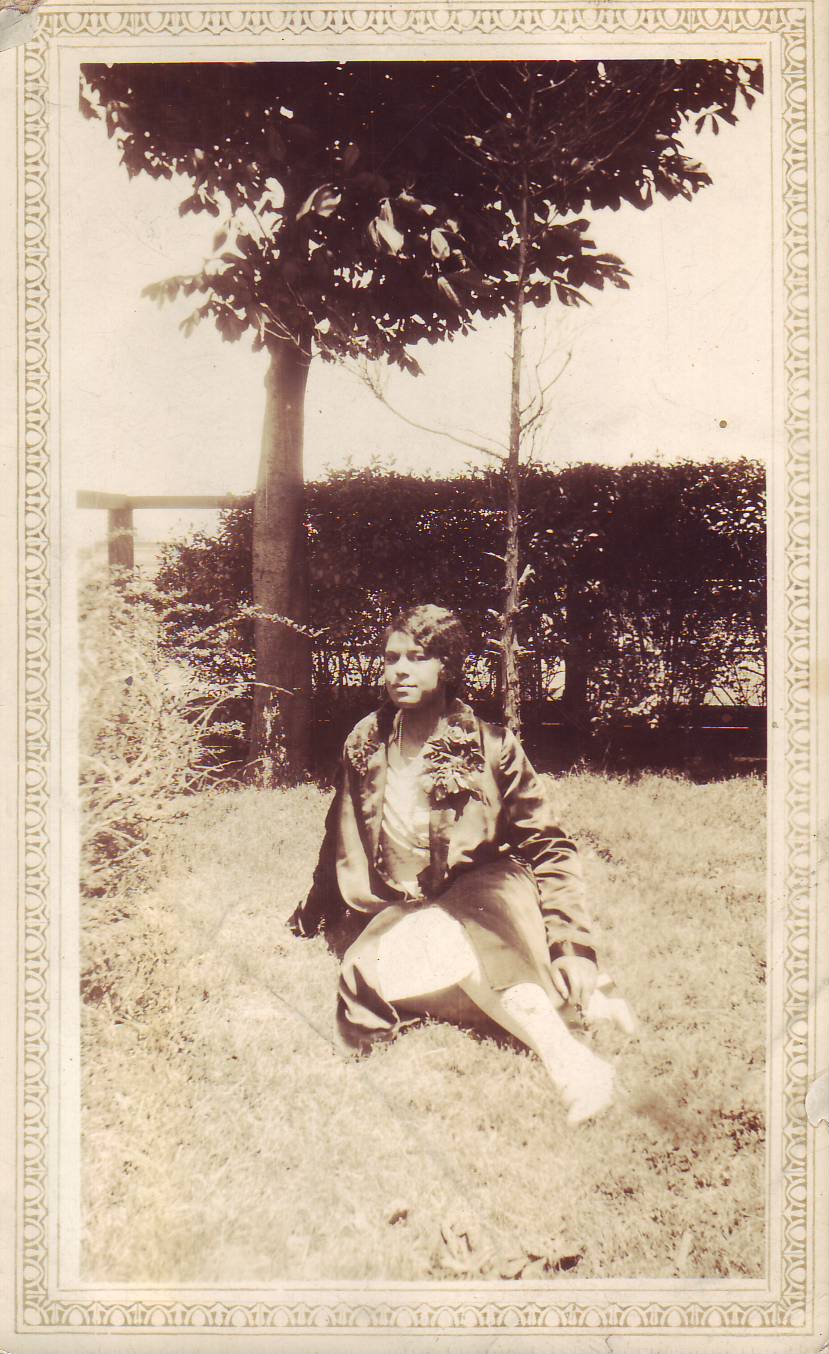
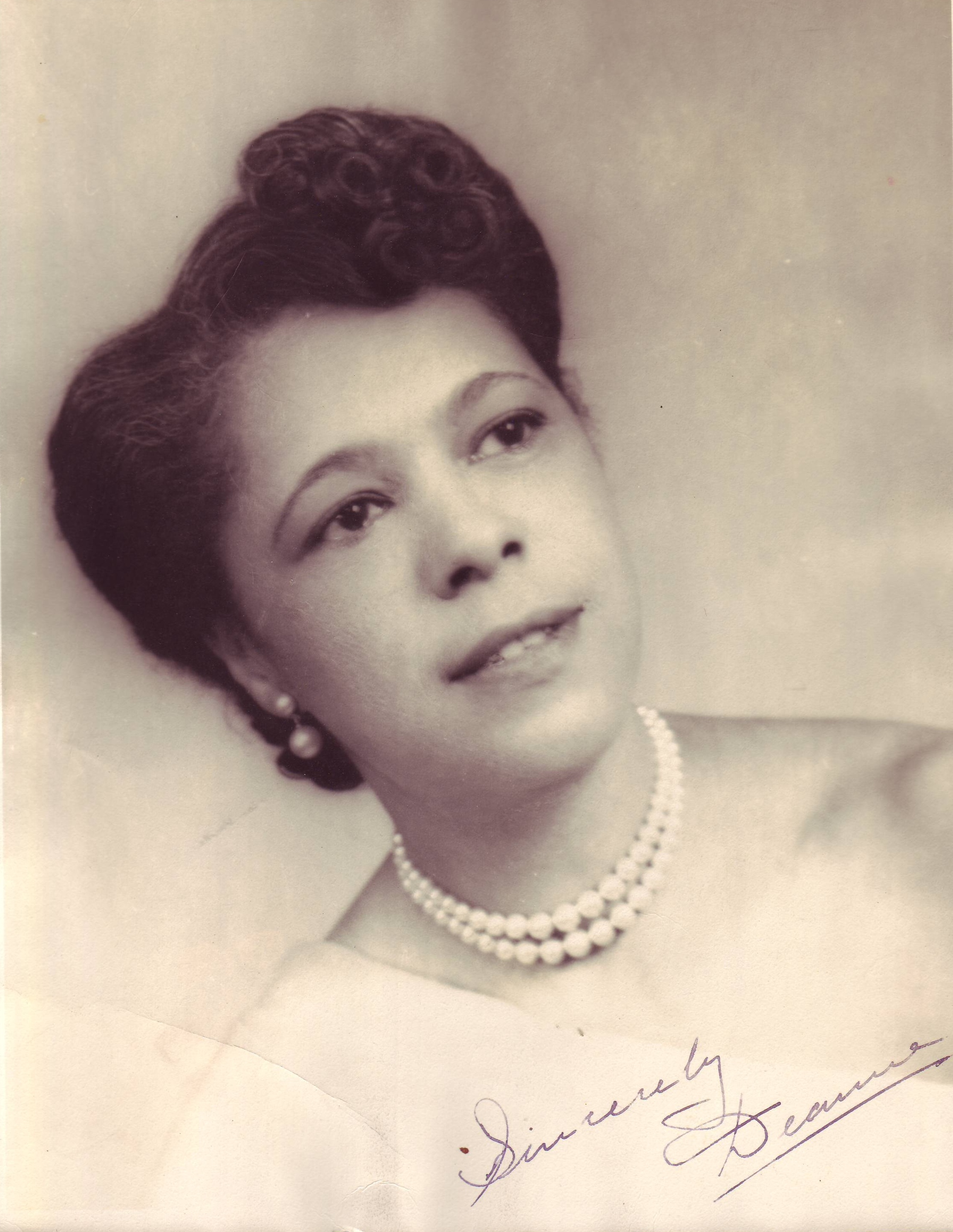
I can’t find the photo right now. The one I took at the last family reunion she attended in, perhaps, the mid-1980s. She was lovely. “Pulled,” as my friends say, with flawless caramel skin, steel grey hair swept in a neat chignon,* stately bosom encased in a champagne-colored lace sheath dress. Cousin Ardeanur Smith Hart, born one hundred twelve years ago today.

McNEELY -- Ardeanur Smith seatedArdeanur, circa 1928, Bayonne NJ.

McNEELY -- Ardeanur_Minnie_Louise_BertArdeanur; her aunt Minnie McNeely, who reared her after her mother’s death; her cousin Louise Colvert; a Murphy; and her uncle Lon Colvert’s sister, Bertha Hart. Statesville, mid-1920s.

McNEELY -- Ardeanur Smith with pearlsArdeanur Smith Hart (8 February 1902-14 January 1996).

*I found it. And I misremembered. Not a chignon, but a neat cap of curls.

Standard
Births Deaths Marriages, North Carolina, Paternal Kin, Photographs

Carrie Henderson Boseman Grantham.

My grandmother met none of Mama Sarah‘s sisters, but she know of them. Loudie, of course, her own grandmother. And Ann Elizabeth, mother of Minnie and Daniel and Dollie Simmons. And Carrie. Who was a little more elusive because she had no children that my grandmother knew of.  She was only a name Sarah mentioned.

I managed to find a few references to her. The earliest is in the Records of the Congregational Church of Christ in Dudley, vol. II, in which Carrie Henderson appears in membership rolls for 1886 with sisters Suddie, Lutie and Sarah Henderson.  (“Suddie,” or Mary Susan Henderson, was not one of the great-aunts my grandmother knew.) Next to Carrie’s name are these notations: “Bowsman” and “absent.”

“Bowsman” was “Boseman,” actually, the surname of the man Carrie married a year later. Wayne County NC marriage records show that, on 25 June 1887, George Boseman, 24, “col’d,” and Carrie Henderson, 18, col’d, applied for a marriage license.  A.T. Dove, M.G. performed their ceremony on 29 June 1887, in Brogden, before Dortch Winn, Jno. Winn, and Frank Parker.  (They apparently were not wed in Carrie’s church, as Dove was not pastor there.)  The marriage was childless, and probably ended with George’s death.

On 21 Dec 1899, Carrie Boseman, 28, married Arch Grantham, 48, colored, in Brogden township. R.B. Johns, M.G. (of the Congregational Church) officiated and W.D. Grantham and Georgiana Winn witnessed.  The family appears in the 1900 census of Grantham township, Wayne County: farmer Arch Grantham, wife Carrie (29), and (his) children [illegible], Emma, Annie, Barfield A., and Lula A.  Carrie reported 0 of 0 children living.

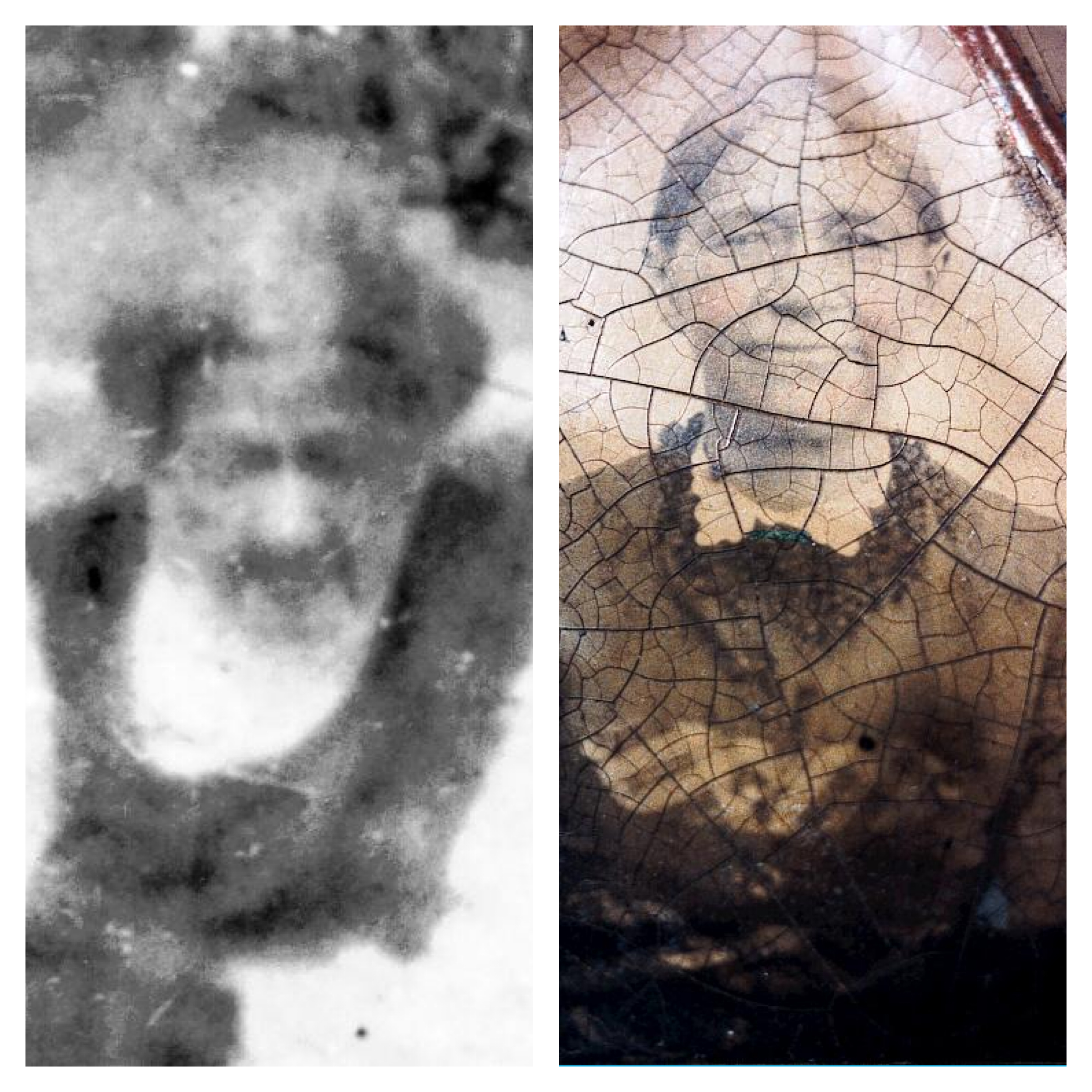
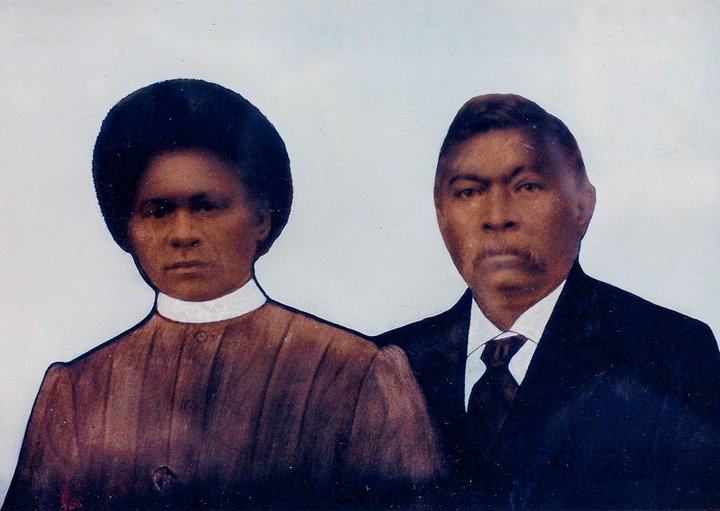
This is where things stood until a couple of years ago, when I ran across B.B., a descendant of Archie Barfield Grantham (1851-1915) and his first wife, Mary Adeline Raynor (1855-1897). In 1906, Arch married his third wife, B.B. told me — so Carrie, still childless, died within five years or so of their wedding. It was nice to be able to round out the thread of her life in that way, but there was more. For many years, a portrait hung on his grandparents’ wall, a hand-tinted, charcoal-enhanced photograph of Archie … and Carrie.

Carrie & Archie Grantham


Standard