Births Deaths Marriages, Maternal Kin, North Carolina, Photographs

Family cemeteries, no. 8: The Nicholsons.

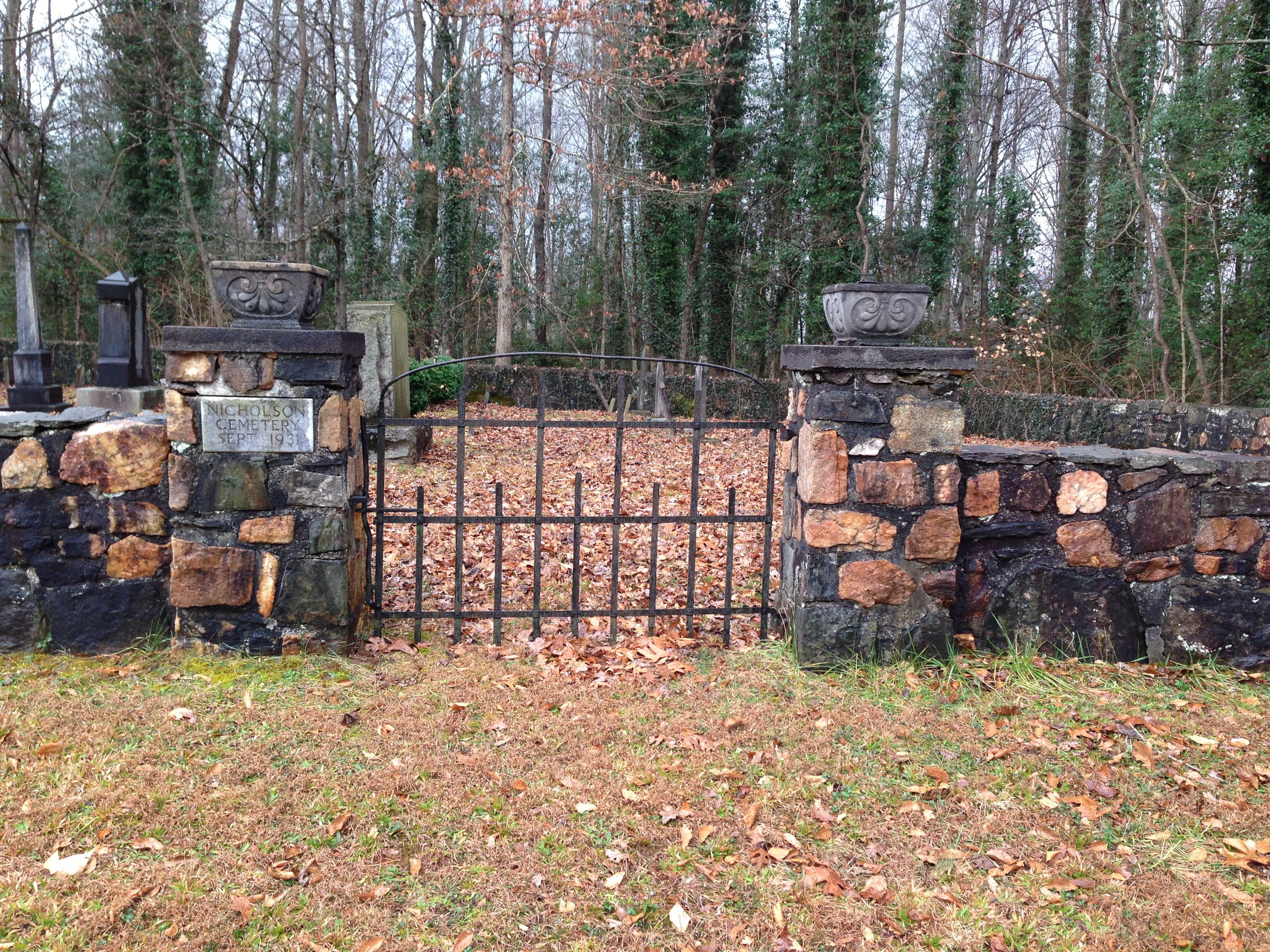
The map was not entirely clear, but the graveyard was definitely on Barnards Mill Road, which branched off Harmony Highway somewhere above Hunting Creek. Though morning, the sky was dark with impending rain. I kept an eye on the left side of the road. A bridge over the creek … an unmarked road … “Bridge Out.”  Wait, wasn’t the cemetery by a bridge?  I backtracked and turned off the highway. After a half-mile or so, the blocked bridge and a path, marked No Trespassing, leading into the woods. I am not a fool. I trotted up to the closest house and knocked. A middle-aged woman peered through a window, then motioned me around to the side door. “I’m looking for a cemetery near here. Welch-Nicholson.” She gestured behind me and smiled. Up the hill across the road, a low stacked-stone wall inset with a simple iron gate surrounded the remains of a hundred years of Nicholsons.

IMG_4594

My great-great-great-great-great-grandfather James Nicholson bought a mill on the creek in the late 1820s and probably established the graveyard. His father, Revolutionary War veteran John Stockton Nicholson, who was born 1757 in Princeton, New Jersey, and migrated to North Carolina circa 1800, is buried Muddy Creek Friends cemetery, Kernersville, North Carolina. He died in 1838.

IMG_4611

John was married twice, to Mary McComb, then Catherine Anne “Caty” Stevenson. Mary bore one son, the James Nicholson above. Caty bore ten, including John S. Nicholson Jr. Mary McComb Nicholson is buried near John Jr., whose stone is shown above. Caty is buried at Muddy Creek.

James Nicholson married Mary Allison in 1815; their children were Thomas Allison Nicholson and John McComb Nicholson. Thomas A. Nicholson married his first cousin Rebecca Clampett Nicholson, daughter of John S. Nicholson Jr. and Mary Fultz.

Thomas Nicholson’s broken gravestone is propped next to that of Rebecca.

IMG_4602

IMG_4605

Thomas and Rebecca’s oldest child James Lee Nicholson, my great-great-great-grandfather, is also buried here. He died a few weeks short of his 30th birthday in 1871.

Photos taken by Lisa Y. Henderson in December 2013.

Standard
Births Deaths Marriages, Free People of Color, Land, North Carolina, Other Documents, Paternal Kin, Photographs

A lot in Negro Town.

This convoluted case involves a dispute between two parties claiming title to a lot that once belonged to Needham Kennedy, Mathew W. Aldridge’s father-in-law. The ins and outs of the lawsuit are difficult to extract from the decision and, in any case, are not the most interesting aspects of the matter for me. Rather, my focus is on the evidence of relationships among Kennedy’s children (and their spouses) and the light shed on the affairs of a family that had quickly accumulated property post-slavery.

There is astoundingly little in conventional records about Needham Kennedy. I assume he was native to Wayne County, perhaps the former slave of one of several Kennedy families in the area. However, to my confusion and dismay, I have found neither him nor his family in any census records prior to 1900. Where were these landowners???

All the more important, then, is the personal information that can be gleaned from the North Carolina Supreme Court’s decision in Bradford v. Bank of Warsaw, 182 N.C. 225 (1921). The main opinion in the case gives some information, but the fullest, clearest details are set forth in a dissenting opinion. A distillation of it all:

Needham Kennedy bought a lot measuring 42 feet by 210 feet in “’Negro Town,’ a suburb of Goldsboro,” on 12 January 1870 and registered his deed six years later.  He also owned other property. Needham died intestate about 1898, leaving five children – Fannie Kennedy Aldridge, Ida Kennedy Darden, Bryant Kennedy, William Kennedy, and Levi Kennedy  – and a wife, the children’s stepmother, who died in 1908. (Their birth mother was named Patience, maiden name possibly Kennedy.)  After the stepmother’s death, the children arranged to divide the property so that William and Bryant, who lived in New Jersey, would receive cash and their sisters and Levi would divide the land. Ida was to get the contested lot (A); Fannie, lot B; and Levi, lot C.

In 1909 and 1910, William, Bryant and Levi conveyed their interest in A to Ida. The deeds from William and Bryant were not recorded until 1921, and Levi’s was lost and never recorded. On 21 March 1910, at lawyer A.C. Davis’ office, Fannie Aldridge and husband Mathew conveyed her interest in A to Ida and her interest in C to Levi.  Levi and wife and Ida Darden and her husband John conveyed their interest in B to Mathew Aldridge. These deeds were immediately probated, and Fannie, Ida and Levi took possession of their respective lots.  (Levi later sold his.)

To secure a sum of money that Ida owed Mathew, Ida gave him a mortgage on A dated 22 March 1910, which was recorded that day. Ida had received rents from A since her stepmother’s death and continued to do so until 20 May 1912. On that day, Mathew Aldridge sold the mortgaged property to Captain A.J. Brown, who recorded the deed on 11 June 1912.

Captain Brown, and later his heirs, received rents from A from the date of purchase until 27 March 1915. On that day, the heirs sold the lot to defendant Bank of Warsaw, which recorded its deed on 1 May 1916. The bank then began to receive rents.

In the meantime, on 14 July 1916, William, Bryant and Levi Kennedy conveyed their undivided 3/5 interest in lot A to J.J. Ham. The deeds were registered 24 August 1916. On 17 October 1917, Ham conveyed his interest in the lot to N.E. Bradford, who registered the deed 24 October 1917. Thus, both Bradford and the Bank claimed interests in the title to A on the basis of deeds executed by various heirs of Needham Kennedy.

My year of property law class is far behind me, and I won’t attempt to untangle the dense reasoning set forth in the majority opinion in this matter.  Suffice it to say, the Bank of Warsaw lost its appeal.

——

Fannie’s husband Mathew W. Aldridge, brother of my great-great-grandfather John, died in 1920. Seven months later, Fannie married W.D. Farmer.  (What’s the story there?) I have not found her death certificate.

Image

Eliza Balkcum Aldridge and her daughter-in-law, Fannie Kennedy Aldridge, circa 1920.

Levi Kennedy died 6 February 1940 in Goldsboro. His death certificate notes that he lived at 310 W. Pine Street, that he was a clothing merchant, and that he was married to Anna Kennedy.  He was born in 1875 in Goldsboro, and his parents were listed as Needham and Patience Kennedy. He is buried in Elmwood cemetery.

Ida Kennedy Darden Lamb died 18 December 1954 in Goldsboro. She was a widow and resided at 305 West Elm Street. She was born 18 March 1874 to “Needman” and Patience Kennedy.

I’ve been unable to trace William and Bryant Kennedy in New Jersey.

Standard
Births Deaths Marriages, North Carolina, Oral History, Paternal Kin, Photographs

Remembering Mother Dear.

I had pneumonia twice.  The first day I went down to Graded School, that day it rained.  I come back – there was a hole in my shoe, and I slopped in all the water and got my feet wet.  That’s what Mama said, anyhow, and I taken with a fever.  

If I got wet – when I went to Graded School, it rained, and I slopped in all the water coming back from there.  Had a hole in my shoe.  Had pasteboard in there.  And then I’d go to sneezing and coughing.  And so Mama said, “You know you oughtn not to got wet!”  Well, how was I gon help from getting wet?  Had to come from school!  So that was the first year I went to school.  I remember that.  And I was sick that whole rest of the year.  I mean, wasn’t strong enough to go down to Graded School – she wouldn’t let me go down there.  So I stayed home, and Mama put all them old rags, that old flannel cloth, and she’d put it in red onions and hog lard.  And I had pneumonia.  And they was sitting up with me.  Said I hadn’t spoken in three days.  And so that old clock where Annie Bell took, it was up there on the mantel, it struck two o’clock.  Mama was sitting on one side of the stove, and Papa on the other.  So I said, when the clock struck, I said, “It’s two o’clock, ain’t it, Mama?”  And they thought I was dying.  So they had been sitting up with me.  So I think didn’t think nothing ‘bout it.  I went on back to sleep.  I didn’t know nothing ‘bout it.  Said I had double pneumonia.  So Mama got – honey, I had to wear a piece of cloth up here on my chest, one on the back, with Vick’s salve and hog grease or whatever that stuff was, mixed all up together and pinned it to my undershirt.  

And I thought about it, with Bessie dead — she died when I was eight months old.  And Mama Sarah took me as a baby and brought me to Wilson.  And I was the only child there.  Well, that’s how come, look like Papa, he felt sorry for me, I reckon.  Her husband did, and I called him the only Papa I knew.  So they all – I was always sickly and puny and: “Give her anything she wanted,” that’s what Dr. Williams – white doctor – so he said, “She can’t live nohow.”  And that’s when I had the pneumonia.  And so I didn’t want nothing but water.  So, “Well, give her all the water she want ‘cause she can’t live nohow.”  But I fooled ‘em!  Dr. Williams’ gone, Mama’s gone, all of ‘em, and I’m sitting right here!” 

IMG_2161

The mantel at 303 Elba Street, 2014.

And for most of my life, she was right there indeed. Every summer, when we drove up from North Carolina to spend a week with her in Philadelphia. Every winter, when she came down to spend the holidays with us and my aunt’s family and her sister. Later, when I was in law school and grad school, I spent my breaks with her, and I even lived with her a short bit when I moved to Philadelphia. I will regret till I’m gone that I did not visit her more often after I left, but when I did I had the good sense to record her stories. Her death was my first real loss, the one that broke the spell, and it pangs me almost as much now as it ever did. I miss this woman.

Image

Remembering Hattie Mae Henderson Ricks (6 June 1910-15 January 2001), my Mother Dear.

Standard
Births Deaths Marriages, Maternal Kin, Migration, North Carolina, Oral History, Photographs

Minnie Beulah McNeely Hargrove.

But there was Aunt Minnie, and then after Aunt Lethea died, Aunt Lethea told her to take care of me, and she just took me on, you know.  And she was always crazy about me.  The first percale sheets that I ever had Aunt Minnie sent them to me, and I never bought anything but percale sheets.  Boy, they were just so luxurious and so nice and everything.

Jay stayed with Aunt Min ‘cause Aunt Min reared him after Aunt Lethea died.  And he was at this same house with Aunt Minnie and Grandma.  Let’s see.  It was Aunt Min and Grandma and Uncle Luther and Jay and I.  We were all in the same house during the summer that I worked up there.

Ardeanur. And she had a brother named James.  And their mother died when they were little children, and Min reared them.  Reared the children.

——

Aunt Minnie, who had no children of her own, reared everyone’s. When her sister Addie McNeely Smith died in 1917, Minnie took responsibility for her children, Ardeanur and James. When sister Elethea McNeely Weaver died five years later, Minnie stepped in to care for her youngest boy, 11 year-old Irving “Jay” Weaver, and promised to keep an eye on Lethea’s favorite niece, my grandmother.

Aunt Min shared a home with her mother Martha Miller McNeely in Bayonne, New Jersey, and after her mother’s death, she and Ardeanur moved to Columbus, Ohio, to live near another sister, Janie McNeely Taylor. She was in her fifties when she defied her disapproving family and married John Hargrove. He did not live long to plague her, though, and in a reversal of roles, she spent her last years with Ardeanur.  Minnie Beulah McNeely Hargrove died 2 December 1982 in Columbus.  She was 93 years old.

Image

Above: Minnie hovering behind her flock. From left, a Murphy boy, Bertha Hart Murdock, Bertha’s cousin Alonzo Lord, Aunt Minnie, and Ardeanur Hart Smith, Statesville, circa 1920.

Image

Minnie in Bayonne, perhaps the late 1920s.

Image

Minnie in later years, Columbus, Ohio.

Image

Aunt Min marries John Hargrove, Columbus, early 1950s.

Image

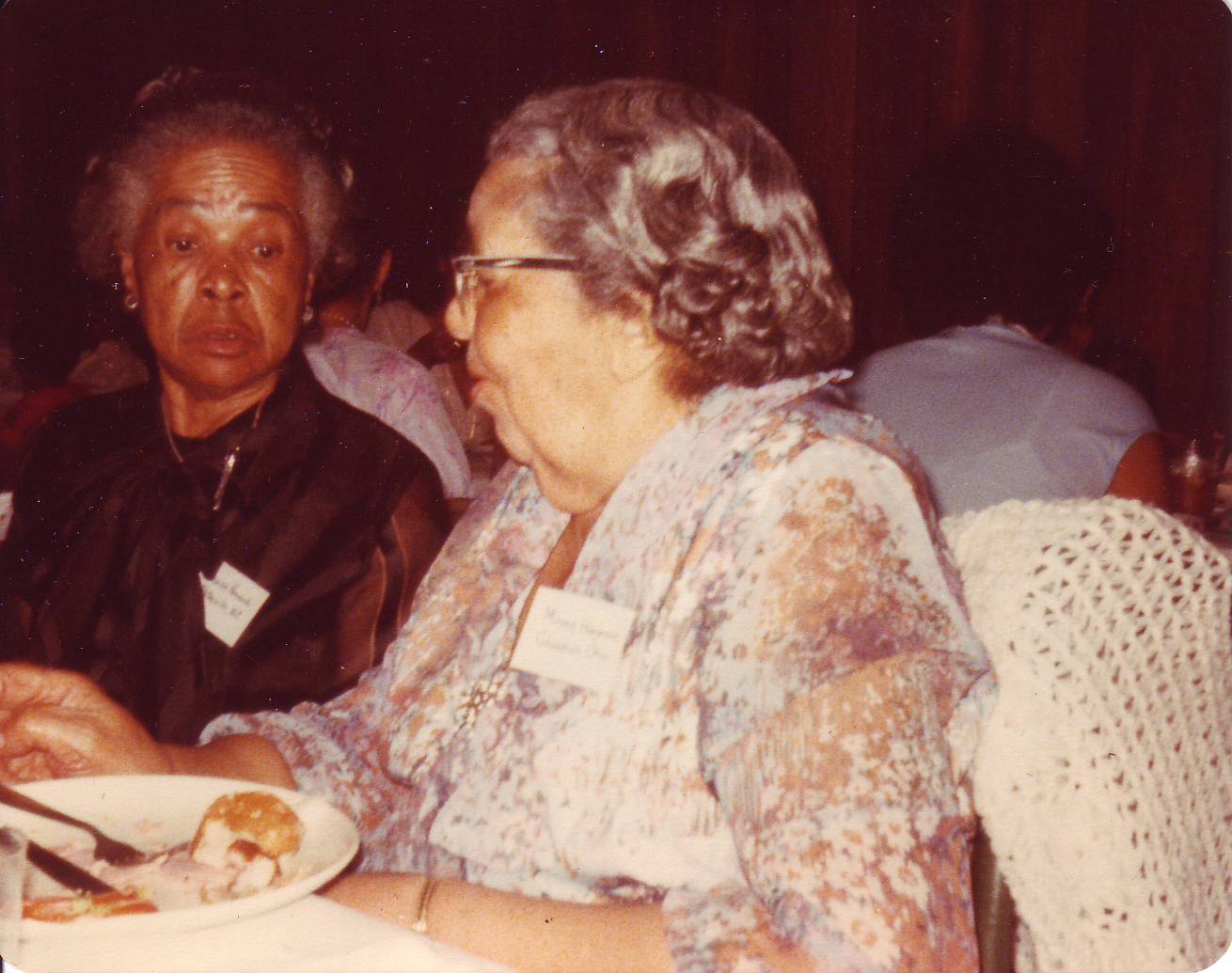
Minnie McNeely Hargrove at the 1980 Colvert-McNeely family reunion, Newport News, Virginia. I was not there. At the time, I was too callow to know what I was missing. Today, I kick myself. I never met her.

Interview of Margaret C. Allen by Lisa Y. Henderson; all rights reserved.

Standard
Births Deaths Marriages, North Carolina, Paternal Kin, Photographs, Religion

Family cemeteries, no. 7: Turner Swamp Primitive Baptist Church.

Image

Rev. Jonah Williams once led the flock at Turner Swamp, and its cemetery is full of kin.

There’s Richard Artis (whose father Richard was Jonah’s — and my great-great-great-grandfather Adam Artis — brother) and his wife, Penny Coley Artis …

Image

… Richard’s brother John Henry Artis (1896-1963) and sister Emma Artis Reid (1877-1964) …

… and several of Richard and Penny’s children, including Alfonza Artis (1908-1948), C. Columbus Artis (1910-1985), Louis D. Artis (1916-1983), Jonah Artis (1918-1966) and Jesse L. Artis (1919-1960) …

… and Magnolia Artis Reid (1871-1939), daughter of Richard and Jonah’s sister Loumiza Artis Artis (wife of  Thomas Artis, no kin);

… and descendants of Adam, Richard, Jonah and Loumiza’s sister Zilpha Artis Wilson, wife of John Wilson, including her daughter Elizabeth Wilson Reid‘s children Milton C. Reid (1890-1961) and Iantha Reid Braswell (1893-1955) …

Nora Artis Reid (1894-1965), who was married to her cousin Milton Reid and was the daughter of Adam Artis’ son Noah Artis, and …

… even Wade Ashley Locus (1897-1945), a distant Seaberry relative of Adam’s wife Frances Seaberry Artis.

Photos taken by Lisa Y. Henderson, December 2013.

Standard
Maternal Kin, Migration, North Carolina, Photographs

Aunt Mat and her children.

Mattie Colvert, oldest daughter of Lon and Josephine Dalton Colvert, was born in 1895 in Statesville, North Carolina. She married Charlie W. James in Statesville, North Carolina, in 1913. In the 1930s, Aunt Mat and her children migrated North to New York City, where this photo probably was taken.

ImageWillis H. James, James E. James, Charles James, Mattie Colvert James, Carrie James James, Lon W. “Lawrence” James, John Bristol Clemons, and Shelton H. James.


Standard
Births Deaths Marriages, Migration, North Carolina, Paternal Kin, Photographs

Funeral Program Friday: Fannie Aldridge Randolph.

FP Fannie Randolph Phila PA 1_Page_1

FP Fannie Randolph Phila PA 1_Page_2

For reasons that aren’t clear to me, the Aldridges that my grandmother was closest to in her adult life were two of her father’s first cousins, daughters of  Matthew W. Aldridge, Fannie Aldridge Randolph and Mamie Aldridge Abrams Rochelle. They grew up in Goldsboro, not Dudley, and both migrated North before 1930, so I am guessing that she met them after she moved to Philadelphia in 1958.

I wish I’d probed these relationships more. Mother Dear and Cousin Fannie lived a short bus ride apart in West Philadelphia and saw each often enough that I recall visiting her house on Filbert Street and seeing her at my grandmother’s on Wyalusing during our short summer stays. I never met Cousin Mamie, but know that my grandmother visited her in Union, South Carolina, and took at least one sightseeing trip (“excursion,” as she called them) with her.

Fannie B. Aldridge left Goldsboro for Philadelphia shortly after the 1910 census was recorded. In 1913, she married Virginia-born Elisha Randolph (1875-1940) and, by 1917, when he registered for the draft, had settled into the rowhouse in the 5800 block of Filbert Street in which she would remain the rest of her life.

Here is a bad partial copy of a photograph of Matthew Aldridge’s daughters. Fannie is at right, standing behind one of her nieces.  The boy in the middle, I believe, was Elijah Randolph, her only child. Her sisters Daisy Aldridge Williams and Mamie are left and center.

Daisy Mamie Fannie Aldridge & children

And here’s Cousin Fannie as I vaguely remember her. This Polaroid dates from about 1973 and was taken in my grandmother’s kitchen. (That’s Mother Dear at right.)

Fannie Aldridge Randolph & Hattie Ricks

Standard
Births Deaths Marriages, North Carolina, Oral History, Paternal Kin, Photographs

Is Mama dead let me know at once.

Mama got sick after we come back from Greensboro.  She got sick.  At least, Mama, we never could tell when she was sick.  ‘Cause she put on so much.  If she wanted to go somewhere – go to New York, Norfolk, anywhere she could get, pack that bag, honey, and she’s gone.  And leave us home!  Leave us there.  She took me to New York with her, and she carried Mamie to Norfolk, carried me to Norfolk one time, then she carried Mamie there.  Oh, she was just always wanting to go.  And Papa didn’t have enough sense, but just wherever she said she was going, she was going, and he give her the money and she’d go. 

But Mama didn’t know she had a bad heart until two weeks before she died.  She was always sick, sick all the time.  She’d go to the doctor, and the doctor would tell her it was indigestion and for her not to eat no pork and different things she couldn’t eat.  ‘Cause Mama was fat.  She weighed 200.  She wasn’t too short.  She was just broad.  Well, she was five-feet-four, I think.  Something like that.  And so, but she loved pork, and she’d try to eat some anyhow ‘cause we always had a hog, growing up.  All the time.  So after they said she couldn’t, she tried not to eat no pork, much.  Fish and chicken, we eat it all the time.  But she was so tired of chicken until she didn’t know what to do.  And I was, too.  But Papa loved all pork, so he’d always get a whole half a shoulder or a ham or something and cook it, and she’d eat some.  But when she went to the doctor, and her pressure was up so high, and he told her, “By all means, don’t you eat no pork.  It’s dangerous to eat pork when your pressure is too high.”  And then that’s when she stopped eating pork.  Well, it didn’t help none, I don’t reckon. 

After that, when she was going to Mamie’s, she had that little bag.  A little basket.  A little, old basket ‘bout that tall with a handle on it.  She had all kinds of medicine in there to take.  And Mr. Silver told her, said, “Well, you just take your medicine bag.”  She’d been married to him a good while.  He said, “Well, you shouldn’t go up there by yourself.  Since I’m down here—”  See, she’d go up and stay with him a little while, and then he’d come back to Wilson and stay a while.  So he said, “You just take your little basket there with your medicine in it.”  So, he said, “Well, I’ll go with you up there and then I’ll come back on to Enfield.”  So he went with her down there to the station.  He was picking up the bags to go up there, told her to walk on up to the station and wait for the train.  

So, she went up there to the station and got on there, and went on and got on the train, and when she got off the train, in Selma —  ‘cause she’d done told me to send her insurance and everything to Greensboro, ‘cause she wont never coming back to Wilson no more.  Because she’d done seen, the Lord showed her if she stayed in Wilson, she wouldn’t live.  If she went ‘way from there, she could get well.  So she was going to Mamie’s.  And when she got off the train and went there – she’d just got to the station door.  And she collapsed right there.  And by happen they had a wheelchair, a luggage thing or something.  The guy out there, he got to her, and he called the coroner or somebody, but he was some time getting there.  But anyway, they picked her up and sat her in the wheelchair.  They didn’t want her to be out ‘cause everybody was out looking and carrying on, so they just pushed her ‘round there to the baggage room. 

And so when the coroner got there, he said, “This woman’s dead.”  So they called Albert Gay, and he was working for Artis then.  Undertaker Artis.  And Jimbo Barnes.  And called them and told them that she was dead.  So, Mr. Silver couldn’t even tell them who to notify. He had Mamie living in Thelma, North Carolina, on McCullough Street, but didn’t know what the number of the house was.  So he was so upset. So they had to call the police for the police to go find Mamie Holt.  On McCullough Street.  And her mother, they said, her mother died. Well, she did die.  But they said it was, I think, Thelma.  Not Selma, but Thelma.  “Well, where is Thelma?  It can’t be my mother. ‘Cause my mother don’t live in no Thelma.  I never heard of that place.  She live in Wilson.” But, see, it was Selma where she died. They got it wrong. 

So then Mamie went down to Smitty’s house and had Miss Smitty send a telegram to me.  On the phone.  Charge it to her bill, and she’d pay her: “IS MAMA DEAD LET ME KNOW AT ONCE”   She asked me if Mama was dead.  And I said, when I got that, Annie Miriam and all them, a bunch of kids was out there on the porch, and so at that time, Jimbo or one of ‘em come up.  And when I saw them, I knowed something.  I had just got the telegram.  Hadn’t even really got time to read it.  Had just read it.  And he said, “Well, you done got the news.”  And I said, “The news?  Well, I got a old, crazy telegram here from my sister, asking me is Mama dead, let her know at once.”  He said, “Yeah, we just, we brought her back from Selma.”  I said, “What in the – ”  Well, I went to crying.  And I don’t know.  Albert Gay or some of the children was ‘round there, and they was running.  Everybody in the whole street almost was out in the yard – the children got the news and gone!  That Mama had dropped dead in Selma.  So I said, well, by getting that telegram, I said, that’s what threw me, honey.  I wasn’t ready for that. I’d been saying I reckon Mamie’ll think Mama was a ghost when she come walking in there tonight.  Not knowing she was dead right at the same time. 

Evangelist

Remembering Sarah Henderson Jacobs Silver on the 76th anniversary of her death.

——

Interview of Hattie Henderson Ricks by Lisa Y. Henderson; all rights reserved. Photo in the collection of Lisa Y. Henderson.

Standard
Births Deaths Marriages, Free People of Color, Migration, North Carolina, Other Documents, Paternal Kin, Photographs

The Randalls of Washington DC.

fannie-a-randall  George Randall

On 18 Dec 1890, Fannie Aldridge married Robert Locust in the presence of her sister Lizzie Aldridge, brother M.W. Aldridge, and Robert’s neighbor George W. Reid. Robert’s first wife, Emma Artis, had died the previous year, and it is likely that he met Fannie, who lived at the other end of Wayne County, through her family. Fannie’s sister Amanda was married to Emma’s father Adam T. Artis, and her brother John was married to Emma’s sister Louvicey Artis.

Fannie and Robert’s first two children, William Hardy and Fred Robert, were born in Wayne County. Circa 1895, the family left North Carolina for Washington DC after– it is said —  Robert and a couple of Fannie’s relatives were involved in the murder of a white man. By time Robert, Fannie, his older daughters, and their boys arrived in DC, they were no longer Locusts. Robert, in fact, assumed a whole new name, and was George R. Randall ever after. According to their grandson, in order to collect Fannie’s inheritance when her father’s estate settled in 1902, the couple had to cross over into Alexandria, Virginia, where they were not known and could safely sign documents as Robert and Fannie Locust.

The 1900 and 1910 censuses recorded the family at 1238 Madison, then 138 B Street (no quadrant designated.) On 20 March 1917, Fannie “Randell” of 412 South Capitol Street was dead of heart disease. She was 44.

Wash Post 3 24 1917Washington Post, 24 March 1917.

In their 20 years in DC, she and Robert/George had been able to usher their children along the path to the middle class. Hardy Randall (1891-1967) went to work for the United States Postal Service. Fred R. Randall (1894-1996), a high school football standout, was a parks director. We met decorated officer Oscar Randall (1896-1985) here. Fannie Randall Dorsey (1900-1994) taught school, as did her sister Arnetta Randall (1904-1993). Edna Randall Breedlove (1909-1990) did not work after her marriage to Jesse Breedlove. George Randall died in infancy, as did two unnamed brothers.

Standard
Births Deaths Marriages, Land, Migration, Paternal Kin, Photographs

Where we lived: gentrified DC.

When she died in 1993 in Washington DC, the estate of Arnetta L. Randall, seventh of George and Fannie Aldridge Randall‘s nine children, included her home at 1377 Florida Avenue NE.

As has much of DC, Cousin Arnetta’s section of Near Northeast has undergone considerable change in the last decade. Her estate sold the house on 18 January 2001 for $12,000. Fourteen months later, it went for $135,000. Three and a half years later, the property again changed hands, this time for $191,000. Its owner held on during the real estate collapse of 2008, then sallied forth into a resurgent market in 2011. On January 25 of that year, he sold for $315,000.  The climb continued: two years later, in February 2013, the house sold for $485,000.

There is surely no part of this Arnetta Randall would have recognized. Neither the astounding amounts that have changed hands over her small two-bedroom rowhouse nor the house itself, renovated in its every nook and cranny and painted a bright yellow on its way to a half-million dollars.

Standard