
More from the Norfolk Journal & Guide — my great-uncles J. Maxwell Allen and William J. Allen.

21 July 1934.
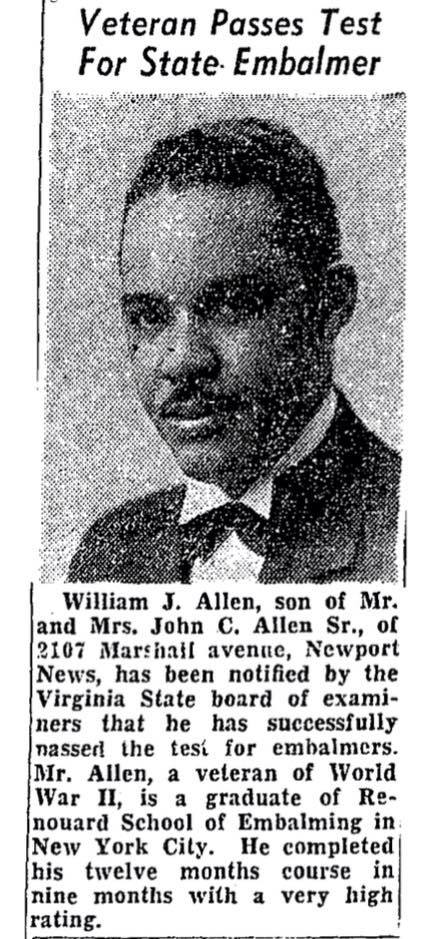
23 August 1947.
More from the Norfolk Journal & Guide — my great-uncles J. Maxwell Allen and William J. Allen.
21 July 1934.
23 August 1947.
My Aldridge cousin Barbie Jones has access to an archive of early editions of the Norfolk Journal & Guide, an African-American newspaper. All morning, she’s been pelting me with gems pulled from the pasts of both my Aldridge-Brewington family and my mother’s close family in Newport News. Here’s the first — stay tuned!

Norfolk Journal & Guide, 20 March 1948.
All five of my grandparents’ children, just three days before my mother’s birthday.
A cousin sent me this undated letter a few days ago, asking if I knew anything about it. She is descended from my great-great-great-grandfather Adam Artis‘ brother Richard Artis. Her Richard is not one of the Richards listed to in the document. (There were several contemporaneous Richard Artises just in the Wayne-Greene-Wilson County corner, none of whom I can link to one another.) The family history recounted in the letter smacks of the apocryphal, but it is interesting, and I will try to follow up on it.

I came back from vacation to find a nice new match at Ancestry.com. R.M. and I are double eighth cousins, as I am descended from two children of Isham and Jane Rogers Randolph — Thomas I. Randolph (1722-1788), who married Jane Cary (1751-1774), and Susannah Randolph, who married Carter Henry Harrison (1736-1793). (Thomas Randolph, Susannah Randolph Harrison, and Bettie Randolph Railey’s sister Jane Randolph married Peter Jefferson and gave birth to Thomas Jefferson.)

Ancestry estimates our relationship as 5th-8th cousins and rates the match as “Good,” meaning that we share 6-12 cM. (Which is quite high for 8th cousins, but is attributable to (1) our double lineage and (2) luck.) That’s lower than I’d ordinarily pursue, but I’ll take it.
On 19 August 1868, Thomas Leahey, Assistant Sub Assistant Commissioner of the Bureau of Refugees, Freedmen & Abandoned Lands (better known as the Freedmen’s Bureau), took pen in hand:

Leahey’s brief letter suggests deep familiarity with Joseph R. Holmes, my great-great-grandfather Jasper Holmes‘ brother. He is telling Holmes that he has moved his office from Farmville to Charlotte Court House and wants Holmes to notify his “people” — the community he represented — where they can find Leahey. Leahey’s invitation to meet at any time implies previous visits, though to date I’ve found no evidence of them in Freedmen’s Bureau records. Leahey’s inquires “whether there is a School for colored Children at Keysville, and if there is not what are the prospects of getting up one.”
Just three days later, in a clear hand and with fairly sound grammar speaking to years of practiced literacy — though he was only three years out of slavery — Holmes replied. He advised that a small for-pay school operated in the Keysville area and expressed pleasure at Leahey’s interest in education. He apologized for not having been to see Leahey sooner — “I have been so busey” — and mentioned that he was headed to Richmond the following day. (Who was “Lut. Grayham” A lieutenant in the U.S. Army’s First Military District?) If “life last,” he promised, he would see Leahey on the next court day.

Apparently, Holmes and Leahey did meet, then and perhaps on other occasions. The next bit of correspondence found between them is dated 24 November 1868, when Leahey sent Holmes a voucher for school rent. Whether this is the private school Holmes referred to in his August letter or a school established by the Freedmen’s Bureau is not clear. Leahey asks that “Mrs. Jenkins” sign the rent voucher as well as triplicate leases for the school. (I haven’t found copies of either to date.)

Who was Mrs. Jenkins? Below is a short stretch of the 1870 census of Walton township, Charlotte County, Virginia. It shows part of Joseph Holmes’ former neighborhood, just west of the town of Keysville. “Former,” because Holmes had been shot dead on the steps of Charlotte Court House in May 1869, as detailed here. There are his children, Payton, Louisa and Joseph Holmes, living with the family of Wat and Nancy Carter, whom I believe to be Holmes’ mother and stepfather. Two households away is 30 year-old presumed widow Lucy Jenkins, white, “teaching school.” Jenkins, born in Virginia, was no Yankee schoolmarm; I’m searching for more about her. Her commitment to the little school at Keysville, even after Holmes’ assassination, evinces some mettle.

Records from “Virginia, Freedmen’s Bureau Field Office Records, 1865-1872,” database with images, www.familysearch.org, citing microfilm publication M1913, National Archives and Records Administration.
My uncle sent this text:

Hampton University‘s women’s soccer team played its first match ever Friday evening. My niece scored the first and only goal. A New Jersey high school soccer phenom, she’s elected to run track in college. When she got to campus though, she walked onto the fledgling team. And immediately upped their game.
I don’t know how many fans cheered on the Pirates Friday. They’re new. They played a ways off campus. Classes haven’t even started yet. I do know, however, that there was a contingent of at least seven beaming and screaming and high-fiving — my father, my mother, my aunt, my uncles, my sister and my brother-in-law. They’d all have been super-proud of Sydney anyway, but those last six? They’re Hampton graduates. All five of my grandparents’ children went to Hampton. And my grandparents themselves? They met while students on campus. As did my sister and her husband. (Sydney’s dad and his twin are graduates.) My grandfather’s sister went to Hampton. So did her granddaughter. And two of my first cousins. And that’s just on my mother’s side. My father’s sister and her daughter have Hampton degrees, too. And more cousins, besides.
So forgive us if our chests are still puffed. I didn’t even go to the school, and I’m delirious with pride. This fourth-generation Hamptonian is not only carrying on a family legacy, but is making her own mark. And I’ve no doubt that she’ll tally equal success in the classroom.
Before my grandmother passed in February 2010 at age 101, she was the oldest living Hampton graduate. If only she could have been in the stands Friday.
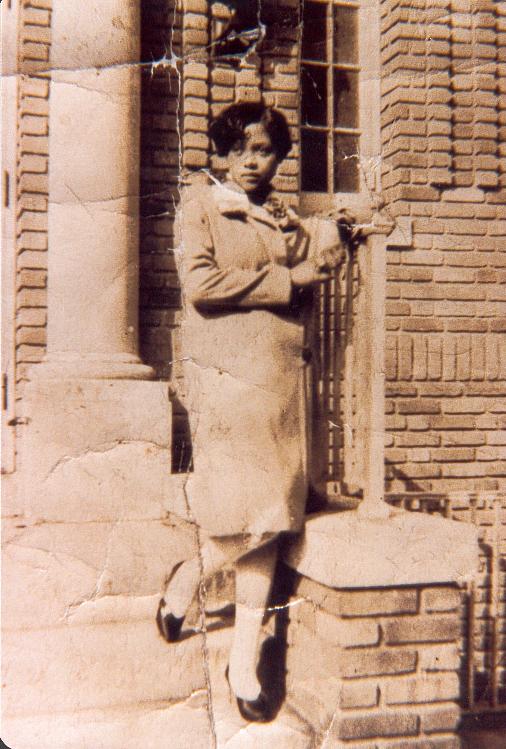
My grandmother on Hampton’s campus, circa 1928.
Back in April, after I connected the dots between my great-grandfather John C. Allen Sr. and Edward C. Harrison, I ran all my information by respected genetic genealogist Angie Bush. She agreed that autosomal DNA testing indicated a very close relationship between my mother and A.B. and that triangulation pointed directly to Edward as their common great-grandfather, but recommended another test that would absolutely eliminate some other line of patrilineal descent. I asked if my uncle would be willing to submit a sample for a Y-DNA analysis, which would show if he, via his father and grandfather, descended from a male Harrison forebear. He agreed without hesitation.
Here’s how it works: The Y chromosome passes down virtually unchanged from father to son. Occasionally, mistakes (or “mutations”) occur in the copying process, and these mutations can be compared to estimate the time frame in which two men share a most recent common ancestor (“MRCA.”) If their test results are a perfect or nearly perfect match, they are related within a traceable timeframe. Per Family Tree DNA, “Paternal line DNA testing uses STR markers. STR markers are places where your genetic code has a variable number of repeated parts. STR marker values change slowly from one generation to the next. Testing multiple markers gives us distinctive result sets. These sets form signatures for a paternal lineage. We compare your set of results to those of other men in our database.”
My uncle sent in his kit in early May, and his results posted a few days ago. The first thing I looked for was FTDNA’s designation of my uncle’s Y-haplogroup. 23andme had assigned him R1b1b2a1a1, which had given me pause because I’d seen the James River Harrisons’ Y-haplogroup listed as R1b1a2. FTDNA’s designation is regarded as more authoritative than 23andme’s, however, so I was anxious to see if the apparent discrepancy remained. It does not. The James City Harrisons’ haplogroup has been updated to reflect the most up-to-date naming conventions and is now R-M269. As is my uncle’s.
I next checked his matches. My uncle took the Y-67 test, which examined markers at four levels, 1-12, 13-25, 26-37, 38-67. I had matches at each level. Upon Angie Bush’s advice, I sent emails to two of my top matches inquiring into their line of descent. I haven’t yet heard back from either of them, but that’s all right.
They are, as are five of the seven top matches, either named Harrison or Bassett:

When I referred to the Harrison Y-DNA Project, I saw that lineage #34 (James River & Presidential Harrisons) contained two kits. One (H-4) traced descent to William Henry Harrison, born 1773 in Charles City County, and the other (H-99) to William Henry Bassett, born 1795.

(An explanatory note below stated: “According to family lore, William Henry Bassett b. 1795 was raised by Elizabeth Harrison Rickman, daughter of Benjamin Harrison IV, “The Signer,” and Elizabeth Bassett. William Bassett’s Y-DNA does not match any of the other known Bassett family’s; however, his descendant has a 63/67 match to the James River Harrison line DNA … indicating that in addition to being raised by the Harrison family, William Bassett was likely the son of one of the James River Harrisons.”)
The row of numbers along the top are the STR markers described above. Men whose markers match at 62/67 (or better) share a common ancestor and are grouped into a lineage. The image above only shows 24 markers, but there are actually 67. With H-4, the Presidential line, my uncle matches 63/67. With H-99, the Bassett line, he matches 65/67! John C. Allen Sr. and his patrilineal progeny, then, are members of Lineage 34. Specifically, they descend, in reverse order, from Edward Cunningham Harrison (1847-1908), William Mortimer Harrison (1817-1865), Thomas Randolph Harrison (1791-1833), Peyton Randolph Harrison (1759-1839), Carter Henry Harrison (1729-1796) [the younger brother of Benjamin Harrison V, signer of the Declaration of Independence, and uncle of President William Henry Harrison], and Benjamin Harrison IV (1696-1744).

Half-brothers John C. Allen Sr. (1876-1953) and Hugh T. Harrison Sr. (1886-1970), sons of Edward C. Harrison.
Many thanks to all who helped solve this 138 year-old mystery — my mother, my uncle, A.B. and her sister M.H., T.N., and the expert analysis and advice of Angie Bush.

My second cousin once removed A.B. and me, May 2015.
Thanks to my cousin M.D., we now know that Mary Agnes Holmes Allen and her mother Matilda belonged to haplogroup L1c1a1a1b.
M.D.’s mother, Nita Lourine Allen Meyers Wilkerson, was my grandfather John C. Allen Jr.‘s youngest sister. She was born 20 March 1913 in Newport News, graduated from Huntington High School, then received a nursing degree from Hampton Institute. Here’s Aunt Nita sitting on the front porch of her parents’ house on Marshall Avenue, circa 1916.

And her high school diploma:

In 1939, she married Marcellus W. Meyers, a native of Washington, DC, with Beaufort, South Carolina, roots. The couple moved to DC, where their only child was born. Aunt Nita retired from nursing in 1975, returned to Newport News, and immediately pursued a passion for Democratic politics. She served and supported local and state campaigns for nearly twenty years until moving to Maryland shortly before her death in 1996.

Nita in evening gown in the front hall of my great-grandparents’ house at 2107 Marshall Avenue, Newport News.
Matilda Holmes passed mtDNA haplogroup L1c1a1a1b to all her children, but only her daughter Mary Agnes Holmes Allen carried it further. In turn, of Mary Agnes’ children, only daughter Nita passed the haplogroup on. Today, as far I know, only M.D. and her son D.D. carry Matilda’s legacy.
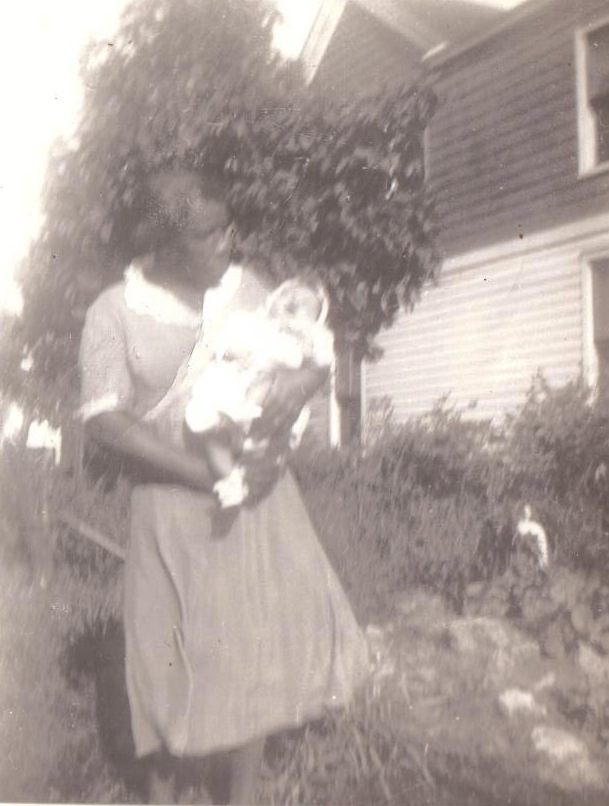
Mary Agnes H. Allen holding baby M., circa 1943.
Photos courtesy of Julia A. Maclin and M.D.
As I’ve written about here, visits to Norfolk, Virginia, to spend time with cousin Tilithia at her cafe were highlights of my grandmother’s childhood. They later lost contact, however, and it was not until I connected with B.J., a descendant of Tilithia’s sister Mattie Brewington Braswell, that I learned that Tilithia lived until 1965. I wish Mother Dear had known that.
In my earlier post, I mentioned that Tilithia was married to railroad fireman Walter Godbold during the years after World War I that my grandmother visited. “Her marriage to Godbold did not last,” I noted, “and the 1930 census found him back in Rocky Mount NC (described as divorced) and her still in Norfolk, holding herself out to be a widow while maintaining the little restaurant at 426 Brambleton Avenue.”
Ancestry.com’s Virginia Divorce Records database shed some light on this fractured set-up:
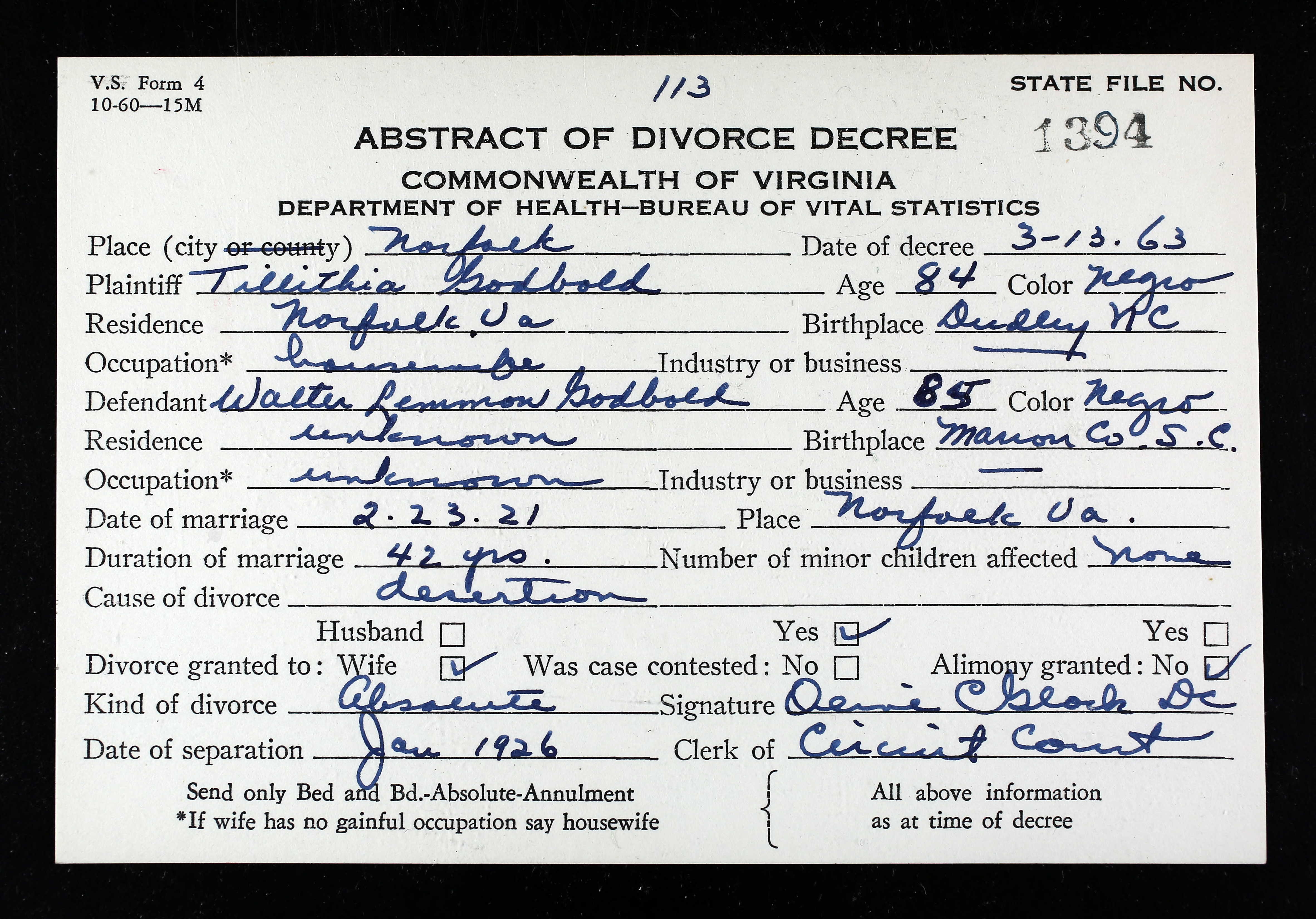
Yes. Apparently, Tilithia and Walter — married in 1921 and separated in early 1926 — stayed married for nearly 40 more years. Only in 1963 did Tilithia receive the divorce she finally filed for (and Walter contested.) Grounds: desertion. Walter was not new to that game, though he turned the tables in his go-round with Tilithia. Here’s the divorce record noting the dissolution of a previous marriage to a woman from his hometown, granted seven months before he married Tilithia:

And what could have led an 84 year-old woman to seek a divorce from a man she probably had not seen in decades? A third shot at love. Less than a month after her marriage to Godbold was dissolved, Tilithia married John Carter Dabney, a retiree nearly twenty years her junior.

This union, if happy, did not last long. A year and-a-half later, on 21 November 1965, Tilithia Brewington King Godbold Dabney passed away. Her heart failed, but presumably did not break.

On 4 September 1945, the “Colored News-Briefs” column of The Hopewell Times, included this brief passage:

That Graham Whirley‘s death by gunshot was not reported salaciously says a lot about the regard in which he was held both inside and out of his community in Hopewell.
Three days later, the Colored News-Briefs column carried a detailed account of Graham’s funeral, held at New Vine Baptist Church in Charles City County the previous Tuesday:

“Will My Mother Know Me There?” — we’ll come back to that.
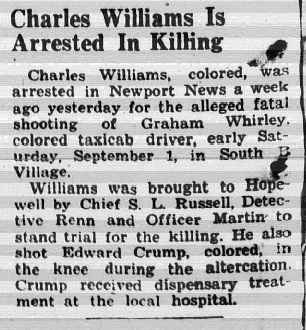
This brief piece was published 14 September. I haven’t yet found follow-up articles that reveal details of Graham Whirley and Charles Williams’ fatal encounter or of the outcome of Williams’ trial. What I have found, however, are numerous examples of the esteem in which Hopewell’s working-class African-American community held this relatively young man.
The first mention, on 8 December 1936, was a sweet one — “Miss Susie Whirley of Richmond was in the city last week visiting her brother at his home in City Point.” Though Graham’s social life — party attendance and motor excursions — received remarks (especially when he was courting a woman called Miss Carrie B. Lightly,) his singing brought the most notice. Time after time, the colored news noted that he had “rendered” a beloved hymn at a Baptist church in or around Hopewell:
In the middle of this, on 22 May 1944, the column announced that “Mr. and Mrs. Graham Whirley of City Point have returned after spending their honeymoon in Baltimore, Maryland.” That, of course, was where his half-brother John Whirley and sister Matilda Whirley Brinage lived. Just sixteen months after he remarried, Graham Whirley, taxi driver and sought-after soloist, was dead. Despite his move across the James River, he had never left his home church, and he is buried at New Vine.
 Scuffalong: Genealogy.