Land, North Carolina, Other Documents, Paternal Kin

He was rejoicing at the opportunity.

The sixth in an occasional series excerpting testimony from the transcript of the trial in J.F. Coley v. Tom Artis, Wayne County Superior Court, November 1908.

Defendant introduces JONAH WILLIAMS:

I have had a conversation about this land. All I know is what Hagans and Tom told me. The first talk was with Napoleon Hagans. (Defendant objects.) Best I remember I went to him to borrow some money to open my brick yard in the Spring. He referred to this deal and some other deal. Tom wanted to take up some papers, and had done so, and I remarked to Hagans how much better off than he was before. He said he was rejoicing at the opportunity. He promised to give 800 lb. of cotton until he could work a advance to him. He said if Tom did that he would never disturb him his life time. I asked Hagans to have it in a written contract, that his heirs might dissent from it. He replied that 800 lb. was a good interest on his money, and his heirs would probably be satisfied. I had a conversation with Tom. I saw him two or three weeks after that. (Plaintiff objects.) I spoke to him about Hagans taking up the Exum paper. He told me Hagans had ***** to take that up. Hagans had given him a chance to pay the debt off. Whenever he paid anything on the principle, he would not have to pay the 800 lb., but simply a lawful interest on the money. I advised Tom to do his best and pay some in on his principal.

CROSS EXAMINED.

He said that he had taken up the mortgage; had it transferred. He said Claim, I might have said mortgage. I don’t say ‘Pole Hagans told me all his business, but I knew about as much as anybody. Said he was going to let him, (Tom) pay 800 lb. of cotton until he could pay the principle. Mortgage given in 1881 to Mrs. Exum. This conversation about 12 or maybe 14 years ago. Don’t know whether it was as late as 1890. Began brick business in 1893. I can’t tell whether it was in 1880 or ’90. ‘Pole Hagans died about two or three years before this took place.  Tom married my sister. He is not a member of my church. I turned him out. He is a Primitive Baptist. I preached Napoleon Hagans’ funeral.

 ——

Elder Jonah Williams was a brother of my great-great-great-grandfather, Adam T. Artis. Adam Artis married Napoleon Hagans‘ half-sister Frances Seaberry. Tom Artis married Jonah and Adam’s sister Loumiza Artis.

Standard
Maternal Kin, North Carolina, Paternal Kin

Blog blessings.

  • On October 23, I blogged about connecting with D.J., a descendant of my great-great-great-grandparents Adam T. Artis and Robert and Mary Eliza Balkcum Aldridge via Lillie Bell Artis Thompson McDaniel Pridgen (1891-1935). A month and a half later, quite separately, I heard from P.M. via this blog. P.M. is also descended from Lillie Bell, though from her marriage to Celebus Thompson. (D.J. is from her second marriage, to McDaniel Whitley.) To my surprise, P.M.’s great-grandmother, Lillie Bell’s daughter Genetta Thompson, married Phillip Elmer Coley, a grandson of Winnie Coley. In her short life, Lillie Belle had twelve or so children. Many migrated north to New York and New Jersey, though, and I had not been able to trace them forward. So glad Scuffalong is bridging that gap!

Genetta Thompson Coley

Genetta Thompson Coley.

  • Just after Christmas, P.P. commented on “All of my possessions to have and to hold,” which featured by great-great-great-grandfather Walker Colvert‘s will. She identified Daniel Mullis, one of the witnesses to the document, as her ancestor. P.P. not only lives in the Eagle Mills area, she’s an avid genealogist and local history buff, she’s my cousin! Her great-grandmother Rebecca Ann Nicholson Barnard was a sister of my great-great-great-grandfather James Lee Nicholson. P.P. has a lifetime of knowledge about northeastern Iredell County and has volunteered to help me in any way possible. Two things she’s already shared: (1) The Welch-Nicholson house didn’t just fall down from age and neglect. It was torched by hooligans out on arson spree. This was back, probably, in the 1980s, not very long after the house achieved historic register status. (2) “Cowles” is pronounced COLES.
  • Around the same time I heard from P.P., I received a message from P.W. She’d been talking to her grandmother about family history, jotted down some names, Googled them, and immediately found “Where we lived: 114 West Lee Street.” To my amazement, she is a descendant of Madie Taylor Barnes, who migrated to New York City during the Great Depression and lost touch with her North Carolina family. I’m looking forward to talking to P.W.’s grandmother soon.
  • And then today: M.S. left a comment noting that her great-great-great-grandfather baptized my great-great-great-grandfather James L. Nicholson in 1842, and she’s a descendant of John A. Colvert, an owner of my great-great-great-grandfather Walker Colvert!

Photo courtesy of Patricia Smith Muhammad.

Standard
Births Deaths Marriages, Free People of Color, North Carolina, Other Documents, Paternal Kin

Misinformation Monday, no. 10.

Another example of the pitfalls of unquestioning acceptance of federal population schedules at face value. What you see (1) may not be what it seems and (2) is not all there is. Here, I follow my great-great-great-grandfather Adam T. Artis over the arc of his life, as recorded in census records.

Adam Artis was born in 1831 to a free woman, Vicey Artis, and her enslaved husband, Solomon Williams, most likely in Wayne or Greene Counties, North Carolina. In the 1840 census of one of those counties, he, his mother and siblings are anonymous hashmarks under the heading “free colored people” alongside the name of a white head of household.

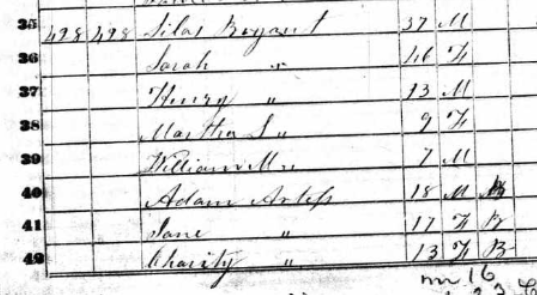
The 1850 census of Greene County is the first record of Adam’s existence:
AArtis 1850 Greene

White farmer Silas Bryant is the head of household. The other Bryants are presumably his wife and children. The significance of Adam Artess, Jane Artess and Charity Artess’ names listed below requires knowledge outside the four corners of the page. As I learned via subsequent research, Jane and Charity were Adam’s sisters. (Their mother and remaining siblings were listed next door at #429.) Though no bonds or other indenture documents survive, it is most likely that the Artis children were involuntarily apprenticed to Bryant until age 21 by the Greene County Court of Pleas and Quarter Sessions. Adam’s age is correct, so I assume that Jane’s and Charity’s are, too. The censustaker evinced some hesitation in describing Adam’s color, appearing to superimpose a B (black) over an M (mulatto.) This is a matter of some concern to descendants who deny that he was of African descent. No photographs of Adam survive, but his great-granddaughter D.B. told me she recalls seeing one in her childhood. It was later stored in a barn and ruined by rainwater. Adam, she said, was brown-skinned. Mulattohood was in the eye of the beholder, but I think it is safe to say that Adam had considerable African ancestry.

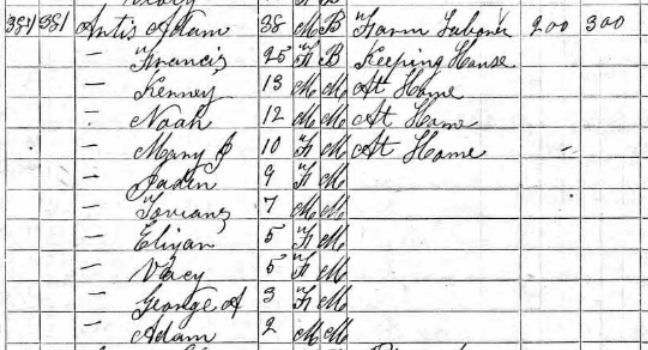
AArtis 1860 NNeuse Wayne

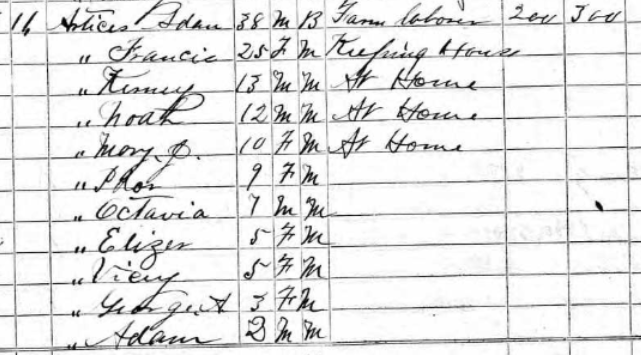
The 1860 census of the North Side of the Neuse River, Wayne County, tells a nuanced story. This entry contains the sole census reference to Adam’s skills as a carpenter, probably gained during his apprenticeship to Bryant. The $200 in personal property probably consisted mostly of the tools of his trade, and the $100 value of real property reflects his early land purchases. (I found a deed in Wayne County for Adam’s sale of ten acres to his brother-in-law John Wilson in 1855. The sale was a buyback, but Adam never recorded a deed for the original purchase.) Adam was a widower in 1860, and Kerney, Noah and Mary Jane were his children by deceased wife Lucinda Jones Artis. They were not his only children, however. His oldest two, Cain and Caroline, were enslaved alongside their mother Winnie Coley, and are not named in any census prior to 1870.) Jane Artis was Adam’s sister. Her age is about right, though his is off by a year or so. Her one month-old infant may have been daughter Cornelia, who is listed in the 1870 census as born in 1860. I’ve included two lines of the next household to highlight a common pitfall — making assumptions about relationships based on shared surnames. Though they were Artises and lived next door, Celia and Simon were not related to Adam Artis. At least, not in any immediate way. (Ultimately, nearly all Artises trace their lineage to a common ancestor in 17th-century Tidewater Virginia.) Adam’s son Jesse Artis testified directly to the matter in the trial in Coley v. Artis: “I don’t know that Tom and I are any kin. Just by marriage.”

So far, we’ve found basically accurate, if deceptively simple, census entries. 1870 is where the trouble starts. There’s this:
AArtis 1870 holden 1

But wait. There’s this, too:

AArtis 1870 holden 2

The first entry is found in the enumeration of Holden township, Wayne County. The second is in Nahunta. The first was taken 18 August by William R. Perkins. The second, 23 September. By William R. Perkins.

Huh?

I can’t begin to explain why Perkins rode the backlanes of northeast Wayne County twice and — in two different handwritings — recorded the same people living in the same houses as residents of different townships. Substantively, though, with a couple of exceptions, the two households attributed to Adam Artis are quite consistent. Adam and his wife Frances (Seaberry, whom he married in 1861) are shown with nine children whose ages are identical in both listings. The last six children were born to Frances, and some of their names take a gentle mauling between records. The oldest child was Ida, which is close to “Idar,” but not at all to the very modern-sounding “Jaden.” And who was Octavia/Tavious, a seven year-old male? Process of comparison and elimination identifies him as Napoleon Artis, often called Dock. Was Octavius his middle name? I’ve ever seen it used in any other place.

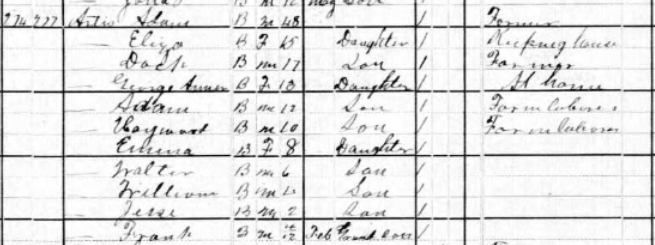
Fast forward ten years to 1880:
AArtis 1880 Nahunta 1880

Adam is again a widower, as wife Frances died shortly after the birth of son Jesse. Daughter Eliza is helping care for her eight siblings, plus grandbaby Frank, whose mother or father I have never been able to identify. (I have not even found clear evidence of Frank in any later record.) This living situation was not tenable, and Adam married again that very year to Amanda Aldridge, his son-in-law’s sister. Tragically, Adam and Amanda’s marriage was never recorded in a census record as she died days after the birth of her last child, Amanda Alberta, in 1899. Thus, Adam is a widower once more in 1900:

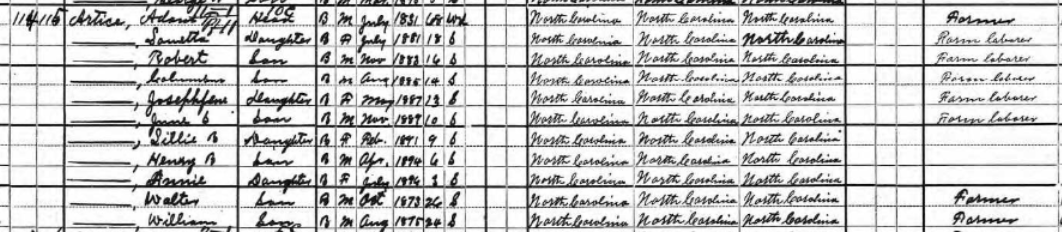
AArtis 1900

“Artice” is an alternate spelling of Artis seldom used by Artises themselves, but occasionally adopted by those recording them. In this record, two of Adam’s children with Frances, Walter and William, were still unmarried and living at home, but the remaining children are Amanda’s. Don’t be fooled by the absence of the infant Alberta. She survived her mother’s untimely death and was taken in by her half-sister Louvicey Artis Aldridge, who, presumably, nursed her along her own babies.

Adam remarried in 1903. The 1910 census accurately reflects his four legal marriages. (His informal relationship with Winnie Coley is omitted.) His latest (and last) bride, Katie Pettiford,  was 50+ years his junior. All of his older children have left (or fled) the nest except 12 year-old Annie Deliah Artis, whose status as “husband’s daughter” is carefully noted. Alphonzo Pinkney Artis was Adam’s last surviving child, though Katie reported giving birth to two others. Alberta was still with John and Vicey Aldridge — listed as “Elberta,” a “granddaughter,” speaking of misinformation — in their household at the other end of Wayne County in Brogden township. (Family stories say that this arrangement ended unhappily when Alberta learned, in her early teens, that she was not, in fact, Vicey and John Aldridge‘s child.)

1910 AArtis Nahunta Wayne

There is no 1920 census entry for Adam T. Artis. This father of nearly 30 children (23 of whom are listed with him in census records) and husband or partner of five (only two of whom show up in the census) died the 11th day of February, 1919.

Standard
Agriculture, Land, North Carolina, Other Documents, Paternal Kin

Maybe he might redeem it.

The fifth in an occasional series excerpting testimony from the transcript of the trial in J.F. Coley v. Tom Artis, Wayne County Superior Court, November 1908. 

Defendant introduces T.F. Jones, who being duly sworn, testifies:

I had a conversation with Napoleon Hagans about this land, the 30 acre piece. (Plaintiff objects to question and answer.) I got after Uncle ‘Pole to see me the land. I told him if he would give me a deed for both places, the Calv Pig, that is the 24 acre piece, and the Tom Pig place, the 30 acre piece, I would take them. He told me he would sell me the Calv Pig place, but the Tom Pig place he had promised to let Tom stay on that as long as he lived, that maybe he might redeem it. That about ended the conversation with us. I bought some timber off this land from Tom. Off of the 30 acre piece. I suppose Hagans knew about it. (Plaintiff objects.) I couldn’t say that Hagans saw me hauling the timber, I guess he saw me. (Plaintiff objects.) Hagans never made any objection. I had a conversation with Tom about this land along during that time, when Uncle ‘Pole Hagans first got rid of that Calv Pig place, about 15 years ago. I asked him if he wouldn’t sell his part, and what would he ask for it, (Plaintiff objects). He said he didn’t want to sell it, he expected to redeem it sometime. Last Fall I told him if he expected to get that mortgage he had better attend to it. He said he had boys in Norfolk, who would take it up; that he had confidence in Will Hagans. That if his boys let it slip out after he died, they could. (Plaintiff objects.)

CROSS EXAMINED.

Mr. W.J. Exum died about 1885. Tom is known as Pig. I don’t know why he was called Pig. I think they got “Pig” from “Diggs”. Some of his people ‘way back there, were named “Diggs”, and they got to calling it “Pig” for short. I remember when Napoleon Hagans died. I was down the Country. I left here in ’94, and came back in 1900. He died during that time. I got this timber 20 years ago. I was buying all I could, I don’t know how much I got. I got it by the tree. I went in 1881 and milled ’till 1890. Either ’81 or ’82. I bought the timber about that time. I didn’t know that the deed from Mrs. Exum to Hagans was executed before 1892.

——

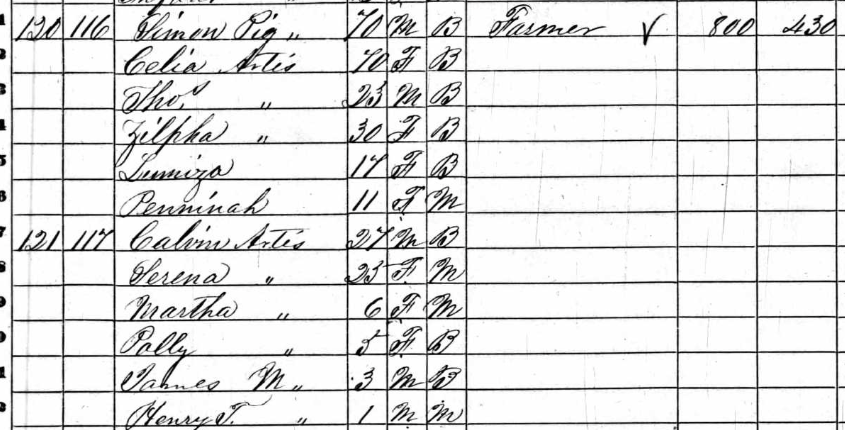
Jones’ explanation of Tom Artis’ nickname is unsatisfying. “Pig” from “Diggs”? In fact, Thomas and Calvin Artis took their name from their father, an enslaved man, who was called “Simon Pig.” Artis was the surname of their mother Celia, a free woman of color. Though I have found no other record that he was manumitted prior to Emancipation, Simon Pig Artis is listed as the head of his household in the 1860 census of Davis township, Wayne County. He reported (or was attributed with) $800 of real property and $430 of personal property. The land was almost surely his wife Celia’s; she is one of the earliest free colored property owners appearing in Wayne County deed books.

Screen Shot 2014-12-18 at 9.32.43 PM

Diggs, on the other hand, while a family surname, was that of Frances Artis Diggs, daughter of Tom and Calv’s oldest sister, Eliza Artis. Frances married Wilson (or William) Diggs in 1868 in Wayne County. (Two of Frances and Wilson’s granddaughters, Etta and Minnie Diggs, married a son, William M., and a grandson, Leslie, of Adam T. Artis. As discussed here, Adam and Celia Artis were not meaningfully related.)

Standard
Education, Other Documents, Paternal Kin

Signature Saturday, no. 1: Adam Artis’ children.

Adam T. Artis was illiterate. Though a smart and successful man, he executed contracts with a shaky X and probably conducted much of his business on the basis of verbal agreements. Here, his mark on a receipt for goods purchased from him by the Confederate government in 1863:

Adam Artis mark

There’s little evidence to show whether Adam’s wives could read and write, but it seems doubtful that the first three or four could. His granddaughter Pauline Artis Harris told me that education was important to him, however, and he hired a teacher to live on his farm and school his children. His efforts bore fruit. Below, the signatures of eight of Adam’s 26 or so children.

The signature of the oldest son, Cain Artis (1853-1917):

Cain Artis Sig

The signature of Louvicey Artis Aldridge (1865-1927) on the final account of her husband’s estate:

Screen Shot 2014-12-05 at 5.15.29 PM

It is, perhaps not surprisingly, the shakiest of the bunch. Vicey was among Adam’s earlier children and likely came along before her father’s resources allowed for tutors. She was also a girl.

From the World War I draft registration card of Walter Scott Artis (1874-1951):

Screen Shot 2014-12-04 at 10.19.31 PM

From the World War I draft registration card of William Marshall Artis (1875-1945):

Screen Shot 2014-12-04 at 10.20.18 PM

From the World War I draft registration care of Jesse Artis (1878-1922):

Screen Shot 2014-12-04 at 10.21.39 PM

Jesse used the alternate spelling “Artice,” which was rarely adopted by members of this family. Notice that somewhere between William and Jesse’s early schooling, cursive capital A’s shifted in style from a form very similar to a printed “A” to one like an oversized small “a.”

From the World War I draft registration card of Robert Elder Artis (1883-1934):

Screen Shot 2014-12-04 at 10.22.22 PM

From the World War I draft registration of Columbus Estell Artis (1886-1973):

CE ARtis Sig

C.E.’s signature is interesting. This round, upright script, from 1917, is a relatively early version. Later, over the course of the hundreds of death certificates he signed as an undertaker, he developed a bold, right-leaning, immediately identifiable signature characterized by a bold slash through the “r” in Artis:

Screen Shot 2014-12-07 at 10.48.17 AM

From the World War I draft registration card of June Scott Artis (1889-1973):

Screen Shot 2014-12-04 at 10.23.21 PM

Though his letters are well-formed and decisive, the missing “S” in Scott suggests a man who signed his name from memory and did not write much.

From World War I draft registration card of Henry J.B. Artis (1892-1973):

Screen Shot 2014-12-04 at 10.26.43 PM

From the Social Security application of Alphonso Pinkney Artis (1903-1976):

[I’ve got this somewhere. I just need to find it.]

Standard
Agriculture, Free People of Color, Land, North Carolina, Other Documents, Paternal Kin

I never heard anything but “rent.”

The third in an occasional series excerpting testimony from the transcript of the trial in J.F. Coley v. Tom Artis, Wayne County Superior Court, November 1908. Paragraph breaks inserted for better readability.

Plaintiff introduces Jonah Reid who being duly sworn, testifies as follows:

I have heard Tom Artis say that he was going soon to pay his rent with cotton to [William S.] Hagans. I don’t know how often I have heard him speak of that, I have heard him say something about it several times when rent was due. I didn’t hear him say what lands. Some times he was cultivating the three pieces, sometimes the 30 acre piece. I am his son-in-law. I never lived with him. Live back of his house. Never heard him call it anything but rent cotton, not interest cotton. (Defendant objects.)

CROSS EXAMINED.

I told Hagans that I heard the old man say he was going to pay his rent, that was along in September, I think this past September. The only reason I told him was he asked me. He came by where I was working on the road. He asked me how long I had been in the family. I told him 16 years. He asked if I had ever heard anything but rent. I told him no. That’s why I told him. That’s all he asked me. Tom worked the three pieces, then afterwards the 30 acre piece. That’s all I remember Hagans said. I didn’t know there had been a suit about the land. Hadn’t had the suit yet. I said I didn’t like to say anything about my father-in-law. Hagans didn’t tell me that he Artis was claiming that he was paying interest. I just answered what he asked me. I told him I had never heard any thing but “Rents”.

——

Jonah Reid was married to Magnolia Artis (1871-1939), daughter of Thomas and Loumiza Artis Artis. Loumiza Artis was a sister of my great-great-great-grandfather Adam T. Artis. One of Adam Artis’ wives, Frances Seaberry, was William Hagans’ paternal aunt.


Standard
Agriculture, Land, North Carolina, Other Documents, Paternal Kin

I would be glad if you would wait a few days.

The second in an occasional series excerpting testimony from the transcript of the trial in J.F. Coley v. Tom Artis, Wayne County Superior Court, November 1908. Paragraph breaks inserted for better readability.

Plaintiff introduces H.S. REID who being duly sworn testifies as follows:

I know the Defendant Tom Artis. I had a conversation with him in reference to payment of cotton to [William S.] Hagans. This last fall I was on the road with Hagans and met Tom Artis carrying a bale of cotton. Heard conversation between Artis and Hagans. When we met in the road Tom said, “You are leaving home, and I have started to your house with a bale of lint cotton.” Hagans told Tom to carry it on as quick as he could, for he needed it about as bad as he ever saw anyone. He said that in a joking way. Hagans started off, and he said, “Hold on Captain!” He told him that he understood that he was going to sell the land down there. Hagans said yes, that it was for sale. Tom said, “I would be glad if you would wait a few days Captain, I think I can raise the money for that place, didn’t say what place just then. Hagans said he had rather sell it altogether. Tom said if he would give him a few days until he could see his boys, he thought he could raise the money for it all. Hagans said alright, it was all for sale. That was about the end of the conversation and we parted. Later then that one day, at Eureka, Artis asked me if I knew when Hagans would be out at his place. I told him about the day Hagans told me he would be out there. Artis said I wish I would deliver a message to Hagans for him, “ask him not to sell that place to Mr. Wright Cook. Said if he did, he would be out of house and home. He said he would rather Hagans sell it to Coley, for he thought he could get along better with Mr. Coley. I delivered the message to Hagans when he came out home. I think this is about the substance. That last conversation was a short while before the sale I think. Am not real sure when it was.

CROSS EXAMINED.

I told this conversation about Tom wanting Hagans to wait before he sold the land. I told several people, I don’t remember all. I am not able to tell. I think Hagans and I talked about Tom Wanting to buy the land. I am not positive. I heard Hagans say that the old man wanted to buy the land from him, as I remember. I think I told the lawyer about the first conversation.

HENRY S. REID recalled by Defendant.

I don’t know that on the occasion I met Tom Artis, that he forbid Hagans selling his land. It wasn’t mentioned that day. I have never admitted to Tom that he forbid Hagans selling that land.

Standard
Agriculture, North Carolina, Other Documents, Paternal Kin

Security for indebtedness.

Goldsboro, N.C. Sept 19, 1905. On the 1st day of Oct 1906 for value received, with interest from date until paid at 6 per cent, per annum, we, or either of us, promise to pay Bennett Live Stock Co. or order twenty seven 50/100 DOLLARS, for bal[illegible] 2 horse Hackney wagon years old which stands security for this note and remains their property till paid for. And as further security for said indebtedness I hereby sell and convey to ________ the following property, to-wit: ________________ with full power to close this lien as provided in Section 1800 of the Code. /s/ Napoleon Artis. Witness Don Scott.

——

Goldsboro, N.C. Octo 26, 1905. On the 10 day of Jany 1906 for value received, with interest from date until paid at 6 per cent, per annum, we, or either of us, promise to pay Edgerton & Edgerton or order One hundred & two DOLLARS, for One bay mare about 8 years old and said mare 9 years old which stands security for this note and remains their property till paid for. And as further security for said indebtedness I hereby sell and convey to ________ the following property, to-wit: It is understood that if $5.00 is paid in this note the balance is to stand until the 1st day of Octo 1906 with full power to close this lien as provided in Section 1800 of the Code. /s/ Robert E. Artis, June Scott Artis. Witness Walter Sasser.

——

Napoleon, Robert and June Scott were sons of Adam T. Artis. Napoleon’s mother was Frances Seaberry; his brothers’ was Amanda Aldridge.

From Lien Record Book 44, Register of Deeds Office, Wayne County Courthouse, Goldsboro NC.

Standard
Free People of Color, Migration, Newspaper Articles, North Carolina, Paternal Kin

Another Arkansas Artis.

Scrolling through old notes, I found two more Artises — Nathan and John — who migrated to Arkansas, probably in the 1880s.

Here’s what I know about them:

  • Nathan and John Artis were the sons of Charity Artis, daughter of Solomon Williams and Vicey Artis. I don’t know who their father was. They were first cousins of Gus Artis and Eliza Artis Everett and second cousins of Guy Lane Jr., all of whom headed west from Wayne County, North Carolina.
  • The 1870 census of Nahunta, Wayne County, shows Solaman Williams, 70 year-old farm laborer, with daughters Charity and Daliley and grandsons Anderson, Nathan, and John.
  • In the 1880 census of Pikeville, Wayne County, Nathan Artis is listed as a nephew in the household of farmer Jonoah Williams, farmer, his wife Pleasant, and children George, Cora, Clarissa, Willie and Vicey.
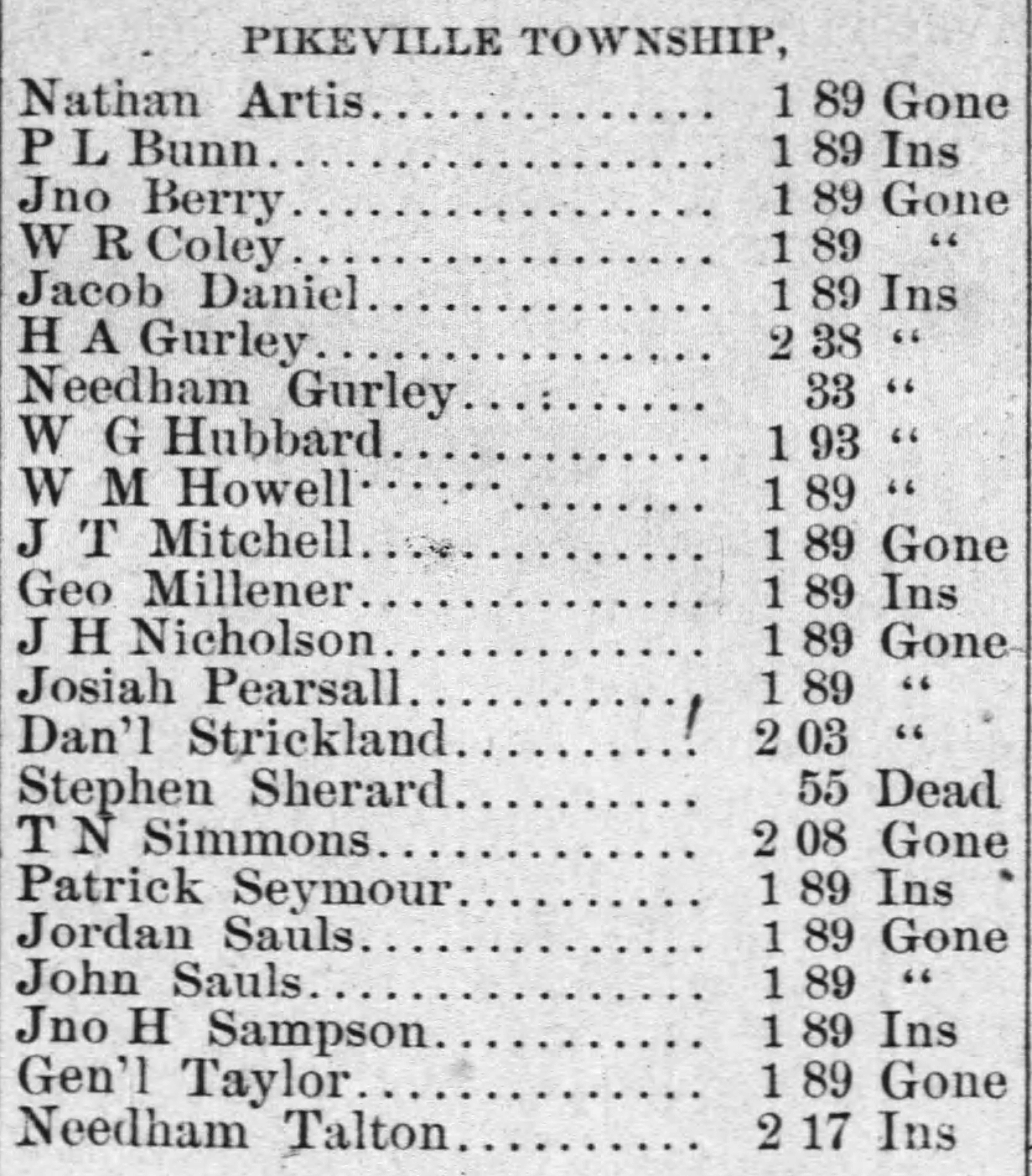
  • This is a notice of delinquent and insolvent taxpayers published in the Goldsboro Headlight on 28 September, 1893. Nathan Artis is GONE.

The_Goldsboro_Headlight_Thu__Sep_28__1893_

Goldsboro Headlight, 1893. 

  • In the 1900 census of Point, Woodruff County, Arkansas: Nathan Artist (born February 1852, NC, farmer), Nora (born Dec 1863), and children John F. (October 1877), Bicy Ann (December 1880), Nathan jr. (March 1883), Adalina (February 1885), James H. (October 1887), Lou (August 1890), Solomon (September 1891), and McKinley (November 1897); plus Nathan’s brother John Artis (May 1866, NC), nieces Parthena (December 1894) and Alsie (February 1899) and nephew John H. (February 1897).  Nathan’s last four children were born in Arkansas.  The nieces and nephews were born in Arkansas to a North Carolina-born father and Tennessee-born mother.
  • In the 1910 census of Point, Woodruff County, Nathan Artis (55, farmer, b. NC), wife Norah (50, b. NC), and children Solomon (16), McKenley (11), Markannon (11), Mittie Ann (8) and Anderson (6), all born in Arkansas.  Nora reported 10 of 15 children living. John Artis (47, born NC) appears in the same township with second wife Bettie (33, born Georgia) and children Parthenia (14), John Henry (12), Elsia Jane (11), Pinkie Ann (7), Josheway (5) and Daisy (3), plus Mary Artis (65), described as “mother.” [Who was this? A stepmother? Bettie’s mother?]
  • Nathan Artis died 3 August 1915 in Woodruff County, Arkansas, and was buried in Harris cemetery in that county. His headstone gives his birthdate as 23 January 1849.
  • Nathan’s five sons registered for the World War I draft: (1) Nathan Artis, born 12 March 1885; resided Brinkley, Monroe County, Arkansas; section laborer for St.L.S.W.Ry.; wife Mary Artis; tall, medium build, brown eyes, black hair; signed his name; registered 12 September 1918; (2) James Artis, born 14 November 1888 in “Goldsburg,” NC; resided Aubrey, Arkansas; farmer for self; supported wife and three children; medium height, slender, brown hair and eyes; registered 5 June 1917; (3) Mark Hanna Artis, born 6 November 1896; resided Audrey, Arkansas; employed by T.F. Turner; nearest relative, Nora Artis; medium height, slender, black hair and eyes; signed with X; registered 5 June 1918; Mark’s twin (4) McKinley Artis, born 6 November 1896; resided Audrey, Arkansas; employed by Angeline Steward; nearest relative, Frances Artis; tall, medium build, black hair and eyes; signed with X; registered 5 June 1918; and (5) Solomon Artis, born 16 November 1893; resided Aubrey, Arkansas; farmer for self; single; medium height and build, black hair and eyes; signed with X; registered 5 June 1917.
  • So did John’s oldest son John Henry Artist, born 8 April 1899; resided Gregory, Arkansas; farmer for John Artist; nearest relative, John Artist; tall, medium build, brown eyes, black hair; signed with X; registered 12 September 1918.
  • John Artis was alive as late as 1930, when he appears in the census of Mississippi County, Arkansas.
  • At least two of Nathan Artis’ sons migrated to the Memphis. McKinley, died there in 1925 of tuberculosis. His first cousin John Henry, who lived in Oakville, Shelby County, died three years later of the same disease brother. His brother “Jack,” however, lived into early middle age, dying in Memphis in 1939. The remainder of Nathan and John Artis’ children seem to have remained, at least till the eve of World War II, in eastern Arkansas.


Standard