
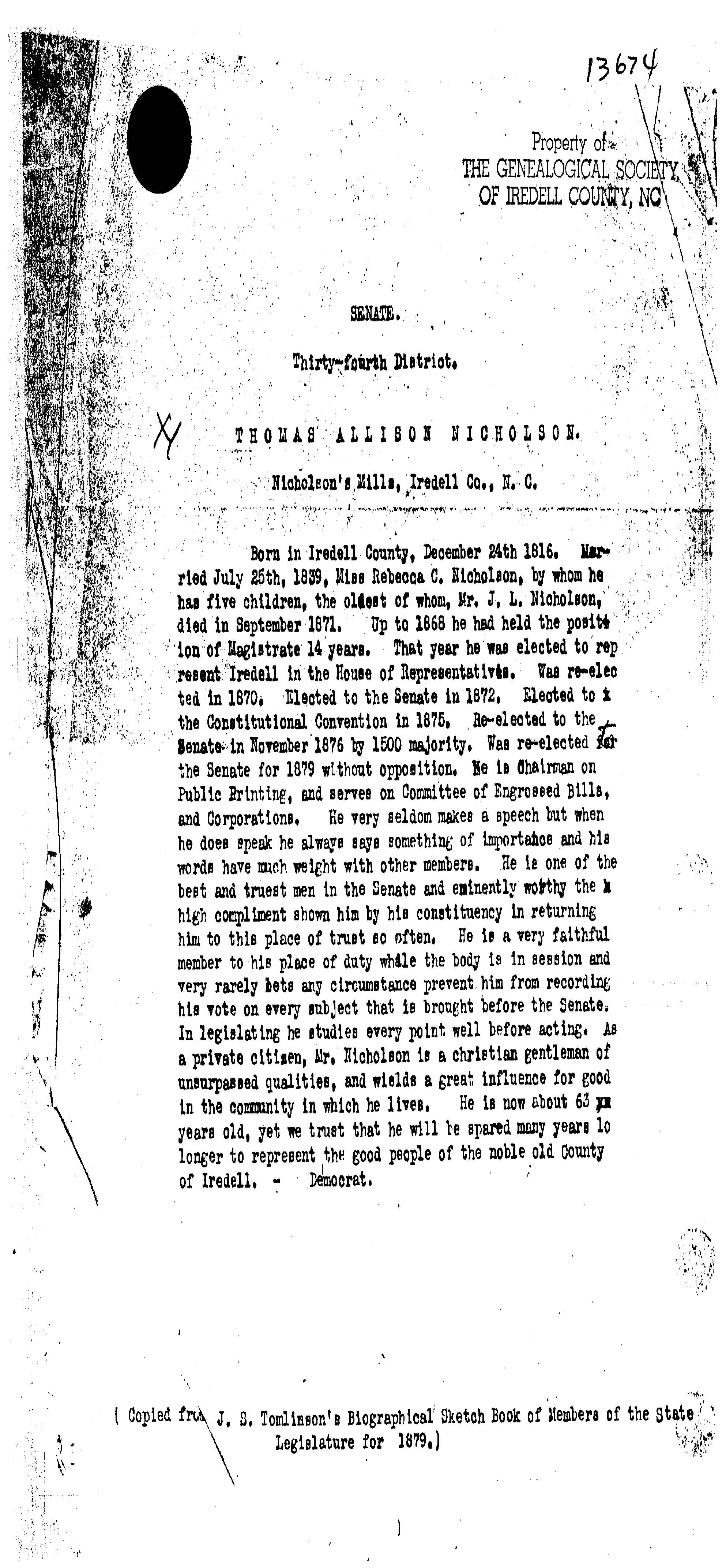
 This Christian gentleman had been a slaveholder, of course. Indeed, owner of his very granddaughter.
Tag Archives: Iredell County
Murdock v. Deal, 208 N.C. 754, 182 S.E. 466 (1935).
In case you’re interested, here’s the text of the Supreme Court’s decision regarding Bertha Hart Murdock’s land. Property law is not my strong suit, especially as it applies to inheritance, so I will not attempt an explication.
——
This is an action for a declaratory judgment construing the last will and testament of T. L. Hart, deceased, and adjudging that by virtue of said last will and testament the feme plaintiff is the owner of an indefeasible estate in fee simple in certain lands described in the complaint, and has the power, with the joinder of her husband, to convey the same in accordance with her contract with the defendant.
The facts admitted in the pleadings are as follows:
T. L. Hart died in Iredell county, N. C., during the year 1930, having first made and published his last will and testament, which was duly probated by the clerk of the superior court of Iredell county, and recorded in the office of said clerk on June 4, 1930.
By his last will and testament, the said T. L. Hart devised his home place in Iredell county “to my daughter, Bertha May Hart and her bodily heirs, forever, never to be sold, and if she dies without bodily heirs, then it must be in trust for my sisters’ heirs, to hold but never to sell the same.”
By a codicil to his said last will and testament, the said T. L. Hart devised to his daughter, Bertha Mae Hart, a tract of land in Iredell county, containing forty-five acres, and described in the complaint by metes and bounds.
At his death, T. L. Hart left surviving as his only heir at law his daughter, Bertha Mae Hart, who has since intermarried with the plaintiff W. J. Murdock. He also left surviving five sisters, three of whom are married. Each of these sisters has children. Neither of his two unmarried sisters has children. Both are now over fifty years of age.
On April 1, 1935, the plaintiffs and the defendant entered into a contract in writing, by which the plaintiffs agreed to convey to the defendant a fee-simple estate, free and clear of all liens or incumbrances, in two tracts of land, one tract containing twelve acres, and being a part of the home place of T. L. Hart, deceased, which was devised to the feme plaintiff by the said T. L. Hart in his last will and testament, and the other tract containing forty-five acres and being the tract which was devised to the feme plaintiff by T. L. Hart, deceased, by the codicil to his last will and testament. By said contract, the defendant agreed to pay to the plaintiffs the sum of $1,000, upon the execution and delivery to him by the plaintiffs of a deed conveying both said tracts of land to the defendant, in fee simple, in accordance with said contract.
The defendant has refused to accept the deed tendered to him by the plaintiffs, and has declined to pay the plaintiffs the sum of $1,000, in accordance with said contract, on the ground that the feme plaintiff is not the owner of an indefeasible estate in fee simple in said tracts of land, and for that reason the plaintiffs cannot convey to him such an estate in said lands, in accordance with their contract.
On these facts the court was of opinion and so held that the feme plaintiff is the owner of an indefeasible estate in fee simple in the forty-five-acre tract, but that she is not the owner of such an estate in the twelve-acre tract.
It was accordingly ordered, considered, and adjudged that plaintiffs are not entitled to the specific performance by the defendant of the contract set up in the complaint, and that the defendant recover of the plaintiffs the costs of the action. The plaintiffs appealed to the Supreme Court, assigning as error the holding of the court that the feme plaintiff is not the owner of an indefeasible estate in fee simple in the twelve-acre tract described in the complaint.
Opinion
CONNOR, Justice.
There is no error in the judgment in this action. By virtue of the last will and testament of her father, T. L. Hart, deceased, and under the statute, C. S. § 1734, the feme plaintiff is the owner of an estate in fee simple in the twelve-acre tract described in the complaint. This estate, however, is defeasible upon the death of the feme plaintiff without bodily heirs. Whitfield v. Garris, 131 N. C. 148, 42 S. E. 568, and Id., 134 N. C. 24, 45 S. E. 904. It is clear that the words “bodily heirs,” used by the testator, must be construed as meaning children or issue; otherwise the limitation over to the heirs of the sisters of the testator would be meaningless. Rollins v. Keel, 115 N. C. 68, 20 S. E. 209. See Pugh v. Allen, 179 N. C. 307, 102 S. E. 394.
The limitation over to the heirs of the sisters of the testator, upon the death of the feme plaintiff, without bodily heirs or issue, is not void. The provision in the will that the home place of the testator, which includes the twelve-acre tract described in the complaint, shall not be sold by either the feme plaintiff or the remaindermen is void as against public policy. This provision, however, does not affect the validity of the devise either to the plaintiff or to the remaindermen. See Lee v. Oates, 171 N. C. 717, 88 S. E. 889, Ann. Cas. 1917A, 514.
There is nothing in the codicil which affects the estate in the home place of the testator devised in the will to the feme plaintiff.
The judgment is affirmed.
Bert’s estate.
She wanted a baby badly.
My grandmother: … that nephew, Dr. Lord’s son, that was Mr. Hart’s nephew. He got what Bert had. Yes, indeed. ‘Cause, see, it was heir property. And see that’s why Bert tried so hard to have a child. Because if she didn’t have a child, it was going to whoever had had a child. You know. And I guess Alonzo did, you know, he was a nephew. When Bert died, it went to him. See, all this property and everything that Mr. Hart owned there was his family’s stuff. Wasn’t Grandma Hart’s.
And in 1941, when she nearly 40 years old, Bertha Hart Murdock had one:
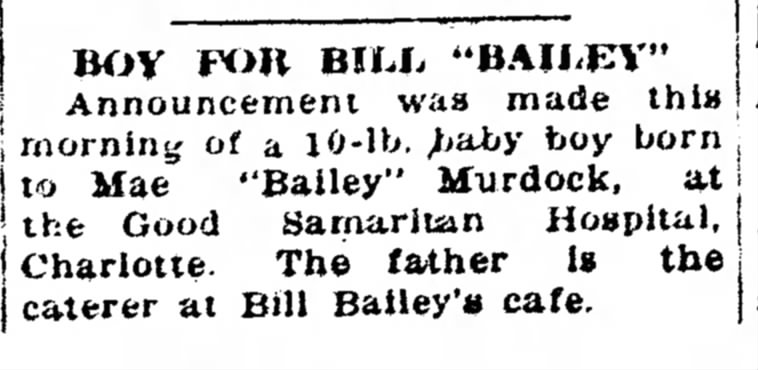
Statesville Landmark, 2 April 1941.
But little William Alonzo Murdock died the day after he was born.
Still, the situation for Bert and her property was not as critical as my grandmother had believed. In Alonzo Hart’s original will, made 15 October 1928 in Statesville, he devised “the home place to my daughter Bertha Mae Hart and her bodily heirs, for ever, never to be sold and if she dies without bodilies heirs. Then it must be in trust for my sisters heirs to hold but never sell same.” The remainder of his property went to his sisters’ heirs.
Thirteen months later, as he languished in the state sanitorium in Quewhiffle, dying of tuberculosis, Hart dictated a codicil. In somewhat opaque and ungrammatical phrasing, Hart “hereby enlarge[d] the privilege to and use at her own and released to her. In stead of one parcel or tract of land I do bequeath and devise to her following described lands, In Iredell North Carolina, 45 acres in Concord Township (Deatonsville) Also 2 lots with one house Statesville Township also 47 acres in Shiloh township and Crawford near Sumters place 22 acres in above township near home belong to the home resdue. I am in my right presence of mind and know what is best for my only and legal heir Bertha Mae Hart.”
In other words, Bertha’s inheritance was generous and unrestricted, and her cousin Alonzo Lord was not to receive anything at all. Things did not go smoothly, however. Hart’s unconventional wording opened the door to challenge, and Bertha was forced to defend her title.
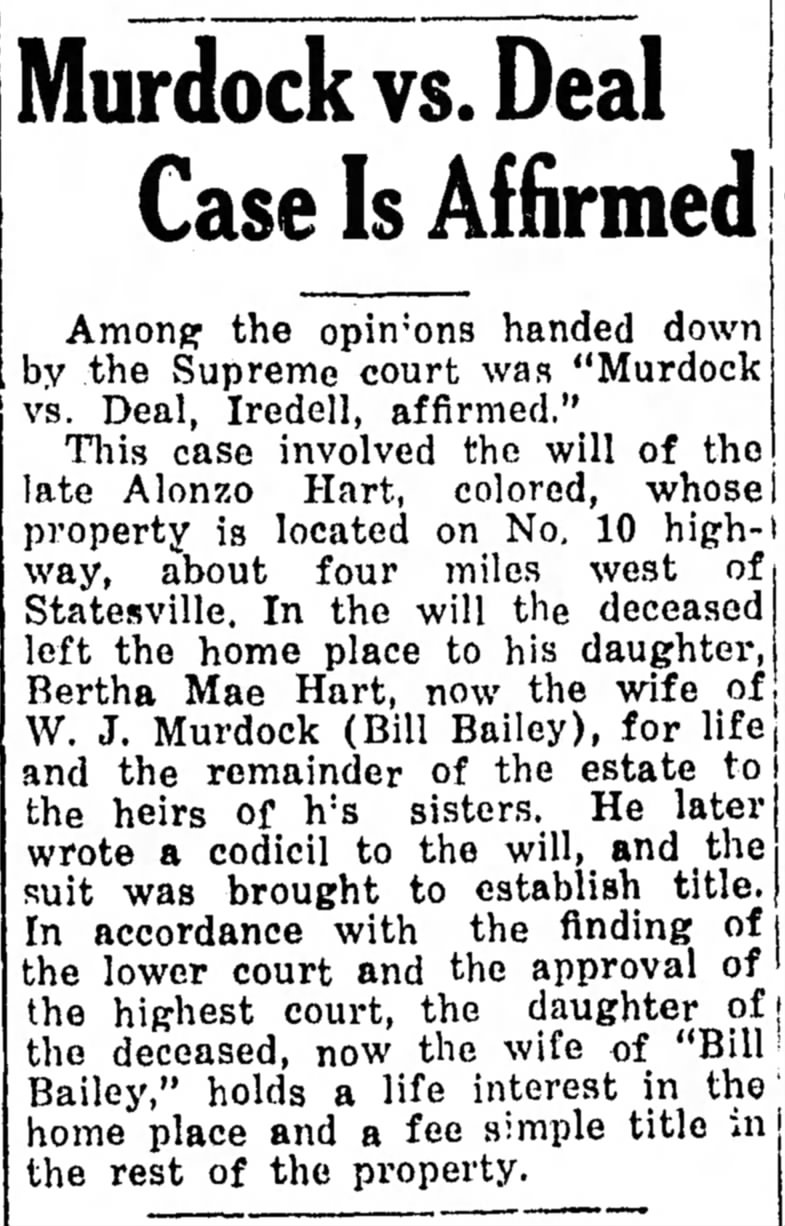
Statesville Landmark, 21 November 1935.
Incredibly, this case went to the North Carolina Supreme Court: Murdock v. Deal, 208 N.C. 754, 756, 182 S.E. 466, 467 (1935).
By time Bertha died in 1955, her estate seems to have been much reduced, but still comprised some of Alonzo Hart’s land. The bulk of her estate went to Odessa A. Williams, who may have been her cousin. Her half-brother H. Golar Tomlin inherited only a half-interest in a lot. His daughter Annie LaVaughn Tomlin Schuyler received the other half. Another niece, Mattie Johnson, received the negligible sum of one dollar, which raises questions: who in the world was she? I only know of Golda’s one child. Was this in fact Mattie James, oldest daughter of Bert’s other half-brother, Lon Colvert? Why bother with a dollar? And why not give the other nieces, Louise Colvert Renwick, Margaret Colvert Allen, and Launie Colvert Jones, their own dollars?

Statesville Landmark, 8 June 1955.
The drama did not end with Bert’s death. In what looks to be the family’s own Bleak House saga, City of Statesville v. Credit and Loan Company, a corporation of the State of North Carolina; W.S. Nicholson and spouse, if any, and if they be deceased, then their unknown heirs, and if any of said unknown heirs be deceased, then their respective heirs, devisees, assignees, and spouses, if any; and the unknown heirs of Minnie Brawley, Florence Camp, Mollie Alexander, and Lula H. Lord, Deceased, and if any of said unknown heirs be deceased, then their respective heirs, devisees, assignees, and spouses, if any; and all other persons, firms and corporations who now have, or may hereafter have, and right title, claim or interest, in the real estate described herein, whether sane or insane, adult or minor, in esse, or in ventre sa mere, active corporations or dissolved corporations, foreign or domestic, 294 S.E.2nd 405, was not decided in the North Carolina Court of Appeals until 1982.
The first sentence of the decision: “The sole issue is whether plaintiff has a valid avigation easement over land owned by defendant.” An avigation easement is a property right acquired from a landowner for the use of air space above a specified height. Alonzo Hart’s home property was located a few miles west of Statesville, adjacent to land now home to Statesville Regional Airport. (Brawley, Camp, Alexander and Lord were his sisters.) The City of Statesville’s claim that it held prescriptive easements was rejected, and partial summary judgment entered for the defendants.
——
Interview of Margaret C. Allen by Lisa Y. Henderson; all rights reserved.
Accept no pass unless …
Ring the Court House bell at 10 o’clock every night and at all other times when necessary to alarm the citizens.
Arrest all slaves absent from home after the bell rings and after the calaboose is finished lock them up till day light. Give them 15 lashes and inform the magistrate of their names and owners.
Accept no pass unless the place or places where the slave is permitted to go is written in the same and arrest the slave if found off a direct line or road from one place to another.
Arrest all slaves engaged in a disturbance either with or without a pass.
A pass allowing a slave to visit his wife is good for one month and then must be taken up and another given or he will be arrested.
Iredell County slave ordinances, undated. North Carolina State Archives.
Nicholson reunion.
These were Harriet Nicholson Hart‘s people, though I can guarantee you she was not there:
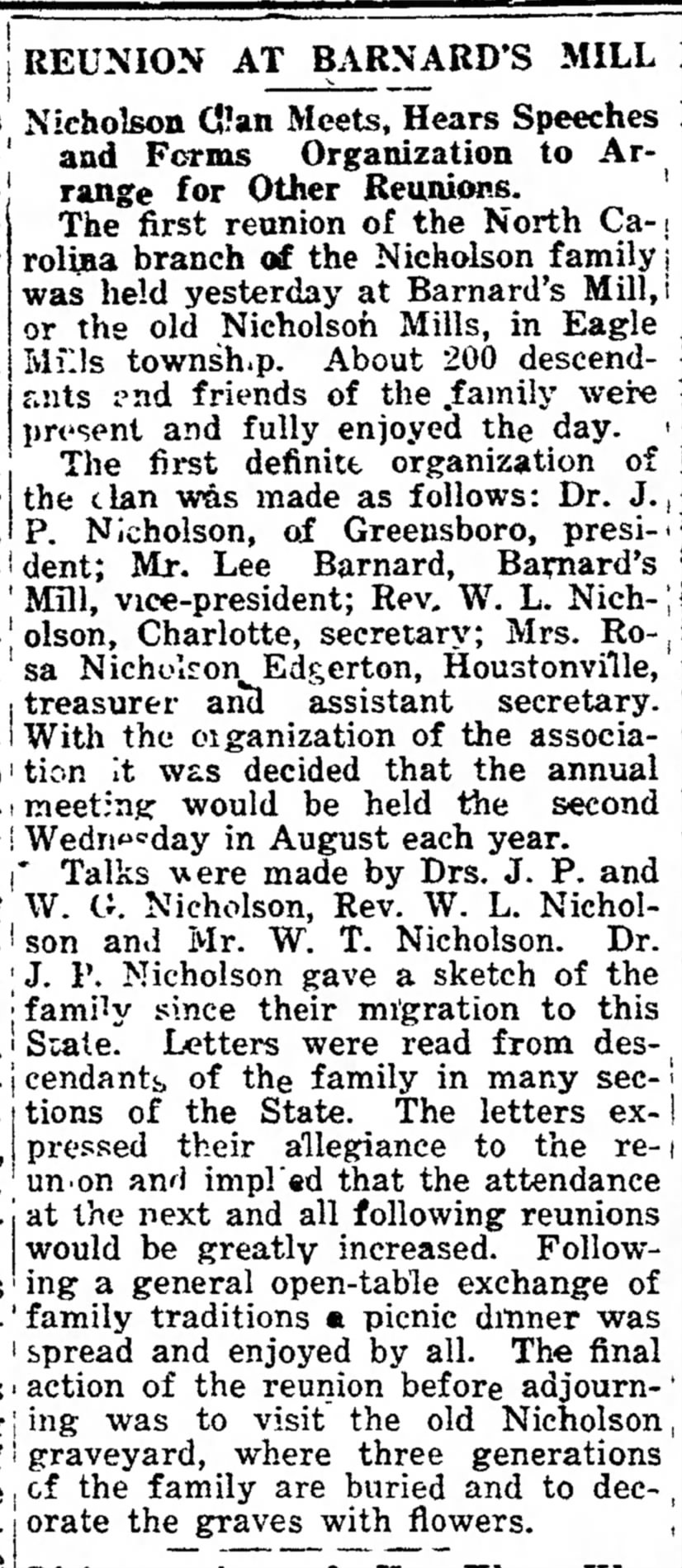
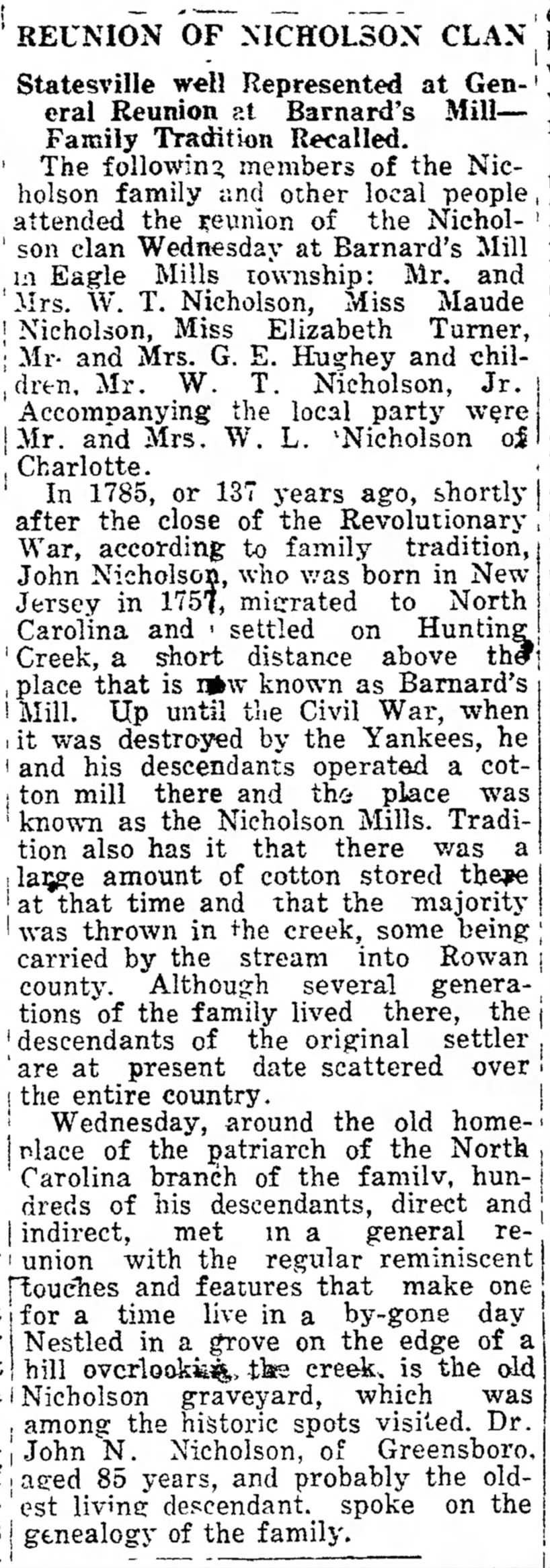
Statesville Landmark, 17 August 1922.

Statesville Landmark, 9 August 1923.

Statesville Landmark, 12 August 1926.
The North Carolina branch of the Nicholson Family descended from Revolutionary War veteran John Stockton Nicholson, born 1757 in Princeton, New Jersey, and his wives, Mary McComb Nicholson (1760- 1783) and Catherine Anne “Caty” Stevenson Nicholson (1766-1843). The Nicholsons and Stevensons arrived in America from England in the mid-17th century. The McCombs were perhaps Irish. John and Mary had one child, James Nicholson (1783-1850). John and Caty had a passel: John Stockton Nicholson Jr. (1787-1868), Mary Nicholson Walker (1788-??), Elizabeth Nicholson Beeson (1790-??), Rebecca Nicholson Clampett (1793-1880), George Nicholson (1796-1802), Moses Pinckney Nicholson (1799-1844), Anderson Nicholson (1801-1879), Catherine Nicholson Clampitt (1804-1841), Phoebe Nicholson Barron (1806-1882), and Hannah Nicholson Idol (1811-1877).
Harriet was descended from both of John S. Nicholson’s wives. Mary’s son James married Mary Allison (1792-1857), daughter of Theophilus and Elizabeth Knox Allison, in 1815. They had two children, Thomas Allison Nicholson (1816-1886) and John McComb Nicholson (1820-??). Thomas married his first cousin, Rebecca Clampett Nicholson (1817-1903), daughter of Caty’s son John S. Nicholson Jr. and Mary Fultz. Thomas and Rebecca’s children were: James Lee Nicholson (1841-1871), John Wesley Nicholson (1843-1913), Mary Jane Nicholson Smith (1846-1922), George Watson Nicholson (1848-1913) and Rebecca Ann (or Annie Rebecca) Nicholson Barnard (1860-1925). As detailed here, J. Lee Nicholson was Harriet’s father.
Nearly all of the reunion attendees mentioned by namein these articles were descended from Thomas A. Nicholson’s children Lee, George and Annie. Rev. W.L. and W.T. Nicholson, for example, were Lee’s sons, and the Barnards were Annie’s children and grandchildren. Dr. J.P. Nicholson, however, was Rebecca C. Nicholson Nicholson’s brother and Dr. W.G. Nicholson, her nephew. I’m not sure who the octogenarian John N. Nicholson was.
Bill Bailey’s life and times.
My grandmother did not mince words when it came to her aunt’s husband. William James “Bill Bailey” Murdock was “trashy.” “We couldn’t stand him,” she said. “He did everything illegal and got away with it.” I laughed, and thought, “Oh, Grandma. Really?”
Well, yes.
Consider this:
 Statesville Landmark, 14 July 1903.
He was born William Bailey in Iredell County, the son of Lela Bailey, black, and John T. Murdock, white, both teenagers. His stepfather was Floyd Murdock, and he eventually adopted the surname, but he was known as “Bill Bailey” all his infamous life. His mother was a cook, and it is likely that he gained his culinary skills at her side. In 1920, he lived on Washington Street in Statesville’s Rabbit Town section with Lela and his first wife Hattie, biding his time as a flour mill laborer.
Two years later, Bill and his roadhouse merited their first in a long line of write-ups in the local newspaper:

Statesville Landmark, 27 November 1922.
Three months later, in March 1923, Ethel Wallace was arrested for shooting her husband — and the husband of her husband’s girlfriend — at Bill Bailey’s Emporium. Before this matter was even tried, Bill himself was arraigned on a charge of assault with a deadly weapon against Howard Houston. It didn’t stick. In February 1924, however, Bill plead guilty to bootlegging, was fined $50 and given two years’ probation. In January 1926, he was arrested for bootlegging again.
In December 1927, Bill was acquitted of assault with a deadly weapon in the shooting of “a colored girl” named Veola Knox and of transporting and possessing liquor, but fined $50 for assaulting Jim Moore. Two years later, on the day after Christmas, someone “severely carved up” Alfred Hough, slashed his jugular, outside Bill Bailey’s.
In July 1931, Bill was charged with manufacturing and possessing “home brew” — a barrel and 18 cases worth — on his premises just beyond the southern Statesville city limits. In November 1932, Crawford Scott was shot in the shoulder just passing by the place. In 1934, three men were arrested for liquor possession at Bill Bailey’s, and 1936 brought this:

Statesville Landmark, 1 October 1936.
Nothing stuck. As the Depression wound down and the War picked up, Bill Bailey’s reputation shifted from gutbucket to speakeasy to wholesome purveyor of steaks and libations to Statesville’s white middle class. Shootings and cuttings disappeared from the pages of the Landmark to be replaced by jovial accounts of “delightful fried chicken suppers” at Bill’s “popular resort,” enjoyed by society ladies, sportsmen, company men, and civic boosters alike.
The bonhomie slammed to a halt on the night of March 28, 1944, when Bertha Hart “Aunt Bert” Murdock shot James Warren, a white serviceman out to celebrate leave with a juicy steak. My mother’s cousin N. asserts that Bill and Bert thought that their clientele, not to mention his father’s relatives — who’d kept Bill out of prison during Prohibition and rewarded his good cooking with steady patronage — would stand by them. It did not happen. The place shut down, and just over a year after wife’s conviction, Bill Bailey was dead.
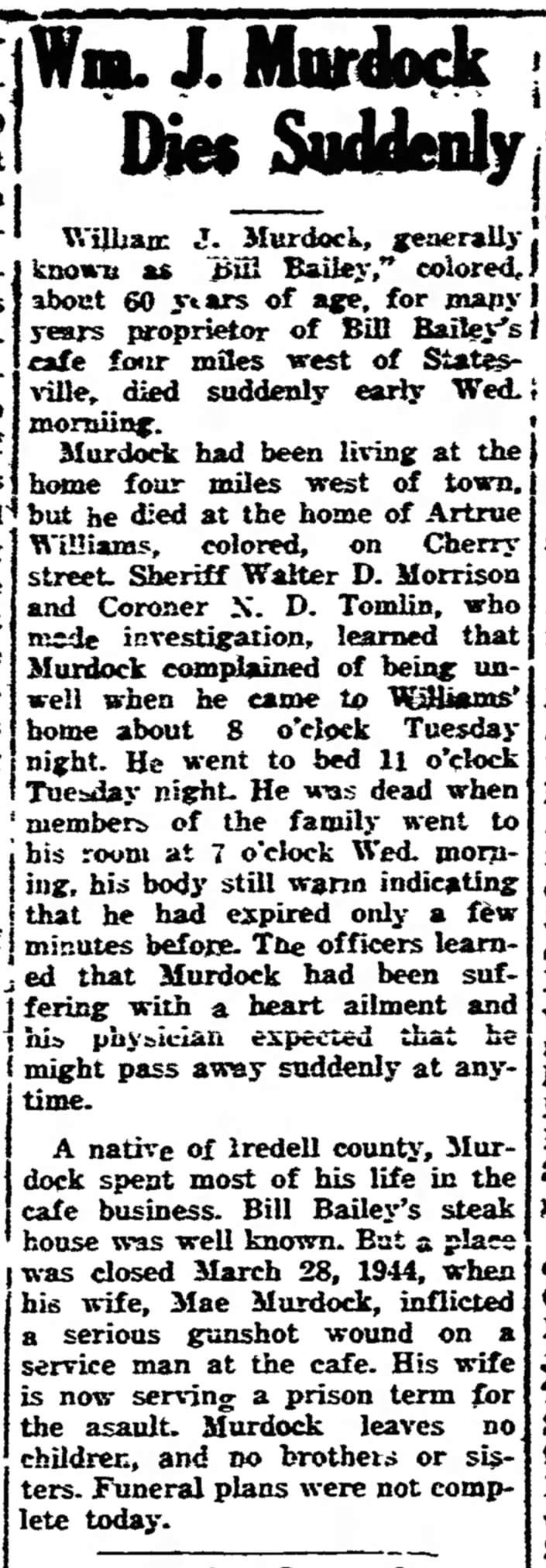 Statesville Landmark, 6 December 1945.
Where did they go?, no. 1: Nicholson.
In 1850, James Nicholson of northern Iredell County dictated a will that distributed 17 enslaved people – Milas, Dinah, Jack, Liza, Peter, Elix, Paris, Daniel, Carlos, Nelson, Lucinda, Joe, Manoe, Armstrong, Manless, Calvin and Sophie — among his heirs. I am descended from one, Lucinda, whose daughter Harriet was conceived after she joined Thomas A. Nicholson’s household. As I wrote here, Lucinda is found post-slavery only on death certificates of two of her children. What of the other 16? Are they any easier to trace?
In a word – no.
Mary Allison Nicholson received five slaves from her husband’s estate. Son Thomas received three outright and a share in five others. Son John McCombs Nicholson received four and a share in the same five. (It is not at all clear whether the groupings of these 17 people respected family units or were simply combinations devised with an eye for equal value.) Mary died in 1857 and, presumably, her property passed to her sons. However, in the 1860 slave schedule of Iredell County, only two Nicholson slaveholders appear: Thomas, who owned 13, and Martin T. Nicholson, who owned three. (Martin was Thomas’ brother-in-law and first cousin.) In the population schedule, Thomas reported owning $11,000 worth of personal property, a figure that would have included the value of his slaves. His brother John reported only $565. Had he sold his?
And the bigger question, where did Thomas’ slaves go after Emancipation? Freedmen did not always adopt the surnames of their immediate masters, of course, but in the 1870 census of Iredell County, only four black residents claimed the surname Nicholson. Eliza Nicholson, age 25, lived in the household of Thomas Nicholson’s son Wes. She presumably is the Liza of James’ estate. Manless Nicholson, 22, his wife (?) Maggie Nicholson, 24, and daughter Annie, 5, lived in Thomas’ household and worked for him. Manless had been jointly owned by Thomas and his brother. In Yadkin, the adjoining county, 35 year-old Alaxander Nicholson (probably the “Elix” above) is listed in the household of Isabel Cartwright. But that is it. No more.
Obviously, some people were simply inadvertently omitted from the 1870 schedule, such as Lucinda and her daughter Harriet, who were clearly living in Iredell then, and Milas Nicholson, who appears ten years later in Turnersburg township, Iredell County, as a 33 year-old with a wife and child. Also, the 1880 census of Deep Creek, Yadkin County, shows an 80 year-old Sophia Nicholson who may have been “Soffie.” (And was probably Manlius “Manless” Nicholson’s mother, as a Yadkin County marriage license and his death certificate indicate.) Of Dinah, Daniel, Nelson, Armstrong and the others, however, there is no trace, either in surrounding counties or under a different surname.
Possums and sweet potatoes.
My grandmother: His mother used to cook possum.
Me: Used to cook possum?
My grandmother: Oh, possum, honey. They would cook those dern things.
Me: Well, possum stew. I guess I have heard of that.
My grandmother: Naw. They didn’t have no possum stew. They’d bake this thing.
Me: Awwww!
My grandmother: And, look, wait a minute. You know they’ve got big mouths. Long mouths. A possum. And he’d put a sweet potato in the possum’s mouth. [I laugh, hard.] I don’t remember cooking one, but my grandmother sure used to cook ‘em. And Papa cooked ‘em. But I refused to cook ‘em. Not me. And you know these people when I came here ate muskrats?!
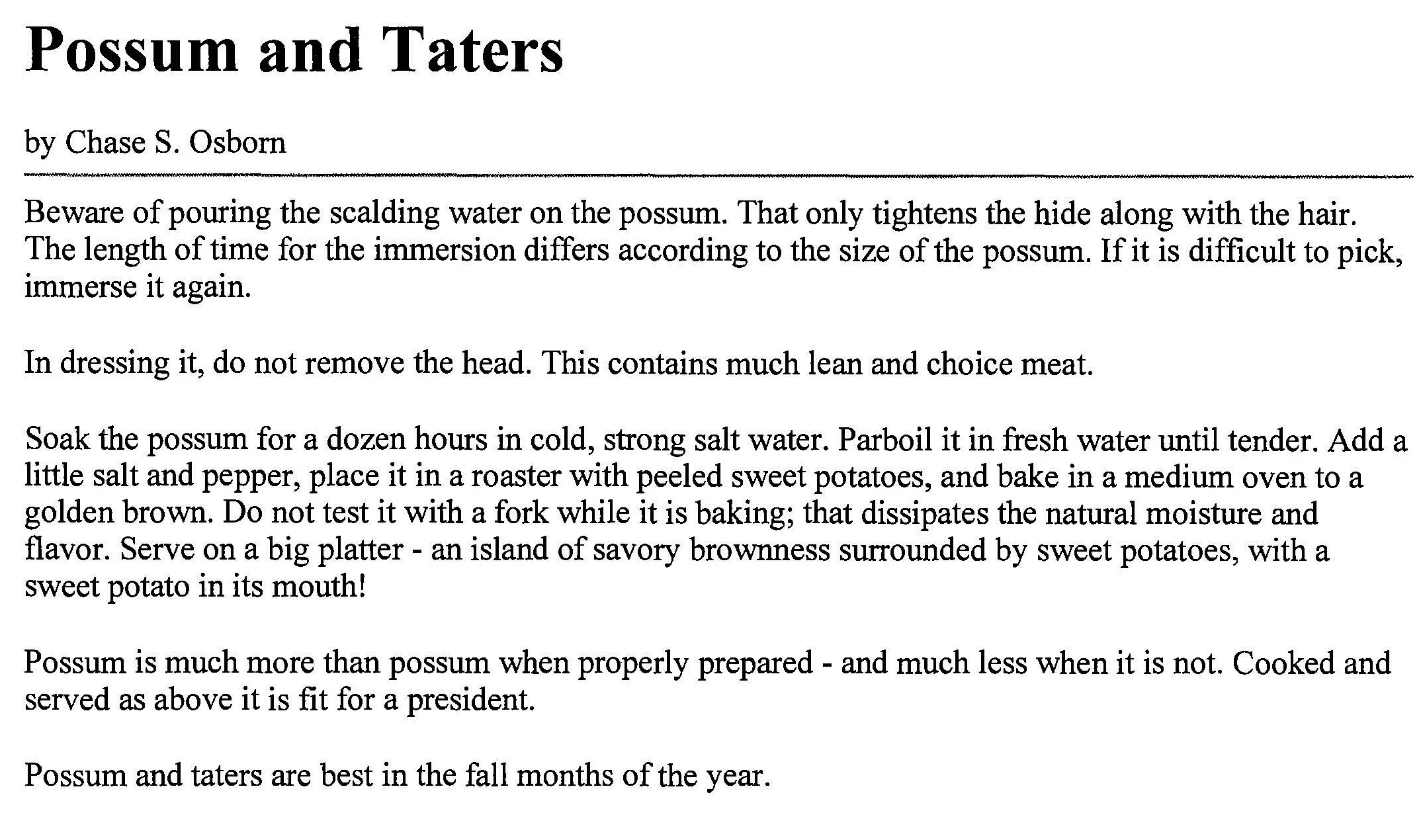
It was Harriet Nicholson Hart who fixed such special dishes for her favorite son.
Interview of Margaret C. Allen by Lisa Y. Henderson; all rights reserved.
She was smart, and she was musical.
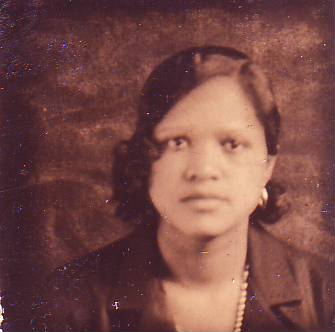
FINALS AT COLORED SCHOOL.
Statesville Colored Graded School Closed Tuesday Night with a Very Creditable Performance.
The closing exercises of the Statesville graded school were held Tuesday night in the new building. Before the exercises began at 8.30, a representative of this paper had the pleasure of looking thru the building and inspecting the most creditable exhibits of the work accomplished by the pupils of the second, third, fourth, fifth, sixth and seventh grades. The exhibit showed surprising skill in drawing, sewing, fancy needle work and other forms of handiwork.
When the exercises began, the auditorium and two adjoining school rooms were filled, and the good order maintained was a noticeable feature. The opening chorus and duet by members of the graduating class were much appreciated by the audience.
“Resolved: That girls are more expensive to raise than boys,” was the subject of the debate discussed in an interesting manner by Eugene Harris and Harry Chambers, on the affirmative, and Guy B.Golden and Jettie M. Davidson, on the negative.
GRADUATING EXERCISES.
Class History. Buster B. Leach
Class Prophecy. Annie B. Headen
Class Poem. Willie D. Spann
Solo — ‘Be Still, O Heart.’ Thomas R. Hampton
Class Will. Maurie Dobbins
Valedictory. Louise Colvert
Class Song – ‘Fealty’
CLASS ROLL.
Mary Louise Colvert, Maurie Catherine Dobbins, Lillian Gennetta Moore, Willie DeEtte Spann, Buster Brown Leach, Annie Bell Headen, Thomas Richard Hampton, Eloise Earnestine Bailey.
Class Motto – We Learn Not for School, But for Life.
The colored people of Statesville take great pride in their school. They have a modern school building, steam heated and supplied with the latest equipment, something which very few towns and cities of the State have provided for its colored population. C.W. Foushee, the principal, has proven himself to be a good school man. He is assisted by eight teachers.
— Statesville The Landmark, 7 June 1923.
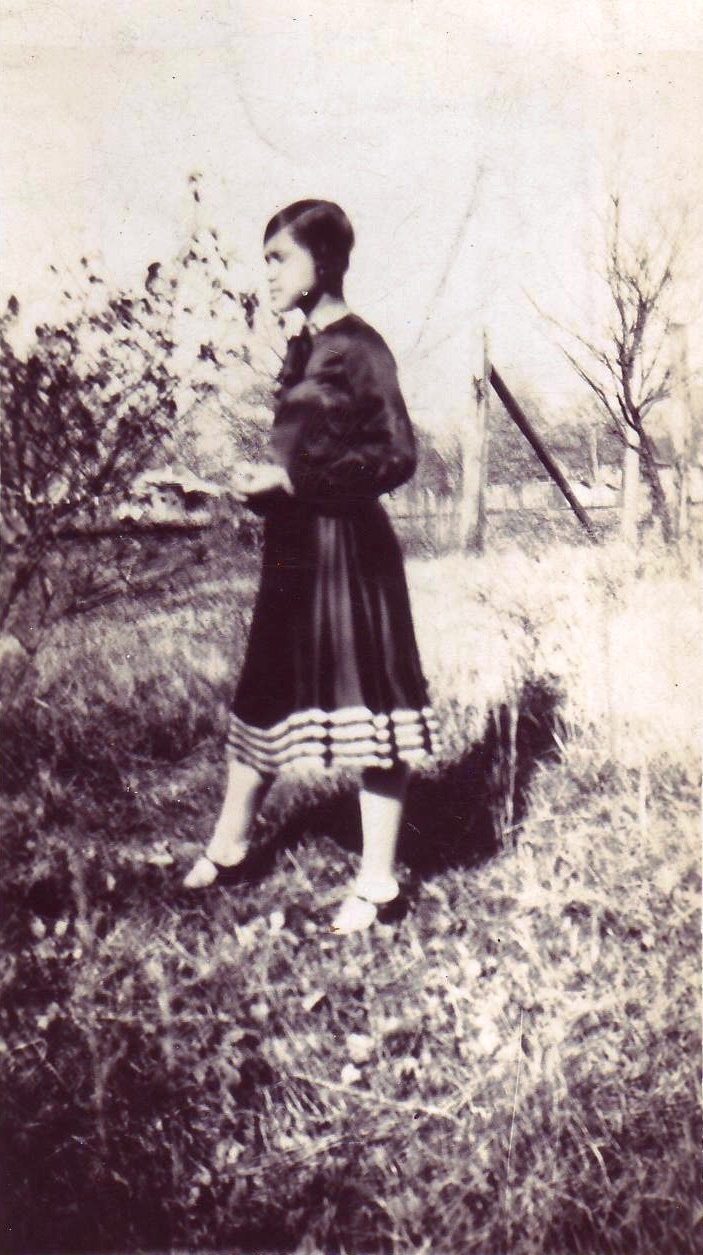
Louise went up to New Jersey and finished high school. They didn’t have a black high school in Statesville. They just had tenth grade. And she went to Jersey and finished high school in Jersey and then took a course in teacher’s education somewhere. I don’t know whether it was Winston-Salem or Salisbury. And then she taught at – Louise played an organ, I mean, she could play the piano. Yeah, she was just as smart as she could be. And she not only could teach, but she was musical. And she had heard she could get a job anywhere because she could do that. And I know Golar used to teach school, but Louise would do her commencement exercise for her. She would, Louise would do that, and they would have concerts. Not concerts, but the whole county would compete. And Golar’s thing would always bring a group of children, ‘cause Louise would teach them, you know. I don’t know, I can’t remember the name of that place. But she had a school out there. Williams Grove. And Louise used to do all the playing for that school, and they would ask her to prepare them for the thing. They had these county somethings. But it involved the whole county. The schools were all over Iredell County. And they would come together, and they would, it would be a big march, and then they would meet somewhere in particular, and then they would compete with the groups of singers and everything like that. And, child, when Louise started that stuff, when she started teaching, she had groups singing – young people and the older people, and then Golar would take her to her school and get her to teach her children.
Happy birthday, Aunt Louise.
Mary Louise Colvert Renwick (6 October 1906-15 September 1989)
——
Interview of Margaret C. Allen by Lisa Y. Henderson; all rights reserved. Photographs in the collection of Lisa Y. Henderson.
North Carolina death certificates: COLVERT.
North Carolina did not require death certificates until 1914. The following abstracts record the deaths of several generations of Colverts.
Lew Colvert. Died 27 Mar 1915, Statesville, of cerebral paralysis. Resided near Center Street, Statesville. Black. Aged about 40. Married. “Laborer for city driving team mules.” Born in Iredell County NC to unknown father and Rebecca Colvert of Iredell County NC. Buried colored cemetery; J.W. Nicholson & Co., undertaker. Informant, L.W. Colvert.
A Runaway and a Driver Hurt
Wednesday afternoon Mr. Isidore Wallace’s team was being driven from the depot with a load of roots and herbs. Just as the wagon turned into Front street from Center a sack of herbs fell off the wagon and struck one of the horses. This frightened them and they ran away, colliding with an electric lightpole on the sidewalk. The colored driver, Lou Colvert, was thrown off and a wheel passed over his head, inflicting a severe but not serious injury. One of the horses broke loose from the wagon and the other ran on to the stables. The wagon was slightly damaged.
— Statesville Semi-Weekly Landmark, 11 Oct 1895.
——
Becky Colvert. Died 26 May 1915, Statesville, of general paresis. Widow. Born 1839. Resided Harrison Street. Born to Jerry Gray and Lettie Gray, both of Iredell County. Buried Zion Hill cemetery; J.W. Nicholson, undertaker. Informant, John Colvert.
——
Selma Eugenia Colvert. Died 7 Oct 1916 of exhaustion from severe burns. Single. Born 25 Aug 1889 to John Colvert of Iredell County and Adaline Hampton of Wilkes County. Informant, John Colvert.

——
John Colvert. Died 6 Oct 1921, Statesville, of endarteritis. Black. Married to Adline Colvert. Age 71. Worked as laborer/teamster driving team. Born Iredell County to Walker Colvert and Elvira Gray, both of Iredell County. Married to Adline Colvert. Teamster laborer, driving team. Buried “colored cemetery,” 9 Oct. Informant, Adline Colvert.
——
Frances Josephine Bradshaw. Died 6 November 1925, Statesville, of colitis. Colored. Minor. Born 12 May 1924, Statesville, to Will Bradshaw of Rowan County and Golar Colvert of Iredell County. Informant, Will Bradshaw.
Me: Now, who was it that you were telling me that — was it William Bradshaw’s sister? What was it about, something about — there was a baby that couldn’t eat certain things.
My grandmother: Oh, yes. His sister…. Oh, she was the prettiest thing I ever saw in my life. Like a doll. Oh, she was a beautiful child. And had this curly black hair just like Papa’s. She was such a pretty little girl.
Me: And who fed her something that she wasn’t supposed to have?
My grandmother: You see, Golar, Mat and Walker’s mother was different from our mother.
Me: Right.
My grandmother: And they would always go out in the country to visit these people. You know. And Golar took her children and went out, you know. To visit. And she, I don’t know what was wrong with the child that she couldn’t eat any, certain things she couldn’t eat. And string beans was one of them. And when she gave her some string beans, and it just … just killed her. And, ahhh, that child suffered. My God, that child suffered. I can remember that evening. I can remember so well seeing that child. She just suffered. [Pants heavily.] It was, I mean, that’s just the way she was breathing and everything. So one morning after she had been sick, her daddy came over there, he said, “You all better come over to the house if you want to see the baby, ‘cause she is dying.” I said, “You are crazy.”
My mother: What’d she have, Mama?
My grandmother: I don’t know what she had. Don’t know what she had. But they say whatever it was – it just tore her intestines. … And little William. William, he just grieved over that, he just grieved for that child. William. We were just so sorry for that child. And then on top of that, then his mother died. It was just awful.
——
Laura Colbert. Died 21 April 1926, Statesville, of mitral insufficiency. Widow of Louis Colbert. Age 66. Cook. Father, Noahie Sharpe of Iredell County. Mother, unknown. Informant, Adgie Colbert.
——
Lon Walker Colvert. Died 23 Oct 1930, Statesville, of encephalitis and catarrh pneumonia in Statesville NC. Clinical test done by C.R. Nicholson, MD. Born 10 Jun 1875 to John Colvert and Harriet Nicholson. Buried 24 Oct 1930 at Union Grove.
——
Adeline Hampton Colvert. Died 4 March 1940, Statesville, of uremia. Resided 623 Harrison Street. Negro. Widow of John Walker Colvert. Born 12 July 1864, Wilkesboro NC to Horace Hampton and Myra [last name unknown], both of Wilkes County. Buried Greenwood cemetery. Informant, Lillie Colvert.

——
George Randolph Colvert. Died 31 Jan 1959, Statesville NC. Resided 423 Harrison Street. Laborer. Never married. Born 9 April 1917 to [illegible] Summers (name blacked out) and Lillie Mae Colvert. Buried Belmont cemetery. Informant, Lillie Mae Colvert.
——
Ida Mae Stockton. Died 23 August 1967, Statesville, of cerebral hemorrhage. Resided 403 Harrison. Widow of Eugene Stockton. Born 27 June 1891, Iredell County, to John W. Colvert and Adline Hampton. Buried Belmont cemetery. Informant, Lillie M. Ramseur.
——
Interview of Margaret C. Allen by Lisa Y. Henderson, all rights reserved.
 Scuffalong: Genealogy.