Births Deaths Marriages, Land, Maternal Kin, Newspaper Articles, North Carolina

John W. McNeely’s heirs.

John Wilson McNeely died childless in July 1871. Or at least, you know, childless in any way that mattered to probate court. He had not made a will, so his heirs at law were his widow Mary McNeely McNeely and his two surviving siblings. His son Henry W. McNeely did not warrant notice.

In August, Joshua Miller, administrator of John’s estate, and Mary McNeely filed a Petition to sell Land for Assets against John’s brother William B. McNeely and sister Acintha McNeely or Corryer [or, as most commonly spelled, Corriher.]  McNeely’s debts totaled about $2000, and his estate was valued at only $800, of which $300 had been set off for his widow.  At death John had owned “about 235 acres on Catheys Creek in Rowan County adjoining the lands of Joshua Miller, Frederick Menus, Dr. F.A. Luckey, and others” and valued at about $7/acre.  This property was to descend to William, age 65, believed to be living somewhere Missouri, and Acintha McNeely or Corryer, age 60, living somewhere in Tennessee.

On 8 September, justice of the peace John Graham, J.M. Harrison, and S.A.D. Hart allotted a year’s provision to Mary McNeely, which included a mouse-colored mule worth $125, four horseloads of hay, 500 bundles of fodder, two hogs, one sow and four pigs, one old buggy and harness, 37 pounds of bacon, two bushels of Irish potatoes, one ax, an old washtub, one “foalding leg table,” one “old poplar cubbard & contents,” one waterbucket and washpan, a half dozen chairs, one candlestand, one bureau, an old looking glass, two beds and furniture, one small Bible, two Hymn books, four handtowels, and three “table cloth.”

William and Acintha were never located,* and, on 31 October, Joshua Miller sold the remainder of John’s personal property at auction. The items sold included a “crout” stand, 550 shingles, “sythes,” a log-chain, tanner’s knives, a cross-cut saw, ceiling-dogs, moulding planes, “clevis & strechers,” planes, “waggon cloth,” “hackel & chain oil,” a cultivator, a tar bucket, five sheep, nine hogs, a red calf, a blue calf, two cows, two horses, a mule, a bureau, mirror, a small table, two beds and furniture, a book case, a clock, two chests, two pairs of boots, shoe tools, sheep skins, a map, Scotts Bible, another Bible, a hymn book, 14 lots of books, a razor and strop, an armchair, ten chairs, one counterpane, a coon skin, two padlocks, a slate, and 240 1/2 acres of land sold at $10.80/acre for a total of $3266.19 1/4.

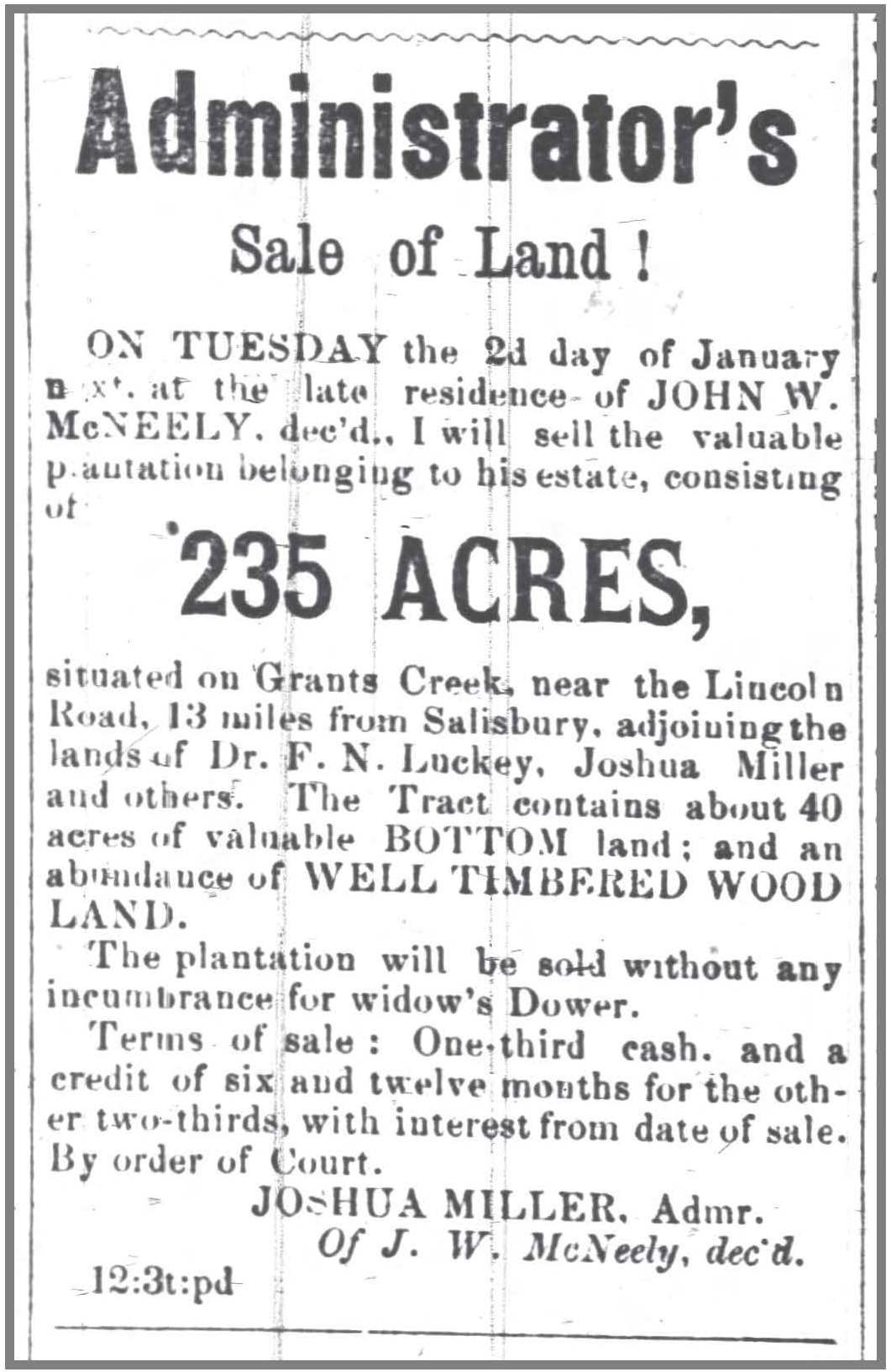
The land sale apparently did not go through, and six weeks later, Miller advertised the sale of 235 acres from John’s estate.

Carolina_Watchman_12_8_1871_Notice_Sale_JW_McNeely_land

Carolina Watchman, 8 December 1871.

It is likely that Henry McNeely’s mother Lucinda worked in John W. McNeely’s household until he died. The 1870 census of Atwell township, Rowan County, lists J. Wilson McNeely and wife Mary at household #292; Henry W. McNeely, wife and children, including a son John Wilson, at #293 (this Henry was NOT John W.’s son, though he was certainly a nephew by marriage and/or cousin); then Lucinda, her son Henry and two grandchildren at #294 and Lucinda’s son Julius, wife and nephews at #295. I have no doubt that Lucinda and her offspring lived on John McNeely’s land. Or that the sale of John’s 235 acres forced them off. By 1880, they were living just north in Mount Ulla township, where Julius bought a small farm.

*I have never found a trace of Acenith McNeely Corriher, but William Bell McNeely outlived his brother by 13 years. More later on his life in Iron County, Missouri.

Standard
Enslaved People, Maternal Kin, North Carolina, Oral History, Religion

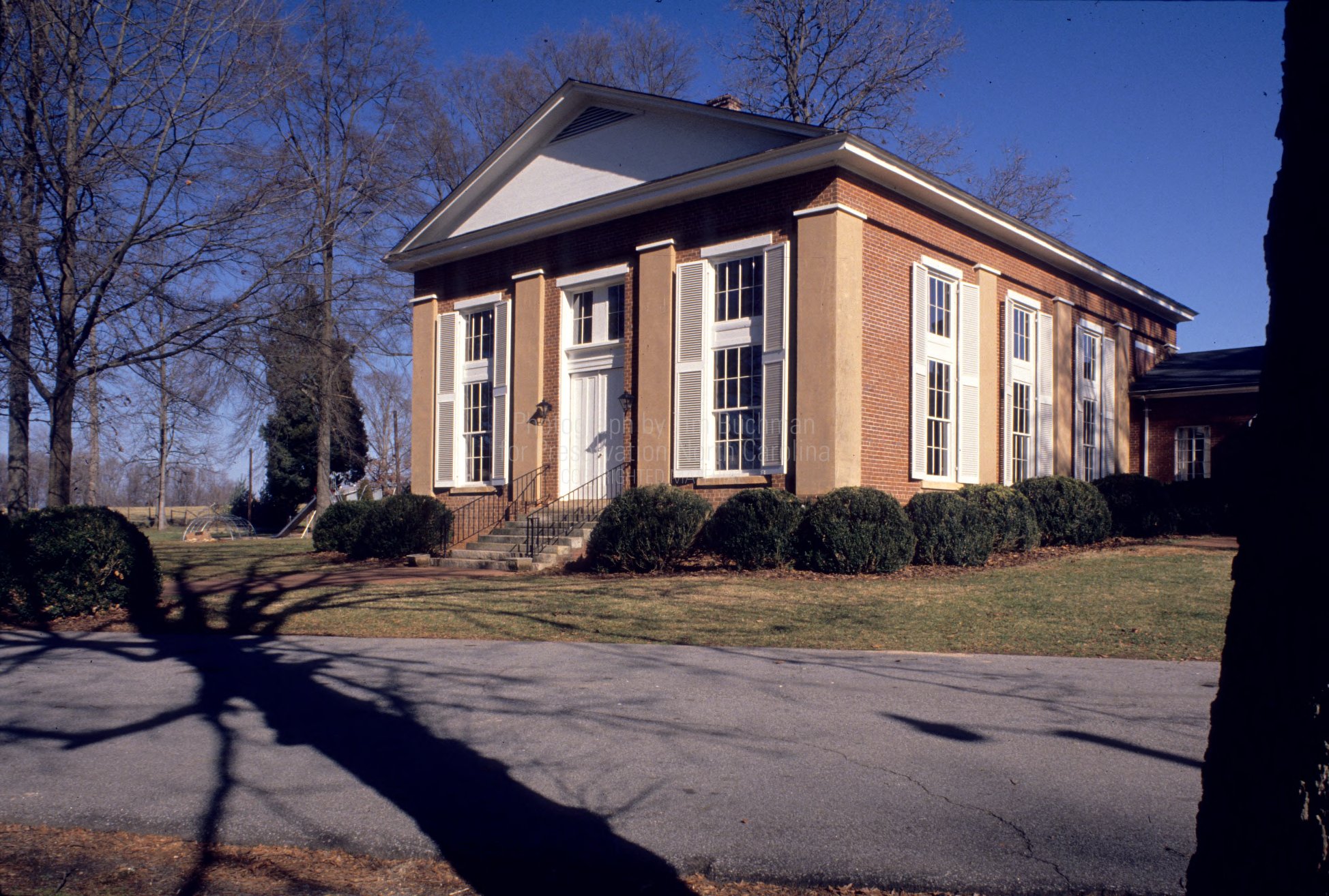
Church home, no. 8: Back Creek Presbyterian Church, Rowan County NC.

Founded in 1805, Back Creek Presbyterian Church is a historic church in Mount Ulla, North Carolina. In 1809, the congregation built a small log house of worship, which was replaced by the congregation’s present Greek Revival sanctuary in 1857. This building was added to the National Register of Historic Places in 1983.  — From http://en.wikipedia.org/wiki/Back_Creek_Presbyterian_Church_and_Cemetery

resolver

Back Creek was the church of my white McNeely forebears — John Wilson McNeely and his father Samuel.  In 1905, Rev. S.C. Alexander and John K. Goodman published History of Back Creek Presbyterian Church, Rowan County, N.C., for 100 Years. It is too much to call it a scintillating work, but its dramatic retelling of the church’s founding compels:

During the latter part of last century, infidelity spread like a contagion all over our country, from one end of it to the other. It gathered round the Church, and settled down upon it like a thick cloud of moral death Although far removed from the busy marts and thorough- fares of the world, this retired part of the Lord’s vineyard did not wholly escape the infection. A cold dead formality had well nigh chilled the vitals of true religion. But this state of things was not permitted to remain long. God heard and answered the prayers of his faithful servants. His life-giving spirit was sent forth with power, and breathed upon the valley of dry bones, and an army of living men stood up to praise Jehovah’s name. This was an important era in the history of our Church and country. It was a time when angels in heaven, and men on earth rejoiced together. It was a time when a most powerful and sudden death-stroke was given to the cause of infidelity. So that its hideous form has never since been reared so high in the majesty of its ugliness to pollute and annoy the Church Thyatira with her then widely extended limits, seemed to have been thoroughly aroused in those exciting times.

As in all communities, so in that venerable Church, there necessarily existed a great diversity of sentiment. The time had now come, when this diversity was to be fully manifested, The Revival of 1802, let it be remembered, was accompanied with many strange phenomena, such as “jerking,” “leaping,” “shouting,” “swooning,” and many such-like bodily exercises. Those who were possessed of more ardent zeal and strong affection, thought this a necessary part of the revival, and produced by the influence of the Spirit. While those of a more phlegmatic temperament, and less impulsive nature, looked upon it as dross around the precious metal; or rather, as the work of Satan trying to counterfeit and hinder the work of religion. Thus there were two parties formed, and each doubtless conscientiously thought they were right. Those who favored the “exercises” were called the “revival party,” as if they alone were desirous of promoting the cause of religion. While those who thought differently were called “opposers” or “anti-revivalists,” as if they wished to hold back the Gospel car. One party wished to have profound silence during public worship. It mattered not how eloquent the speaker was, or how powerful the movings of the Spirit, all must be quiet and still. The other party wished to give vent to their feelings in whatever way inclination might lead. If they felt happy they would shout aloud for joy, or if distressed they would cry out for mercy. The congregation ofttimes presenting the appearance of a Bochim-Babel.

Thus the matter went on for two or three years each party becoming more and more sensitive; and owing to the weakness of human nature, one seemed to exasperate the other, until it became evident to all that some final and decisive action should be taken for the welfare of the Church. A day of fasting and humiliation was appointed, that they might pray for wisdom to guide them in the path of duty, and that they might adopt some plan of action which would be for their peace and edification. The day was accordingly observed. At which meeting the Session was publicly charged with a neglect of their duty in permitting what was looked on by one party as disorder and confusion to exist in time of public worship. The Elders defended their conduct in a mild and Christian-like manner, but all to submit to the other. Thus the day seemed likely to close without having bettered their condition. But something must be done was the universal feeling. Whereupon, it was resolved unanimously, that all those who sympathized with the “Revival Party,” and acted under its influence, should be permitted to withdraw from the Congregation, and leave the other party in the quiet possession of their house and minister. This resolution was acted upon immediately, when about thirty families withdrew, including five Elders — all that Thyatira [Presbyterian Church] then had — men of whom the world might be proud. This was the birthday of Back Creek. The mother travailed with pain, and a noble daughter was born. —

Thus the infant colony, springing off from the western part of Thyatira principally, was left without a minister, and without a house in which to worship. But with zeal like theirs, with hearts so large, and hands so willing, all difficulties were soon removed, and their necessities met. They resolved to build a house in their midst, in which they could worship as their conscience dictated.

A year after Back Creek’s founding, my great-great-great-great-grandfather assumed a leadership role:

On the 27th of December, 1806, William Kilpatrick, Samuel McNeely, and George Andrew, were added to the list of Elders — men of whom we cannot speak too highly. Each was distinguished for his own excellency of character. When sitting in council about the welfare of the Church, it is said William Kilpatrick would devise ways and means for the prosperity of Zion. George Andrew would discourse on its practicability. He would present it in one aspect and then in another, in order that it might be weighed well, — while the venerable John Barr and Samuel McNeely who knew their Bible by heart, would decide whether it were right or not, or whether it would be for the general good. Thus each wheel in the machinery performed its part; and the consequence was, the Church like a healthy plant, grew and flourished, and became a praise in the land. In 1833, another addition was made to the Session by the election and ordination of William King, Thomas Mathews, John Houston, John M. Lowrance and Abner Adams. — Only two of this number are spared to be with us now. The other three have fallen asleep. They were men with whom you were all familiar. Their names are embalmed in your memories. Their excellencies are well known. — And you have long since mourned their loss.

Fifty years later, his son was elected deacon:

On August 10, 1856, the last public service, the last sermon was preached in the “Old Log Church,” built in 1811. The first Deacons in Back Creek Church were elected on May 22, 1858, viz:— Col. Alfred M. Goodman, Jno. F. Clodfelter, Jacob P. Goodman, Moses Lingle, James Miller and J. Wilson McNeely; and on the following June 27 they were regularly ordained and installed. Prior to this the financial,and temporal affairs of the Church were administered, (under the session) by a board of trustees elected by the Congregation, but not regularly ordained and installed into office as is now the more scriptural practice with Deacons.

Given the close association of the McNeelys with Back Creek, it is likely that their slaves also attended the church.

Before the emancipation of the Southern Negro he worshipped with his master in the same church, and enjoyed all the church privileges, consistent with the relations existing between the white and negro races; many of them being worthy members of the church. The gallery in this church was built for their express accommodation. Faithful attention was given to their moral and religious training. Frequently the minister in charge would preach a sermon specially to them; they leading and furnishing the music, of no inferior quality. And they were not forgotten in the Sabbath-School; separate classes were formed of them, taught by the whites. This relation and condition continued for some time after “freedom;” finally, they changed order of relation, and natural trend of events led to their separation from the church of the whites, and to their distinct organization; still, however, some reluctantly took this step.

I don’t know about the “natural trend” or the reluctance. In any case, my forebears remained in the larger fold for, as my grandmother put it, Henry W. McNeely, J. Wilson’s son and former slave — “when he moved to Statesville, when Mama’s daddy moved to Statesville, child, he ran that Presbyterian church.”

The early lists of church members do not determine the proportion of whites to colored.

In regard to the numerical strength of Back Creek, from time to time, complete records fail us. In 1829 the membership was 124, but it is not stated how many white.

In 1850 we numbered 136 white and 26 colored — total 162.

In 1864, 96 white and 74 colored — total 170.

In 1869, 58 white and 50 colored — total 108.

In 1880, 83 white and no colored — total 83.

In 1894, 77 white; in 1900, 90 white; and in 1905, 150 white.

Sometime after 1869, African-Americans left — or were put out of — Back Creek en masse. Hopefully, a little research will reveal their new church home.

Photograph at http://d.lib.ncsu.edu/collections/catalog/buch0494, all rights reserved.


Standard
Maternal Kin, North Carolina, Photographs

The reunion.

Reunion 1978 01My grandmother and her children: the first reunion.

It was in July. I’m sure of that, but not the actual date. The first Colvert-McNeely family reunion. We gathered in Statesville, of course, where my grandmother Margaret and her sisters Louise and Launie Mae were born and grew up. The reunion called not only their descendants, but those of their older half-sisters, Mattie and Golar, and their maternal McNeely kin. I was 14 that summer and not much interested in anyone more than three or four years older than I. Nor had I been seized with the unquenchable genealogical fervor that would light me up a decade later . So I lounged around the hotel pool and wasted opportunities that year, and subsequent, to winnow every broad hint and slender clue from the ever-waning recollections of my elders. My great-aunt Louise, who lived in Statesville all her life and probably knew the most. My great-great-aunt Min, last of the McNeely siblings. The “other” Colverts, cousins and children of my great-grandfather’s half-sisters — were they even there? I’d been surprised to learn later that some were living in 1978. (They were not much spoken of. Was there a rift?) Who was in Statesville that summer? Whom did I miss?

CM Reunion 1978

The last day. Or maybe the first. My uncle John’s wife Gladys, my mother, my grandmother (in curlers — she would not approve of this post), my uncle John, an unknown man (a Colvert? a McNeely? who?), my mother’s first cousin Donald, my aunt Lynne, my father. Statesville, 1978.


Standard
Births Deaths Marriages, Enslaved People, Maternal Kin, North Carolina, Other Documents, Photographs

Cousin Rufus McNeely.

Lucinda McNeely‘s son John Rufus McNeely and Emeline Atwell registered their 11-year cohabitation in 1866. John and Emeline’s youngest son, born in 1873, was Rufus Alexander McNeely. He died in 1964.

Image

This photo of Rufus is attached to the Ancestry.com public family tree of jeromemurray128. I’ve reached out unsuccessfully several times with offers to share information about the McNeelys. Perhaps he’ll see this post and get in touch. In the meantime, I hope he won’t mind me sharing this wonderful snapshot!

Standard
Education, Maternal Kin, North Carolina

Colored children of school age.


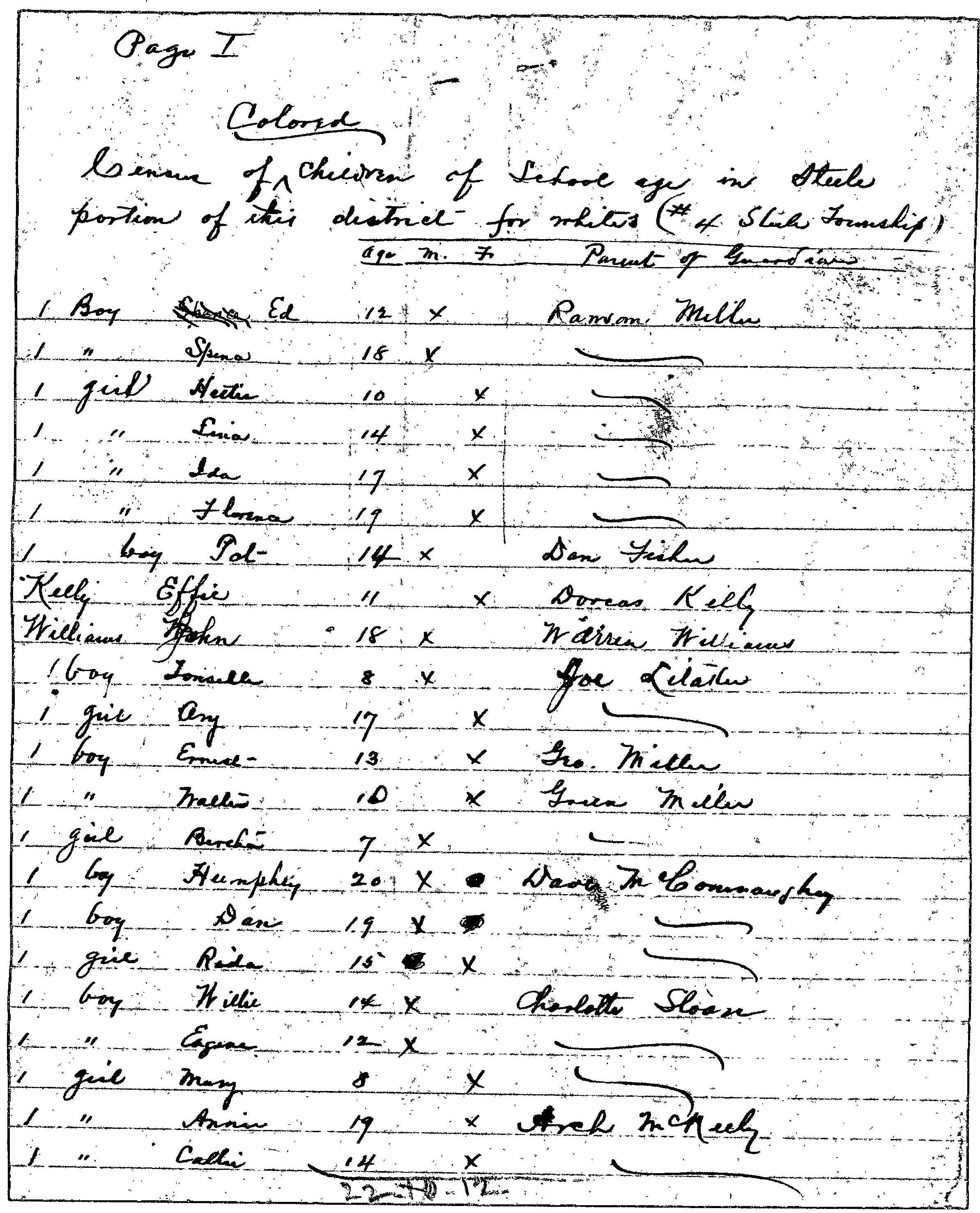
McNEELY -- School records_Page_1

McNEELY -- School records_Page_2

Thirty-five years after Emancipation, the Miller-McConnaughey and McNeely families were still clustered in western Rowan County, working small farms that they owned or rented. Education was a prized advantage, and many children in the neighborhood completed at least a few years.  This school census, taken in 1900, lists all school-aged children in a household, though there is no way to tell if the children actually attended.

The six youngest children of Ransom and Mary Ann McConnaughey Miller are listed: Florence A., Ida L., Margaret Lina, Spencer Lee, Hattie A., and Thomas Eddie Miller.

Green and Grace Adeline Miller Miller‘s household included Walter, 10, and Bertha, 7. Both children were listed as the couple’s grandchildren in the 1900 census. Bertha Todd was the daughter of Green and Adeline’s daughter Margaret Miller and Alfred Todd. I don’t know who Walter Kerr’s parents were, but it seems likely that his mother was either Margaret or Mary Caroline Miller.

George Miller, by then in his mid-60s, is listed with a 13 year-old boy named Ernest. This appears to be the Earnest Hilliard listed in his household in the 1900 census and described as a grandson. Was he Maria Miller’s son?

Finally, Arch McNeely, nephew of Martha Miller McNeely‘s husband Henry W. McNeely, is listed with four of his children, Ann J., Callie, Julius L.A., and Mary E. McNeely.

Copy of document from School Records, Rowan County Records, North Carolina State Archives.

Standard
Births Deaths Marriages, Maternal Kin, Newspaper Articles, North Carolina, Other Documents

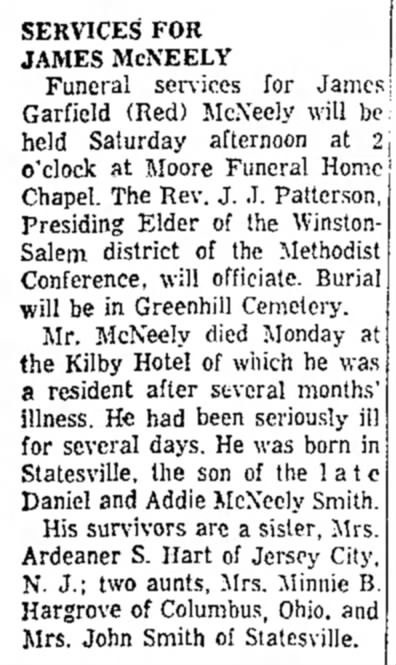
Cousin Red McNeely … or Smith.

So, was he James Garfield Smith or James Garfield McNeely?

Addie Lucinda McNeely married Daniel Smith in Statesville NC on 2 October 1902. Their daughter Ardeanur Smith was born the following February and son James Garfield Smith on 11 April 1906. I have never found the family in the 1910 census and do not know how long Addie and Daniel remained together. When her uncle Julius McNeely’s estate opened, Addie Smith with her siblings was listed as one of the heirs. Unlike her married sisters, however, her husband’s name does not appear alongside hers. In 1917, mid-proceedings, Addie died — I’ve never found her death certificate either — and her name was struck through and was replaced by that of her children, “Ardenia” and James Smith.

I have not located James again with any certainty before 1942. (There’s a “James McNeelly” of the right age listed in the 1930 census of High Point NC, but he had a wife, which my James allegedly never had.) When he registered for the World War II draft, James gave his name as “James Garfield McNeely.” Why the shift from “Smith,” which he apparently never used as an adult? Though his birth year appears to be off by one year, this is clearly our man. He was born in Statesville, and Janie McNeely, his mother’s youngest sister, is named as his contact. (The neighborhood in which he lived and worked is now part of the Washington Street Historic District, and Club Carolina merited a brief mention in the application for historic status.)

James G McNeely

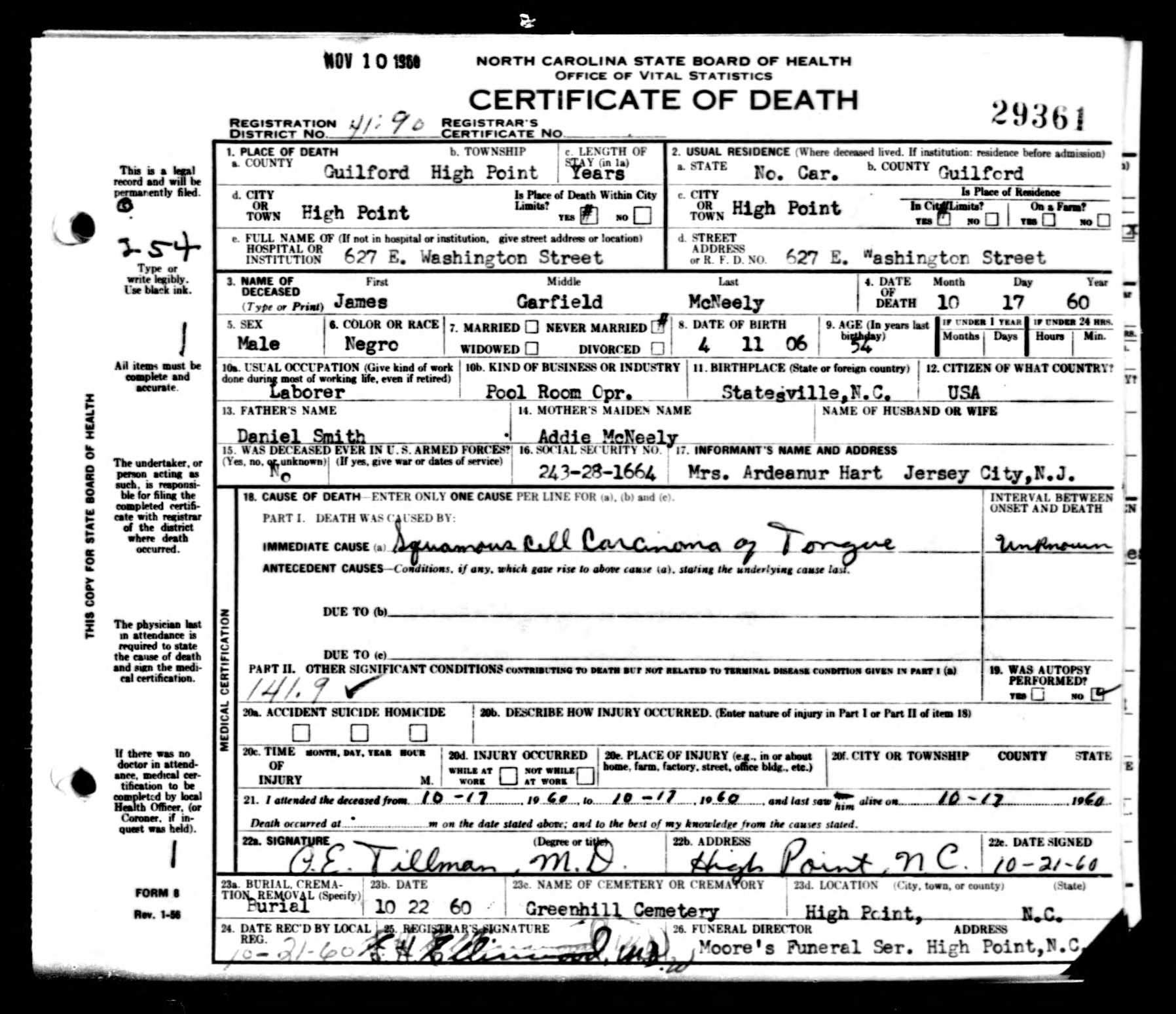
Cousin James disappears from the record again until his death certificate was filed. He was working at a pool room and living at the Kilby Hotel when he died. Ardeanur Hart of Jersey City NJ was informant and gave her brother’s name as James Garfield McNeely.

James G McNeely Death Cert

Here’s his obituary:

James G McNeely 21 October 1960 HP Enterprise

High Point Enterprise, 21 October 1960.

And a note of acknowledgment from his family. (Who in the world were the Martins and Griffins?):

JG McNeely HP Enterprise 11 13 1960

High Point Enterprise, 13 November 1960.

[Sidenote: The physician who signed James’ death certificate? Dr. O.E. Tillman? His son and I met in high school and became good friends in college. He married A.B., my roommate and closest college friend, and I was in their wedding. Dr. Tillman is now retired, but remains active in High Point civic affairs.]


Standard
Enslaved People, Maternal Kin, North Carolina

McNeelys enumerated.

Perhaps he ticked them off on his fingers: “One female, aged 24 to 36. … One female, under ten years of age. … Three males, all under ten….” The enumerator for the 1840 federal census of Rowan County dutifully recorded the information that Samuel McNeely provided, inking in  small numerals in the appropriate column under “SLAVES.” The adult female was Lucinda. The female child was her daughter Alice, and two of the males were her sons John and Julius. It is likely that the third boy was also Lucinda’s, as Samuel was not likely to have purchased a small child and Alice was too young to bear children.

Samuel died in 1843 and, under the terms of his will, son John W. McNeely inherited slaves Lucinda and her offspring. In the 1850 slave schedule, John reported owning eight slaves: a 34 year-old black female [Lucinda]; a 19 year-old black female [Alice]; a 17 year-old black male [John]; a 14 year-old black male [the third boy above, name unknown]; a 12 year-old black male [Julius]; a 9 year-old mulatto male [Henry, Lucinda’s son by John W. McNeely]; a 2 year-old mulatto male [Joseph Archy, Alice’s son]; and a 1 year-old black female [probably Alice’s daughter Mary].

In 1860, John W. McNeely reported only seven slaves: a 44 year-old black female [Lucinda]; an 11 year-old black female [Mary]; a 22 year-old black male [Julius]; a 19 year-old mulatto male [Henry]; a 12 year-old mulatto male [Archy]; a 9 year-old black male [Alexander “Sandy,” who was probably Alice’s son]; and a 7 year-old black male [John Stanhope, who was probably Alice’s son.]  The same seven appear, by name finally, in the 1863 Confederate tax valuation. [A vexatious question: Where was John Rufus in 1860 and 1863? When he married in 1866, he reported John W. McNeely as his former owner. Had he in fact spent his final years of servitude under a different master?]

And then came freedom. In the 1870 census of Atwell township, Rowan County, at household #294: Lucinda McNeely, age 54, domestic servant; Henry McNeely, 29, school teacher; Joseph A. McNeely, 22, farm laborer; and Elizabeth McNeely, 13, “attends school.” [According to my grandmother, this Elizabeth was Henry’s daughter, abandoned by her mother at his doorstep.] At #295: Julius McNeely, 32, farm laborer; wife Mary McNeely, 25, “keeps house”; and nephews Alex’r McNeely, 17, farm laborer; and John S. McNeely, 18, farm laborer. [On the other side, at #292: John W. McNeely, 63, and wife Mary, 63, and at #293: Henry W. McNeely, 35; wife Nancy E., 24; and children Margaret, 3, and John W., 1. This Henry W. McNeely, son of James H. McNeely, was John W.’s cousin, though the exact relationship is unclear.]

Standard
DNA, Maternal Kin, North Carolina

DNA Definites, no. 12: Van Pool.

Iredell County, North Carolina, was settled in the mid-eighteenth century largely by Scots-Irish and German immigrants pushing down the spine of the Shenandoah Valley from the mid-Atlantic colonies. Interspersed among them, of course, were the omnipresent English, but also here and there a Dutch family. Such were the Van Pools, who settled first in Maryland before heading south in the mid-18th century.

Ancestry DNA estimates D.F.M. as my 5th-8th cousin. I would not have noticed her name among my hundreds of distant matches, but Shared Ancestor Hint — a comparison of family trees, and Ancestry’s best feature — brought her into sharp focus. To be precise, we are fifth cousins, once removed, both descendants of John Van Pool and his wife, Elizabeth Peyster Van Pool. I am descended from daughter Nancy Van Pool, who married Samuel McNeely, and D.F.M. from son David Van Pool. Nancy and Samuel McNeely’s son John W. McNeely fathered Henry W. McNeely, my maternal grandmother’s maternal grandfather.

Ancestry also estimates L.B. as my 5th-8th cousin, and I found him, too, via Shared Ancestor Hint. We are in fact 7th cousins, descended an equal number of generations from Jacob Van Pool and Elizabeth Hampton via sons John Van Pool and Henry Van Pool.

Standard