Births Deaths Marriages, Paternal Kin, Photographs

Happy birthday, John J. Holt.

My grandmother said:

Papa closed John up in the couch.  Closed up the davenport on him. Just by it — he was grunting or groaning for breath or something.  I went out to see what it was, coming from out of the kitchen and dining room where he was in that room across the hall on that open couch.  That’s where Papa was looking his old shoes or something to put on, and he went there and turned up the end of that thing.  If he had shut him up in there, it’d a killed him, but he just turned up the end of it.  And he didn’t see his shoes, so he come on out.  And we heard this noise – “nyyyaaa-nya, nyyyaaa-nya.”  And we looked in and saw that thing turned up, and Mamie run in there and grabbed him, she grabbed up John and, oh, she was shaking and shaking and shaking, crying, and I was crying ‘cause I thought he had killed him.  So we had him up by the arms, just holding him, just fanning him and fanning him and fanning him, and I was just scared he was gon die.  You never know.  And so after that Mamie said, “Let me get out of here.”  ‘Cause you know Mamie and Papa didn’t get along – and she said that he was trying to kill her child.  Papa, well, he didn’t know what he’d done.  And he was sorry.  He said he was so sorry it happened, he wouldn’t hurt that child for nothing in the world.  And he was just crazy ‘bout John.  But Mamie left there that night, honey.  She left there with that baby, and she said, “I don’t know when I’ll be back here.”  So I got after Papa ‘bout it.  And he said he didn’t know the baby was in there.  He wouldn’t hurt that baby for nothing.  And so Annie Bell, she heard about it, and she come over there and laid Papa out.  He said he didn’t know the child was there.  He said, “Well, y’all ought to have taken up the bed when you got out.”  But the child was in there still sleep.  “But take him up and put him in another room.”  Not put him in that thing so he couldn’t get out.  So Mamie left there and went on back to Greensboro, and she didn’t never like Papa after that.  She didn’t like him no how.  Yeah, she just felt like he did it for meanness, but he didn’t.  Then Mamie said, well, she know he was getting old, and so she forgive him ‘cause things like that happen. She said, “I’m not gon fault him for doing that.  I don’t think he would have did it to the child.  He might would do something to me, but….” 

Image
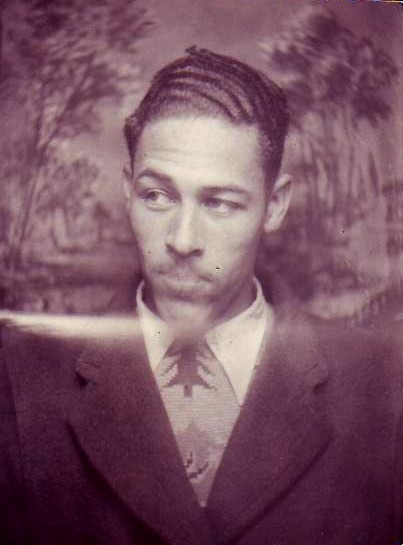
 Cousin John around the time of the sofa debacle, circa 1924, Wilson NC.

John J. Holt was the first child born to Bazel and Mamie Henderson Holt. His harrowing enclosure in the couch left him with lingering injuries, but he overcame them to grow into a lean, green-eyed hipster with “Latin lover” looks.

Image

John Holt fedora

Cousin John, early 1940s.

After serving in the Army in World War II, John married Helen Mack and reared six children in Bronx, New York. At 90, he is the oldest living Henderson male.

Image

Happy birthday, John J. Holt!

——

Interview with Hattie H. Ricks by Lisa Y. Henderson, all rights reserved; photos or copies in collection of Lisa Y. Henderson.

Standard
Education, Maternal Kin, North Carolina

Golar.

My great-aunt Golar Augusta Colvert, born in 1897. Her uncle Harvey Golar Tomlin, born in 1894.  My great-grandmother’s cousin, Goler Lee Miller, born in 1895.

Who were these people — all born within 25 miles of Salisbury, North Carolina — named for?

William Harvey Golar, the Canadian-born president of Livingstone College, a small, four-year institution in Salisbury affiliated with the African Methodist Episcopal Zion Church. Golar was appointed president in 1893 and was renowned for his energetic fundraising ability during his nearly 20 years of service.

Harriet Nicholson Tomlin Hart, mother of Golar T. and grandmother of Golar C., was an enthusiastic AMEZ, and I’m guessing that Goler’s parents George and Adline Miller were, too.

Standard
Maternal Kin, Paternal Kin, Photographs, Vocation

Where we worked: barbers and hairdressers.

Lon W. Colvert, Statesville NC – owned and operated L.W. Colvert Barbershop, 1900s-1920s.

James N. Guess Sr., Goldsboro NC – owned and operated barber shop, 1900s-1950s; 114 Walnut East, circa 1906; 120 Walnut East, 1912.

H. Golar Tomlin, Statesville NC – barber in brother’s shop, 1910s.

Charles H. Henderson, Richmond VA – barber, 1910s-1920s.

Roderick Taylor Sr., Wilson NC – barber, 1910s-1947; Paragon Shaving Parlor, 1916; Tate & Hines Barbershop, New Briggs Hotel, Nash Street, 1917; Hines Barbershop, Nash Street.

Ernest Smith, Goldsboro NC – worked in uncle’s barber shop, circa 1917.

Golar Colvert Bradshaw, Statesville NC – Poro agent, 1920s.

John W. Colvert II, Statesville NC – barber, 1920s-1937.

Blanchard K. Aldridge, Fremont NC – barber, 1920s-1965.

Freeman Ennis, Wilson NC – bootblack, barber shop, circa 1930.

Julia Allen Maclin, Newport News VA – owned and operated hairdressing shop, 1940s-1970s.

Ardeanur Smith Hart, Columbus OH — hairdresser, 1940s?-1980s?

——

The third in an occasional series exploring the ways in which my kinfolk made their livings in the 19th and early 20th centuries.

POSTSCRIPT, 1/21/2014: This brief history focuses on an earlier period, but provides useful insight into the role of African-American barbers.

Standard
North Carolina, Paternal Kin, Photographs

Finding the Barfields.

Some time in the late 1980s, I learned the name of my great-grandmother Bessie Henderson’s father — Joseph Buckner Martin — and learned that, after the death of Bessie’s mother Loudie, Buck Martin had several children with a woman whose last name was Barfield.  I marinated on that for a few years, then a bit of sleuthing revealed that Sarah Barfield was the woman, and her children were Walter, Amy, Lillie and Daisy Barfield. I found Walter Barfield Jr. in the phone book, cold-called him, and found him to be a gracious and welcoming cousin. His father had passed away not too many years before, but Aunt Lillie was still living, and he was happy to introduce us the next time I came home to North Carolina.

sarah barfield

Sarah Barfield

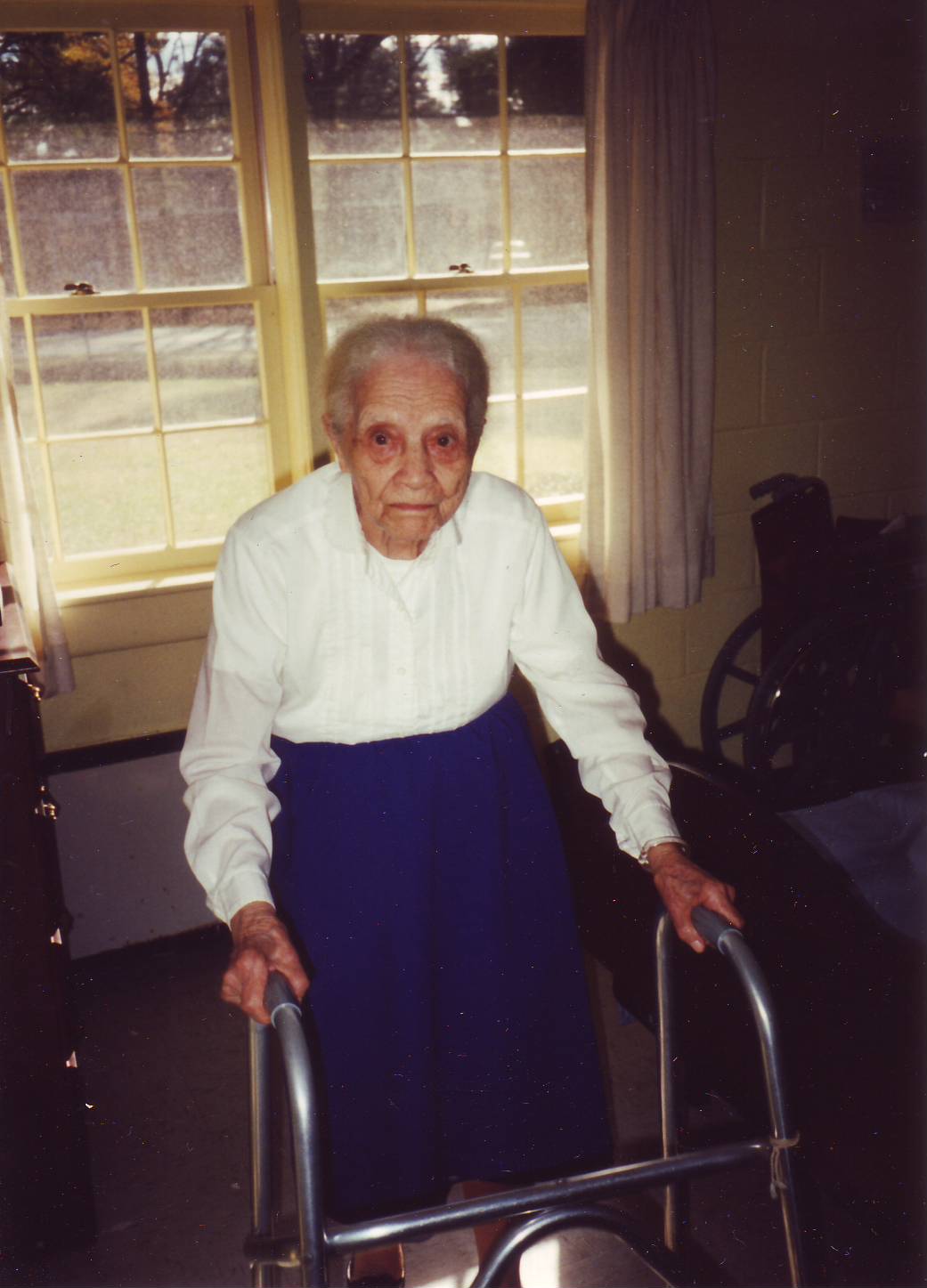
I met my great-great-aunt in the spring of 1993 at the nursing home in which she lived in Mount Olive. She was a tiny woman with a wizened, apple-cheeked face, her ivory-white hair pulled back in a small bun.

FB0036

I took  notes:

  • She said she never saw her half-sister Bessie Henderson, but remembers when she died [in 1910].  Her sister Amy went to the funeral and came home and cried and cried.
  • Jack Henderson, her half-brother, used to visit them in the country.  Once when he came, he wanted to meet their father.  She took him there, and Buck received his oldest son in a friendly manner.  He was good to his children.
  • Her sister Amy was in her 30s when she died; Daisy was 18.  They are buried in the Barfield cemetery, between Mount Olive and Dudley, not far from the railroad.
  • Her youngest granddaughter has a photo of Daisy.
  • She has a daughter Gladys and a son Walter Lee Holmes.
  • She bought the house that Buck left her mother from one of Ira Martin’s children, to whom it had reverted after her mother Sarah’s death.
  • Her house burned up with most of her photographs.
  • She knew Buck’s brother Alfred Martin.  He committed suicide.
  • Once on her way to Washington to see her husband, she spent the night in Wilson with Sarah Henderson Jacobs, who told her, “Don’t ever marry an old man.”  Walter Lee was 2 years old at the time. [This would have been about 1922.]
  • She remembered that my grandmother had children by a “barber man.”

The second time I visited Aunt Lillie was at Christmas, and I took my grandmother with me. When we walked in, Aunt Lillie stared wordlessly, then reached out to touch her face.

15768_176423273526_505368526_2933109_7444236_n

Lillie Barfield Holmes passed away peacefully on 1 June 2003, just shy of her 100th birthday.

——

Photographs taken by Lisa Y. Henderson, 1993.

Standard
Births Deaths Marriages, Free People of Color, North Carolina, Other Documents, Paternal Kin

Adam Artis’ children, part 5: Katie Pettiford.

From the “Adam Artis Family History”:

After Amanda died, Adam died Katie Pettieford of Goldsboro. They had one son, Pickney. Adam was 71 and she was 21 when they got married. Katie employed a male nurse to look after Adam. She sold off his land bit by bit.

Adam died of old age at about 100 years. His last wife, Katie, in 1923, had someone dig down to his coffin and saw off his feet. Several years later she committed suicide. She poured kerosene around a room and set it on fire.

In fact, Adam Artis married his fourth and final wife, Katie Pettiford, on 9 July 1902 in Wayne County. He was 71, as told, and she was about 20. Their only son, Alphonzo Pinkney Artis, was born in April 1903. By common account, Pinkney left home as a boy — ran away, in fact, to Baltimore. Adam died in 1919 at age 87. Katie, who remarried, died in 1940.  Her death certificate notes that she burned up inside her house, but does not mention suicide.

As for the rest, the story I’ve heard is that Katie, guilt-ridden over her abuse of Adam in his decline, grew convinced that he was haunting her from the grave. On the advice of a root doctor, she had his body exhumed and his feet cut off to keep him from walking the world.

Standard
Births Deaths Marriages, Maternal Kin, Newspaper Articles, North Carolina, Oral History, Photographs, Vocation

Lon Colvert: straight and shady.

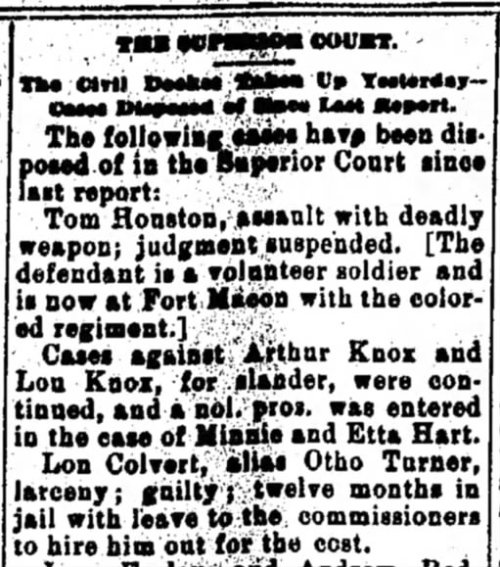
If reports are to be believed, Lon Colvert had a bit of a shaky start. “Otho Turner”?
Image

Statesville Landmark, 18 August 1898.
Carolina_Mascot_Sville_2_8_1900

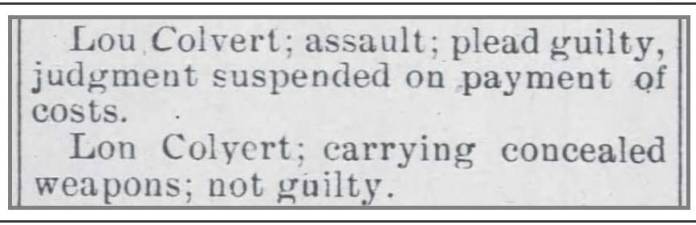
Statesville Carolina Mascot, 8 February 1900.

Lou Colvert was Lon’s uncle. No details on Lon packing. But he switched gears a bit.  To retailing, which specifically meant selling liquor — unauthorized.

Iredell County Superior Court —

Lon Colvert, retailing; guilty.  

— Statesville Landmark, 5 Nov 1901.

Another poor outcome.

“Cases Disposed of Since Monday — Some Recruits for the Chain Gang — A City Ordinance Held Invalid”

The following cases have been disposed of in the Superior Court since Monday:    …

Lon Colvert, convicted of retailing, was discharged on payment of the costs. 

— Statesville Landmark, 8 Nov 1901.

But somewhere along in here, he began to right his ship.

Notices of New Advertisements.

L.W. Colvert has moved his barber shop from Depot Hill to 109 east Broad street.

— Statesville Landmark, 23 Aug 1904.

It’s not clear when Lon first opened his barber shop, or how he got into the business, but it was a good move. Depot Hill was a few blocks south of downtown; the 100 block of East Broad was right at the heart of the business district. He had arrived.

Still, there were setbacks. (I read “liquor” in this “little pilgrimage,” but I could be wrong.)

“Played His Bondsman False and Will Spend his Holidays in Jail.”

Thursday afternoon a colored barber, Lon Colvert by name, braced Mr. J.P. Cathey for a horse and buggy with which to make a little pilgrimage that night, and Mr. Cathey refused.  Lon was just obliged to make that little run, so later he stated the case to Jo. Thomas.  Jo. is the colored individual who worked for Mr. Cathey then and who is now being boarded by the county.  Jo. slipped out with a horse and buggy.  Lon made his trip, came back, paid Jo. one plank, which he shoved down in his jeans, and then Jo. slept the sleep of the consciousless offender.

But the snow that fell during the interval between the exit and return of that buggy caused Jo’s little house of cards to tumble.  Next morning Mr. Cathey saw the tracks, asked Jo. who had got a buggy the night before, and Jo straightaway told the thing that was not.  So Mr. Cathey got off of Jo’s bond, which he had signed not long since, and now Jo. is behind bars.

— Statesville Landmark, 20 Dec 1904.

He pressed on.

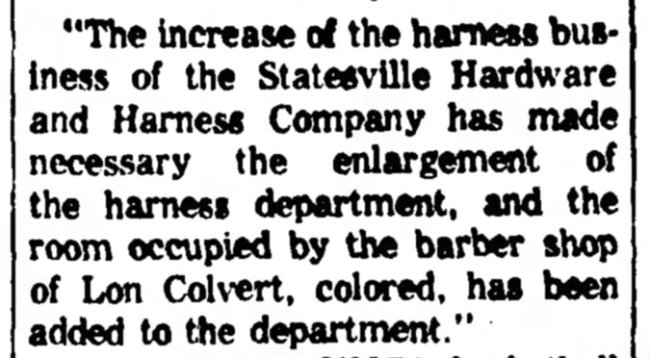
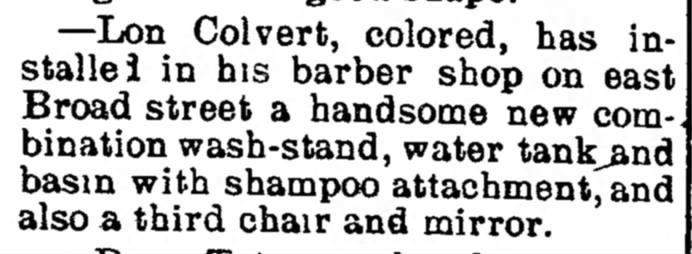
Lon Colvert, colored, has recently equipped his barber shop on east Broad street with a handsome two-chair dressing case and has made other improvements in the shop.

— Statesville Landmark, 1 Jan 1907.

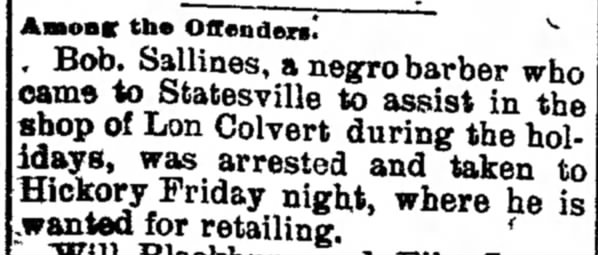
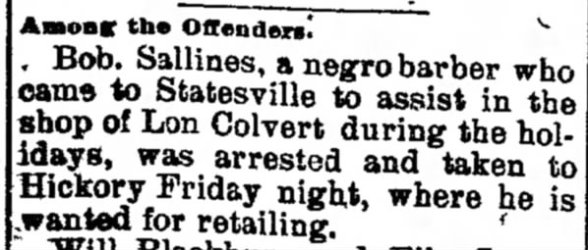
Occasionally, his friends let him down.
Image

Statesville Landmark, 1 January 1907.

But he had a new wife and a new baby to add to his first three, and the straight and narrow was starting to win.
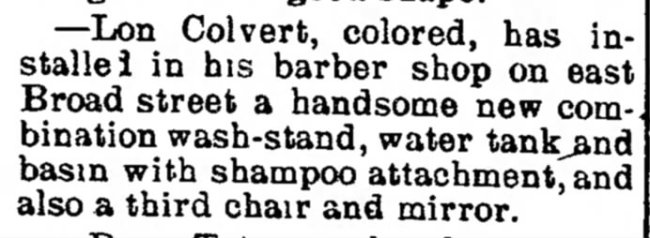
Image

Statesville Landmark, 7 May 1907.

Image

Statesville Landmark, 7 January 1910.

A momentary setback, no more. Lon moved his business back down Center Street toward the train depot and entered the golden age of his entrepreneurship, the period of my grandmother’s childhood.

Papa had a barber shop.  Well, of course, Papa did white customers. And, see, the trains came through Statesville going west to Kentucky and Tennessee and Asheville and all through there.  They came through, and they had, they would stop in Statesville to coal up and water up, you know.  There were people there to fill up that thing in the back where the coal was.  And there was another — it had great, big round things that they’d put in water.  And when those trains would stop for refueling, they would, there were a couple of men who would come. I can see Walker and my uncle and Papa standing, waiting for these men who were on the train to give them a shave and get back on the train in time.  And there wasn’t any need of anybody else coming in at that time ‘cause they couldn’t be waited on.  They were waiting for these conductors and maybe mailmen, but I know there would be at least three at a time.  And Papa would shave them.  And he made a lot of money.

Papa had a taxi, too. Walker drove it most of the time.  And then he would hire somebody to drive it other times.  And then when people had to go to Wilkesboro, Papa would take them.  Because Wilkesboro was a town north of Statesville. And there was no transportation out there.  No buses, no trains, or anything.  So when people would come on the train that were, what they call them, drummers, the salesmen, when they would come through, Papa would carry them up there. 

And he had this clean-and-press in the back of the barbershop. And, look, had on the window, on the store, ‘Press Your Clothes While You Wait.’  I can see those letters on there right now.  ‘Press Your Clothes While You Wait.’  And people would go in there, get their clothes pressed, you know.  And I know ‘barber shop’ was on the door….  ‘L.W. Colvert Barber Shop.’  ‘L.W.’ was on the side of this door, and ‘Colvert’ was on this side of the door.  They had a double door.

There were, of course, risks to doing business. Though I’m casting a side-eye at the carnie. (“H.G.” was Lon’s 21 year-old half-brother Golar, and I never knew he was a partner in the business.)

Damages for Scorching Suit — Court Cases.

Lon Colvert and H.G. Tomlin, doing a pressing club business under the name of Colvert & Tomlin, were before Justice Sloan Saturday in a case in which Chas. Moore, white, a member of the carnival, was asking $18 damage for them.  They pressed a suit for Moore and it was scorched, for which Moore asked damage.  The case was finally compromised by Colvert & Tomlin paying Moore $5 and $1.20 cost. 

— Statesville Landmark, 27 March 1917.

And there was the little matter of a charge of carrying a concealed weapon in 1919; a jury returned a not guilty verdict.  Still, a burglary at the shop was an omen. The good years were coming to an end. Lon was struck with encephalitis in the 1920s and was largely unable to work in his final years.
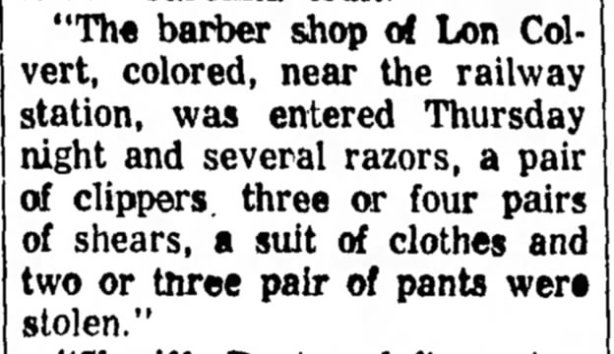
Image

Statesville Landmark, 25 September 1925.

By this time, Golda had embarked upon a peripatetic life in the Ohio Valley, and  Walker was left to keep his father’s businesses running.  He exercised his best judgment.

Walker Colvert, driver of the Wilkesboro jitney Steve Herman, driver of the Charlotte jitney, and Henry Metlock, driver of the Taylorsville jitney were charged with delivering passengers to the depot rather than the jitney station.  It appearing that all the violations were emergency calls, the defendants were discharged.

Statesville Landmark, 1 Mar 1926.

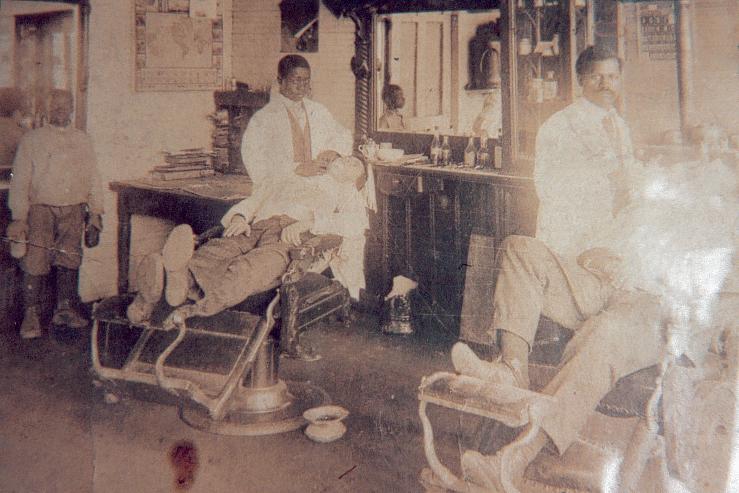
Lon Colvert died 23 October 1930.  “He was an old resident of Statesville,” his obituary noted, “and for a number of years had a barbershop on South Center street, near the Southern station.”
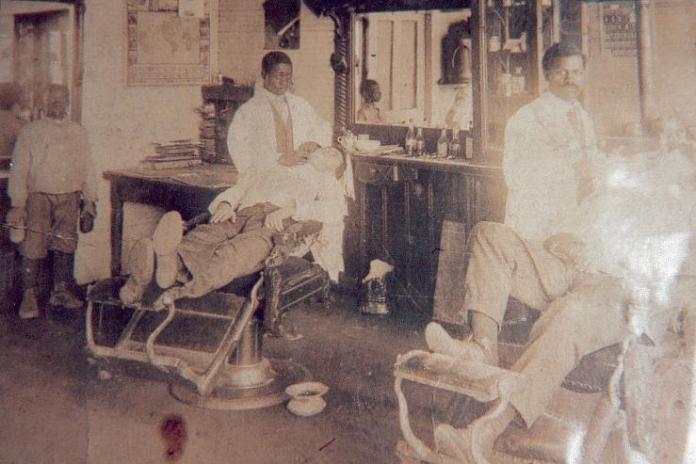
COLVERT -- Barbershop 2 The barbershop, 1918, when it was at 101 South Center Street. Walker Colvert, center, and L.W. Colvert, right.

——

Interview of Margaret C. Allen by Lisa Y. Henderson; all rights reserved. Copy of photograph in possession of Lisa Y. Henderson.

Standard
Maternal Kin, Newspaper Articles, North Carolina

Nicholson reunion.

These were Harriet Nicholson Hart‘s people, though I can guarantee you she was not there:

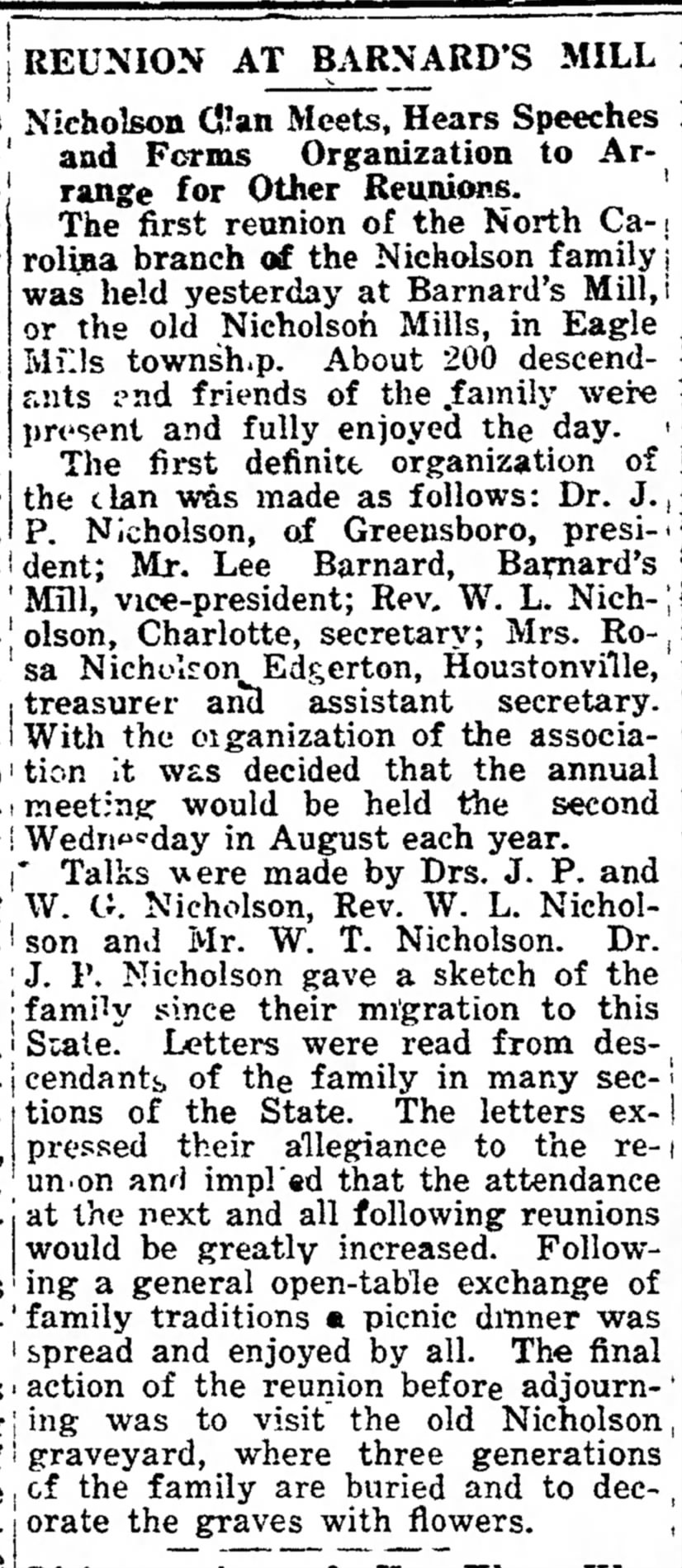
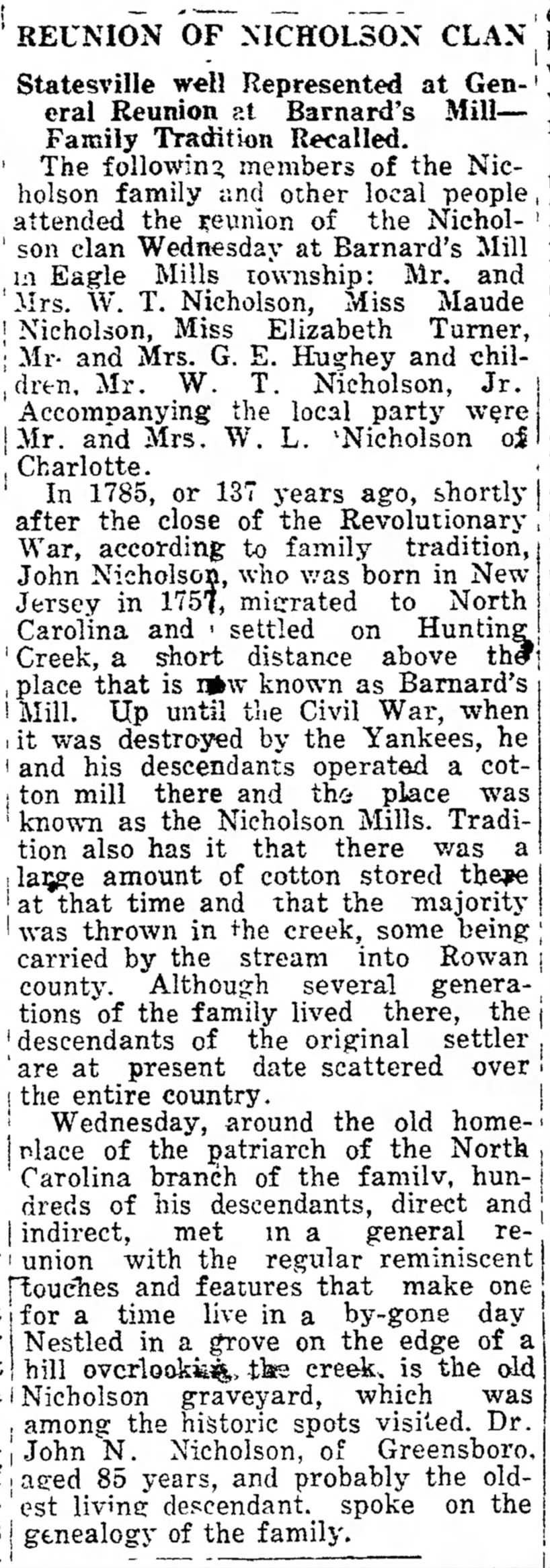
Nich Reunion 1 8 17 22

nich reunion 2 8 17 22

Statesville Landmark, 17 August 1922.

Nich Reunion 8 9 1923

Statesville Landmark, 9 August 1923.

Nich Reunion 8 12 1926

Statesville Landmark, 12 August 1926.

The North Carolina branch of the Nicholson Family descended from Revolutionary War veteran John Stockton Nicholson, born 1757 in Princeton, New Jersey, and his wives, Mary McComb Nicholson (1760- 1783) and Catherine Anne “Caty” Stevenson Nicholson (1766-1843).  The Nicholsons and Stevensons arrived in America from England in the mid-17th century.  The McCombs were perhaps Irish.  John and Mary had one child, James Nicholson (1783-1850). John and Caty had a passel: John Stockton Nicholson Jr. (1787-1868), Mary Nicholson Walker (1788-??), Elizabeth Nicholson Beeson (1790-??), Rebecca Nicholson Clampett (1793-1880), George Nicholson (1796-1802), Moses Pinckney Nicholson (1799-1844), Anderson Nicholson (1801-1879), Catherine Nicholson Clampitt (1804-1841), Phoebe Nicholson Barron (1806-1882), and Hannah Nicholson Idol (1811-1877).

Harriet was descended from both of John S. Nicholson’s wives. Mary’s son James married Mary Allison (1792-1857), daughter of Theophilus and Elizabeth Knox Allison, in 1815. They had two children, Thomas Allison Nicholson (1816-1886) and John McComb Nicholson (1820-??). Thomas married his first cousin, Rebecca Clampett Nicholson (1817-1903), daughter of Caty’s son John S. Nicholson Jr. and Mary Fultz.  Thomas and Rebecca’s children were: James Lee Nicholson (1841-1871), John Wesley Nicholson (1843-1913), Mary Jane Nicholson Smith (1846-1922), George Watson Nicholson (1848-1913) and Rebecca Ann (or Annie Rebecca) Nicholson Barnard (1860-1925). As detailed here, J. Lee Nicholson was Harriet’s father.

Nearly all of the reunion attendees mentioned by namein these articles were descended from Thomas A. Nicholson’s children Lee, George and Annie. Rev. W.L. and W.T. Nicholson, for example, were Lee’s sons, and the Barnards were Annie’s children and grandchildren. Dr. J.P. Nicholson, however, was Rebecca C. Nicholson Nicholson’s brother and Dr. W.G. Nicholson, her nephew. I’m not sure who the octogenarian John N. Nicholson was.

Standard
Births Deaths Marriages, Free People of Color, Migration, Other Documents, Paternal Kin

Age 121?!?

ImageOn March 30, 1932, in Lucy, Tennessee, just north of today’s Memphis International Raceway, an old man closed his eyes a final time. His doctor described his death in an unusually detailed, almost poetic, passage: “causes due to advanced age weakening of heart muscles beats slowing down until stopping quietly but regular.” He was, according to the death certificate, 121 years old, and his name was Guy Lane.

Guy Lane?!?!

I scanned the rest of the form: farmer … living in Shelby County … born in North Carolina … son of Guy Lane … an informant named Lillie ….

My great-great-great-great-grandmother, Vicey Artis, born free in or near Wayne County around 1810, had a sister named Sylvania. Both women married enslaved men. (And their brother Daniel married an enslaved woman.) On 31 August 1866, Vicey Artis and Solomon Williams and Sylvania Artis and Guy Lane registered their decades-old cohabitations in Wayne County and thereby legalized their marriages. Old Man Guy died before 1880, but ….

Sylvania and Guy Lane’s twelve children, who used both parents’ last names, were born over the course of more than twenty years.  Morrison Artis, born 1837, was first, followed by Mary Artis (1839), Jane Lane Sauls (1842), Daniel Artis (1843), Mitchell Lane (1845), Mariah Artis (1846), Guy Lane Jr., Penny Lane (1850), Dinah Lane (1851), Julie Lane Sutton (1853), Washington Lane (1855) and Alford Lane (1859).

In 1869, Guy Lane Jr. married Dinah Dew in Wayne County. They appear together in the 1870 and 1880 censuses and had at least six children: Ora, Moses, Lizzie, William, Mary S., Milton F. Lane, and a girl. By 1900, though, Guy and his family are nowhere to be found in North Carolina. Instead, they surface 800 miles due west, just outside Memphis. (Had they been Exodusters sidetracked on the way to Arkansas?)  Guy had a new wife, of four years — Eliza, born in Tennessee — but his youngest two children, Milton and Guy Jr. (actually III), both born in NC, were with him. In 1910, on the Memphis & Shakerag Road, 60 year-old Guy and Eliza Lane are listed with eight year-old daughter Lilly. Both reported that they had been married twice, and Eliza reported that only one of her nine children was living. In the 1920 census, the couple are living with Lillie and her husband Robert Burnett. Guy continued to work as a farmer, and his age is reported as 78. Ten years later, in 1930, Guy and Liza are living alone again, and his age has leapt inexplicably to 114. By time he died in 1932, Guy had gained another seven years.

The credible evidence suggests that cousin Guy Lane, in fact, was born about 1848, making him a more reasonable 84 years old when his heart slowed down until stopping quietly. He is not forgotten.

Standard
Maternal Kin, Other Documents, Paternal Kin, Vocation

Where we worked: hotels, clubs and boarding houses.

Caswell C. Henderson, Raleigh NC – porter, Yarborough House, circa 1886.

yarborough house

Richard Morgan, Asheville NC – husband of Elvira Colvert Morgan; saloon servant, circa 1900.

Larry R. Artis, Washington DC — porter, public house, circa 1920.

Rufus Williams, Charlotte NC — husband of Carrie Reeves Williams; porter, club, circa _____; waiter, clubhouse, circa _____.

John E. Reeves, Boston MA — hotel waiter, circa ___________.

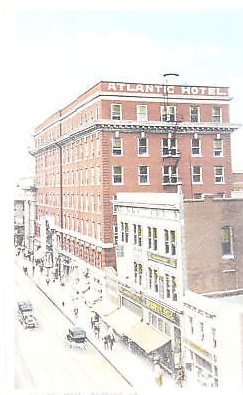
Ira Braswell Sr., Norfolk VA — husband of Mattie Brewington Braswell; hotel bellman, Atlantic Hotel, circa 1910s-1920s; head waiter, Atlantic Hotel, circa 1930.

atlantic hotel

Lewis Renwick Sr., Statesville NC – husband of Louise Colvert Renwick; porter, Battery Park Hotel, Asheville, 1917; bellman, Vance Hotel, 1920s-1950s.

Edward McNeely, Statesville NC – bellboy, Hotel Iredell, circa 1916; hotel porter, Hotel Iredell, circa 1917.

Lafayette Artis, Washington DC – bellboy, Harrington Hotel, circa 1917.

Earle M. Hagans, Norfolk VA – waiter, Southland Hotel, circa 1918.

Toney Brewington, Norfolk VA – bellman, Southland Hotel, circa 1918.

Ned Barnes, Raleigh NC – porter in club, circa 1920.

Quincy E. McNeely, Asheville NC – waiter, boarding house, circa 1930.

Curtis Braswell, Norfolk VA — hotel waiter, circa 1930.

Freeman Ennis, Wilson NC — bellboy, 1930s.

Hattie Brewington Davis, Atlantic City NJ – worked at Ostend Hotel, circa 1937.

ostend

—–

The second in an occasional series exploring the ways in which my kinfolk made their livings in the 19th and early 20th centuries.

Standard