Births Deaths Marriages, Enslaved People, Land, Maternal Kin, North Carolina

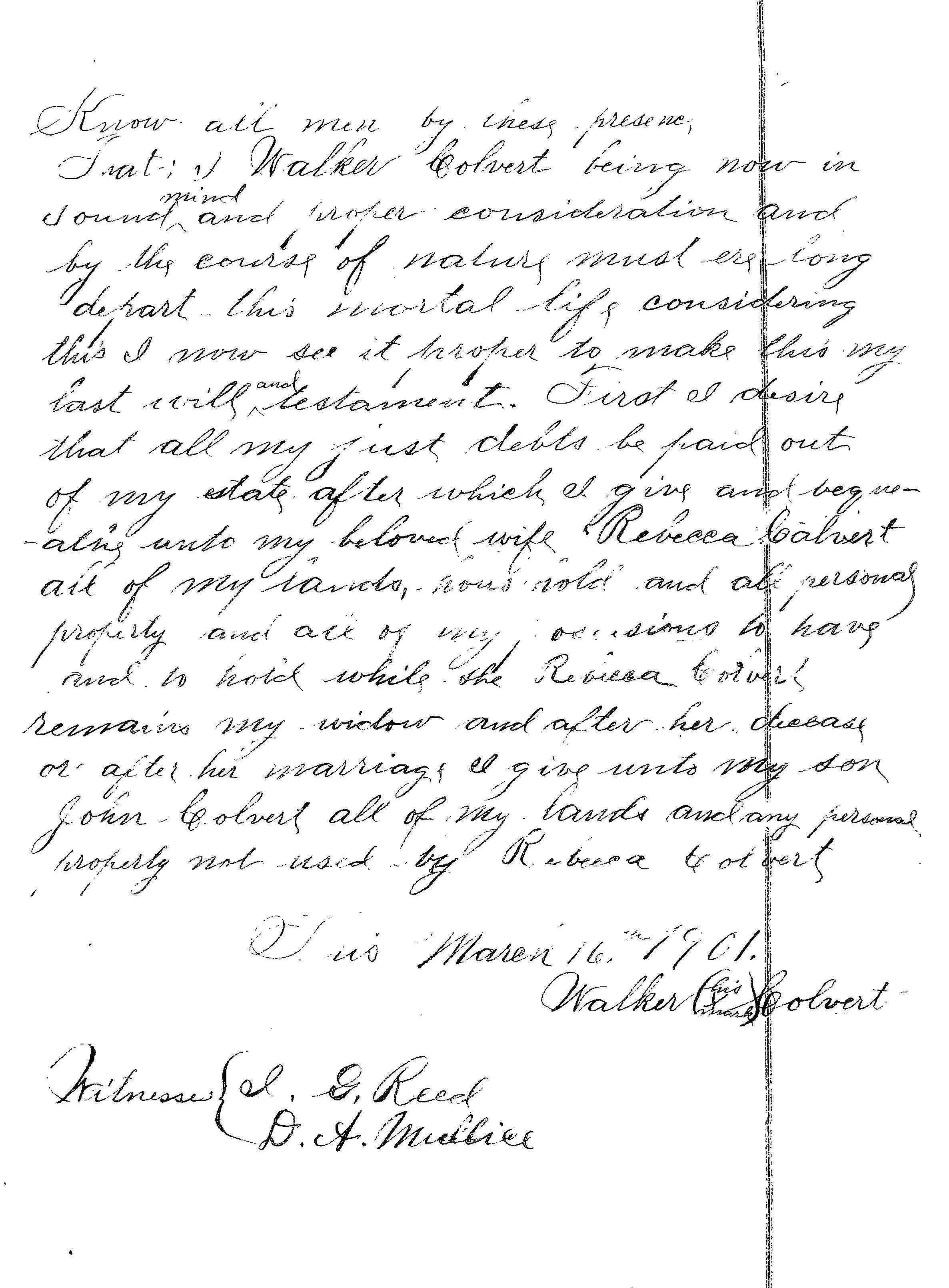
All of my possessions to have and to hold.

COLVERT -- W Colvert Will_Page_1

COLVERT -- W Colvert Will_Page_2

Born 40 years into American independence, and less than ten after the importation of African slaves was banned, Walker Colvert could have prayed for, but never foreseen, that he would gain his freedom just past the midpoint of his life and that he would die possessed of something to leave his wife and son.


Standard
Births Deaths Marriages, Maternal Kin, Newspaper Articles, North Carolina, Other Documents

Cousin Red McNeely … or Smith.

So, was he James Garfield Smith or James Garfield McNeely?

Addie Lucinda McNeely married Daniel Smith in Statesville NC on 2 October 1902. Their daughter Ardeanur Smith was born the following February and son James Garfield Smith on 11 April 1906. I have never found the family in the 1910 census and do not know how long Addie and Daniel remained together. When her uncle Julius McNeely’s estate opened, Addie Smith with her siblings was listed as one of the heirs. Unlike her married sisters, however, her husband’s name does not appear alongside hers. In 1917, mid-proceedings, Addie died — I’ve never found her death certificate either — and her name was struck through and was replaced by that of her children, “Ardenia” and James Smith.

I have not located James again with any certainty before 1942. (There’s a “James McNeelly” of the right age listed in the 1930 census of High Point NC, but he had a wife, which my James allegedly never had.) When he registered for the World War II draft, James gave his name as “James Garfield McNeely.” Why the shift from “Smith,” which he apparently never used as an adult? Though his birth year appears to be off by one year, this is clearly our man. He was born in Statesville, and Janie McNeely, his mother’s youngest sister, is named as his contact. (The neighborhood in which he lived and worked is now part of the Washington Street Historic District, and Club Carolina merited a brief mention in the application for historic status.)

James G McNeely

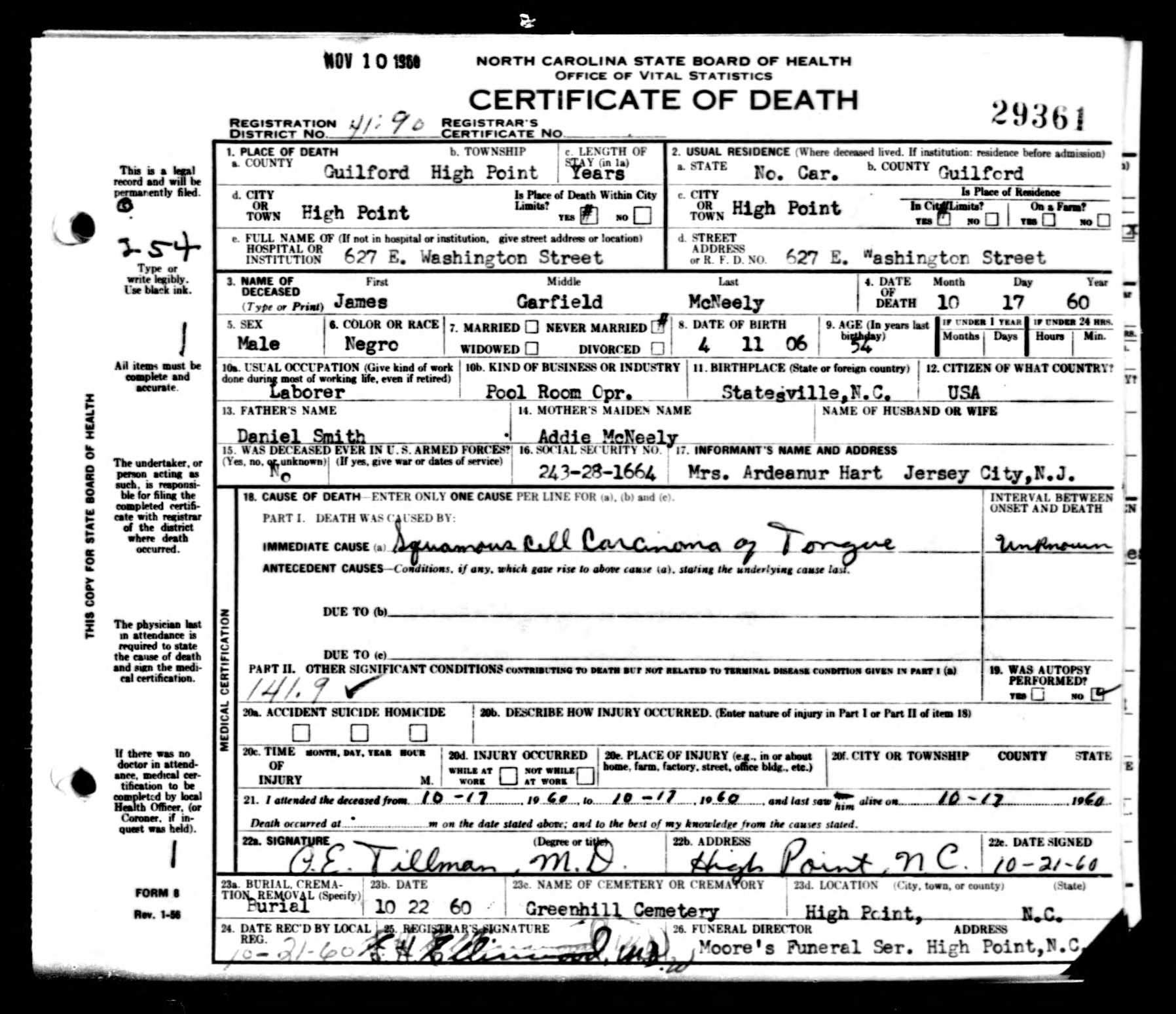
Cousin James disappears from the record again until his death certificate was filed. He was working at a pool room and living at the Kilby Hotel when he died. Ardeanur Hart of Jersey City NJ was informant and gave her brother’s name as James Garfield McNeely.

James G McNeely Death Cert

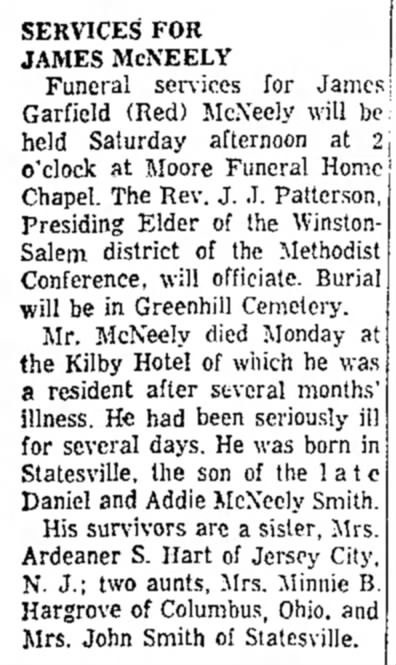
Here’s his obituary:

James G McNeely 21 October 1960 HP Enterprise

High Point Enterprise, 21 October 1960.

And a note of acknowledgment from his family. (Who in the world were the Martins and Griffins?):

JG McNeely HP Enterprise 11 13 1960

High Point Enterprise, 13 November 1960.

[Sidenote: The physician who signed James’ death certificate? Dr. O.E. Tillman? His son and I met in high school and became good friends in college. He married A.B., my roommate and closest college friend, and I was in their wedding. Dr. Tillman is now retired, but remains active in High Point civic affairs.]


Standard
Maternal Kin, Paternal Kin, Vocation

Where we worked: healers and helpers.

Margaret Balkcum Henderson, Dudley NC – midwife, 1870s?-1900s?

Louvicey Artis Aldridge, Dudley NC – midwife, 1890s?-1920s?

Sarah Henderson Jacobs Silver, Dudley NC – midwife, 1890s.

Joseph H. Ward, Indianapolis IN – doctor, 1897-1950s.

Vera L. Baker Holt, Goldsboro NC — registered nurse, 1900s.

Diana A. Adams Artis, Wilson NC — wife of Columbus E. Artis, registered nurse, 1910s-1950.

Henrietta Colvert, Wilson NC, Asheboro NC, Roanoke VA – registered nurse, 1910s-1960s?

J. Thomas Aldrich [Aldridge], Saint Louis MO – doctor, circa 1930-1968.

Worth A. Williams, Charlotte NC — dentist, 1920s-1960s

Nita Allen Meyers Wilkerson, Washington DC — registered nurse, 1930s-1970s.

J. Maxwell Allen, Lynchburg VA, Charles City VA — dentist, 1930s-1959.

Leon M. Braswell, Lynchburg VA — doctor, 1930s-1950s.

Henry C. Best, Wilson NC – husband of Annie Artis Best; hospital orderly, circa 1930.

Irvin L. McCaine Sr., Asheville NC, Oakland CA, Mount Vernon NY — husband of Mable Williams McCaine; dentist, circa 1940-circa 1980.

John W. Stockton, Statesville NC — orderly, Davis Hospital, 1940s-?

Hattie Henderson Ricks, Wilson NC –- nurse’s aide, 1940s-1958.

Leroy T. Barnes, Queens NY, Los Angeles CA — husband of Jeanne Davis Barnes and Wanda Davis Moseley Barnes, radiologist, 1940s-1987.

Jarvis E. Sherrod, Wilson NC – hospital orderly, 1940s-1950s.

Frederick R. Randall, New York NY — physician, 1940s-ca. 2000.

R. Stewart Randall, Washington DC — physician, 1940s-1992.

The fourteenth in an occasional series exploring the ways in which my kinfolk made their livings in the 19th and early 20th centuries.

Standard
Maternal Kin, Other Documents, Virginia, Vocation

Man of a thousand hustles.

My great-grandfather, the longshoreman, rose from the docks to become a union officer and civic leader in Newport News, Virginia. The arc of that narrative seemed long and interesting enough, but we now know that it does not quite do this hard-working man justice. In fact, in just the first decade-and-a-half of the twentieth century, John C. Allen worked a half-dozen jobs to keep his growing family comfortably fed, clothed and sheltered. The 1900 census records John’s occupation as shipyard laborer, which is more or less consistent with received wisdom. Newport News city directories, however, capture the full range of John’s hustles over the years:

1902 — Allen Jno, eating house, Ivy Ave nr 18th. John’s church, Zion Baptist, was at 20th and Ivy, at the heart of Newport News’ East End. Presumably, John owned this small and apparently short-lived restaurant and probably lived on premises. (Fifteen years later, John’s nephew Junius Allen lived at 1752 Ivy, which is at the corner of 18th Street.)

1903 — Allen Jno C, lab h 748 21st   John was probably laboring at the shipyard. 748 21st Street is the house in which my grandfather and his siblings spent their early childhood years. I need to check deeds to find out if John Sr. bought it 1902-03. My grandparents also lived here during the first five or so years of their marriage.

1910 — Allen Jno C, painter h 748 21st  John is described as a shipyard painter in the 1910 census, and he seems to have worked this job at least two years.

1911 — Allen Jno C, painter h 748 21st  

1912 — Allen Jno C, agt Am Ben Ins Co h 748 21st  Insurance agent??? John had come an impressively long way for a man who’d been illiterate when he arrived in Newport News a dozen years earlier. American Beneficial Insurance Company was a black-owned business founded in 1902 in Richmond, Virginia, by Rev. Wesley F. Graham, a Baptist minister.

1913-14 — Allen Jno C, grocer 2206 Madison av h 2107 Marshall av  Around 1913, John bought the house on Marshall Avenue in which he and his wife lived out their years, at which my parents married, and in which his daughter Julia lived and operated a beauty parlor when I was a child. The Madison Avenue grocery is a complete mystery. [Postscript, 13 April 2014: A mystery only to me, apparently. You just have to ask the right questions. After my mother read this post, she sent me a text identifying “Mama Taylor” and her husband as folks who operated a grocery that may have been her grandfather’s. Post-postscript, 19 April 2014: my Uncle C. told me that (1) Mama Taylor and her husband Johnnie lived above a grocery they operated in the 1900 block of Madison Avenue; (2) Mama Taylor was close to “her Johnnie,” my grandfather; (3) Mama Taylor was about his grandparents’ age; (4) he wondered if Mr. Taylor and John C. Allen Sr. were related, as they had similar builds and full heads of white hair; (5) at least during my uncle’s childhood, John and Agnes Allen ordered their groceries from a white-owned business in the 2100 block of Madison, not from the Taylors.]

1914-15 — Allen Jno C, clk h 2107 Marshall av  Clerk? What kind of clerk?

The 1916 and 1917 city directories revert to the 1913-14 grocer entry, but when John Allen registered for the World War I draft in 1918, he reported that he worked as a laborer for Hampton Roads Stevedoring Company. The 1918 and 1919 city directories also show him as a laborer. (Had the grocery store closed? Why? Was there better money on the docks?)

UPDATE: On 31 May 1917, J.C. Allen ran a small ad in the Newport News Daily Press announcing the liquidation via auction of his grocery store at 2206 Madison Avenue:

img (3).jpg

The 1920 census finally recorded John’s occupation as “longshoreman on piers.” (John was 45 years old in 1920, well into middle age. Unloading ships in this era was brutal work even for young men.) Subsequent city directories label him “longshoreman” (1923), “mgr International Longshoreman’s Union” (1925), “mgr Intl Longshoreman’s Locals 844 & 946 gro” (back in the grocery business, 1927).

In the 1930 census, John worked as a longshoreman for a steamship company, but is reported as a laborer in the 1931 and 1932 directories. In 1933, he’s again a manager with the union, but the 1940 censustaker described him as a longshoreman in “frt. transport.” (Incidentally, sometime in the late 1930s, he helped found Whittaker Memorial Hospital and joined its and Crown Savings Bank’s boards of directors.)

A 1953 obituary laconically notes that John C. Allen “worked for the Newport News Shipbuilding and Dry Dock Co. for about 10 years and then became a stevedore.” Ah, but he did so much more.

John Allen ca1950

John C. Allen at his son-in-law’s in yet another role — farmer. Near Jetersville, Virginia, 1940s.


Standard
Maternal Kin, North Carolina, Oral History, Photographs

Papa used to keep him just slick and pretty.

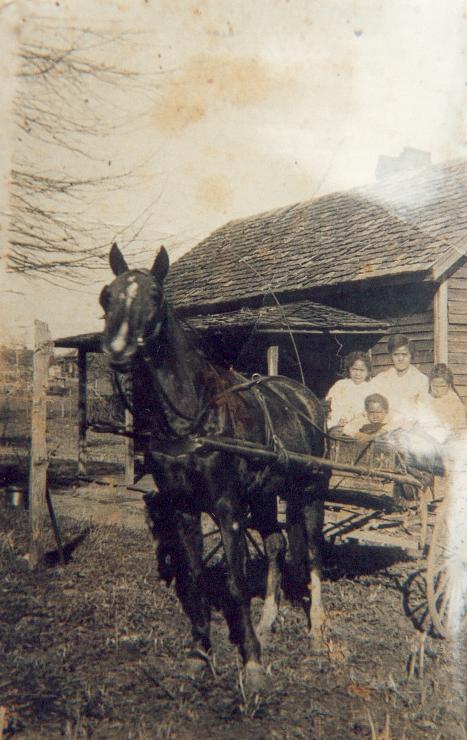
His name was Prince. And Papa sold Prince when he bought a car. But when he bought Prince, Prince had never been broken in. Nobody’d ever ridden him. And this man broke him in for Papa. But he was still high-spirited, because he was a race horse. And he had four white feet. That is what was so distinctive about him. He was chestnut. And we were so crazy about him that we would go in the – Papa had a big enclosed lot, like, that he could come out in. Other than the stable. And we would go in there with him, but he wouldn’t bother us. He would never bother us. And this old gentleman would be what was called currying. He would curry the horse and brush him and all, and he would hold me up and let me brush it. What was the man’s name? I can see him right now. He was an old man and real light. He was almost white. He had light hair, had white hair. And he loved Mama’s cooking. She used to bake something that was a pie. She called it a pie – but it was sweet potatoes. It was not mashed like you’d make up in a sweet potato pie ‘cause she would slice them and put them in the pie. Then she would make a sauce with nutmeg and lemon juice and thicken it with flour, you know. And then she would cook all of that in a big plate thing like that. And when Papa sold Prince, we went down where the man who had bought him had him, and he would look bad. His skin – you know Papa used to keep him just as slick and pretty. And that man would come to the house and wash him down with soap and water and everything and made him pretty. And he had pretty white feet. But Papa sold him to that man when he bought the car. And we went down there one day to see Prince, and he looked awful. He looked bony. He just looked awful. And we went down a little hill where he was in an enclosure. And we called him, and he came running over there where we were. We were so glad to see him. And we went home and told Papa that Prince said he wanted to come home. Yes, Lord. We wanted Prince moved.

COLVERT -- Colvert Girls & Bert

Possibly Prince (though he only has two white feet), circa 1913, with Louise Colvert, Launie Mae Colvert, Bertha Hart and Margaret Colvert.

—–

Interview with Margaret Colvert Allen by Lisa Y. Henderson; all rights reserved.

Standard
Foodways, Maternal Kin, North Carolina, Oral History, Virginia

I never ate a bite in my life.

My grandmother, Margaret Colvert Allen: Papa was a hunter.

Me: He hunted?

My aunt: Papa was?

Grandma: Yeah. He hunted.

Me: So, he had hunting dogs.

Grandma: Yes, indeed. He had a place made to put his dogs in and — hound dogs, you know. Hunting dogs.

Me: Did — he hunted deer or smaller things?

Grandma: Naw. He never hunted deer. But he hunted rabbits and squirrels and quail. [Inaudible] and he would catch ‘em [inaudible] but I didn’t ever cook one. [Laughs.] His mother used to cook possum.

Me: Used to cook possum?

Grandma: Oh, possum, honey. They would cook those dern things.

Me: Well, possum stew. I guess I have heard of that.

Grandma: Hmm?

Me: Possum stew. I guess I have heard people talk about that.

Grandma: Naw. They didn’t have no possum stew. They’d bake this thing.

Me: Awwww!

Grandma: And, look, wait a minute. You know they’ve got big mouths. Long mouths. A possum. And he’d put a sweet potato in the possum’s mouth. [I laugh, hard.] I don’t remember cooking one, but my grandmother sure used to cook ’em. And Papa cooked ’em. But I refused to cook ’em. Not me. And you know these people when I came here ate muskrats?

Me: [Laughing.] In Newport News?

Grandma: John’s people ate muskrats. And you know the merchants would have ‘em hung up all on the outside the street, you know, like you used to have chicken cages where you could go and pick ….? Well, they would have these muskrats killed, and they were real bloody, and they would be hanging, and they’d just be killed. I mean, it wasn’t nothing wrong with ‘em if you liked that kind of thing. I cooked it for your daddy, but I declare before God I have never eaten a bite. [I laugh.] Not a bite.

My aunt: When I went to Africa, and we would take our day trips, they would have some kind of animal that they had split open –

Me: Butterflied. [Laughing.]

My aunt: And a rodent. Some kind of rodent. And I ain’t eating that. They had some kind of little rodent. And they had, like, barbecued it or something. And his head was still on.

Grandma: What you mean – little or big?

My aunt: Ma’am?

Grandma: How big would it be? ‘Bout the size of a squirrel or something like that?

My aunt: I don’t think it was a squirrel.

Grandma: Aw. Well, I don’t know what they were then. But, honey, these merchants on Jefferson Avenue used to have those muskrats hanging out there, honey, and you talking ‘bout bloody, and they would have skinned them, you know. And they were hanging like that. Ah. And bloodied. Ooooo. They would be so bloody. I fixed one and cooked it, but seriously, my hand to God, I never ate a bite in my life. I never intended to eat a bite. And my daddy didn’t like ‘em either. So my grandmother used to always bring him something down, she’d come down sometimes Sunday afternoon or Saturday night.

My aunt: Grandma Allen?

Grandma: No, no, no, no, no. My daddy.

Me: Harriet.

Grandma: She would always bring him something. Always bring him something. And this day she was supposed to have brought him some rabbit. Fried rabbit, you know. And I never shall forget. He sat over there by the window. Now, he’d had his dinner. He’d had Mama’s dinner, but when Grandma came and brought something he had to have some of that. He sat over there, and he ate, ate that piece of what he thought was rabbit, and he got down to the bone, and he knew it wasn’t rabbit. Because he didn’t – and he said, “Mama, what is this?” And she was crying laughing at him eating muskrat when he swore he’d never eat a bite. And she, I can see her right now. She was sitting over there, and, child, she was laughing. Laughing ‘til she cried. And Papa said, “You better be glad you’re my mama, ‘cause I certainly would whip you today if you weren’t my mama.” He was so mad.

Muskrat_eating_plant

—–

Interview of Margaret C. Allen by Lisa Y. Henderson; all rights reserved. Photo courtesy of Wikipedia.

 

Standard
Maternal Kin, Paternal Kin, Vocation

Where we worked: morticians and embalmers.

Isham Smith, Goldsboro NC – husband of Nancy Henderson Smith; undertaker, circa 1900-1914.

William T. Abrams Jr., Union SC — husband of Mamie Aldridge Abrams Rochelle; undertaker in family business, circa 1930.

William J. Allen, Newport News VA – embalmer, 1930s-1970s?

James N. Guess Sr., Goldsboro NC —  husband of Annie Smith Guess; owner and operator of funeral home, Pine between James and Center Streets, 1910s-1950s.

Guess Fun Hom 6 22 1940 Af Am

The Afro-American, 22 June 1940.

James N. Guess, Jr., Goldsboro NC – worked for father’s funeral business.

Columbus E. Artis, Wilson NC – owner and operator of Artis & Freeman Funeral Home, 1920s; C.E. Artis Funeral Home, 1920s-1950s.

Concord Daily Tribune 5 24 1921

Concord Daily Tribune, 24 May 1921.

The twelfth in an occasional series exploring the ways in which my kinfolk made their livings in the 19th and early 20th centuries.

Standard
Births Deaths Marriages, Maternal Kin, North Carolina

Family cemeteries, no. 10: Green Street.

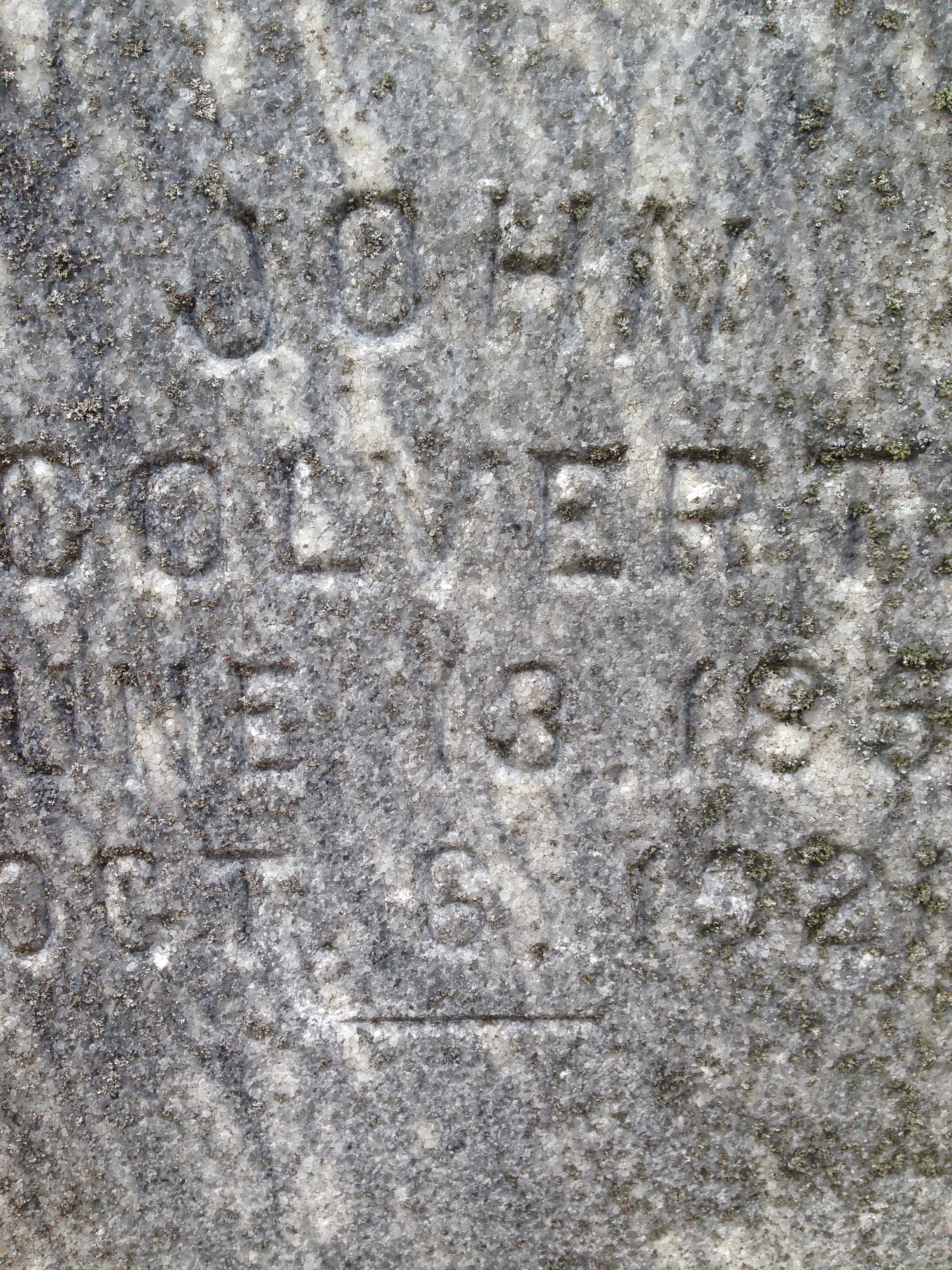
Green Street cemetery is a three-acre square smack in the middle of Statesville’s African-American southside. My great-aunt’s house faced the graveyard, but I don’t recall anyone ever talking about family members being buried there. Nonetheless, several years ago, I found three: my great-great-grandfather John W. Colvert, his wife Adaline Hampton Colvert (the double stone below) and their daughter Selma Eugenia Colvert, who is buried nearby. I suspect that others rest there, including John Colvert’s parents, his son Lon W. Colvert, Lon’s first wife Josephine Dalton Colvert, and his children Walker Colvert and Golar C. Bradshaw.

IMG_4585

IMG_4588

Standard
Enslaved People, Maternal Kin, North Carolina

McNeelys enumerated.

Perhaps he ticked them off on his fingers: “One female, aged 24 to 36. … One female, under ten years of age. … Three males, all under ten….” The enumerator for the 1840 federal census of Rowan County dutifully recorded the information that Samuel McNeely provided, inking in  small numerals in the appropriate column under “SLAVES.” The adult female was Lucinda. The female child was her daughter Alice, and two of the males were her sons John and Julius. It is likely that the third boy was also Lucinda’s, as Samuel was not likely to have purchased a small child and Alice was too young to bear children.

Samuel died in 1843 and, under the terms of his will, son John W. McNeely inherited slaves Lucinda and her offspring. In the 1850 slave schedule, John reported owning eight slaves: a 34 year-old black female [Lucinda]; a 19 year-old black female [Alice]; a 17 year-old black male [John]; a 14 year-old black male [the third boy above, name unknown]; a 12 year-old black male [Julius]; a 9 year-old mulatto male [Henry, Lucinda’s son by John W. McNeely]; a 2 year-old mulatto male [Joseph Archy, Alice’s son]; and a 1 year-old black female [probably Alice’s daughter Mary].

In 1860, John W. McNeely reported only seven slaves: a 44 year-old black female [Lucinda]; an 11 year-old black female [Mary]; a 22 year-old black male [Julius]; a 19 year-old mulatto male [Henry]; a 12 year-old mulatto male [Archy]; a 9 year-old black male [Alexander “Sandy,” who was probably Alice’s son]; and a 7 year-old black male [John Stanhope, who was probably Alice’s son.]  The same seven appear, by name finally, in the 1863 Confederate tax valuation. [A vexatious question: Where was John Rufus in 1860 and 1863? When he married in 1866, he reported John W. McNeely as his former owner. Had he in fact spent his final years of servitude under a different master?]

And then came freedom. In the 1870 census of Atwell township, Rowan County, at household #294: Lucinda McNeely, age 54, domestic servant; Henry McNeely, 29, school teacher; Joseph A. McNeely, 22, farm laborer; and Elizabeth McNeely, 13, “attends school.” [According to my grandmother, this Elizabeth was Henry’s daughter, abandoned by her mother at his doorstep.] At #295: Julius McNeely, 32, farm laborer; wife Mary McNeely, 25, “keeps house”; and nephews Alex’r McNeely, 17, farm laborer; and John S. McNeely, 18, farm laborer. [On the other side, at #292: John W. McNeely, 63, and wife Mary, 63, and at #293: Henry W. McNeely, 35; wife Nancy E., 24; and children Margaret, 3, and John W., 1. This Henry W. McNeely, son of James H. McNeely, was John W.’s cousin, though the exact relationship is unclear.]

Standard