Births Deaths Marriages, Free People of Color, Migration, Newspaper Articles, North Carolina, Paternal Kin

Anna J. Henderson Simmons.

Something brings me back to Anna J. Henderson Simmons. At no more than 20 years old, she left all the family she knew to follow her new husband 800 miles to Canada, where his Wayne County family had settled decades earlier.   It is hard to get a sense of Anna’s life. Her husband Montreville Simmons achieved a measure of success as a farmer in central Indiana, but evidence suggests that he was a difficult man to live with. Did she ever see her birth family again? Probably not, and evidence suggests that her children had an uncertain grasp on the facts of her early years.

Here’s what I know of my great-great-great-grandfather Lewis Henderson‘s sister:

In the 1860 census of Westbrooks, Sampson County, North Carolina, appear James Henderson, mulatto carpenter; wife Eliza; and four children, Anna J., Susan, Hepsie, and Alexander. Eliza (or Louisa) Armwood, daughter of John and Susan Armwood, was James’ second wife.

Ten years later, the family had moved about 20 miles east-southeast and appear in the 1870 census of Faisons, Duplin County: James Henderson, 52, mulatto farmer; wife Eliza; and children Ann, 17, Susan, 16, Hepsey, 14, Aleck, 13, John H., 11, Nancy, 6, and Betty, 3, plus James’ son James, 27, and boarders James Ammons and Thomas Cox. (Were the latter two relatives of either James or, more likely, Eliza/Louisa?)

The following spring, on 3 March 1871, Anna Henderson married Montraville Simmons, 19, son of Calvin and Hepsie Whitley Simmons, in Duplin County. The license lists Anna’s parents as James Henderson and Louisa Armwood. Montraville had been born in Wayne or Duplin County and migrated to Chatham, Kent County, Ontario, Canada with his family in the 1850s. After the death of his first wife, Victoria Brown, whom he married in Chatham in 1865, Montraville returned to North Carolina for a new spouse. (There’s a suspicious marriage on 16 April 1848 in Oakland, Michigan, between 23 year-old Montreville Simmons of North Carolina and Harriet Lucas of Richmond, Ohio. Was this yet another early marriage for Anna’s Montraville?)

Henderson Simmons

Duplin County, North Carolina, Marriage Register.

The family was captured in the 1881 census of Chatham, Kent County, Ontario, Canada: Montreville Simmons, 40, farmer; wife Annie, 29; and children Elizabeth, 8, Doctor T., 7, Susan M., 4, and Montreville, 2. All were born in the United States except Doctor and Montreville jr., who were born in Ontario, and all were Baptist. [Where in the U.S. was Susan born? Had Anna gone back to North Carolina? Or had the family lived some short period across the nearby border?]

Sometime in the next twenty years, the Simmonses cast their lot permanently as Americans. For reasons unknown, they settled near Logansport, Indiana, in rural Cass County north of Indianapolis. In the 1900 census of Eel township, on Park Avenue in Logansport, the census taker recorded farmer “Montville” Simmons, born April 1850, wife Anna, born March 1861, and sons James R., December 1879, Montville, June 1882, and Dock, December 1879. Montville and Anna were recorded as born in North Carolina; their sons in Canada. Montraville and Anna had been married 28 years and reported five of five children living. The family was described as black. [The evidence concerning the Simmons children is confusing. Census records name Elizabeth (born circa 1872), Doctor/Dock (born circa 1874), Susan M. (born circa 1877), James R. (born circa 1879), Montraville Jr. (born circa 1880) and Edward (born 1881.) However, records in Indiana indicate another daughter, Moncy, who died in 1942.]

Montraville Simmons was a successful farmer, but a life of material (if heavily mortgaged) comfort did not necessarily spell ease for Anna. Montraville’s name peppered the local paper regularly, as Pharos-Tribune reporters gleefully chronicled his clashes with neighbors and his personal peccadilloes.

Anna herself managed to stay out of print until 1905, when the ailing woman parachuted into a spat between her husband and his creditors. Headlines blared her surprising intervention, and it’s hard not to see Montraville’s hand as a puppet master in this 11th hour shenanigan.

fde18e1441d94fe6af87424a4a2b890e_crop

Logansport Pharos Tribune, 22 December 1905. 

Sadly (she was only about 50 years old) but perhaps mercifully, within six months, Anna Henderson Simmons was dead. Her death certificate, which contains some curious errors, reported that Annie Simmons, married, died 16 Jun 1906 in Cass County, of Basedow’s disease [now known as Graves’, a disease of the thyroid]. She was born 2 February 1856 in North Carolina and was buried at Free Union Baptist in Irvin township, Howard County, Indiana, by Kroeger & Strain, funeral directors. The informant for the certificate was Montraville Simmons. The father or the son? I don’t know, but it’s hard to believe that either reported Anna as white, though that’s what the certificate notes. It’s less hard to believe that Montraville Jr. might have misreported his mother’s parents as James Harrison and Eliza Henderson. He, after all, had surely never met them. (And when he married Jessie Winslow in Cass County in 1903, he cited his mother’s maiden name as Anna Harrison.)

On 18 June, the Pharos Tribune ran a brief obituary:

oigt6072OI83632774

——

Who were Anna Henderson Simmons’ legacies? Is there a lost branch of Hendersons in middle Indiana?

  • Elizabeth Simmons (circa 1872-??) probably died before adulthood. Or she is the same person as Moncy Simmons.
  • Moncy A. Simmons (1872-1942) married first Daniel Bassett, then Newton Palmer; no known children.
  • Doctor R. Simmons (27 November 1874-after 1951) married Fannie Gibson; no children.
  • Susan M. Simmons (circa 1877-1937) married Britton Bassett; two children, who died in infancy. She helped rear her brother Montraville’s son Harold.
  • James R. Simmons (circa 1879-aft. 1900) probably did in young adulthood; no children. Or, he is the same person as Edward Simmons.
  • Montraville Simmons Jr. (circa 1880-31 March 1910) married Jessie Winslow in 1903. His son Harold Simmons was born about 1904. On 7 October 1911, Jessie gave birth to Helen Elizabeth Simmons in Chicago and listed Montraville on Helen’s birth certificate, but he could not have been the child’s father. Similarly, in the 1920 census, Jessie Winslow Simmons, remarried to Earnest W. Griggs, attributes by inference two additional children to Montraville Jr., Frances (born 1913) and Alma (born 1916). Neither were his. Harold is mentioned in his aunt Moncy’s obituary, but does not regularly appear in census records.
  • Edward Simmons (24 November 1883-1936) married only after his parents’ deaths, but married four times in 20 years. He had no children.

In other words, improbable as it seems, Anna’s seven children produced a single grandchild, and he seems not to have any children. There are not, it seems, any Kokomo cousins.

Standard
Newspaper Articles, North Carolina, Paternal Kin

Case continued ….

Ummmm….

Screen Shot 2015-09-18 at 3.40.39 PM

I have so, so many questions about this little blurb from the 1 April 1890 edition of the Raleigh State Chronicle.

Number one: were these men the David, Robert Jr., and Joseph Aldridgeborn 1858, 1866 and 1869, who were the younger sons of Robert and Mary Eliza Balkcum Aldridge? (One and a half: if not, who were they?)

Two: Croatan Indians? (This is the name by which today’s Coharie Indians were known at the end of the nineteenth century.) The Aldridges?

Three: Voodooism?!?!! (For that matter, tramping and vagrancy? What were these Wayne County farmers doing in Wake County?)

Four: Can I find out what happened? I’ll need to get into Wake Superior Court records at the North Carolina State Archives.

Standard
Education, North Carolina, Photographs

Spaulding remembers.

Last night, the C.C. Spaulding High School Class of 1965 honored my father at their 50th reunion banquet. He began his coaching and teaching career at this little school in Spring Hope, North Carolina, newly married and fresh out of Saint Augustine’s College. Seven years past Brown v. Board of Education, Nash County schools were still segregated, and the children of Spaulding were mostly from struggling farm families. Neither slender resources at home nor paltry county funding could tamp down a spirit of camaraderie and pride in achievement that lasts even to this day.  Occasionally, when I’m home, we will run into one of my father’s old students or players — now in their late 60s — and they always beam to see him, the first of generations of young men and women who benefitted from his tough, but unstinting, guidance.

I took these photos of Spaulding’s gymnasium on a road ramble in November 2011. The school, now a community center, still anchors little Spring Hope. I have no independent memory of Spaulding — my father left for Rocky Mount City Schools in the late ’60s — but I was cradled there. My mother tells me that, at basketball games, teenaged girls would volunteer to change my diaper while she cheered the team on. The class of ’65 was the first to know me, and I thank them.

IMG_6721

IMG_6734

Little has changed.

Spaulding 65

Spaulding High School Class of 1965.

Standard
North Carolina, Other Documents, Paternal Kin

Betty and Edward Henderson.

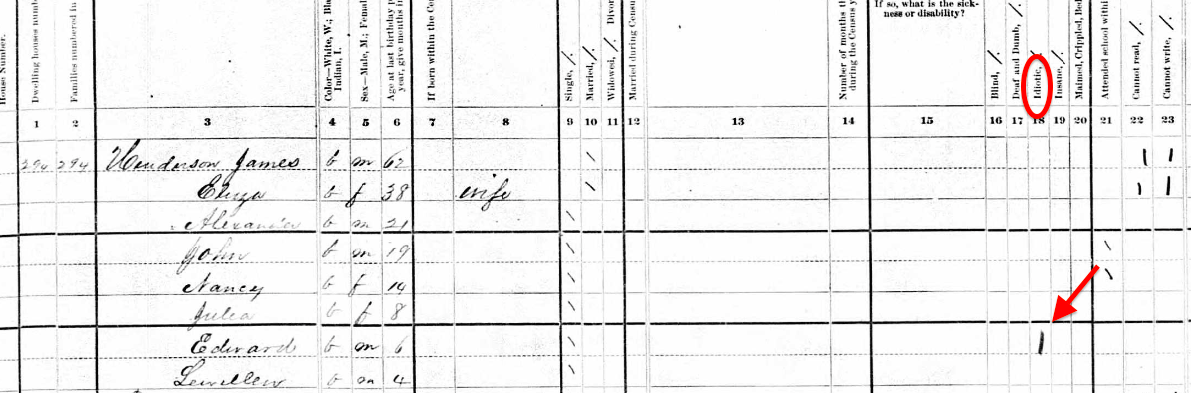
How have I missed this??? Betty and Edward Henderson were two of great-great-great-great-grandfather James Henderson‘s younger children. Each appeared in a single census record — Betty as a three year-old in 1870, and Eddie as a six year-old in 1880.

Screen Shot 2015-08-08 at 12.49.30 PM

1870 federal population schedule, Faison, Duplin County, North Carolina.

Screen Shot 2015-08-22 at 9.28.39 PM

1880 federal population schedule, Faison, Duplin County, North Carolina.

I have just noticed that both were described, in the unfortunate parlance of the day, as “idiotic.” The word did not mean then, as it connotes today, “stupid” or “foolish.” Rather, it was a medical term designating a person with severe intellectual disabilities. What condition affected these children? A congenital defect? An environmental deficiency?

It is impossible to know. Neither Betty nor Edward seems to have lived to adulthood, and I honor their brief lives here.

Standard
Births Deaths Marriages, North Carolina, Other Documents, Paternal Kin, Religion

Memorial page.

In 1915, forty-five years after her husband Lewis Henderson helped found Dudley’s Congregational Church, Margaret Balkcum Henderson was buried in its graveyard. She was the last member of my direct Henderson line on the church rolls. To this day, however, my kin can be found in Congregational on Sunday mornings, worshipping, singing, ushering, fellowshipping.

In 1970, the church published a photo-filled anniversary booklet commemorating its centennial. A Memorial Page lists more than 150 members who had gone on to their reward before the church marked its hundredth birthday. At least a third of those memorialized are my direct or collateral kin.

Memorial Page

  1. The Aldridges were my grandmother’s father James Thomas Aldridge‘s family. Frances Aldridge [Newsome] (1883-1961) was Tom’s elder sister. John J. Aldridge (1885-1964) and Ora Bell Mozingo Aldridge were his brother and sister-in-law, and Fitzgerald Aldridge (1917-1962) was their son. John W. Aldridge (1853-1910) and Louvicey Artis Aldridge (1865-1927) were Tom’s parents (and my great-great-grandparents), and Lula Aldridge (1882-1917) another sister.
  2. Joshua Brewington married John W. Aldridge’s sister Amelia Aldridge Brewington (1855-1895).
  3. Richard Boseman married Lillie Aldridge (1871-1944), daughter of William Aldridge and Cornelia Simmons. William’s father was John Matthew Aldridge (ca. 1810-ca. 1868), brother of my great-great-great-grandfather Robert Aldridge (1819-1899.) Estelle and James were Richard and Lillie’s children. Arlander Boseman, their cousin, married Flora E. Manuel, daughter of Shafter and Mamie Cobb Manuel, below.
  4. I’ve written of the Carters here. Marshall Carter married Frances Jacobs, sister of “Papa” Jesse A. Jacobs Jr. Ammie, Willoughby, Freddie, Granger, Johnnie, and Littman Carter were Marshall and Frances’ sons. Hersey Carter was a grandson. And Florence Carter Camp was their only daughter. Florence’s son William Homer Camp married Onra Henderson, daughter of Henry L. Henderson and Nora Aldridge Henderson. Ammie Carter is listed as Nora Aldridge Henderson’s cousin on her delated birth certificate. Johnnie Carter was my great-great-great-uncle James Lucian Henderson‘s caretaker and sole heir. And their brother Milford E. Carter married my great-grandfather Tom’s sister, Beulah M. Aldridge (1893-1986).
  5. Mack D. Coley, grandson of Winnie Coley, married Hattie Wynn (1873-??), daughter of Charles Wynn and Frances Aldridge Wynn (1853-??). Frances was a daughter of J. Matthew Aldridge and Catherine Boseman Aldridge. Roosevelt Coley (1905-1977) was Mack and Hattie’s youngest child.
  6. Mittie Boseman Flanagan (1896-??) was another daughter of Richard and Lillie Aldridge Boseman.
  7. Archie Barfield Grantham’s father, also named Archie Barfield Grantham, married Carrie Henderson Boseman, sister of my great-great-grandmother Loudie Henderson (1874-1893), in 1899. Carrie died within the next five years.
  8. John H. Henderson (1861-1924) was half-brother of my great-great-great-grandfather Lewis Henderson (1836-1912), father of Carrie and Loudie and others. John married Sarah Simmons. Their son Henry L. Henderson (1901-1942) married Nora Aldridge (1902-1961), another daughter of John and Vicey Aldridge. Aaron “Jabbo” Henderson (1922-1944) was John and Vicey’s son, and Katie Lee Henderson, wife of Horace B. Henderson, was their daughter-in-law. (My Henderson line: Lewis and Mag Henderson’s daughters Ann Elizabeth, Carrie, Loudie, Mary Susan and Sarah Henderson were members of Congregational Church.  And probably sons Lucian and Caswell, too, in their youth. Ann Elizabeth and Loudie’s children were baptized in the church in the 1890s. By 1910, however, only, Lewis and Mag remained. He died in 1912, and she, in 1915.)
  9. Elizabeth Syrona Simmons Hill (1925-1965) was the daughter of George Gideon Simmons and Luella Solice. George G. Simmons (1895-1962) was the son of Samuel M. Simmons and Elizabeth Wynn Simmons (1876-1930), whose parents were Edward J. and Susan Henderson Wynn. Susan (1854-1907) was the sister of John and Lewis Henderson.
  10. Solomon Jacobs was the brother of “Papa” Jesse A. Jacobs Jr.
  11. William Shafter Manuel (1898-1966) was the son of Alonzo Manuel and Sallie Wynn Manuel (1877-1967). His mother’s parents were Edward and Susan Henderson Wynn.
  12. Blonnie Coley Flowers Matthews (1898-1948) was the daughter of Mack and Hattie Wynn Coley.
  13. Yancy Musgrave (1892-1961), son of Alfred and Polly Ann King Musgrave, married Annie C. “Dolly” Simmons (1898-1934), daughter of Hillary B. Simmons and Ann Elizabeth Henderson Simmons (1862-1900). Ann Elizabeth was the sister of my great-great-grandmother Loudie Henderson.
  14. Amanda Aldridge Newsome (1892-1919) was a daughter of John and Vicey Artis Aldridge.
  15. Hillary B. Simmons (1855-1941), son of George W. and Axie Jane Manuel Simmons, married Ann E. Henderson in 1879.
  16. Frances Aldridge Speight was possibly the daughter of William and Cornelia Simmons Aldridge.
  17. Charles Sykes (1920-2004) was the son of William O. and Gertrude Wynn Sykes (1885-1954). Gertrude’s parents were Charles and Frances Aldridge Wynn. [Why was Charles included in a memorial in 1970? Was there another Charles Sykes?]
  18. Blanche Coley Williams (1900-??) was another daughter of Mack and Hattie Wynn Coley.
  19. Charles Wynn married Frances Aldridge, daughter of Matthew and Catherine Boseman Aldridge.
  20. Eddie Wynn (1886-1965), son of Edward J. and Susan Henderson Wynn, married Fronnie Greenfield.
  21. Israel H. Wynn (1892-1967) was the son of W. Frank and Hepsey Henderson Wynn (1856-circa 1894) (who were the brother and sister, respectively of Edward and Susan Henderson Wynn). Israel married his first cousin Frances “Frankie” Henderson (1891-1985), daughter of John and Sarah S. Henderson.
  22. Levi Wynn … well, there were lots of Levi Wynns in Dudley. (Levi was one of the “five Wynn brothers” who headed a large and prosperous free family of color in southern Wayne County and northern Duplin County in the antebellum era. I use quotation marks because (1) there were more than five male Wynn heads of household in the period; (2) there is evidence that, though surely very closely related, they were not all brothers; (3) there were women who appear to have been Wynn sisters heading families.) This may have been the Levi Wynn (1883-??) who was a son of Charles and Frances Aldridge Wynn.
Standard
Births Deaths Marriages, Maternal Kin, North Carolina, Photographs

The things you overcome and master.

Sville_R_amp_L_417_1944_JWStockton_poem

Statesville Record & Landmark, 17 April 1944.

John Walker Stockton was the oldest son of Eugene and Ida May Colvert Stockton, who named him for his grandfather, John Walker Colvert. Born in February 1910, he was just over a year younger than my grandmother and just ten months older than her sister Launie Mae — his first cousins. However, though they lived blocks apart, the families were not close. My grandmother never mentioned him in her recollections and, if he or any of the Stocktons were invited to reunions, they did not come. I was stunned to learn, then, that John Stockton lived until 2000. And he was in Statesville that whole time.

In the 1930 census of Statesville, Iredell County, at 214 Garfield Street (owned and valued at $4000), the census taker found  brick mason Eugene Stockton, 57, wife Ida M., 45, and children John, Lili M., Sara, Alonzo, Winifred, and Eugene Jr. Ten years later, John was working as a hospital orderly and living at 429 Harrison Street with “Lilly” Colvert, 48, and her son George, 23. Though John was described as Lillie Mae’s cousin, he was in fact her nephew. (Ida May named her daughter Lillie Mae Stockton after her sister Lillie Mae Colvert.) Lillie, who worked as a maid, indicated that she had had two years of high school, and George, a hotel bellhop, four. John, to my surprise, had had a year of college. (Where? Johnson C. Smith — where his younger brothers Alonzo and Eugene matriculated? Nearby Livingston? Why did he leave?)

Later that year, John registered for the World War II draft. He was 30 years old; I don’t believe he ever served.

32892_1821100519_0081-03359

The back of the card noted that he had brown eyes and black hair and a mole on his nose, that he had a dark brown complexion, and that he stood 5’8 1/2″, 157 lbs. (Slighter than I thought. The Colverts were not big people, but I somehow envisioned him taller.) Davis, the hospital at which he worked, is still in operation, but in a different location. The original building, now a moldering wreck, attracts urban explorers and mystery seekers who believe it haunted.

On 1 April 1945, almost exactly a year after “Hero or Heel” was anthologized, John Stockton married Nera Clemons Sharpe, daughter of Hobart and Mary James Sharpe. The couple had no children, but were married 54 years before John’s death and are buried together at Iredell Memorial Gardens.

Picture_016

John Walker Stockton. (I love everything about this photograph.)

Standard
Births Deaths Marriages, Migration, North Carolina, Other Documents, Paternal Kin

The baby boy, found. (Sort of.)

When you’re not looking for something, there it is.

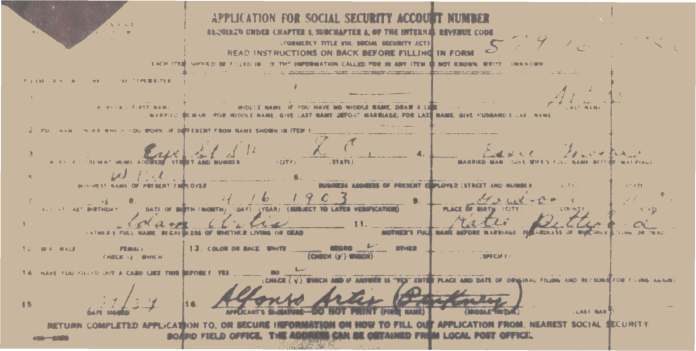
The story I’d heard was that Adam T. Artis‘ youngest child, Pinkney Alphonso Artis, had run away to Baltimore as a young man (or maybe even teenager) and refused to return. I believed it; I certainly had not been able to find much trace of him. He was listed as a child with his parents in the 1910 census, then disappeared from that set of records. I found his Social Security application, filed in Washington DC on 29 May 1939, which told me that “Alfonso Artis” lived at 70 Eye Street, SW; was married to Essie Moore; was employed by WPA; and had been born 16 Apr 1903, Goldsboro, North Carolina, to Adam Artis and Katie Pettiford.

AP Artis SSN App

Just over a year later, in June 1940, his mother died, and “Pinkney Artis” of Washington DC was listed as the informant on her death certificate. And that was it. That was all I knew about Pinkney.

Until the other day, when I stumbled upon this, hidden in plain sight:

Screen Shot 2015-08-09 at 10.05.31 PM

The 1940 census, Nahunta township, Wayne County: Adam’s notorious last wife, the remarried Katie A. “Cain” (her death certificate says “King”), son “Pinkny” A. Artis and daughter-in-law Ester Artis. Pinkney reported that he had been living in the same place five years earlier. (His wife had been in DC in 1935. What a transition that must have been.) They were surrounded on all sides by Artises. At #28, Richard Baker, his wife Odessa (daughter of Pinkney’s half-brother Henry J.B. Artis) and their daughter Daisy; at #29, Simon Exum (son of Simon Exum and Pinkney’s aunt Delilah Williams Exum) and his family; and at #31, J.B. Artis himself with wife Laurina and two children.

So, then, not only have I found no trace of Pinkney in Baltimore in his early years, but there is evidence that he was in Wayne County during at least the mid-1930s. He did come home. But where was he all that time?

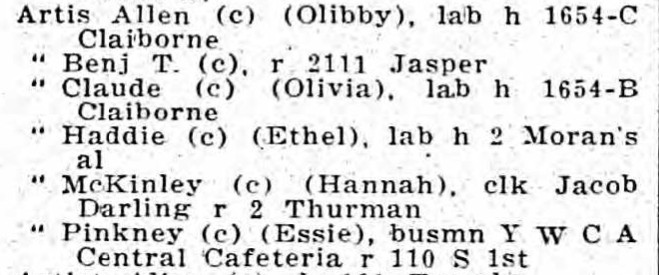
I still have not found Pinkney in the 1920 or 1920 censuses, but here he is in the 1932 city directory of Richmond, Virginia:

Screen Shot 2015-08-14 at 11.09.42 AM

Did he and Essie marry in Richmond? In DC? I don’t know. How long did they live there? I don’t know that either. But these finds add some texture and definition to Pinkney’s life, and I’ll continue to search.

Standard
Education, North Carolina, Other Documents, Paternal Kin

Signature Saturday, no. 6: James Henry’s Hendersons.

For decades, men (and the rare women) who apprenticed free children of color in North Carolina were required to teach them to read and do basic math. However, in the crackdown on free colored people that followed the Nat Turner Rebellion, this mandate was first ignored and then done away with altogether. It is not a surprise then that census records generally report that my great-great-great-great-uncle James Henry Henderson was illiterate.

JasHHenderson

James H. Henderson (1838-1920).

What of his children though? Was he able to send them to school long enough to gain at least the rudiments of literacy? His first five children were daughters. I have not found Mary Ella, Elizabeth or Nancy Henderson in census records as adults, but Amelia Henderson Braswell‘s entries indicate that she could neither read nor write. The evidence is mixed for James’ “outside” daughter Carrie M. Faison Solice, whose mother was Keziah “Kizzie” Faison. The 1900 and 1930 censuses say no, she could not; the 1910 and 1920 say yes, she could. As for James’ sons and youngest daughter and some of their offspring, here’s what I’ve found:

Elias Lewis Henderson (1880-1953) was James and Frances Sauls Henderson’s oldest son. He was a farmer and founder of Saint Mark Church of Christ, near Fremont, Wayne County. I am fairly certain that he could read, but have found no sample of his handwriting.

Elias L Henderson Text

David John Henderson (1901-1960) was E.L. and Ella Moore Henderson’s oldest son.

Screen Shot 2015-08-04 at 7.26.35 PM

Their second son was James Henry Henderson (1906-1947).

James Henry Henderson Sig

And Ira Junior Henderson (1911-1984) was their third.

Screen Shot 2015-08-08 at 1.52.25 PM

Jazell Westly Henderson (1924-2004) was Elias’ son with his second wife, Sarah Edmundson Henderson.

Jazell W Henderson Sig

James Ira Henderson (1881-1946) was James and Frances Henderson’s second son. He signed his World War I draft card with an X.

Screen Shot 2015-08-06 at 9.03.47 PM

Here’s the signature of Ira’s son, William Henry Henderson (1902-1974).

Screen Shot 2015-08-06 at 8.56.56 PM

James’ son Lewis Henderson (1885-1932) was named after his uncle, my great-great-great-grandfather Lewis Henderson (1836-1912).

Lewis Henderson Sig

Lewis had ten daughters and one son, James Ivory Henderson (1922-1986).

Screen Shot 2015-08-06 at 8.58.55 PM

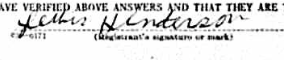
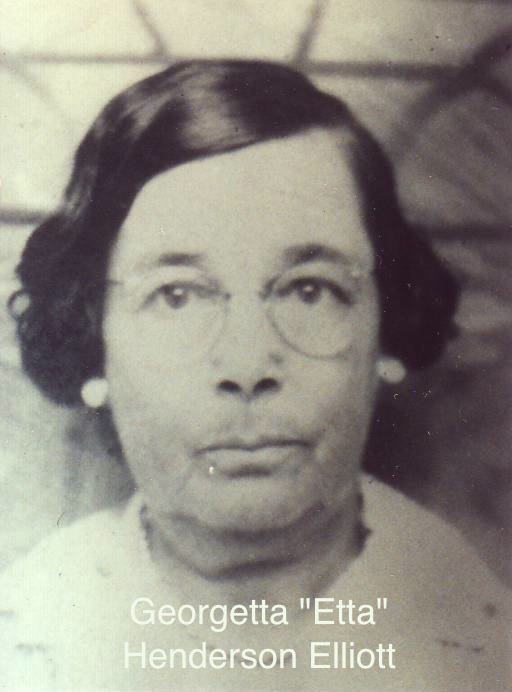
Georgetta Henderson Elliot (1889-1972), called Etta, was James and Frances Henderson’s youngest daughter. This signature appears on her daughter Mackie Bee‘s marriage license, but there is a possibility that it was inscribed by the officiating minister, rather than Etta herself.

Screen Shot 2015-08-02 at 4.06.41 PM

Georgetta Henderson 001 Text

Standard
Births Deaths Marriages, North Carolina, Paternal Kin, Photographs

The brothers.

Yesterday would have been Cousin Snook’s 92nd birthday. My grandmother spoke of him and his oldest brothers in tandem — “Snook, Dink and Jabbo.” They were her double cousins, the sons of her second cousin once removed Henry Lee Henderson and her aunt Nora Aldridge Henderson. Jabbo died early, without children, but my relationships with Dink and Snook’s descendants, as well as with their surviving youngest brother, are deeply cherished.

Dink and Snook

Johnnie D. “Dink” Henderson (1925-1992) and Horace B. “Snook” Henderson (1923-1984).

Aaron Henderson

Aaron H. “Jabbo” Henderson (1922-1944).

Standard
North Carolina, Paternal Kin, Photographs

Bessie, in color.

I’ve talked about Bessie Henderson‘s portrait before. It is perhaps the most cherished of the original photographs I hold, likely the only picture taken in her short life.

I recently asked my cousin J.G., great-grandson of Bessie’s first cousin Daniel Simmons, if he would take a shot at colorizing Bessie’s photograph. She died at 19 in early 1911, and no one now living ever saw her alive. (In fact, I’ve known only five people — my grandmother, her sister Mamie, Beulah Aldridge CarterFannie Aldridge Randolph, Jessie Mae Jacobs — who did. The last of them passed in 2001.) So I just wanted to see her as she might have looked. See her in something other than sepia tone.

And here she is.

Bessie Henderson 001 - before after side by side-2

I was struck on two fronts. First, there is Bessie’s beauty anew. And then … the detail. The lacy ruffles of her blouse, the tiny collar pin bar, the pleats of her skirt. And the background? It was years before I saw the white bird swooping past Bessie’s wrist. But trees? A pool of water? Ducks? Who knew?

Here’s a little video of Bessie’s progression. Thank you again, J.G.!

Standard