North Carolina, Oral History, Paternal Kin, Photographs

Treasures.

I’m in D.C. for work this week, and I was able to steal away from my conference to spend a few hours with O.H.D., my grandmother’s first cousin. Cousin O. has lived in the District since 1940 and in her Capitol Hill row house since 1945. Our conversation was wide-ranging, but I, of course, drew out stories of our family’s history. Cousin O. spoke of my grandmother Hattie, of my grandfather, of her grandmother Louvicey Artis Aldridge (from whom she received her middle name), of her uncles Johnny and Zebedee Aldridge, of C.E. “Uncle Columb” Artis, of her aunts Lula and Frances Aldridge, of Uncle Fred Randall, of Alberta Artis Cooper, of C.C. Coley (in whose restaurants she occasionally filled in as cashier and in whose convertible she rode during Howard University homecoming parades), of Lucian and Susie Henderson, and of many others. She knows me well and had set aside a tiny treasure she’d recently uncovered — a postage stamp-sized photo of her first cousin, James Earl Aldridge. Cousin Earl, born the year before Cousin O., was the son of John and Ora Mozingo Aldridge. He passed away in 1975. As always, love and thanks, Cousin O.

earl-aldridge

James E. Aldridge Sr. (1919-1975).


Standard
Paternal Kin, Photographs, Vocation

Happy birthday, Daddy!

During the school year, the rhythms of my childhood moved around my father’s coaching schedule. He assisted in football and track, but basketball was his forte. Tuesdays and Fridays were game nights from the time I was born — that first winter, students changed my diapers in the gymnasium bathroom while my mother cheered in the bleachers.

My father has been a rock and a guide to my sister and me, but he also deeply impacted the hundreds of young men who played basketball for him. He was a sternly principled coach who cared as much about their lives off the court as their production on it. Basketball had been a path to success for him, a means to get an education that his family could not otherwise have afforded. He is a great believer in “getting your books,” and he did all he could to prepare his players for college and to guide them to opportunities to play at that level.

screen-shot-2016-09-12-at-11-29-42-am

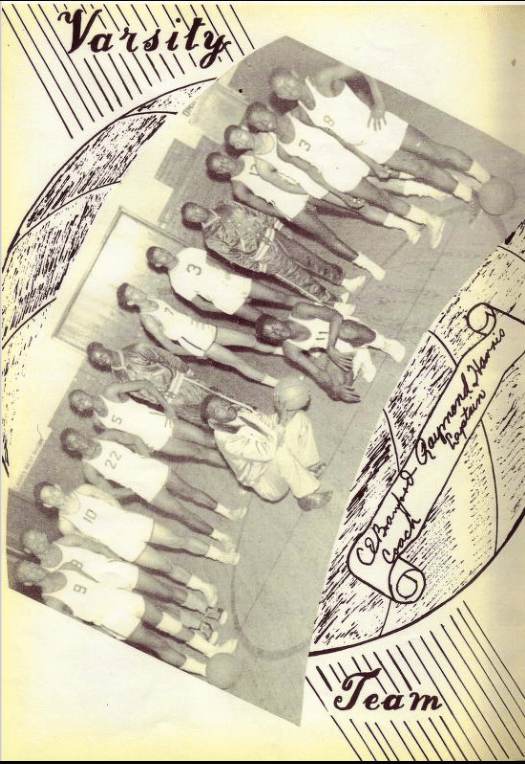
#7, center, C.H. Darden High School varsity basketball team, 1952.

pics0037

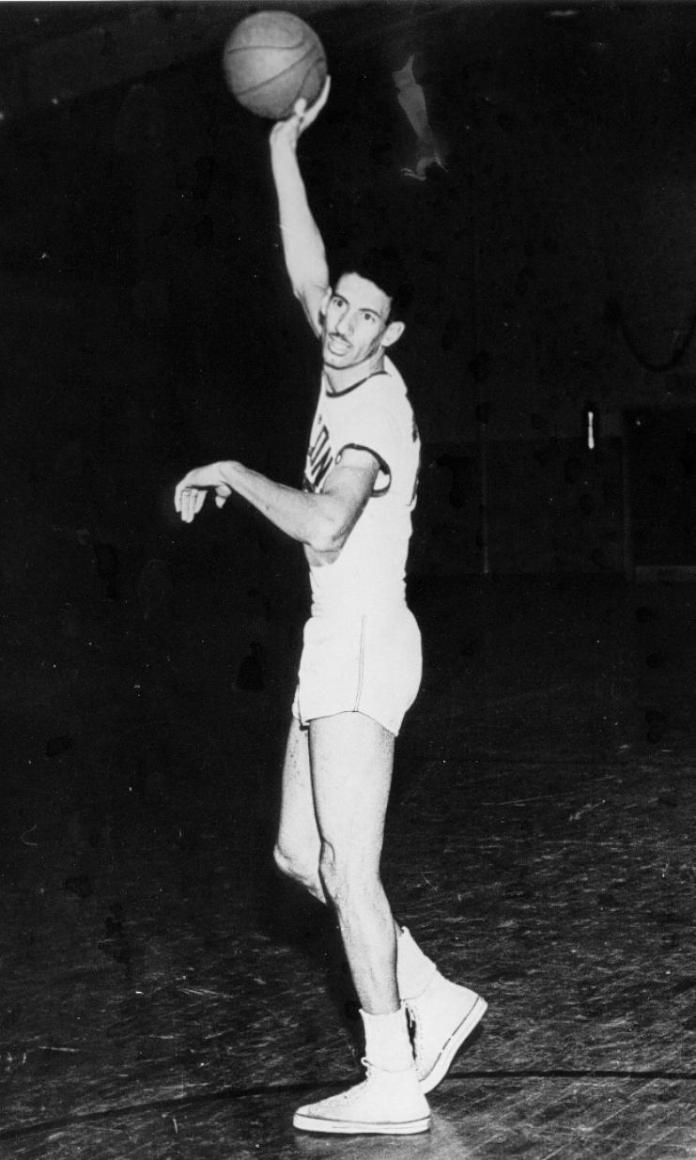
During his years playing basketball in the Air Force, circa 1956.

daddy-bball

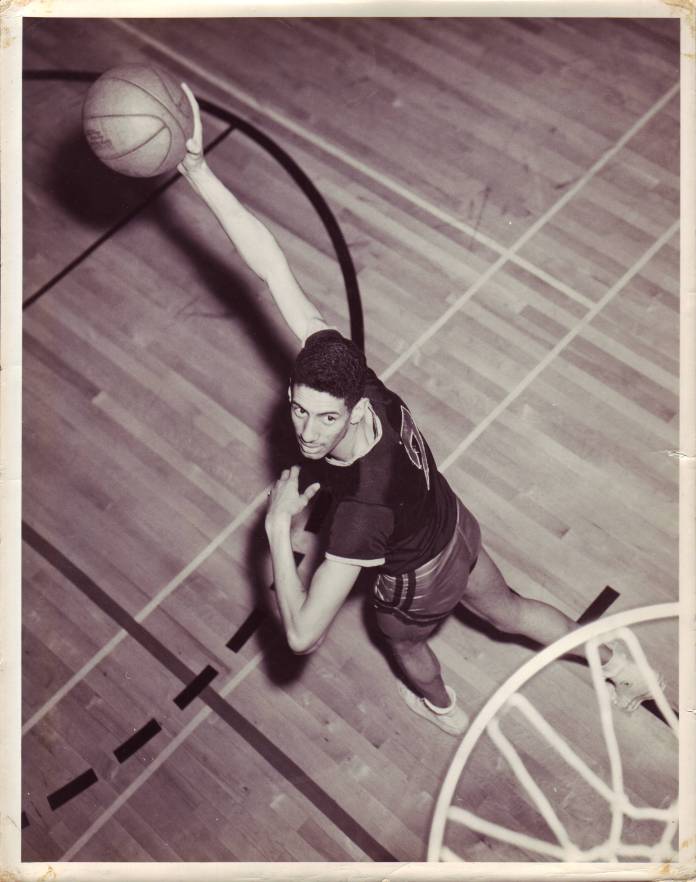
Playing center at Saint Augustine’s College, circa 1960.

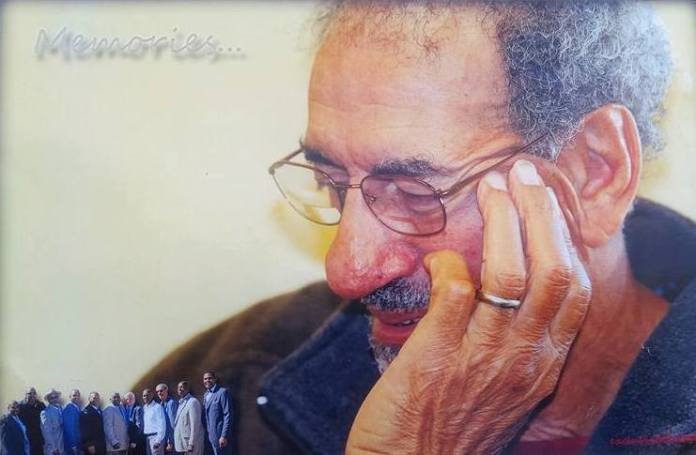
Every once in a while, some of my father’s former players will get together to take him out to reminisce over a good meal. I’m sure they all join me, my mother and sister in wishing him the happiest of birthdays!

memories

Photo credits: C.H. Darden High School yearbook, 1952; personal collection; courtesy of J. Battle.

Standard
Births Deaths Marriages, Migration, North Carolina, Paternal Kin, Photographs, Virginia

Cousin Dollie.

Said my grandmother:

The house where Dollie, Cousin Min’s sister, lived, well, they had gone to Goldsboro to live.  I think.  First they were living in Mount Olive, then Dudley.  She married Yancey Musgrave. He was a brown-skinned man. And Dollie used to visit, too.  She had asthma real bad.  And she used to come home and have to sit up.   You had to take a quilt and fold it up and put it up in the bed for her to sit up on.  ‘Cause she couldn’t lay down.  She couldn’t breathe. I don’t know what become of Dollie. Her and Cousin Min’s mama was Ann Elizabeth.  Mama Sarah’s sister.  They had a brother named Daniel.  Yeah.  Daniel.  Daniel, he lived, he come to Wilson and stayed with us a while, and then went back to Goldsboro.  Got married anyway and had a whole bunch of children.  And come up to …  I believe he come up to Baltimore.  And he had a whole lot of children.

I’ve written of Daniel Simmons and Minnie Simmons Budd here. With Annie C. “Dollie” Simmons Musgrave, they were the only children of Ann Elizabeth Henderson Simmons to live to adulthood. My grandmother’s “Mama” was their aunt Sarah Henderson Jacobs Silver. Her mother Bessie was their first cousin.

annie-simmons-musgrave

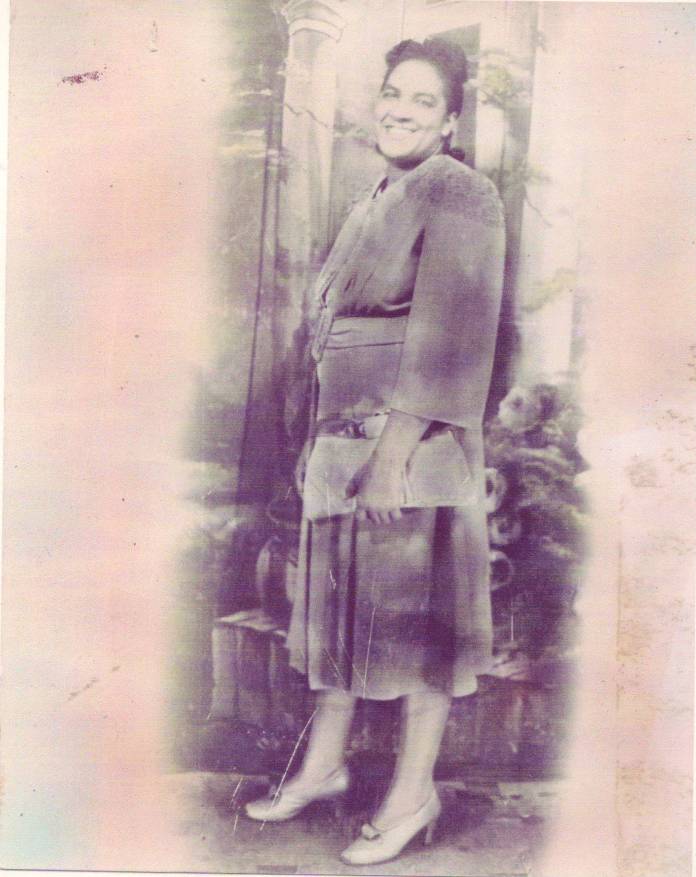
Annie C. “Dollie” Simmons Musgrave, perhaps in Norfolk.

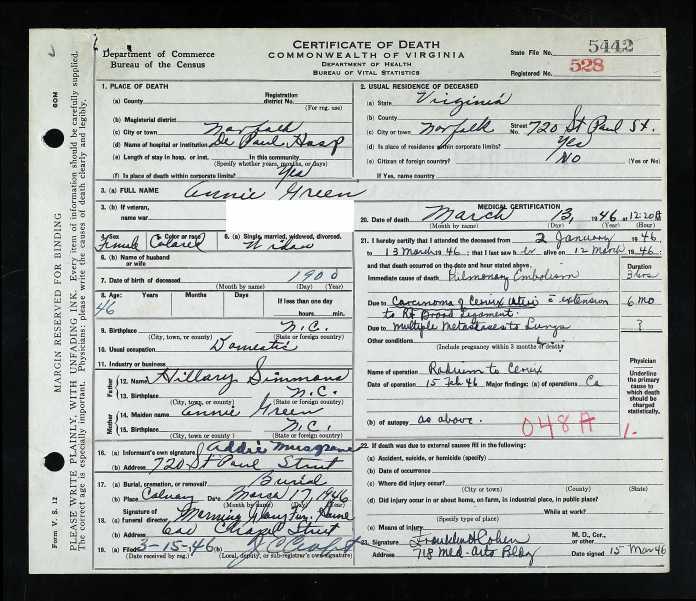
Dollie Simmons Musgrave died in Norfolk, Virginia, in 1946 after a battle with cervical cancer. (She apparently had remarried to a Green — she and Yancey divorced? — but I do not know who, where or when. Her death certificate erroneously lists her mother as Annie Green, rather than Henderson.)

43006_162028006056_0092-00028

Virginia, Death Records, 1912-2014 [database on-line], http://www.ancestry.com.

Standard
Business, Migration, Newspaper Articles, North Carolina, Paternal Kin, Photographs

Restaurateur, litigant, race man.

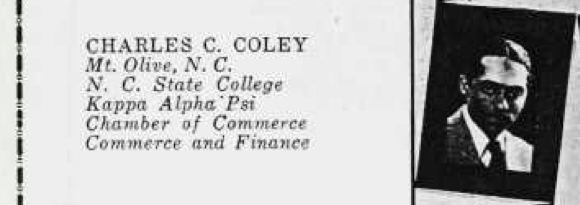
I was running some random Google searches when I ran across this Howard University yearbook entry. Charles C. Coley, class of 1930, was the son of Mack D. and Hattie Wynn Coley, grandson of Frances Aldridge Wynn, and great-grandson of J. Matthew Aldridge.

Screen Shot 2015-08-17 at 9.57.17 PM

In the 1910 census of Brogden township, Wayne County: school teacher and widower Mack D. Coley, 45, and children Blonnie B., 12, Blanche U., 10, Charlie C., 7, and Rosevelt, 5, and great-aunt Kattie, 74.

In the 1920 census of Mount Olive, Brodgen township, Wayne County: on Rail Road Street, teacher Mack D. Coley, 54; wife Lillie, 40, teacher; and children Blonnie, 22, teacher; Blanche, 20;  Charley, 17; Rosevelt, 15; and Harold, 2.

In the 1930 census of Washington, D.C.: at 70 Que Street, Northwest, Charles Coley, 26, and wife Harriett, 20, lodgers in the household of Oscar J. Murchison. Charles worked as a lunchroom waiter. Harriett was a native of Hawaii. They divorced before long, and Charles married Frances Elizabeth Masciana (1920-2010), the District-born daughter of an Italian immigrant father and an Italian-African American mother.

During the 1930s, Great Depression be damned, Coley began to build his entertainment and culinary empires, which eventually came together under C.C. Coley Enterprises, headquartered on U Street, D.C.’s Black Broadway. He rented jukeboxes to establishments across the city and owned several barbecue restaurants and other businesses in Northwest D.C. (More than a few Wayne County home folk newly arrived to the District got jobs working in Coley businesses.) On 16 December 1939, the Pittsburgh Courier screamed “Charge ‘Sabotage’ in Music Box Scandal” over a story whose heading was longer than its column inches.

pc-12-16-1939-cc-coley

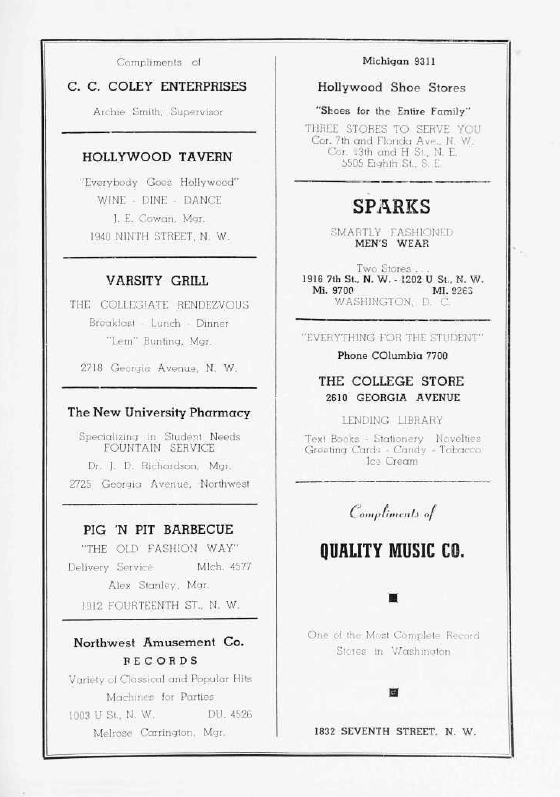
Coley was unfazed by this dust-up. In 1942, he was able to place an ad in Howard University’s yearbook touting several of his enterprises, the Hollywood Tavern, the Varsity Grill, the New University Pharmacy, the Pig ‘N Pit, and Northwest Amusement Company Records.

screen-shot-2016-09-07-at-9-37-22-pm

In 1942, C.C. put his financial weight behind the Capital Classic, an early fall match-up between black college football teams that anchored black D.C.’s fall social calendar. The Washington Post, in articles published 30 October 1980 and 9 September 1994, described the Classic’s genesis this way:

“Begun in 1942 by now-retired businessmen Charles C. Coley, Jerry Coward and Jessie Dedman, who were later joined by attorney Ernest C. Dickson, the Classic was a black business community extravaganza. From their offices on then fashionable U Street, the entrepreneurs founded the Capital Classic, Ltd. company to lure the interest and dollars of D.C.’s thousands of “colored” fans away from the professional teams which wouldn’t employ or seat blacks properly, and return those dollars to the black college teams.”

“The Classic offered the community, according to one of the printed programs, ‘. . . a massive arena where the radiant beauty of Negro women, who for so long, where beauty is concerned, have been in the shadows — shaded by the accepted Nordic ideal can move proudly to stage center and radiate the bronze charm that will always be the heritage of women of color.'”

Coley was also an early civil rights activist. His financial backing enabled trailblazer Hal Jackson break into D.C. radio, and an op-ed piece in the 14 April 1943 edition of the Pittsburgh Courier gave details of more direct action. Angered by the difficulty he had catching cabs in Washington, Coley contacted the Urban League with a proposal. He would pay the salary for a man to work full-time tracking instances of discrimination by cabbies. “Mr. Coley has these taxicab drivers who pass up passengers, white or colored, at the Union Station or anywhere else in the city, fighting for their licenses.” The city’s Public Utilities Commission was shamed into putting its own spotters on the street. “Discrimination is being met a knockout blow — not by what Mr. Coley said, but what he did. … This story is … being passed along for the benefit of some Negroes who, in similar situations, never think of putting their money where their mouth is.”

Screen Shot 2016-09-03 at 10.01.37 PM

Baltimore Afro-American, 13 November 1948.

Despite the photo op above, the Classic soon met difficulties behind-scenes. Coley withdrew temporarily from active promotion in 1945, and Dr. Napoleon Rivers replaced him as guarantor. Quickly, according to a federal lawsuit, Rivers began to “usurp control” and failed to pay Coley’s partners their shares. In ’47, he even set up a rival match — the National Classic — at Griffin Stadium. (For details, see the 23 October 1948 edition of the New York Age.  The National Classic, by the way, moved to Greensboro, North Carolina, in 1954 and morphed into the C.I.A.A. football championship game. See the Pittsburgh Courier, 23 October 1954.) The Classic recovered and prospered until fading away in the 1960s.

Charles C. Coley died 11 April 1986 in Washington, D.C. He is buried in Rock Creek Cemetery.

Wash Post 16 Apr 1986

pignpit

C.C. Coley’s Pig ‘N Pit Restaurant at 6th and Florida Avenue, Washington DC. This undated Scurlock Studios image is found in Box 618.04.75, Scurlock Studio Records, ca. 1905-1994, Archives Center, National Museum of American History.

Standard
Births Deaths Marriages, Free People of Color, North Carolina, Other Documents, Paternal Kin, Photographs

Napoleon Artis, known as Doc.

Napoleon Octavius “Doc” Artis was the oldest son of Adam T. Artis and Frances Seaberry Artis.

In the 1870 census of Holden, Wayne County: Adam Artices, black farmer, wife Francis and  children Kerney, Noah, Mary J., Idar, Octavia, Elizer, Vicey, George A., and Adam.  Adam reported owning $200 personal property and $300 real property. In Nahunta township, there was a duplicate listing: farmer Adam Artis, wife Francis, and children Kenney, Noah, Mary J., Jaden, Tavious, Elizar, Vicy, George A., and Adam. In Nahunta, the family appears next door to Adam’s brother-in-law and sister John and Zilpha Artis Wilson.

In the 1880 census of Nahunta township, Wayne County: farmer Adam Artis, 48, and children Eliza, 15, Dock, 17, George Anna, 13, Adam, 12, Haywood, 10, Emma, 8, Walter, 6, William, 4, and Jesse, 2, and grandson Frank, 4 months. (Frances died shortly after Jesse’s death.)

On 10 January 1887, Napoleon Artis married Sallie Taylor in Wayne County.

In the 1900 census of Saulston, Wayne County: farmer Napolion Artis, 37, wife Salie, 29, and children Humphrey, 12, Lesley, 8, and Odel, 6, plus his grandfather Aaron Sebery, 85 [father of Frances Seaberry Artis, often called Frances Hagans], and his brother Jesse, 23.

Tragedy struck soon after. As reported in the Goldsboro Headlight on 3 January 1903:

On Christmas day, Humphrey Artist, the 18 year-old son of Dock Artis, colored, was shot and killed by William Smith, also colored, in Saulston township.  The latter claims the shooting accidental but the coroner’s jury pronounces it criminal neglect.  Smith was promptly arrested and brought here to be jailed.

In the 1910 census of Saulston, Wayne County: on Goldsboro & Snow Hill Road, Napoleon Artist, 46, with wife Sallie J., 35, and children Leslie, 18, and Odel, 15. Next door: Celepus Thompson, 23, wife Lillie, 20, and daughter Jenettie, 5 months. [Lillie was Napoleon’s half-sister. Two doors away: six year-old Lula Shadding, see below.]

On 21 January 1914, Lesly Artis, 22, son of Napoleon and Sallie Artis, married Minnie Diggs, 19, in Nahunta, Wayne County. Odell Artis of Saulston was a witness to the ceremony.

On 5 June 1917, both of Napoleon’s surviving sons registered for the World War I draft registration: Odell Artis, born 14 August 1893 in Wayne County; resided at RFD 1, Saulston, Wayne County; worked in farming; nearest relative, Napeon [sic] Artis, Saulston; single; medium height and weight; brown eyes, black hair. Leslie Artis, born 5 Feb 1892 in Wayne County; resided in Goldsboro; had a wife and two children; tall and slender; black hair, black eyes.

In the 1920 census of Saulston, Wayne County: Napoleon Artis, 57, wife Sallie, 45, and son Odell, 24. Napoleon reported owning his farm. Also in Saulston: Leslie Artis, 28, wife Minnie, 25, and daughters Gertie, 5, Alberta, 4, and Malave, 2.

On 4 December 1920, Lula Shadding, 19, of Saulston married Ed Fowler, 20, of Saulston at a Freewill Baptist church in Pikeville. Their license names Dock Artis and Minnie Shadding as Lula’s parents.

On 20 January 1921, Odell Artis, son of Napoleon and Sally Artis, married Olivia Diggs, daughter of Suler Diggs, in Wilson. Edgar Diggs applied for the license and served as one of the witnesses. (The marriage record mistakenly lists Napoleon as the groom.)  By 1929, the couple had moved to Washington, D.C., and appear in city directories thereafter. Odell worked as a Pullman porter. [Lizzie Olivia Diggs Artis was a first cousin to Minnie Diggs Artis.]

Napoleon seems to have been skipped in the 1930 census. In Saulston township, Wayne County: farmer Lesley Artis, 37, wife Minnie, 35, and children Gurtie, 15, Alberta, 14, Mallie V., 13, Katheleen, 8, Sallie, 6, Russel, 4, and Marvin Artis, 2.

In the 1940 census of Saulston township, Wayne County: on Saulston and Snow Hill Road, Leslie Artis, 48, wife Minnie, 48, and children Mallie V., 21, Sally May, 15, Russell, 13, and Marvin, 12, and father Napoleon, 77.

On 16 April 1942, Napoleon Artis died in Saulston township.  His death certificate reports that he was the widowed spouse of Sallie Artis, that he was born 28 Feb 1863 to Adam Artis and Frances Hagans of Wayne County, and that he was buried 18 April 1942 in Shadden Cemetery, Wayne County. Son Leslie Artis was the informant.

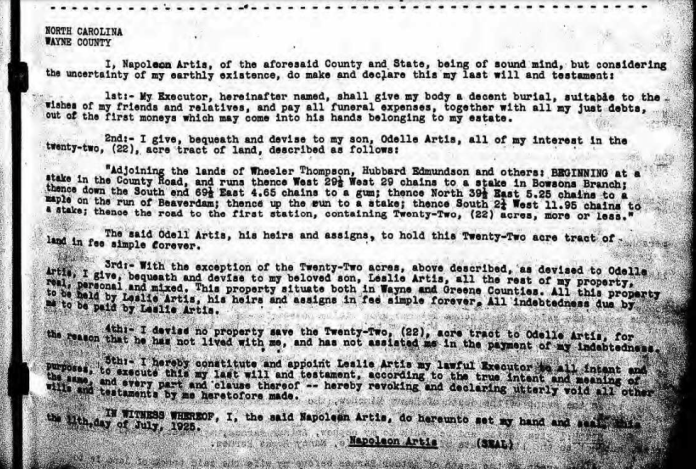
Napoleon’s will entered probate in September 1942. Written 17 years earlier, its terms bequeathed one 22-acre parcel in Wayne County [adjacent to Wheeler Thompson, father-in-law of his sister Lillie Beatrice Artis Thompson Whitley Pridgen] to son Odell and his remaining property in Wayne and Greene Counties to son Leslie. The explanation: Odell “has not lived with me, and has not assisted me in the payment of my indebtedness.”
Screen Shot 2016-09-04 at 4.49.50 PM

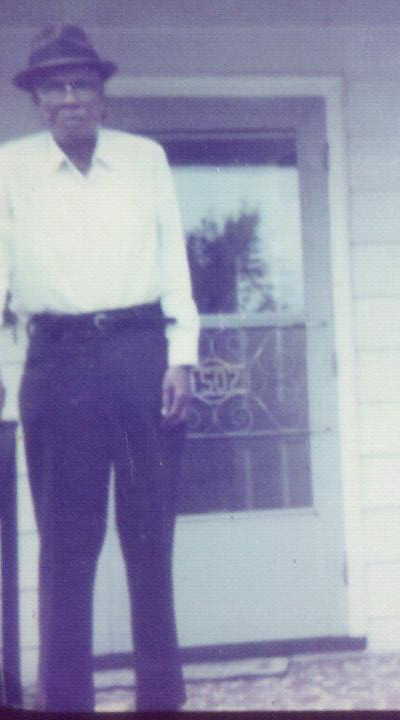
Leslie Artis died 10 March 1974 at Wayne Memorial Hospital in Goldsboro. His death certificate notes that he was a retired farmer born 5 February 1892 to Napoleon Artis and Sallie Taylor.  He was buried 13 March 1974 in Diggs cemetery, Wayne County. Informant was his daughter Gertie M. Best.

[The Francis Diggs Cemetery is located at 168 Watery Branch Road, Stantonsburg (but in Wayne County.) This was originally the family cemetery of Leslie’s wife Minnie Diggs Artis, who was descended from Celia Artis. Leslie’s family members buried there include wife Minnie D. Artis  (1894-1970), daughter Alberta Artis Suggs (1916-2000), daughter Mallie V. Artis Hobbs (1918-2014), son-in-law Alonzo Shackleford (1921-1996), son Russell Lee Artis (1926-1963), and son Marvin “Doc” Artis (1927-1998).]
Leslie Artis

Leslie Artis

Minnie Diggs Artis

Minnie Diggs Artis

North Carolina Wills and Estates, 1665-1998 [database on-line], http://www.ancestry.com; photos courtesy of user James Diggs at http://www. ancestry.com.

Standard
Births Deaths Marriages, Migration, Paternal Kin, Photographs

Family cemeteries, no. 19: Mount Hope cemetery, Logansport, Indiana.

IMG_9558

LPT 11 3 1951 F simmons

Logansport Pharos-Tribune, 3 November 1951.

Screen Shot 2016-09-02 at 9.12.37 PM

Logansport Press, 11 November 1951.

Fifty years after they married, Dock Simmons buried his beloved wife Fannie at Mount Hope cemetery at the northern edge of Logansport. The week after her death, her sisters joined him in publishing thanks to all who had expressed condolences for their loss. The notice is my last glimpse of Dock.

My first thought when I found the headstone above was: “How sad. There was no one left — no siblings, no children — to etch in Dock’s death date.” My second: “Wait. Is Dock even buried here?”

Curiously, I have not been able to find Dock’s death certificate. He does not appear to have died in Indiana, whose death certificates are available online through 2011. Where, then? Did he spend his last years with one of Fannie’s sisters? (The Simmonses had sheltered Fannie’s mother and brother.) Perhaps with her nieces or nephews? (He had only one, Harold.)

I sent an inquiry to Mount Hope and received an immediate response from its sexton: “I am sorry to say that there is no indication that Doc Simmons is here.”

Standard
Land, Newspaper Articles, Paternal Kin, Photographs

Indiana Chronicles, no. 3: Dock Simmons’ Logansport.

As discussed here, in 1900, Doctor T. “Dock” Simmons went in with his father Montraville to purchase 138 acres in Noble township, Cass County.

Things did not go well.

On 9 June 1901, the Logansport Pharos-Tribune reported “Trouble on Watts Farm: Father and Son Cannot Agree on Conducting Affairs.” Dock and Montraville argued as Dock was preparing to take his “best girl” to church. A few days later, Dock proposed to “go and leave the farm forever, giving his father his interest, if he would allow him to take his team [of three horses] away.” “To this the father objected, but the son, tired as he says of the unpleasant conditions that have prevailed on the farm for some time, was determined to leave, and in spite of his father’s threats, hitched up a team and drove to town.” Montraville jumped on a horse, passed Dock on the way into Logansport, and went to the police station. As Dock passed, a police officer ordered him to come in. He and his father then agreed to drop the matter and went back to the farm. Barely two hours later, Dock re-appeared at the station “with a bleeding head and a lump on his cheek” and accused his father of hitting him with a rock. He did not to press charges, however, and the police advised him to go home and “patch up the matter as best he could.” “It is likely that young Simmons will sue for the division of the property which consists of 140 acres.” He apparently did not.  A 9 June 1905 Pharos-Tribune article reported that the Watts farm owned and operated by Montraville, Dock and Montraville Simmons Jr. had been sold at sheriff’s auction to satisfy a $3000 judgment against “the Simmons people.” Somehow, though, they got the land back.

On 26 August 1901, Dock Simmons and Fannie Gibson were married by a Justice of the Peace in Logansport.

PT 8 26 1901

Logansport Pharos-Tribune, 26 August 1901.

The couple made their home in town, away from Dock’s bullying father, as on 26 September the Logansport Daily Report briefly mentioned that Fannie was very sick at their Park Avenue home.  Two months later, on 15 August, Dock was horribly scalded by steam from a blown-out traction engine while working at the farm with his brother (probably Edward). A newspaper article mentioned that Dock, who lived on Helm Street, was confined to his father’s home with terrible burns. A different paper, the Logansport Daily Report, said he lived on “Lockwood street, West Side,” a statement that lines up with the 1905 Logansport city directory: w[est] s[ide] Lockwood 1 [block] s[outh] Melbourne av.”

1905 Dock

In the 1910 census, Dock and Fannie appear at yet another address: 57 Seybold Street. However, on 6 January of that year, the Pharos-Tribune reported that Fannie had broken her arm in a fall in her yard “two miles west of the city on the Wabash river road.” And on 28 May, when Dock was robbed by a female highwayman, the Daily Tribune described him as a Dunkirk resident. Then on 7 February 1911, in describing an accident in which Dock was knocked from his wagon by a streetcar, the Pharos-Tribuine gave his address as Park Street. It is not until about 1920 that the Simmonses’ address achieves regularity at 129 Seybold Street.

What is going on here??? Were Fannie and Dock really bouncing around Logansport every few months? No, and a modern map of Logansport helps explain. The oldest section of town, shown here underlying the city’s name, formed at the junction of the Eel and Wabash Rivers. The area across the Eel from the city’s point was known as its West Side.  This neighborhood, at A, is informally bounded by the old Vandalia railroad tracks. Market Street is the major thoroughfare shown snaking across the city. It becomes West Market as it crosses west over the Eel. (The spot marked B is approximately where Dock was robbed by the Lady Bandit.) Dunkirk, shown here at C, is an unincorporated community just west of the city. (The Simmons’ farm was a few miles beyond Dunkirk.)

IMG_9555

Here’s a closer look at the west side of the West Side. All the streets named as habitats for Dock and Fannie Simmons — Helm Street, Lockwood Street, Park Avenue, Seybold Street, and Wabash River Road (now West Wabash Avenue) — form a two-block rectangle. It’s possible that they occupied several houses in these blocks before finally settling at 129 Seybold, but it’s more likely that the inconsistencies were the result of the use of a street name to designate an area, rather than a precise address, and they were in the same house the whole time.

IMG_9554

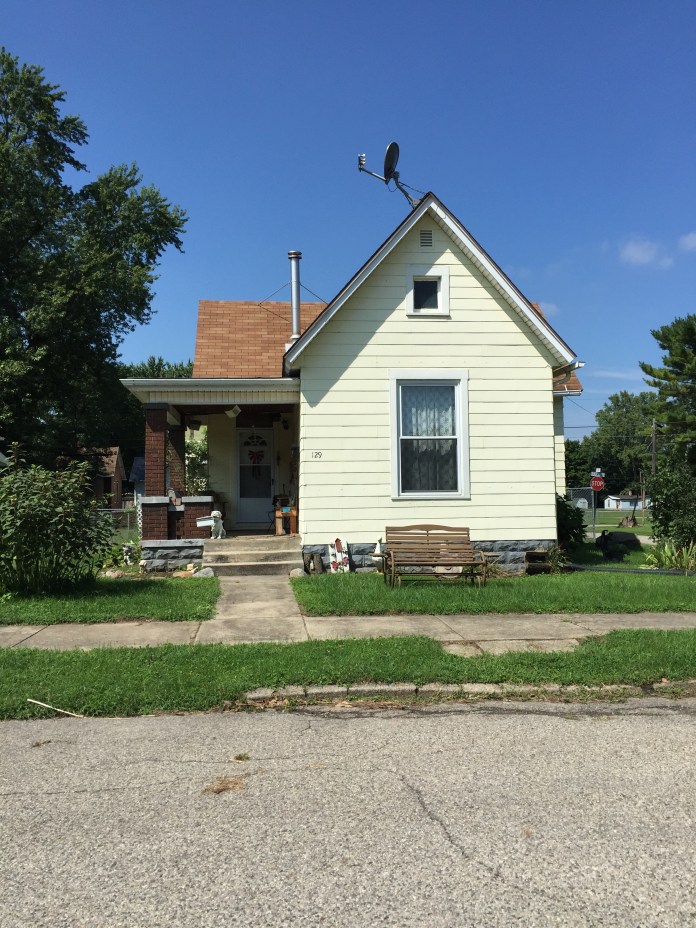
Dock and Fannie seem to have lived at 129 Seybold until the end of their days, and the house, built about 1900, remains home to a Logansport family.

IMG_9466.jpg

Photograph by Lisa Y. Henderson, August 2016.


Standard
Births Deaths Marriages, Paternal Kin, Photographs

Family cemeteries, no. 17: Crown Point cemetery, Kokomo, Indiana.

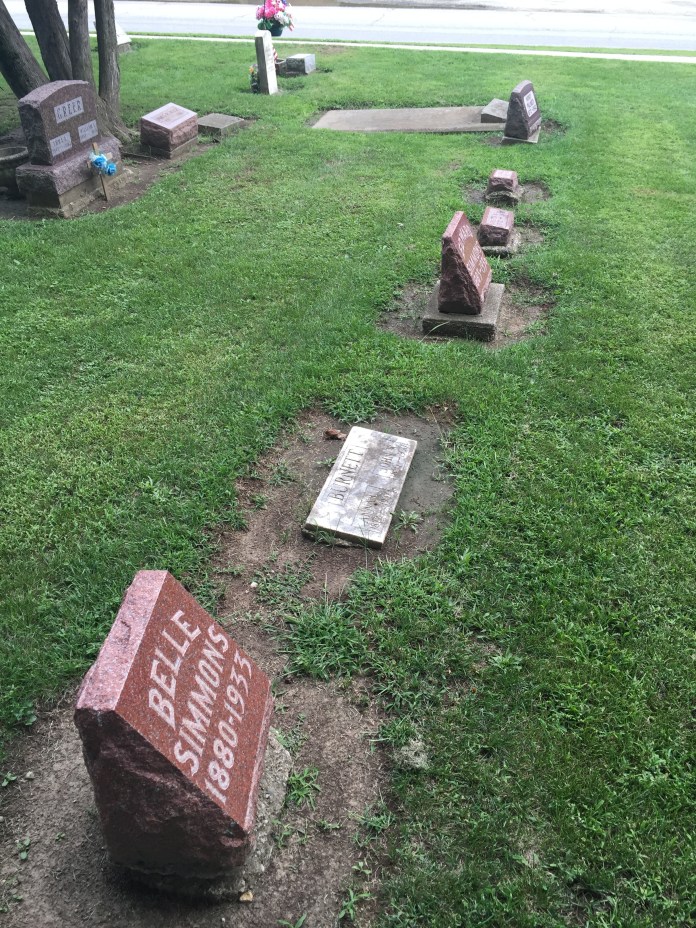
Three of Montraville and Anna Henderson Simmons‘ children are buried in Crown Point, though only two have stones:

Plus, one of Edward’s wives, Belle Simmons:

Susie Simmons Bassett, who died in 1937, lies beside her sister in an unmarked grave. The graves lie in a broken line in section 221 of the cemetery.

IMG_9551

Photos taken by Lisa Y. Henderson, August 2016.

Standard
North Carolina, Paternal Kin, Photographs

June Scott Artis.

My cousin Adam just celebrated a birthday, but gave me a present. He is the latest in a line of at least nine Adams named in honor of our common ancestor, Adam Toussaint Artis. I am descended from Adam’s daughter Louvicey Artis Aldridge, and Adam, from his son June Scott Artis. (Actually, we’re double cousins, as June’s mother was Amanda Aldridge, sister of Louvicey’s husband John W. Aldridge. Yes — Adam married his daughter’s sister-in-law.)

The gift was this photo, which must have been taken very close to end of June Artis’ life and depicts him and his wife Ethel Becton Artis. Though Adam had dozens of children, photos of relatively few survive. I recognize in June’s face the “peak-ed” nose that my grandmother attributed to his half-sister Vicey and full sister Josephine Artis Sherrod.

Screen Shot 2016-08-16 at 7.39.48 PM

In the 1900 census of Nahunta township, Wayne County:  Adam Artice, 68, a widowed farmer,  with children Louetta, 18, Robert, 16, Columbus, 14, Josephfene, 13, Jun S., 10, Lillie B., 9, Henry B., 6, Annie, 3, Walter, 26, and William Artis, 24.

In the 1910 census of Stantonsburg township, Wilson County: Columbus Artis, 24, grocery storekeeper, with brothers June Scott, 20, and Henry J., 16, box factory laborers,plus two lodgers, John Newsome, 30, and Eliza Diggs, 24 (who were relatives of their brother William’s wife Etta Diggs Artis.)

J.S. Artis married Ethel Becton on 29 January 1912 in Wayne County.

June Scott registered for the World War I draft in Wayne County. He reported that he had been born 23 November 1889 near Eureka, Wayne County and resided on RFD 1, Fremont.  He farmed for himself near Eureka and was described as being tall and slender with dark brown eyes and black hair.  He signed his name “June Cott Artis” on 5 June 1917.

In the 1920 census of Stantonsburg township, Wilson County: on Stantonsburg & Wilson Road, farm manager June S. Artis, 30, wife Ethel, 26, and children James, 7, Edgar, 7, Manda Bell, 3, and farm laborer Edgar Exum.

In the 1930 census of Stantonsburg township, Wilson County: farmer June S. Artis, 40, wife Ethel P., 34, and children James B., 17, Edgar J., 15, Amanda B., 14, and Gladys L. Artis, 5.

In the 1940 census of Stantonsburg township, Wilson County: farmer June S. Artis, 50, wife Ethel, 46, and children James Brodie, 25, Edger, 23, and Gladys, 16.

June Scott Artis died 2 June 1973 in Stantonsburg of chronic myocarditis, secondary to chronic nephritis.  His death certificate reports that he was married to Ethel Becton and was born 23 November 1895 to Adam Artis and Mandy Aldridge.  He was buried 7 June 1973 at Artis Cemetery in Wayne County.

Ethel Becton Artis died 14 October 1994, days after her 102nd birthday.

Standard
North Carolina, Paternal Kin, Photographs

Get to know your people.

13920730_10153814075318527_4752335870985139564_n

Effenus Henderson (left) is an internationally known human resources and diversity thought leader. Wade Henderson (right) is president of the Leadership Conference on Civil and Human Rights. About 5 years ago, the two met at National Urban League conference. “You’re from North Carolina?,” asked Wade, “My father was from Wilson.” “You need to talk to Lisa,” said Effenus. Wade did. And last week there we all were, in Dudley, North Carolina — birthplace of our grandparents — at the Henderson Family Reunion.

Standard