
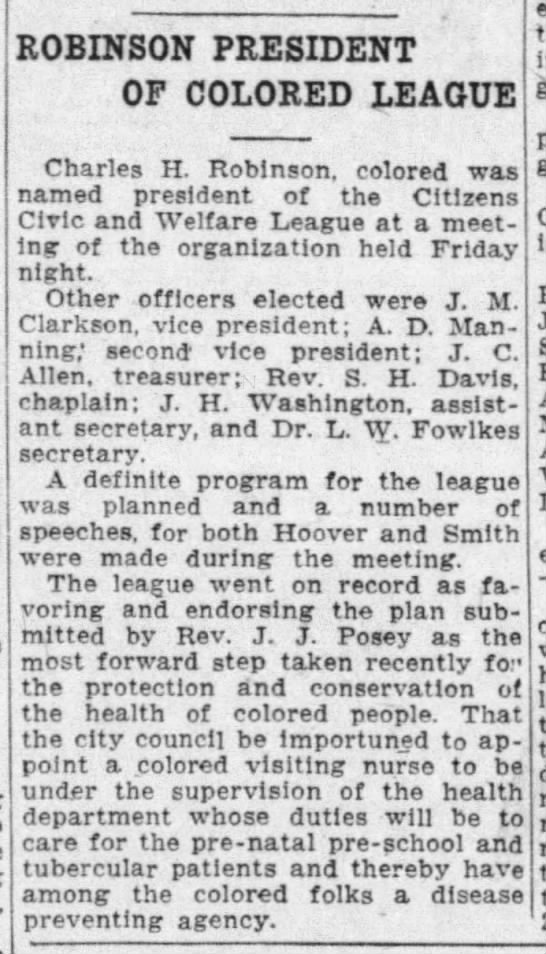
The Daily Press (Newport News, Virginia), 2 September 1928.
Among his many civic responsibilities, John C. Allen Sr. served as treasurer of the Citizens Civic and Welfare League.
The Daily Press (Newport News, Virginia), 2 September 1928.
Among his many civic responsibilities, John C. Allen Sr. served as treasurer of the Citizens Civic and Welfare League.
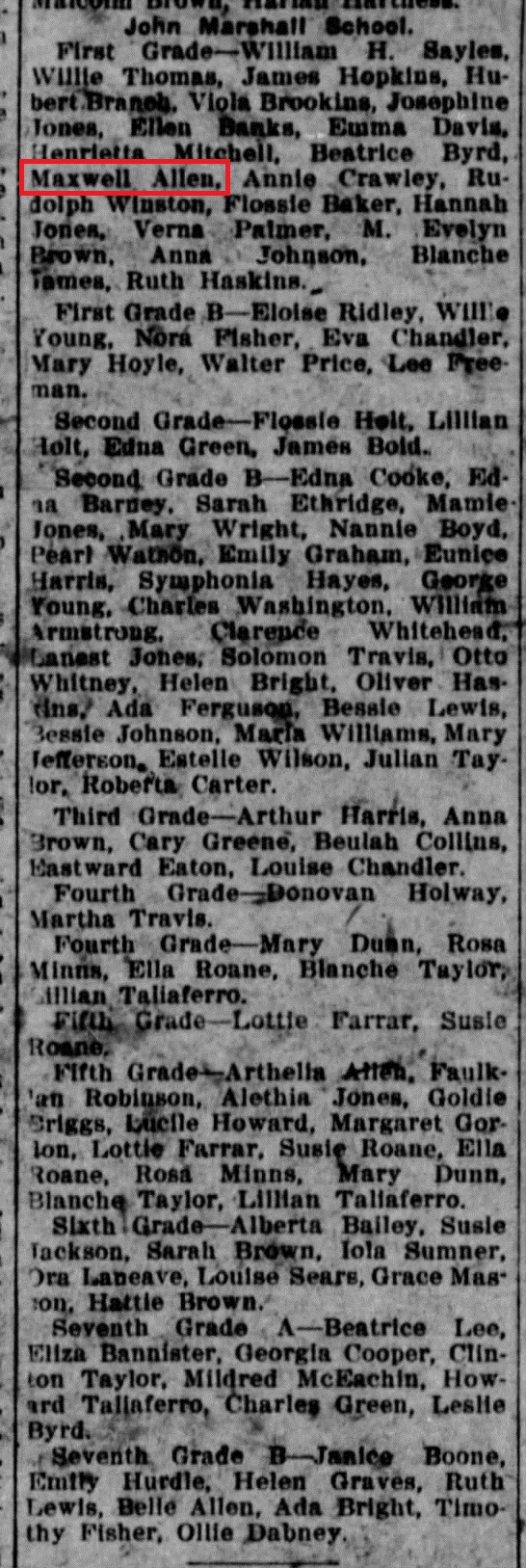
The Daily Press, 9 May 1911.
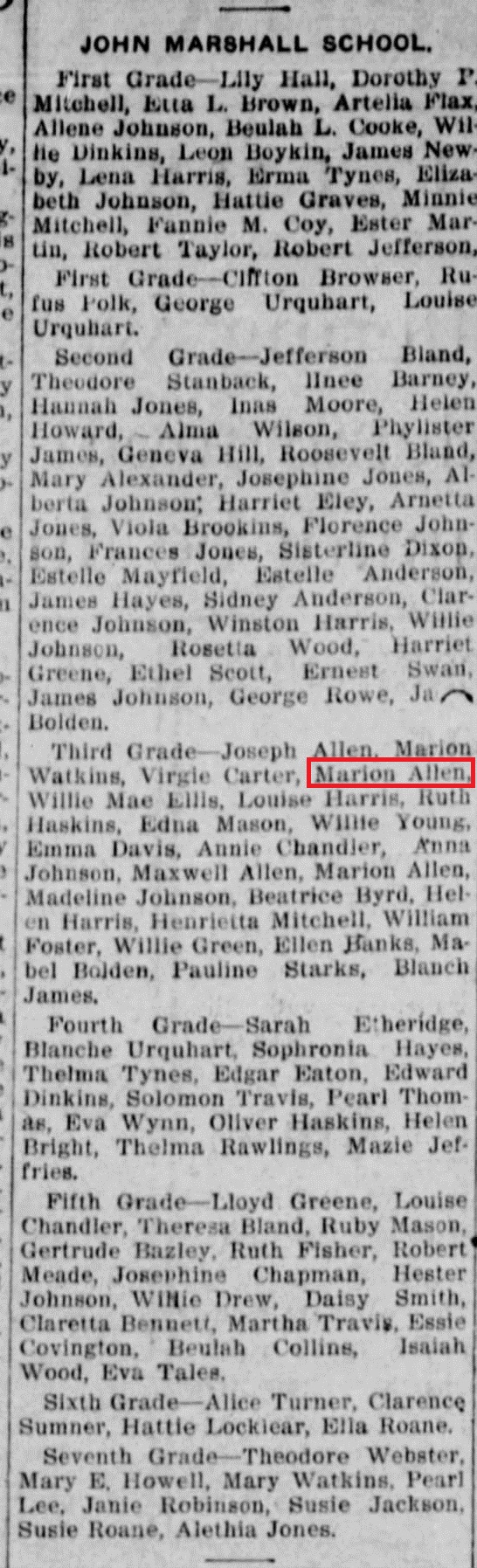
The Daily Press, 10 November 1912.

The Daily Press, 10 December 1939.
My great-uncle J. Maxwell Allen, great-aunt Marion Allen Lomans, and first cousin once removed J. Maxwell Allen Jr. excelled in their elementary school studies at John Marshall School in Newport News, Virginia. John Marshall opened in 1896.
I finally ponied up for expanded access to Newspapers.com’s holdings and immediately tapped into a vein of articles about my Allen family in Newport News, Virginia. Expect a river of posts, starting with the earliest print references I have found to my great-grandfather John C. Allen Sr.
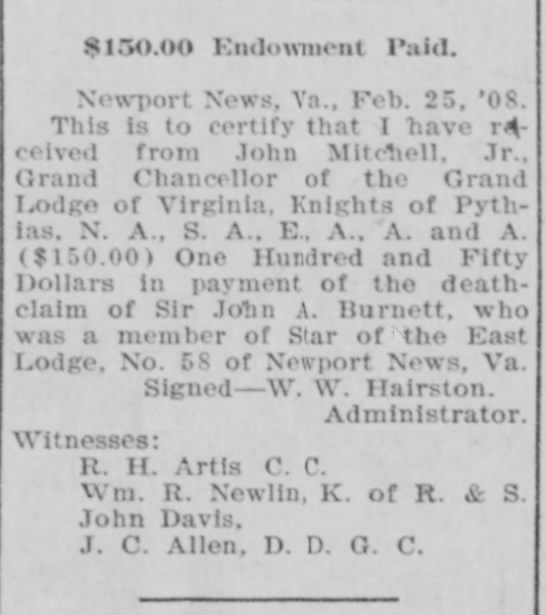
Richmond Planet, 7 March 1908.
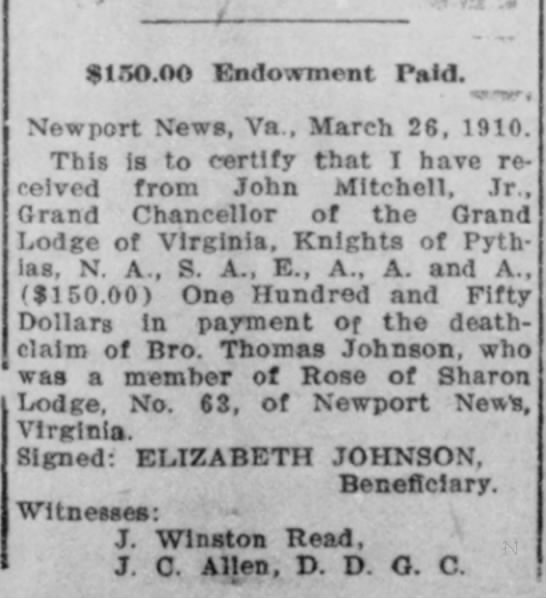
Richmond Planet, 2 April 1910.
John Allen arrived in Newport News from Charles City County in 1899, an unlettered farm boy. Less than ten years later, he held high office in the Knights of Pythias of North and South America, Europe, Asia, and Africa, an African-American fraternal organization founded in Richmond in 1869 after a black man was denied membership by the Pythians’ Supreme Lodge.
These notices, published in Richmond’s black newspaper, signaled to the public the fraternal organization’s trustworthiness and largesse and undoubtedly attracted new members and expanded its influence.
In the summer of 2002, my uncle Charles C. Allen told me this about my grandfather John C. Allen Jr.:
[Daddy] had to get reestablished after the war. But he had a friend named Buster Reynolds. And Buster Reynolds was reputed to have made his money in the numbers, and so when the numbers were getting real hot and heavy, when it was reputed that the Mafia was trying to take the numbers over, Buster got out. And he built this service station, and he had a Texaco franchise, and he had Daddy to build the station. And Texaco liked the work so much that Daddy built two more stations for Texaco. And both of the stations that were built in the black community are still up. They’re not gas stations anymore, but the buildings are still up. And the one that was built Overtown is gone. But even the station that was in the white community, Texaco had him to build that one, too.
Today I found this:

The Daily Press (Newport News, Virginia), 1 February 1948.
My uncle passed away in January; I wish dearly that I’d been able to share this with him.

The former service station at 28th and Chestnut, Newport News, 2002.
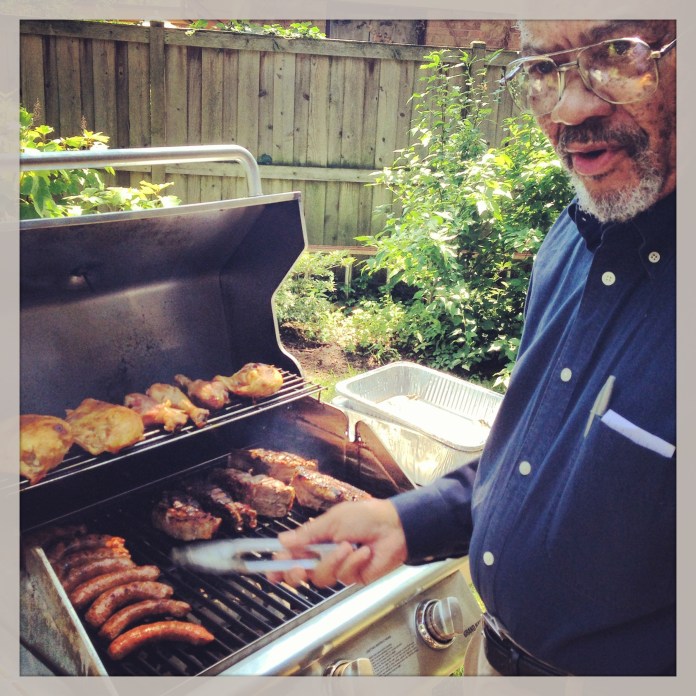
My uncle Charles C. Allen passed peacefully last night, surrounded by love. I am grateful to have been able to say goodbye last week and to receive one last lesson — on living and dying with grace — from his bottomless well of wisdom.
His eldest son’s words speak loudest:
“Last night, we lost the rock of the family, my father Charles C. Allen. His illness was brief, and he died on his own terms surrounded by the people he loved. He was married to my mother for 57 years (they’d known each other for over 60 years) and leaves three children, three grandchildren, and three surviving siblings. Dad possessed a tremendous sense of dignity, integrity, and inner fortitude. He was a friend to many. If you needed advice, he’d offer it (sometimes you didn’t need to ask), if you needed a shoulder to lean on, he was there. If you had done him wrong, he turned the other cheek and looked for ways to meet in the middle. Over the course of his 81 years, he mentored literally dozens of people of all races and creeds. Dad lived a full and productive life, and he did it his way. We will miss him, but will also live our lives as a direct reflection of his values and work ethic.”

My heroes — my father, my mother, my uncle.
——
Charles Claybourne Allen
21 September 1935-20 January 2017
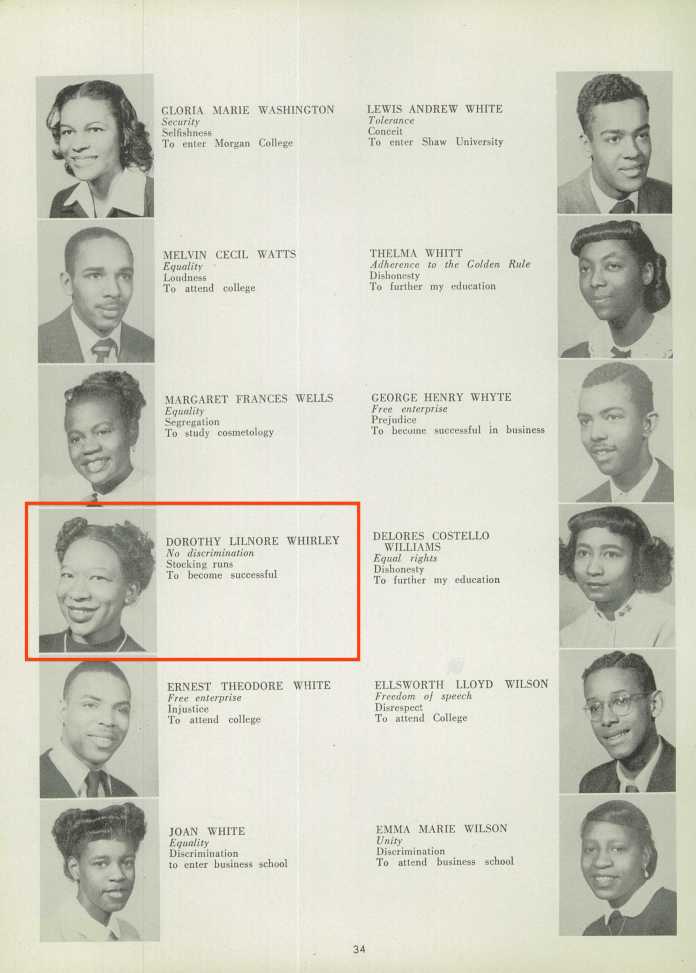
1948 yearbook, Frederick Douglass Senior High School, Upper Marlboro, Maryland.
Senior Dorothy L. Whirley listed “no discrimination” as the characteristic of a true democracy, “stocking runs” as her pet peeve, and “to become successful” as her plan after graduation. Dorothy, the daughter of Matilda Whirley and McKinley Steward, was born in Charles City County, Virginia, in December 1929. Her grandmother was Emma Allen Whirley (1879-after 1930), daughter of Graham and Mary Brown Allen.
More from the Norfolk Journal & Guide — my great-uncles J. Maxwell Allen and William J. Allen.

21 July 1934.
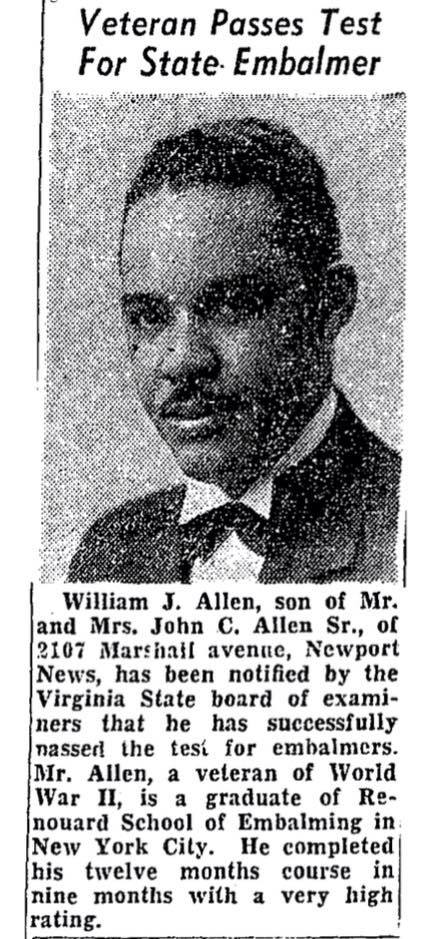
23 August 1947.
My Aldridge cousin Barbie Jones has access to an archive of early editions of the Norfolk Journal & Guide, an African-American newspaper. All morning, she’s been pelting me with gems pulled from the pasts of both my Aldridge-Brewington family and my mother’s close family in Newport News. Here’s the first — stay tuned!

Norfolk Journal & Guide, 20 March 1948.
All five of my grandparents’ children, just three days before my mother’s birthday.
Every time I see you as a little girl, I think of one time you came, and I was going Overtown and you said you were going with me. You wanted to go with me. So I carried you with me, and I saw a lady I had been working with, and she had a granddaughter named Lisa, too. And so she said, “Oh, hello, Grandmother, you have your Lisa, too!” And I said, “I have my Lisa, too.” And you said, “Don’t call her Grandmother ‘cause she is not your grandmother.” That lady just laughed about that thing. You said, “Don’t call her Grandmother. She is not your grandmother. She is my grandmother.” Yes, sir. But you were ‘sleep before I got to Orcutt Avenue.
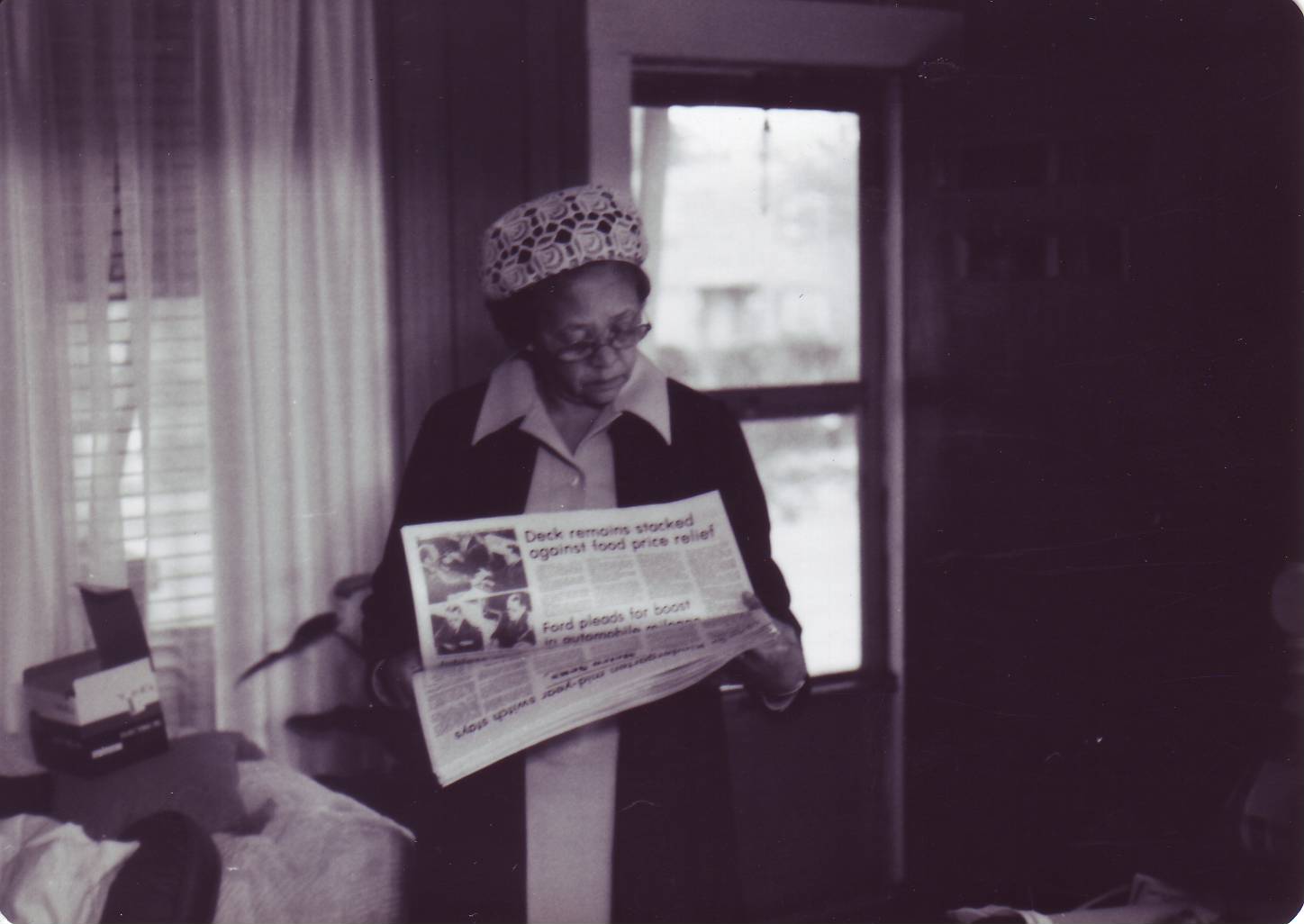
Margaret Colvert Allen (2 August 1908-11 February 2010)
Missing my grandmother on her birthday.
Back in April, after I connected the dots between my great-grandfather John C. Allen Sr. and Edward C. Harrison, I ran all my information by respected genetic genealogist Angie Bush. She agreed that autosomal DNA testing indicated a very close relationship between my mother and A.B. and that triangulation pointed directly to Edward as their common great-grandfather, but recommended another test that would absolutely eliminate some other line of patrilineal descent. I asked if my uncle would be willing to submit a sample for a Y-DNA analysis, which would show if he, via his father and grandfather, descended from a male Harrison forebear. He agreed without hesitation.
Here’s how it works: The Y chromosome passes down virtually unchanged from father to son. Occasionally, mistakes (or “mutations”) occur in the copying process, and these mutations can be compared to estimate the time frame in which two men share a most recent common ancestor (“MRCA.”) If their test results are a perfect or nearly perfect match, they are related within a traceable timeframe. Per Family Tree DNA, “Paternal line DNA testing uses STR markers. STR markers are places where your genetic code has a variable number of repeated parts. STR marker values change slowly from one generation to the next. Testing multiple markers gives us distinctive result sets. These sets form signatures for a paternal lineage. We compare your set of results to those of other men in our database.”
My uncle sent in his kit in early May, and his results posted a few days ago. The first thing I looked for was FTDNA’s designation of my uncle’s Y-haplogroup. 23andme had assigned him R1b1b2a1a1, which had given me pause because I’d seen the James River Harrisons’ Y-haplogroup listed as R1b1a2. FTDNA’s designation is regarded as more authoritative than 23andme’s, however, so I was anxious to see if the apparent discrepancy remained. It does not. The James City Harrisons’ haplogroup has been updated to reflect the most up-to-date naming conventions and is now R-M269. As is my uncle’s.
I next checked his matches. My uncle took the Y-67 test, which examined markers at four levels, 1-12, 13-25, 26-37, 38-67. I had matches at each level. Upon Angie Bush’s advice, I sent emails to two of my top matches inquiring into their line of descent. I haven’t yet heard back from either of them, but that’s all right.
They are, as are five of the seven top matches, either named Harrison or Bassett:

When I referred to the Harrison Y-DNA Project, I saw that lineage #34 (James River & Presidential Harrisons) contained two kits. One (H-4) traced descent to William Henry Harrison, born 1773 in Charles City County, and the other (H-99) to William Henry Bassett, born 1795.

(An explanatory note below stated: “According to family lore, William Henry Bassett b. 1795 was raised by Elizabeth Harrison Rickman, daughter of Benjamin Harrison IV, “The Signer,” and Elizabeth Bassett. William Bassett’s Y-DNA does not match any of the other known Bassett family’s; however, his descendant has a 63/67 match to the James River Harrison line DNA … indicating that in addition to being raised by the Harrison family, William Bassett was likely the son of one of the James River Harrisons.”)
The row of numbers along the top are the STR markers described above. Men whose markers match at 62/67 (or better) share a common ancestor and are grouped into a lineage. The image above only shows 24 markers, but there are actually 67. With H-4, the Presidential line, my uncle matches 63/67. With H-99, the Bassett line, he matches 65/67! John C. Allen Sr. and his patrilineal progeny, then, are members of Lineage 34. Specifically, they descend, in reverse order, from Edward Cunningham Harrison (1847-1908), William Mortimer Harrison (1817-1865), Thomas Randolph Harrison (1791-1833), Peyton Randolph Harrison (1759-1839), Carter Henry Harrison (1729-1796) [the younger brother of Benjamin Harrison V, signer of the Declaration of Independence, and uncle of President William Henry Harrison], and Benjamin Harrison IV (1696-1744).

Half-brothers John C. Allen Sr. (1876-1953) and Hugh T. Harrison Sr. (1886-1970), sons of Edward C. Harrison.
Many thanks to all who helped solve this 138 year-old mystery — my mother, my uncle, A.B. and her sister M.H., T.N., and the expert analysis and advice of Angie Bush.

My second cousin once removed A.B. and me, May 2015.
 Scuffalong: Genealogy.