Free People of Color, Letters, Migration, Paternal Kin, Virginia

An Artis founding story.

A cousin sent me this undated letter a few days ago, asking if I knew anything about it. She is descended from my great-great-great-grandfather Adam Artis‘ brother Richard Artis. Her Richard is not one of the Richards listed to in the document. (There were several contemporaneous Richard Artises just in the Wayne-Greene-Wilson County corner, none of whom I can link to one another.) The family history recounted in the letter smacks of the apocryphal, but it is interesting, and I will try to follow up on it.

12204629_1082251135118609_994336071_n

Standard
Business, Newspaper Articles, North Carolina, Paternal Kin

C.D. Sauls, influential colored man of Snow Hill, invests.

In 1897, cousin Cain D. Sauls was one of two African-American members of a five-man delegation that traveled eastern North Carolina advocating for the “Snow Hill Railroad.”

Goldsboro_Weekly_Argus__4_15_1897_CD_Sauls_Snow_Hill_RR (1)

Goldsboro Weekly Argus, 15 April 1897.

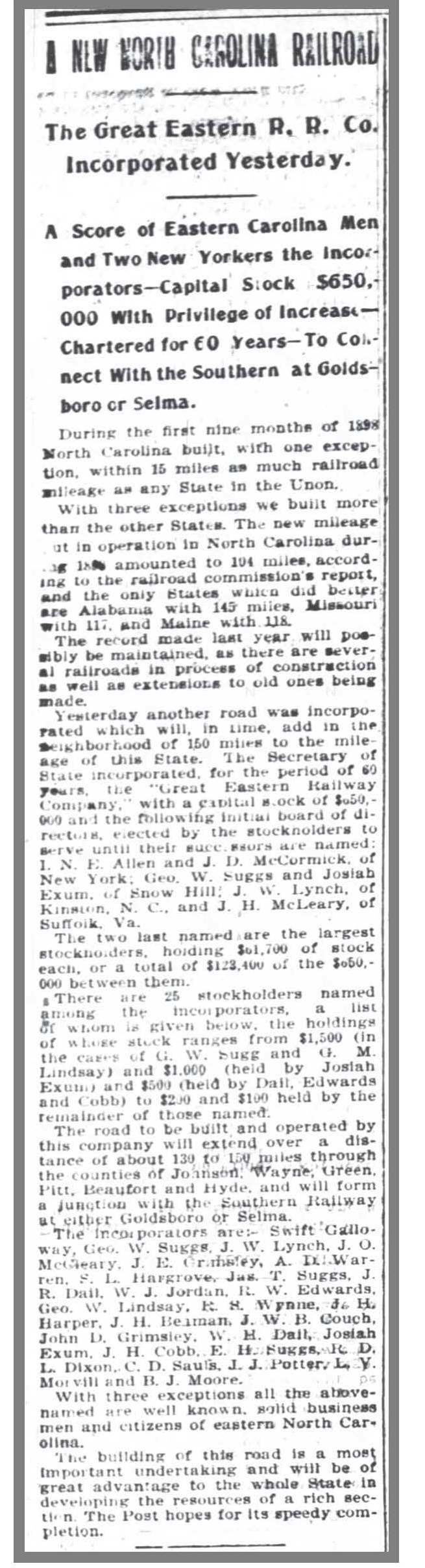
A little over a year later, North Carolina’s secretary of state approved the incorporation of the Great Eastern Railway Company, which planned to build and operate a 130+ mile railroad passing through Johnston, Wayne, Greene, Pitt, Beaufort and Hyde Counties. Among the 25 stockholders incorporating the railroad? C.D. Sauls!

Raleigh_Morning_Post_10_15_1898_Great_Eastern_RR

Raleigh Morning Post, 15 October 1898.

Standard
Births Deaths Marriages, Migration, North Carolina, Other Documents, Paternal Kin

The baby boy, found. (Sort of.)

When you’re not looking for something, there it is.

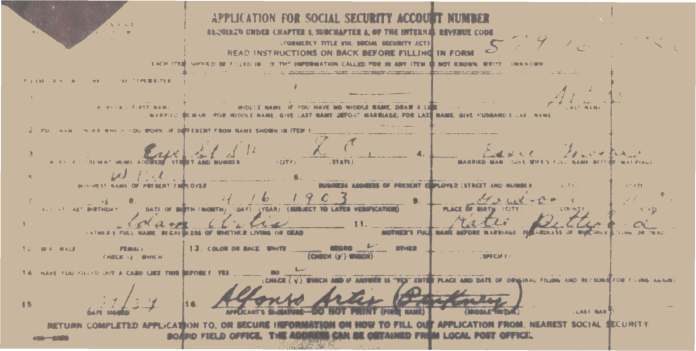
The story I’d heard was that Adam T. Artis‘ youngest child, Pinkney Alphonso Artis, had run away to Baltimore as a young man (or maybe even teenager) and refused to return. I believed it; I certainly had not been able to find much trace of him. He was listed as a child with his parents in the 1910 census, then disappeared from that set of records. I found his Social Security application, filed in Washington DC on 29 May 1939, which told me that “Alfonso Artis” lived at 70 Eye Street, SW; was married to Essie Moore; was employed by WPA; and had been born 16 Apr 1903, Goldsboro, North Carolina, to Adam Artis and Katie Pettiford.

AP Artis SSN App

Just over a year later, in June 1940, his mother died, and “Pinkney Artis” of Washington DC was listed as the informant on her death certificate. And that was it. That was all I knew about Pinkney.

Until the other day, when I stumbled upon this, hidden in plain sight:

Screen Shot 2015-08-09 at 10.05.31 PM

The 1940 census, Nahunta township, Wayne County: Adam’s notorious last wife, the remarried Katie A. “Cain” (her death certificate says “King”), son “Pinkny” A. Artis and daughter-in-law Ester Artis. Pinkney reported that he had been living in the same place five years earlier. (His wife had been in DC in 1935. What a transition that must have been.) They were surrounded on all sides by Artises. At #28, Richard Baker, his wife Odessa (daughter of Pinkney’s half-brother Henry J.B. Artis) and their daughter Daisy; at #29, Simon Exum (son of Simon Exum and Pinkney’s aunt Delilah Williams Exum) and his family; and at #31, J.B. Artis himself with wife Laurina and two children.

So, then, not only have I found no trace of Pinkney in Baltimore in his early years, but there is evidence that he was in Wayne County during at least the mid-1930s. He did come home. But where was he all that time?

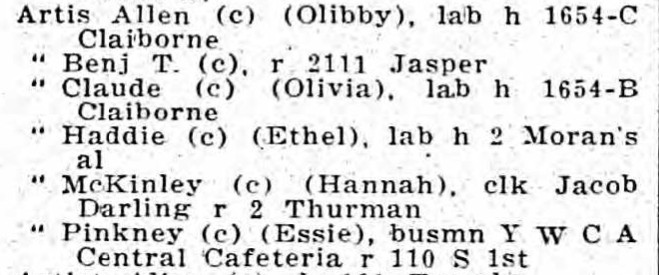
I still have not found Pinkney in the 1920 or 1920 censuses, but here he is in the 1932 city directory of Richmond, Virginia:

Screen Shot 2015-08-14 at 11.09.42 AM

Did he and Essie marry in Richmond? In DC? I don’t know. How long did they live there? I don’t know that either. But these finds add some texture and definition to Pinkney’s life, and I’ll continue to search.

Standard
Free People of Color, North Carolina, Paternal Kin, Rights

No damages.

More times than I might have imagined, see here and here and here and here and here, members of my extended family have figured in litigation that made its way to the North Carolina Supreme Court. Here’s another such case:

William Hooks v. William T. Perkins, 44 NC 21 (1852).

In 1845, the Wayne County Court of Pleas and Quarter Sessions bound brothers Rufus Artis and Thomas Artis to William Hooks to serve as apprentices until age 21. At the time of their indentures, Rufus’ age was reported as 7 and Thomas’ as 18. In 1849, after the court determined that Thomas was, in fact, only 15 when apprenticed, a judge ordered his indenture amended to correct his true age. Hooks, apparently, never got around to it.  Meanwhile, William Perkins hired Thomas. Deprived of the young man’s labor, Hooks attempted to enforce the court order, and Perkins took up Thomas’ cause.  Arguing that Thomas was bound to serve him until his true age of 21 — regardless of the age listed on his indenture — Hooks sued Perkins for damages for the period from November 1848 to February 1849 during which Perkins would not turn Thomas over.  The state Supreme Court held that Hooks should have amended Thomas’ indenture to reflect his actual age at the time it expired, per the court order.  Having failed to do so, Hooks was not Thomas’ master when Perkins hired him and was not entitled to damages.

Notwithstanding the court’s findings, Rufus, 11, and Thomas Artis, 20, were listed in the household of farmer William Hooks, along with another apprentice, W.H. Hagins, 15, in the 1850 census of North Side of the Neuse, Wayne County. (William Perkins does not appear in the county’s census at all.)  Worse, by 1860, Rufus Artis had lost ground, as the census of Nahunta, Wayne County, lists him as a 17 year-old — rather than the 21 or 22 year-old he actually was — in Hooks’ household, along with Polly Hagans, 15, and Ezekiel Hagans, 13.  In other words, what Hooks could not get out of Thomas Artis, he appears to have extracted from his younger brother.

Rufus Artis eluded the census taker in 1870, but he was around. On Christmas Eve 1874, he married Harriet Farmer in Wayne County. The family appears in the 1880 census of Nahunta, Wayne County: Rufus Artis, 46, wife Harriet, 30, and daughters Hannah, 13, and Pennina, 9. The family lived very near a cluster of three other sets of extended Artis families descended from Vicey Artis, Celia Artis, and Vincent Artis, none of whom were not known to have been related. (Or, at least, not closely so.) In the 1900 census of Nahunta, Rufus and Harriet, their children grown and gone, shared their home with Harriet’s mother, 73 year-old Chanie Farmer. Daughter Pennina had married Curry Thompson, son of Edie Thompson, on 11 October 1893 in Wayne County. They had two daughters, Harriet (1895) and Appie (1896). On 10 January 1917, Harriet Thompson married John Henry Artis, born 1896 to Richard Artis and Susannah Yelverton Artis. Richard, of course, was the son of Solomon Williams and Vicey Artis, and the brother of my great-great-great-grandfather Adam T. Artis.

Standard
North Carolina, Other Documents, Paternal Kin

Signature Saturday, no. 5: Napoleon Hagans and family.

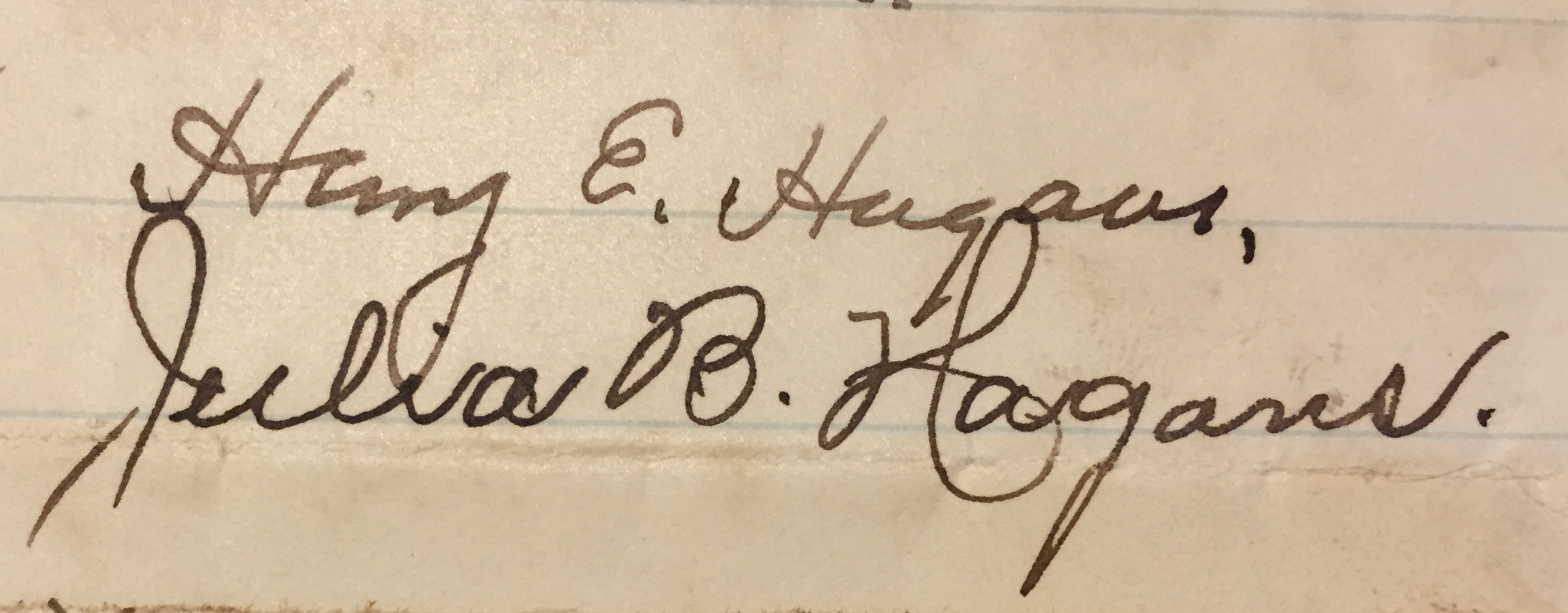
Napoleon Hagans, self-made man, could neither read nor write. His wife, Appie Ward Hagans, born into slavery, picked up the rudiments of an education at some point in her life and was able to scratch out a shaky signature, as shown in this 1888 deed. By time his sons were born, Napoleon had begun his ascent into Wayne County’s African-American elite, recognized by both blacks and whites as a savvy and successful cotton farmer. Thanks to his wealth, the children he reared, Henry and William Hagans, would lead lives very different from their father’s, starting with their educations at local schools and then Howard and Shaw Universities.Napoleon Hagans X Appie Hagans SigHenry E. Hagans spent much of his life as a teacher and principal, and his small, firm hand reflects his pedagogical life. He likely met his wife, Julia B. Morton of Danville, Virginia, at Howard. This sample of their signatures is on a deed dated 1899.
HE Hagans & Julia Hagans SigWilliam Hagans’ signature was bolder and more architectural than his brother’s, as shown on the 1916 deed below. Though not a teacher, his early career as secretary (read: assistant or even chief of staff, if there was additional staff) to United States Congressman George H. White and as businessman/farmer provided ample opportunity for him to display his conjoined signature. (William M. Artis, son of Adam T. and Frances Seaberry Artis, was William Hagans’ first cousin, and Hannah E. Forte Artis was the wife of William Artis’ brother, Walter S. Artis. William likely did not attend school beyond eighth grade, but his penmanship is lovely. Hannah, too, clearly benefitted from several years of schooling. I wish I knew more about late 19th century rural African-American schools in Wayne County.)
WS Hagans WM Artis Hannah Artis Sig

Standard
Births Deaths Marriages, North Carolina, Other Documents, Paternal Kin

Jonah’s Jonah.

This caught me a bit by surprise.                                    42091_343647-01367

Jonah Reid’s first wife was Magnolia “Maggie” Artis, daughter of Thomas Artis and Loumiza Artis ArtisPatrick Exum and J.D. Reid witnessed their marriage on 30 August 1892 in Wayne County.  Patrick’s mother, Delilah Williams Exum, was Maggie’s late mother’s sister.  (Judge James Daniel “J.D.” Reid was Jonah’s maternal uncle.  He would later become a prominent school principal, bank promoter and hospital administrator in Wilson, North Carolina.  Jonah and Maggie named their son Judge Daniel Reid in his honor.) Magnolia Artis Reid died of apoplexy on 1 June 1939 in Township No. 13 [Cokey], Edgecombe County. She was 68 years old.

Three months later, as shown above, Jonah Reid remarried. That’s a little surprising. So soon. At his age. But what’s really surprising is whom he named as his father. Jonah Williams?

Elder Jonah Williams?

Jonah Reid appears in the 1880 census of Nahunta, Wayne County, in the household of his widowed grandfather Wash Reid (spelled “Reed.”) Washington Reid was one of several related Reids, born free in the early 19th century, who built successful farms in the area of Turner Swamp. Several members of this family intermarried with Artises, including Isaac Reid, who married Adam T. Artis‘ daughter Ida in 1877; William Reid, who married Zilpha Artis Wilson‘s daughter Bettie in 1882; Henry Reid who married Adam Artis’ daughter Georgianna in 1883; John Gray Reid, who married Richard Artis‘ daughter Emma in 1907; and Milton C. Reid, grandson of William and Bettie, who married his cousin Nora M. Artis, granddaughter of Adam Artis, via son Noah, in 1916. Wash and Penninah Reid’s daughter Louisa gave birth to Jonah Reid about 1874. (She later married Perry Barnes.) That same year, Jonah Williams’ wife Pleasant had a daughter, named Vicey after his mother.

Jonah Reid’s first marriage license does not list his parents. (If in fact his father was the Jonah Williams, Reid was marrying his first cousin, which was not uncommon during the time.) In his second, he openly claimed Jonah Williams as his birth father.  His marriage license is not proof of paternity, but does suggest a starting point for researchers in his line.

Standard
Free People of Color, North Carolina, Paternal Kin

Greene County Artises.

By the early antebellum period, dozens of Artis families had drifted down from southern Virginia to form a large node in Wayne County. The 1840 census lists more than 40 Artis heads of household in that county. By contrast, there were never more than a handful of Artises recorded in neighboring Greene County in the antebellum era, and none at all before 1850. (This, of course, does not mean they were not there. Only that they did not qualify as heads of household.) Were the Greene County Artises an off-shoot of one of the many Wayne County Artis lines? Are they a single extended family? Were they all free prior to the Civil War? Or were some of them freedmen who adopted the surname of their free-born kin?

I’ve begun to pull together all sources of information about antebellum Artises in Greene County to try to find answers.

CENSUS RECORDS

In 1850, clustered:

  • at #429, Vicy Artess, 40, and her children Zilpha, 22, Louis, 8, Jonah, 7, Jethro, 5, and Richard, 1.  Vicey Artis with her oldest daughter and youngest children.
  • at #431, Sylvany Artess, 36, and children Daniel, 7, Mitchel, 5, Meriah, 4, Gui, 2, and Penny, 3 months.  As detailed here, I believe Vicey and Sylvania Artis were sisters. White farmer John Lane, who likely apprenticed Sylvania’s children and enslaved their father Guy, was listed at #430.

In 1860, in Bull Head district:

  • at #25, James, 16, and Jetherroe Artis, 14, farmhands, with Silas Bryant.  These boys appear to be Vicey’s sons Jonah and Jethro and have followed their siblings into service as Bryant’s. Vicey herself is listed a few miles over the line in Wayne County with daughter Charity and Charity’s children, an unnamed one year-old “infant” and 8 year-old son Jethro.
  • at #26, Dannel, 17, Mike, 13, Penney, 12, Dyner, 9, Juley, 7, and Washington Artis, 5, with John Lane. These children, of course, are Sylvania’s younger children. Sylvania (“Silvano”) herself is living next door to her sister Vicey in Wayne County with a one year-old boy named Hiram Artis.
  • at #36, Mary Artis, 27, servant in the household of Richard Baker. Who is Mary Artis, and where was she in 1850?

And in Tyson’s Marsh district:

  • Nancy, 17, Aron, 13, Richard, 11, Calvin, 9, and Rebecker Artes, 5, in the household of G.S. Peacock. Where had the oldest children been in 1850? In 1870, Calvin Artis, 20, is a farmhand in the household of Sarah Wooten, Snow Hill township, Green County. In 1880 Snow Hill township: Richard Artis, 29, Charlotte, 24, Hattie, 3, and Jessee Artis, 1. On 9 March 1876, Calvin Artis applied for a marriage license for Richard Artis, 24, son of Isom Heath and Matilda Artis, and Charlotte Ellis, 21. Matilda was said to be living at that time. Where was she in 1850 and 1860 then?
  • at #161, servant Percy Artes, 25, and her children Henry C., 1, and Thomas, 5, in the household of Murrhyer Best. In 1850, Persey Artice and Rufus Artice, both 17, were listed in the household of Martin Sauls in North Side of the Neuse, Wayne County. In 1870, Snow Hill, Greene County, Prissy Artice, 35, and son Thomas, 14.

DEATH RECORDS

Margaret Artis. Died 4 March 1920, Carrs township, Greene County, North Carolina. Age 70. Widow of Ed Artis. Born Greene County to Penny Speight. Buried Carr’s Farm. Informant, Tom Speight. Not found in census or other records.

Thomas Artis. Died 30 July 1941, Bullhead township, Greene County, North Carolina. Widower of Mary Artis. Born 21 December 1853 in Wayne County to John and Leathy Artis. Buried family cemetery, by C.E. Artis. Informant, F[illegible] Exum. In the 1860 census of Davis district, Wayne County: John Artis, 39, wife Lethy, 40, and children Sarah J., 13, Zachary, 11, Millie, 9, Wm. T., 7, and Betsey Artis, 4. He was the grandson of Celia Artis.

Fillis Artis. Died 28 October 1916, Ormondsville township, Greene County, North Carolina. Married. Born 1853 in Greene County to Charity Edwards. Informant, W.H. Phillips. Phyllis Artis was not free-born, but married a man whose parents were. Phyllis Lee, age 35, daughter of Jerry Edwards and Charity Coward, married Rom Artis, 27, son of Jordan Artis and Arley [Olive] Artis, in Greene County on 11 January 1897. (Romilus was born about 1868, perhaps in Lenoir County. Census records show that his father lived in Wayne.) In the 1900 census of Contentnea township, Pitt County: Rom Artis (born 1868); wife Filliss (born 1860); four sons-in-law [stepsons?] John (1885), Allen (1886), Milton (1889) and Charley Leary (1891); son-in-law(?) William Artis (1893); daughter-in-law(?) Mande Artis (1895); and mother Ollie Artis (1840.)

Henry Artis. Died 10 January 1935 in Paris, Edgar County, Illinois. Barber. Resided 437 East Court. Born 21 March 1835, Snow Hill [Greene County], North Carolina to Louis Artis and Elizabeth Bass. Widower of Gabreil Artis. In the 1870 census of Otter Creek, Vigo County, Indiana: Lewis Artis, 39, Elizabeth, 38, Lucy A., 33, Elie, 20, Peggy, 14, Thomas, 8, John, 5, and William Artis, 4 months; the first three born in North Carolina. In the 1880 census of Charleston, Coles County, Indiana: North Carolina-born Henry Artis, 41, Ohio-born Ellen Artis, 43, and others.

CEMETERY RECORDS

Olive Artis. 1832-22 May 1904, Artis cemetery, Artis Cemetery Road, Greene County.

Phillis Artis. Wife of Rom Artis. 12 March 1861-28 October 1916, Artis cemetery, Artis Cemetery Road, Greene County. See Fillis Artis, above.

——

Standard
Births Deaths Marriages, Free People of Color, North Carolina, Other Documents, Paternal Kin

Collateral kin: Celia Artis and family.

As noted previously, there is no known relationship between Celia Artis and my great-great-great-grandfather Adam T. Artis, though it is likely that most free colored Artises shared a common ancestor in the misty mists of time. Like, the late 17th century. Celia’s family and Adam’s family were among several sets of Artises living in northeastern Wayne County in the antebellum era, and they intermarried and otherwise interacted regularly. Here’s what I know of Celia Artis and her descendants.

Celia Artis was born just before 1800, presumably in Wayne County. Nothing is known of her parentage or early life. She married an enslaved man named Simon and gave birth to at least six children. In 1823, she gave complete control over her oldest children to two white neighbors, brothers (or father and son) Elias and Jesse Coleman, in a dangerously worded deed that exceeded the scope of typical apprenticeship indentures: This indenture this 16th day of August 1823 between Celia Artis of the County of Wayne and state of North Carolina of the one part, and Elias and Jesse Coleman of the other part (witnesseth) that I the said Celia Artis have for an in consideration of having four of my children raised in a becoming [illegible], by these presence indenture the said four children (to viz) Eliza, Ceatha, Zilpha, and Simon Artis to the said Elias and Jesse Coleman to be their own right and property until the said four children arives at the age of twenty one years old and I do by virtue of these presents give and grant all my right and power over said children the above term of time, unto the said Elias and Jesse Coleman their heirs and assigns, until the above-named children arives to the aforementioned etc., and I do further give unto the said Elias and Jesse Coleman all power of recovering from any person or persons all my right to said children — the [illegible] of time whatsoever in whereof I the said Celia Artis have hereunto set my hand and seal the day and year above written,    Celia X Artis.

Despite the “own right and property” language, Celia did not sell her children exactly, but what drove her to this extreme measure? Because she was not legally married, her children were subject to involuntary apprenticeship until age 21. This deed records her determination to guard her children from uncertain fates by placing them under the control of men she trusted, rather than those selected by the court.

Despite the deed’s verbiage, it is likely that the children continued to live with their mother during their indenture. Certainly, Celia, unlike many independent women of the era, had the wherewithal to care for them, as evidenced by her purchase of 10 acres from Spias Ward in 1833. Wayne County deeds further show purchases of 124 acres and 24 acres from W[illiam] Thompson in 1850 and 1855.

By 1840, Celia Artis was head of a household of eight free people of color in Black Creek district, Wayne County — one woman aged 36-54; three girls aged 10-23 [Eliza, Leatha, Zilpha]; one girl under 10 [unknown]; two boys aged 10-23 [Calvin and Simon]; and one boy under 10 [Thomas].

In the 1850 census, she was enumerated on the North Side of the Neuse, Wayne County, as a 50 year-old with children Eliza, 34, Zilpha, 28, Thomas, 15, and Calvin, 20, plus 6 year-old Lumiser, who was probably Eliza’s daughter. Celia is credited with owning $600 of real property (deeds for much of which went unrecorded), and the agricultural schedule for that year details her wealth:

  • Celia Artis.  50 improved acres, 700 unimproved acres, value $600. Implements valued at $25. 2 horses. 1 ass or mule. 1 ox. 21 other cattle. 40 sheep. 500 swine. 500 bushels of Indian corn. 100 lbs. of rice. 2 lbs. of tobacco. 100 lbs. of wool. 100 bushels of peas and beans. 200 bushels of sweet potatoes.

She also appears in the 1850 Wayne County slave schedule, which records her (and another free woman of color Rhoda Reed’s) ownership of their husbands:

1850 slave sched Celia ARtis

In 1860, in a surprise move, the census taker listed Simon Pig Artis, Celia’s husband, as the head of household. If he’d been freed formally, there’s no record of it. (Simon Pig’s nickname is explained here.) He is also listed as the 70 year-old owner of $800 of real property and $430 of personal property — all undoubtedly purchased by Celia. Their household included son Thomas, daughter Zilpha, and granddaughters Lumizah, 17, and Penninah, 11. On one side of the family: the widower Adam T. Artis, his three children, his sister and her child; on the other: Celia and Simon’s son Calvin, his wife Serena [maiden name Seaberry, and a cousin of Adam’s next wife Frances Seaberry], and their four children. Other neighbors included Lemuel Edmundson.

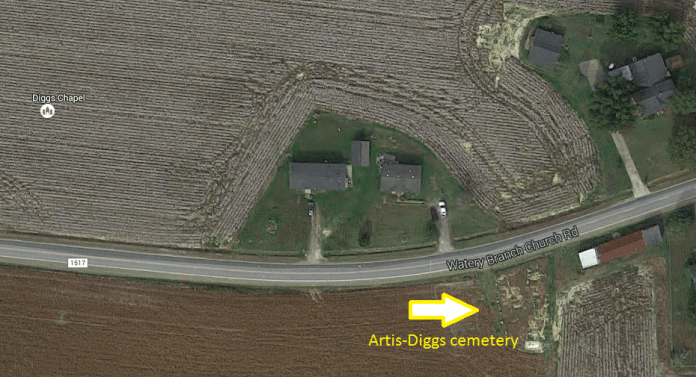
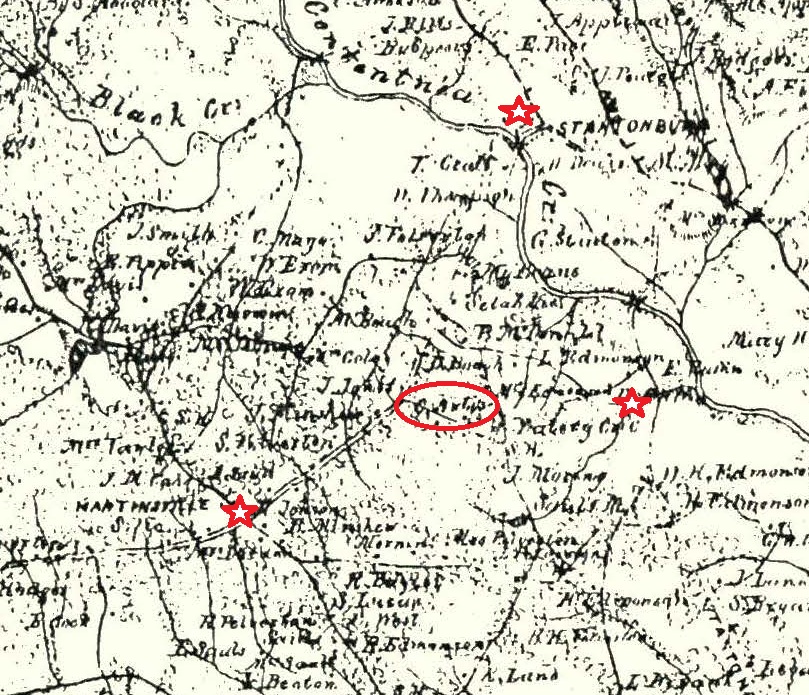
The 1863 Confederate field map below indicates “C. Artis” near Watery Branch and “L. Edmundson.” (The stars mark the creek and the towns of Stantonsburg and “Martinsville,” now Eureka.) The family’s cemetery remains on that land, as marked in the second map. (Watery Branch is perhaps a mile south along Watery Branch Road. And Diggs Chapel, presumably, is connected to the family. See Eliza Artis, below. The road visible below Celia’s name on the 1863 map was probably the precursor of Watery Branch Church Road.) Conf Field Map 2

Watery Branch

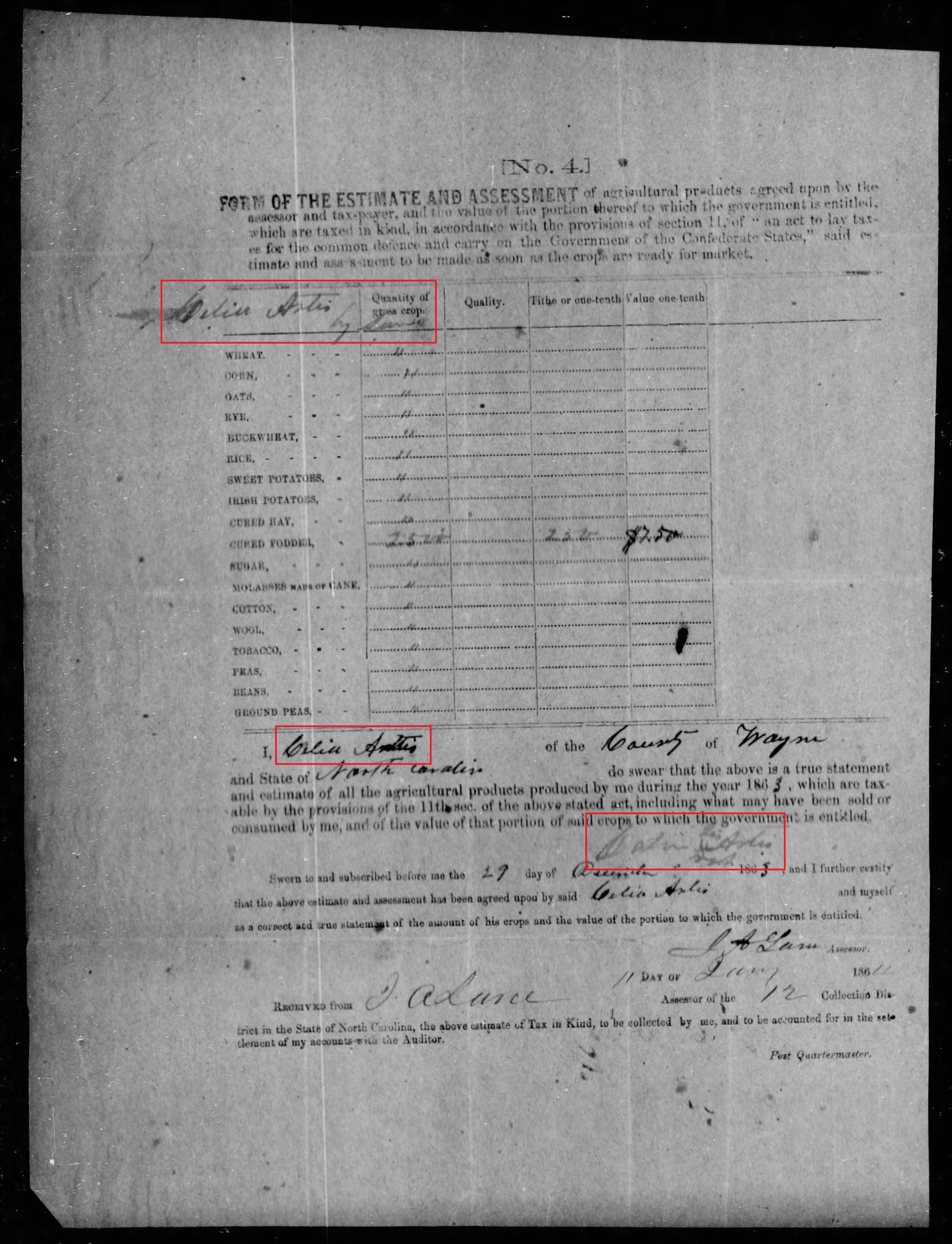
During the Civil War, both Celia Artis and her son Calvin were assessed taxes by the Confederate state government in the form of tithed crops. In December 1863, Celia had to hand over a tenth of her 2500 pounds of cured fodder to support the war effort.

celia artis conf

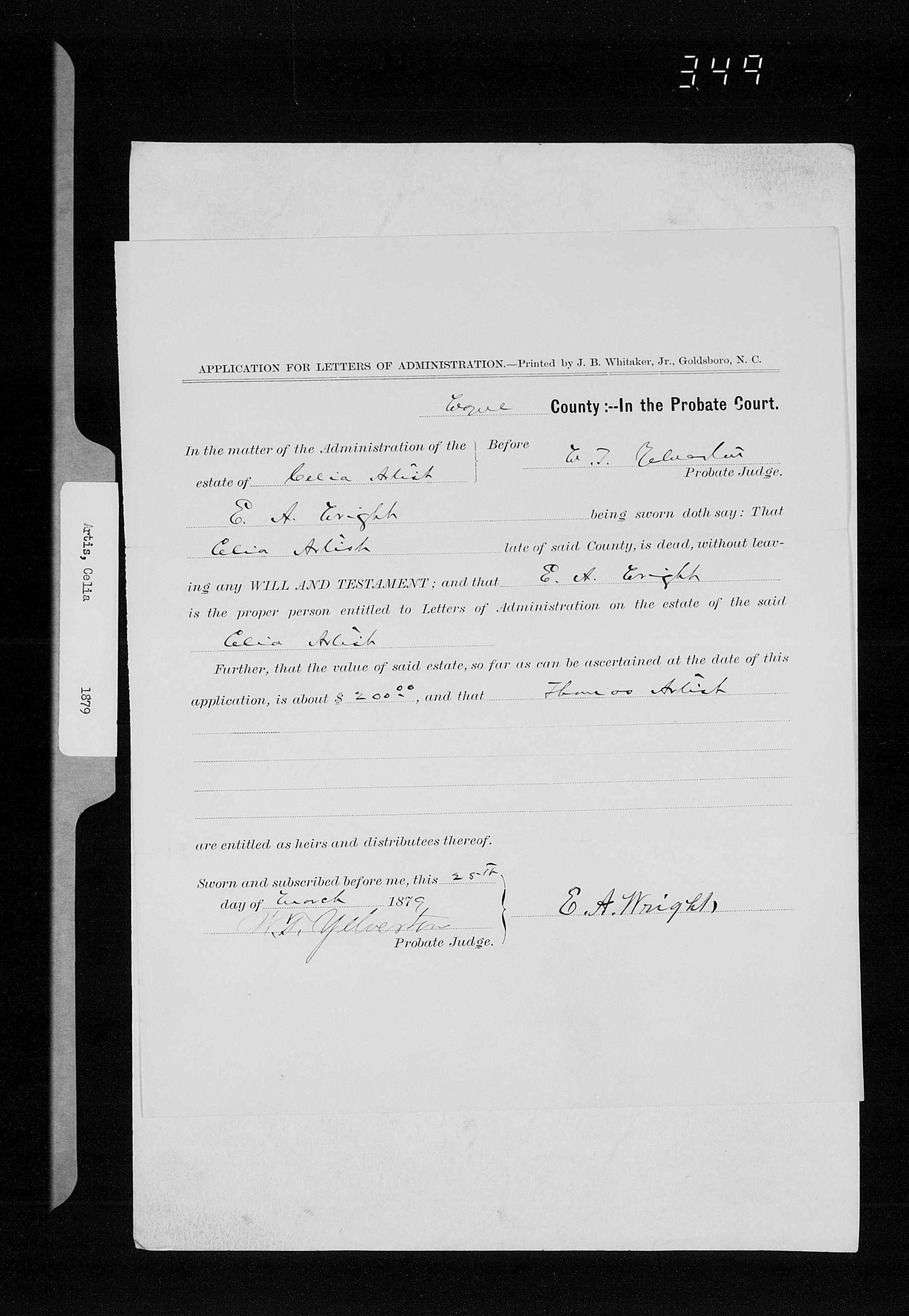
Neither Celia nor Simon appears in the 1870 census. It seems likely that Celia was alive for at least a few more years, however, as her estate was not opened until 1879. It was surprisingly small, suggesting that she had distributed most her land and valuables (or otherwise lost them) before her death. Son Thomas is listed as the sole heir to her $200 estate. I don’t know what became of Simon Pig.

record-image_TH-1971-35571-13786-29

Here’s what I know of Celia Artis’ children:

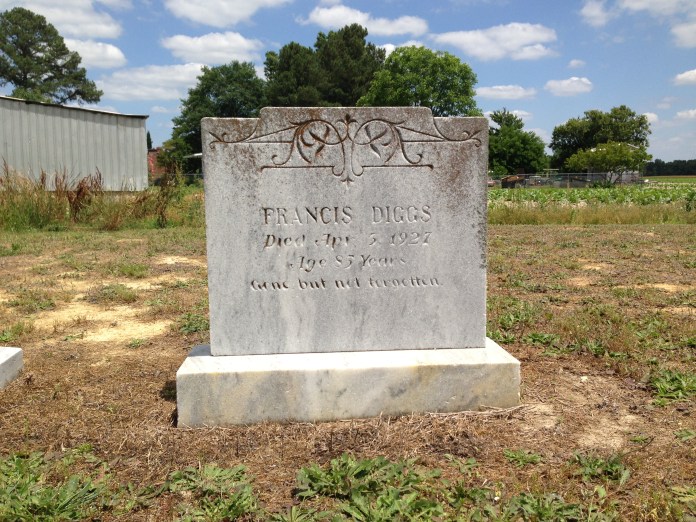
  • Eliza Artis was born circa 1816. She never married but had at least three daughters, Loumiza, Frances and Penina Artis. Descendants assert that the father of some or all of them was James Yelverton, a white farmer who lived nearby. Loumiza is known only from the 1850 and 1860 censuses. Frances was born about 1845. She never married but had at least two children, Sula and Margaret, allegedly by Wilson (or William) Diggs, whom she married in Wayne County on 15 October 1868. (Margaret’s daughters Etta and Minnie Diggs married William M. Artis and Leslie Artis, respectively, a son and grandson of Adam T. Artis. Sula’s daughter Lizzie Olivia married Leslie Artis’ brother Odell.) Penina, born about 1849, married James Newsome. Eliza’s will was filed in Wayne County:

In the Name of God Amen: I Eliza Artis of the County of Wayne and State of North Carolina being of sound mind and memory and considering the uncertainty of human life do therefore make Publish and declare this to be my last Will and testament: That is to say first after all my burial expenses are paid and discharged the residue of my estate. I give and bequeath and dispose of as follows to wit to John Newsom son of James Newsom and Penina Newsom Four Dollars to Francis Diggs all the balance of my personal and real estate that I may be in Possession of at my death during her Natural life and after the death of said Francis Diggs all of said Personal and real estate is to be equally divided between Francis Diggs’s three children Sula Artis Margrett Diggs and William Diggs Likewise I make constitute and appoint Noble Exum and George Exum to be my Executors to this my last Will and testament hereby revoking all former wills made by me In witness whereof I have hereunto subscribed my name and affixed my seal this the eleventh day of February in the year of our lord one Thousand eight hundred and Ninety  Eliza X Artice {seal} In the presence of Witnesses John H. Skinner, R.H. X Locus  Hand-written notation in margin: “See Book No 32 Page 320 Register of Deeds Office” [Wayne County Will Book 1, page 524]
IMG_2213

——

  • Letha Ann Artis (the “Ceatha” above) was born about 1820 and married John Artis. They lived in the Eureka area of Wayne County and their children included Sarah Artis, Zachary/Zachariah Artis, James Artis, Mildly Artis Baker (whose grandson Richard V. Baker married Lillie Odessa Artis, daughter of Henry J.B. Artis and granddaughter of Adam T. Artis), William Thomas Artis, Elizabeth Artis Brantham, and Jackson Artis. Letha Ann died circa 1896.

I Lethy Ann Artice of Nahunta Township, State of North Carolina being of sound mind and memory, do declare this to be my last will and testament. I give and bequeath to my son James Artice Five acres of land known as my fathers place to have to hold through his natural life, after his death to Maggie Artis his daughter. But should she want to live on said land before his death, I give her a right, so to do. I give and bequeath to Luby Baker and Anna Baker the children of Mildly Baker Four acres provided Mildly Baker shall be guardian for said children until they reach their majority. I give and bequeath to Bettie Bradford and Brantham Five acres land to have and to hold their natural life afterwards to their heirs. I give and bequeath to Zachary Artice Five acres land. I give and bequeath to John and Octavius the sons of Thomas Artis my son Four acres land if they should want to sell each other all right but no one else. I give and bequeath to Zachary his fathers chest. All heirs to pay Zachary Artice for burial expenses Sarah & Jackson, before coming in possession of the property I give. I also give to Zachary the big pot, I also give him his house, no matter on whose land it falls on. Be it understood I have already given Zachary ½ acre during my life time. I also gave Thomas Two Dollars and a Bull. I also give Baker a cow and calf, Betsey two Dollars I say this to show what I have given. Betsey and Mildly I give one bed a piece, my large bed to be divided between Tom & Zachary. I also give Maggie Artice James daughter, Sarahs chest. I also give the [illegible] and gear to Scintha Ann Artice. All the heirs, with Scintha Ann take my wearing clothes also House furniture also. But should Zachary want any particular thing, as he been my protector let him have it I appoint I.F. Ormond Executor of this will. In witness whereof I Letha Ann Artice have herewith set my hand and seal This 9th day of Oct 1892   Letha Ann X Artice Subscribed by the testator in the presence of each of us and declared by her to be the last will testament Witnesses   J.H. Skinner, Noble Exum  [Wayne County Will Book 2, page 184; proved 2 January 1897, Superior Court, Wayne County]

——

  • Zilpha Artis was born in the 1820s. She never married and had no known children. She died in 1882, leaving this will:

Know all men by these presents that I Zilpha Artis of the County of Wayne and State of North Carolina being of sound mind and memory but considering the uncertainty of life do make and declare this my last will and testament in manner and form following that is to say. That my Executor Philip Fort shall provide for my body a decent burial according to the wishes of my relatives and friend and pay all funeral expenses together with my just debts to whomsoever due out of the money that may first come into his as a part or parcel of my estate. I give and devise to my niece Francis Diggs all of my entire lands and all my household and Kitchen furniture to have and to hold to her the said Francis Diggs for and during the time of her natural life and after her death to be equally divided between her two children Sula Artis and Margaret Diggs their heirs and assigns forever I give and bequeath to my Sister Eliza Artis the sum of fifty cents I give and bequeath to my Sister Leatha Artis the sum of fifty cents I give and bequeath to Brother Calvin Artis the sum of fifty cents And I give and bequeath to my brother Thomas Artis the sum of fifty cents And lastly I do hereby appoint and constitute Phillip Fort my lawful executor to all intents and purposes to execute this my last will and testament according to the true intent and meaning of the same and every part and clause therein hereby revoking and declaring utterly void all other wills and testaments by me heretofore made. In testimony whereof I the said Zilpha Artis do hereunto set my hand and seal this 19th day of November A.D. 1881    Zilpha X Artis {seal} Signed and sealed in the presence of B.J. Person, John B. Person [Wayne County Will Book 1, page 245; proved 20 September 1882, Probate Court, Wayne County]

——

  • Simon Artis. I’ve found no record of Simon after his 1823 indenture to the Colemans.

——

  • Calvin Artis, known as Calv Pig, was born about 1830. In 1853, he married Serena Seaberry, daughter of Theophilus and Rachel Smith Seaberry and a cousin of Adam Artis’ wife (and my great-great-great-grandmother) Frances Seaberry Artis. Their children were Martha Artis Locus, Polly Artis, James Madison Artis (who married Adam T. Artis’ oldest daughter Caroline Coley), Henry T. Artis, Nettie Artis Exum, Ellen Artis, Talitha Artis, Simon Artis, and Jeffersonia Artis. Calvin seems to have died between 1880 and 1900.

——

——

Federal population, agricultural and slave schedules;Confederate Papers Relating to Citizens or Business Firms, 1861-1865, National Archives and Record Administration; Deeds, Register of Deeds Office, Wayne County Courthouse, Goldsboro; Will Books, Office of Clerk of Superior Court, Wayne County Courthouse, Goldsboro.

Standard
Business, North Carolina, Other Documents, Paternal Kin

That is the promise I made my father.

The tenth in an occasional series excerpting testimony from the transcript of the trial in J.F. Coley v. Tom Artis, Wayne County Superior Court, November 1908.

W.S. HAGANS recalled by Referee.

I testified that I told Tom that I wouldn’t sell this land to anybody who wouldn’t make the same agreement on which he had been living on the land, that is the promise I made to my father in his presence. I requested Mr. Coley to carry out this agreement. Mr. Coley said he would let the Defendant stay as long as the Defendant could let him. I considered it the same promise I made my father. I told him what rent the old man was paying. He didn’t agree to let him stay for the same rent. Said he would raise it. Said he would let him stay as long as he would protect him, and give him good crops.

CROSS EXAMINED.

The conversation was before the delivery of the deed to Coley. I remember the occasion when Henry Reid and I were together, we talked with Tom about the land. Reid was on my buggy one day, and we met the Defendant. The Defendant wanted me to sell him this 30 acres of land, and I told him that I would prefer selling it all together. He wanted to purchase the property from me in the presence of H.S. Reid. That tract that Coley gave mortgage on was additional security, was worth 4 or $5000. That was the 60 acre tract. (Coley mortgaged.) He gave me notes due for January of next year, and the January following. I have traded those notes. (Plaintiff objects.) Artis stated to me when he came to my house that it would be to my advantage to sell to Mr. Coley, in preference to Mr. Cook, on account of Mr. Coley would not only take the two pieces, the 30 and the 24 acre lot, but would also take the 9 3/4 acre lot, and that he wanted me to let him have it, on the grounds stated yesterday, Mr. Cook being disagreeable etc.

CROSS EXAMINED.

I think I told all these reasons yesterday; I am repeating this because my lawyer asked me. I just didn’t think about the Henry Reid statement. I told my lawyer. I said I would not let anyone have the property, until they had made me the same promise I made my father in presence of Defendant. Mr. Coley also agreed to it. I didn’t say it because I wasn’t asked. I told Mr. Cook that he must let the old man stay there. Mr. Cook said that he had no desire whatever of removing the Defendant. I told Mr. Cook that I heard that he wanted to move his son-in-law up there, and I feared that on that account he would interfere with the Defendant. Mr. Cook said his son-in-law was very well situated on another place, belonging to him, Cook.

What did it take to call a white man “disagreeable” in open court in 1909?

Standard
Births Deaths Marriages, North Carolina, Other Documents, Paternal Kin

Small world.

42091_343641-00147

In midwinter of 1911, Primitive Baptist minister Jonah Williams made his way to the home of Stanford Holmes to preside over the marriage of Peter Barnes and Sinthia Pate.  Jonah was the brother of my great-great-great-grandfather, Adam T. Artis. Thirty-three year-old Peter was the son of Calvin and Celia Barnes. Thirteen years previously, Peter’s brother Redmond Barnes had married Jennette Best in Wilson County. Redmond and Jennette Barnes‘ daughter Edith Bell married Theodore Roosevelt Ellis in 1933, and their first son was Theodore Jr., who married my father’s sister in 1960.

Standard