Births Deaths Marriages, Free People of Color, Migration, North Carolina, Paternal Kin

Artis in Arkansas.

Surprisingly few of Adam Artis‘ 25+ children migrated out of North Carolina, perhaps because the family’s relative farming wealth and good standing in their community made life in North Carolina — even in the 19th century — attractive. Two who did strike out went West. Sort of. They went to Arkansas.

——

Augustus Kerney “Gus” Artis was born about 1857 to Adam and his wife Lucinda Jones. He was a mere toddler when his mother died, and he was reared primarily by Frances Seaberry Artis, whom Adam married in 1861. Gus inherited one-third of his mother’s share of the estate of her father Jacob Ing, a small nest egg that may nonetheless have represented the pinnacle of his wealth. In 1879, Gus married Rebecca Morgan in Wayne County. Though a 13 year-old girl is implausibly described as their daughter in the 1880 census, there is convincing evidence of a daughter Lena, born in 1882. What Gus did or where he was over the years after her birth is a mystery, for in 1893 he suddenly appears in the city directory of Little Rock, Arkansas, living at the corner of Allen and Elm in North Little Rock. (Which, by all accounts, was a swampy outpost known as Argenta at that time.) In 1898, Lena Artis married Charlie Hill in Pulaski County. By 1900, however, she was back in her parents’ house on Washington Avenue in North Little Rock.  Farm laborer Gustice Artis and wife Mary R. (presumably Rebecca), married 19 years, are listed with Lena, 18, born in North Carolina, and Mary, 13, an adopted daughter born in Arkansas. By 1910, both daughters had left the household, though Mary reported them living. Augustus, then in his early 50s, worked as a laborer in a greenhouse. Lena, described as a widow, was living and working as a “dining room girl” in a Scott Street boarding house. I’ve found none of the Artises in the 1920 census, though Gus and Mary were still alive. Gus didn’t last much longer though. He died of heart disease 2 June 1921 in Brandie township, Pulaski County, and was buried in the “fraternal cemetery.” His death certificate lists his final occupation as “scavenger.”

——

Twenty-five miles east of North Little Rock, Gus’ younger sister Eliza Artis Everett also built a life far from her home. She was the twin of my great-great-grandmother Louvicey Artis Aldridge; the girls were born in 1865 to Adam Artis and his second wife Frances. I have not found their marriage license, but around 1890, Eliza married Haywood Everett. By 1900, they had migrated to Williams township, Lonoke County, Arkansas, and joined a veritable colony of Wayne County migrants, including Haywood’s elderly parents. Families listed near them in the census carried such familiar surnames as Barnes, Best and Coley. In 1910, the Everetts appear in the Richwoods section of the county. In 1920 and 1930, they are in Walls township. They never had children. On 10 October, 1936, Eliza Everett died of pancreatic cancer. Her husband remarried before she was cold in her grave.

——

Did Gus and Mary Rebecca Artis and Haywood and Eliza Everett migrate together in the late 1880s/early 1890s? Why Arkansas? Did Gus and family originally settle among other Wayne County families in Williams township, Lonoke County, before moving closer to Little Rock? And then there’s this — the Lonoke County Race War of 1897-1898?!?!

Standard
Births Deaths Marriages, Free People of Color, North Carolina, Other Documents, Paternal Kin

A Seaberry clue.

Back in December, I went on a hunt for Artis cemeteries in the Eureka area. One that I found, just south of the others, holds the remains of William M. Artis and his family. Today, while I was sorting old documents, I ran across William’s death certificate. His place of birth, which I’ve surely read a hundred times, seized my eye:

Wm_Artis_Death_Cert-1

“Family (Seabury)”? Was this graveyard originally the resting place of William’s maternal great-grandfather, Aaron Seaberry, who died just after 1910? Are there other Seaberrys here, including William’s mother Frances Seaberry Artis? (Who was erroneously referred to as Frances Hagans above. “Hagans” was her mother’s maiden name and the surname of her half-brother Napoleon Hagans. William’s age is off, too. He was 70 when he died.)

Standard
Civil War, Free People of Color, Land, North Carolina, Other Documents, Paternal Kin

Map, in color.

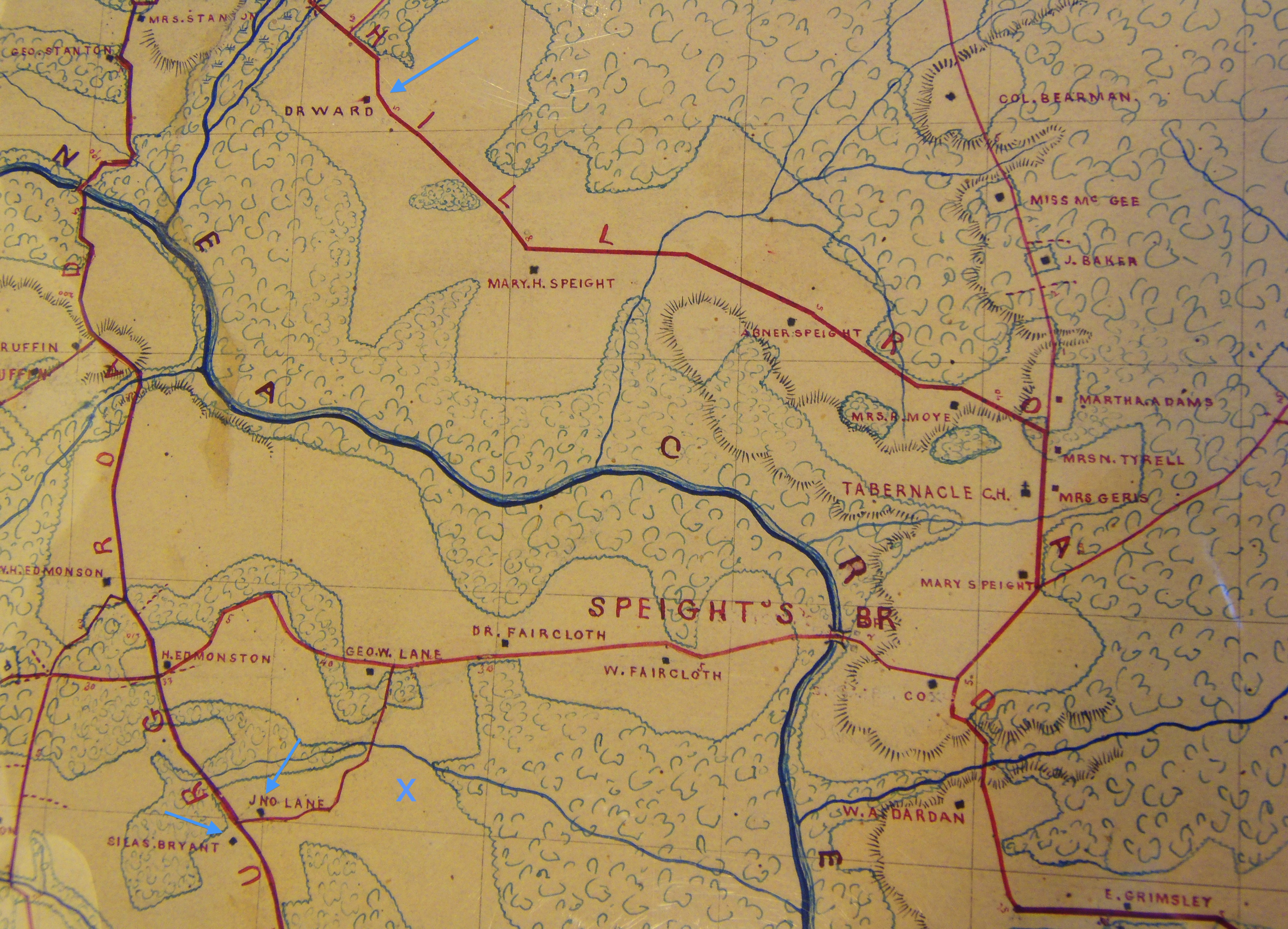
Last time I was at the North Carolina State Archives, I went looking for the original of this Confederate field map. I didn’t find it, but Trisha Blount Hewitt did.

OLYMPUS DIGITAL CAMERA

Dr. David G.W. Ward’s plantation is just below Stantonsburg at the top, and Silas Bryant and John Lane’s farms — where the Artises were apprenticed — are bottom left. X marks the approximate spot of the Artis Town cemetery.

More thanks to Trisha.

Standard
Civil War, Free People of Color, Newspaper Articles, North Carolina, Paternal Kin, Politics

He would be murdered if he did not cease.


Weekly Standard Raleigh 5 6 1868 Jacob Ing

Raleigh Weekly Standard, 6 May 1868.

Jacob Ing’s radical ideas surfaced well before Reconstruction. As made clear in his last will and testament, he had a long relationship with a free woman of color named Chaney Jones (also known as Hester or Easter Jones) and fathered several children for whom he provided. One, daughter Lucinda, was the first legal wife of my great-great-great-grandfather Adam T. Artis.

[Small world: Jacob Ing witnessed the last will and testament of Reubin Taylor of Nash and Edgecombe Counties and served as executor of the estate of Reubin’s sons Dempsey and Kinchen Taylor, who owned my great-great-grandparents.]

Standard
Business, Newspaper Articles, North Carolina, Other Documents, Paternal Kin

Demanded possession of the body.

Wilson_Daily_Times__8_12_1921 Batts & Artis

Wilson Daily Times, 12 August 1921.

This terrible dispute over the body of a dead 12 year-old girl took place in the early days of C.E. Artis‘ first undertaking business, Batts & Artis. The death certificate of Martha Lucas, who died of peritonitis, shows that Darden & Son prevailed.

S123_124-1585

Standard
Agriculture, Free People of Color, Land, Newspaper Articles, North Carolina, Paternal Kin, Politics

Our colored friend has grown richer.

Image

ImageGoldsboro Messenger, 21 October 1880.

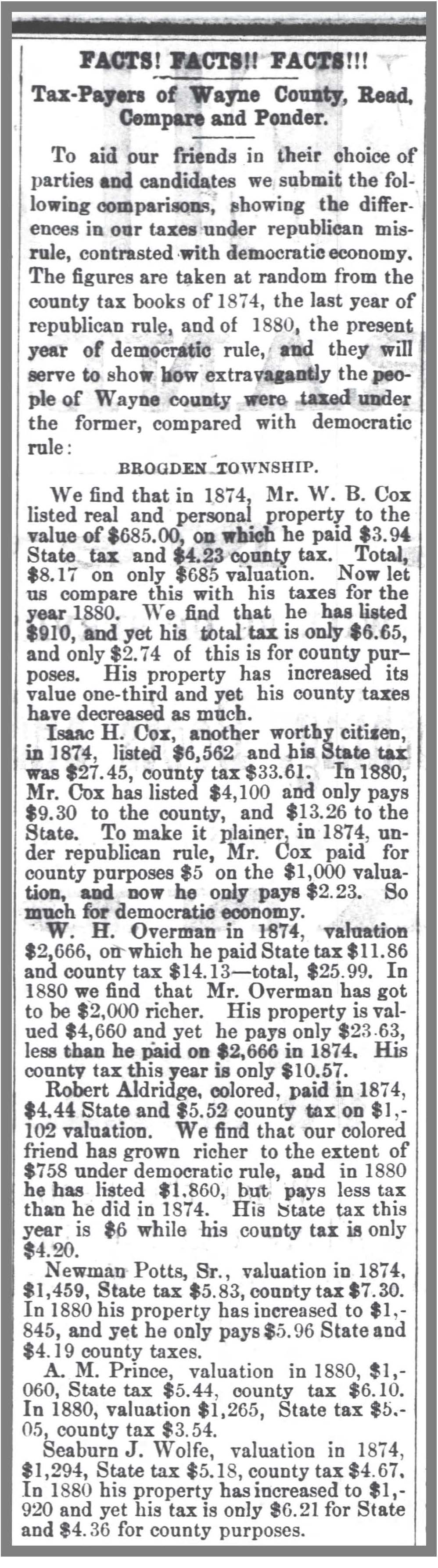
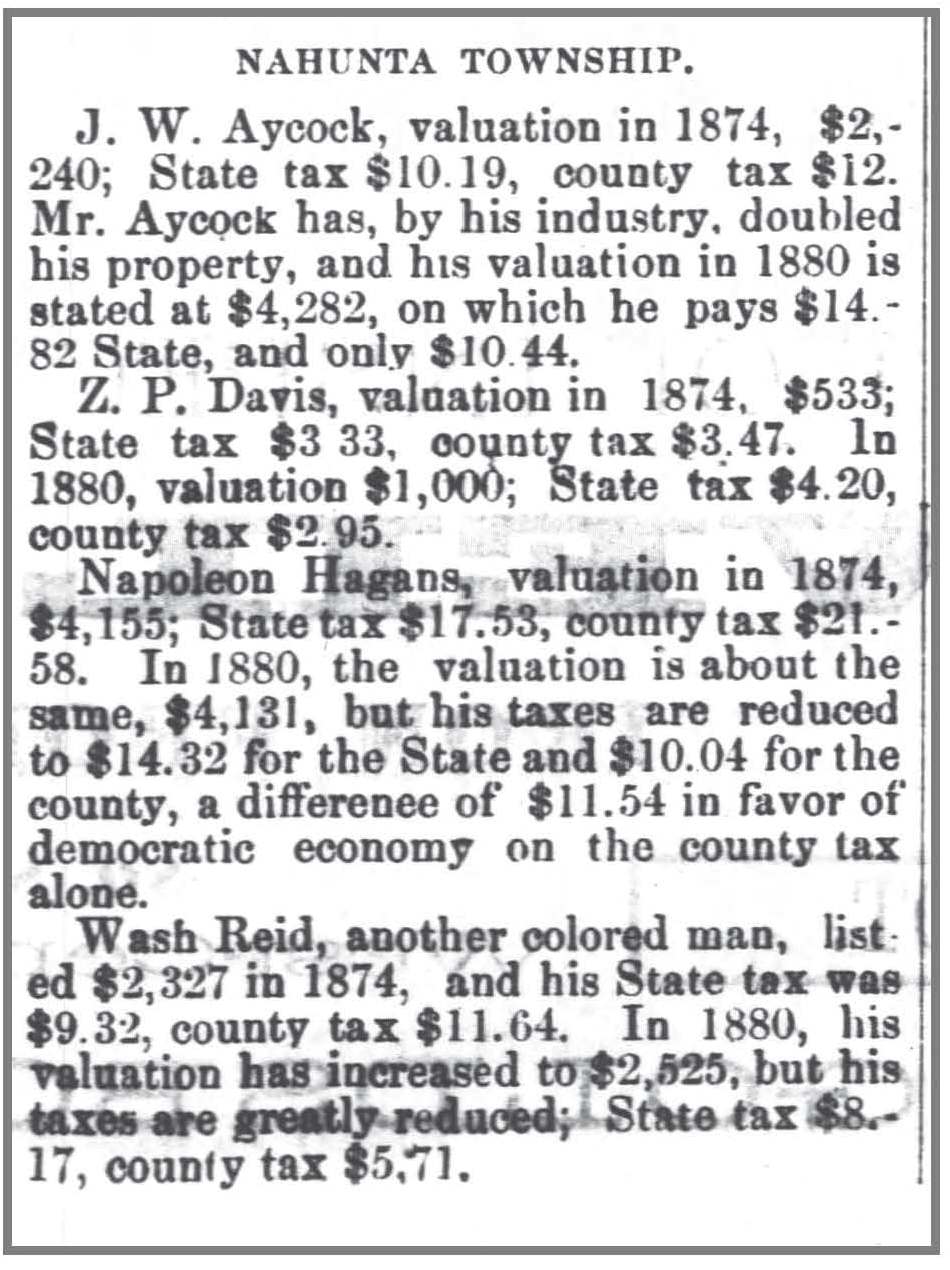
These propaganda pieces are part of a single article published to demonstrate that the rising tide of Democratic rule had floated all boats as land values increased while taxes fell. (In other words, the end of Republican rule meant more money in the pocket, as well as a foot on the neck of African-Americans.)

Two of the “colored friends” noted were my kin — my great-great-great-grandfather Robert Aldridge and Napoleon Hagans, the brother of my great-great-great-grandmother Frances Seaberry Artis. (And Washington Reid’s nephews William and Henry Reid, sons of John Reid, married Adam Artis’ niece Elizabeth Wilson and daughter Cora Artis, respectively.) Aldridge, Hagans and Reid (as well as Artis, Frances’ father Aaron Seaberry and Betty’s father John Wilson) were all prosperous free-born farmers.

Standard
Agriculture, Births Deaths Marriages, Free People of Color, Newspaper Articles, North Carolina, Paternal Kin

Well-to-do farmer — with lots of children.

An expanded version of the 47-children article that ran in the Statesville Landmark (and, indeed, all over North Carolina):

Image

Wilmington Messenger, 3 January 1906.

I still don’t know more than 25 or so of Adam Artis‘ children (which is gracious plenty) and don’t believe there were many more than that. But if he didn’t have 80+ grandchildren by 1906, he certainly had many, many more than that before all was said and done. (As always, I ignore the snark, but what is a “typical southern darkey”?)

Standard
Births Deaths Marriages, Free People of Color, Land, North Carolina, Paternal Kin, Photographs

Final resting place.

I wasn’t sure how I was going to get at it. GPS coordinates and satellite views showed the cemetery way back from the road on private property, without even a path to get to it. I took a chance, though, and pulled up in the driveway of the house closest to it. A wary, middle-aged white woman was settling an elderly woman into a car as I stepped out. I introduced myself and told her what I was looking for. “Goodness,” she said. “I remember a graveyard back up in the woods when I was child. You should ask my cousin J.”

Following her directions, I knocked on the house of a door perhaps a quarter-mile down Turner Swamp Road. J.S. answered with a quizzical, but friendly, greeting, and I repeated my quest. Minutes later, I was sitting in J.’s back room, waiting for him to change shoes and look for me some gloves and find the keys to his golf cart. We bounced along a farm path for several hundred yards, then followed the edge of the woods along a fallow field. Along the way, J. told me about his family’s long history on the land, and the small house and office, still standing, in which his forebears’ had lived. As we approached the final stretch, he cautioned me about the briers that we were going to have to fight through and pulled out some hand loppers to ease our path. The cemetery, he said, was there — in that bit of woods bulging out into the plowed-under field.

IMG_4797

When they were children, J. and his cousins roamed these woods at play. Though only a few markers were now visible, he recalled dozens of graves on this hillock. Turner Swamp runs just on the other side of the tree line nearby. Without too much difficulty, we cut our way in and angled toward the the single incongruity in this overgrown copse — a low iron fence surrounding a clutch of headstones. I made for the tallest one, a stone finger pointing heavenward through the brush. At its base:

IMG_4783

Elder Jonah Williams, brother of my great-great-great-grandfather Adam T. Artis.

IMG_4786

At his side, wife Pleasant Battle Williams. And his children Clarissa, J.W. and Willie nearby.

IMG_4789

In Glimpses of Wayne County, North Carolina: An Architectural History, authors Pezzoni and Smith note that the largely forgotten graveyard was believed to hold the remains of members of the Reid family. This is quite possibly true as Reids have lived in this area from the early 1800s to the present. As I followed J. through the brush and my eye grew accustomed to the contours of the ground beneath us, I could see evidence of thirty to forty graves, and there are likely many more. Had this been a church cemetery? Was Turner Swamp Baptist Church (or its predecessor) originally here, closer to the banks of the creek for which it is named? If this were once the Reid family’s graveyard — known 19th and early 20th century burial sites for this huge extended family are notably few — how had Jonah and his family come to be buried there?

IMG_4794

I am indebted to J.S. for the warmth and generosity shown to a stranger who showed up unannounced at his doorstep on a chilly December day, asking about graveyards. I have been at the receiving end of many acts of kindness in my genealogical sleuthings, but his offer of time and interest and knowledge — and golfcart — are unparalleled. He has invited me back anytime, and I intend to take him up on the offer.

Standard
Births Deaths Marriages, Enslaved People, Free People of Color, Land, Newspaper Articles, Paternal Kin

Six acres on the south side of the road.

Goldsboro_Messenger_3_10_1884_Sol_Wms_estate_debtors_notice

Goldsboro Messenger, 10 March 1884.

 Gboro Messenger 9 11 1884 Wms v Artis

Goldsboro Messenger, 11 September 1884.

Solomon Williams‘ son (and estate administrator) Jonah Williams placed these notices in a local newspaper. Solomon’s six acres could not be meaningfully divided among the eight children that survived him. Ruffin Bridge is another name for Peacock’s Bridge, which spans Contentnea Creek on the Wilson-Greene Counties border. It is not at all clear to me, however, which road would have been regarded as the road from Goldsboro to the bridge.

Standard
Education, Enslaved People, Land, North Carolina, Oral History, Paternal Kin, Photographs

Meeting the Saulses.

All week, I was pressed. Wave after wave of thunderstorms had been crashing over eastern North Carolina, tornadoes swirling in their wake. The rain didn’t stop until the night before I flew in, and I knew that Contentnea Creek floods early and often. Friday dawned bright and blue though. I headed down Highway 58, excitement brimming like the sheets of water standing in fields on both sides of the pavement. Though several roads around Stantonsburg were still closed, my path was clear, and I pulled into the Saulses’ driveway at the stroke of 10 A.M.

Cousin Andrew Sauls is a reserved man, but welcoming and friendly, and he and his wife, Cousin Jannettie, put me quickly at ease. They were curious about my connection to Daniel Artis and the Saulses, and as I began to explain about Vicey and Sylvania and Adam T., we realized that he had known many of “my” Artises as a young man. In addition to farming hundreds of acres northwest of Snow Hill, his father, Isaac Sauls Jr., bought, rehabbed and sold farms, was a skilled carpenter, and operated several businesses. In 1947, after a short-lived stint operating a funeral home in Snow Hill, Isaac bought a saw mill, refurbished it, and began cutting lumber the following year. Cousin Andrew started working there as a ten year-old and recalled that the factory made good money for more than 20 years because there was a high demand for raw lumber. In those days, he said, “I didn’t know nair black person had a brick house in Greene County. Nor hardly any white ones.” People needed lumber for home repairs and to build tobacco barns and other out buildings. Though most of the Saulses’ customers were white, they also sold to many black farmers in Greene and surrounding counties, including Les, William and Walter Artis in Wayne County. Brothers William and Walter were sons of Adam T. and Frances Seaberry Artis, and Leslie, son of Napoleon Artis, was their nephew. (William, Walter and Napoleon were brothers of my great-great-grandmother, Louvicey Artis Aldridge. All were grandchildren of Vicey Artis Williams, who was Daniel Artis’ sister.)  Cousin Isaac recalled Les as one of the richest black men in Wayne County, and the first he knew of to own a Cadillac. He laughed as he recounted hauling a load of lumber to Walter Artis as a 17 year-old and being offered some liquor. Isaac Sauls Jr. also operated a “stick mill” that cut tobacco sticks for farmers during the summer months.

After a while, Cousin Andrew’s only surviving sibling, sister Hattie, who lives nearby in the “home house,” joined us and chimed in as Andrew talked about their father’s and grandfather’s achievements. He has an astounding memory and reeled off the dates and details of land purchases dating back ninety years to his father’s first acquisition of 57 acres for $400 in 1924. Today the family owns about 440 acres, which it leases to another farmer. When I mentioned his great-uncle Cain “C.D.” Sauls‘ involvement with an African-American bank in Wilson, he astonished me by exclaiming, “I remember my daddy talking about that! It went under. I think he said it was Stanback and Reid.” [And sure enough, J.D. Reid and H.S. Stanback were the bank officers convicted of the fraud that led to the bank’s failure.]

According to Cousin Andrew, in 1929, Isaac Sauls Jr. leased land to the state for the erection of a Rosenwald school. That school served African-American students in the area from 1930 until 1959. When it closed, Cousin Isaac bought the building and converted it into a house in which his son William lived until his death. The structure now stands a few hundred feet north of Cousin Andrew’s house. [Here for National Register of Historic Places nomination form for another Rosenwald school in Greene County.]

IMG_5186

Cousin Hattie spoke of C.D. Sauls’ ownership of several businesses in Snow Hill, including a hotel and a funeral home. She was not sure if he was a formally educated man, but he appeared to be. He was on personal terms with Booker T. Washington and traveled to Tuskegee Institute to speak on occasion. He also owned shares in a cotton mill in Concord, North Carolina. (This would have been the ill-fated Coleman Manufacturing Company.) He apparently occasionally contibuted a column to a newspaper in Kinston, and she promised to send me a copy of an article.  Later, when I mentioned that my mother had taught at North Greene Elementary School for a few years when she first came to North Carolina, Cousin Hattie asked if she knew Annie Edwards Moye, who’d taught there for 45 years. (Annie Moye was a descendant of Clara Artis Edwards, daughter of Daniel Artis.) I didn’t know the answer at the time, but soon learned that my mother in fact had commuted to Greene County with Mrs. Moye and other teachers who lived in Wilson!

Neither his father nor his grandfather had much education, said Cousin Andrew, but they were smart and shrewd and skilled and able to form strong business relationships on the strength of their word. Isaac Sr., born at the start of the Civil War to the enslaved daughter of a free-born, land-owning man and his enslaved wife, was a master carpenter who began to accumulate land at an early age and passed his drive and determination on to his children. One hundred and fifty years later, his gift shines in his grandson Andrew.

me and AS

Cousin Andrew and me at Artis Town cemetery, 2 May 2014.

Standard