Agriculture, Newspaper Articles, North Carolina, Paternal Kin

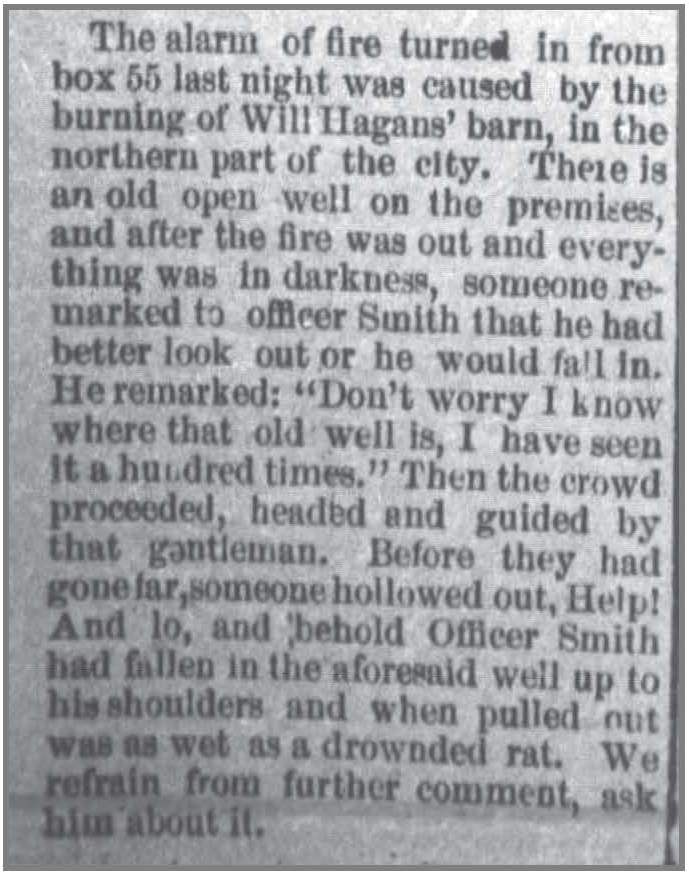
A burned barn, an old well, and Officer Smith.

Goldsboro_Daily_Argus_6_11_1904_hagans_barn

Goldsboro Daily Argus, 11 June 1904.

Beyond the story of Officer Smith’s swift comeuppance, there is “Will Hagans’ barn, in the northern part of the city.” William S. Hagans and his family lived in Goldsboro at this point, and his landholdings were 15 miles north in the area of Fremont and Eureka, near the Wilson County line. For what, then, did he use a barn in town?

Standard
Agriculture, Land, North Carolina, Other Documents, Paternal Kin

Maybe he might redeem it.

The fifth in an occasional series excerpting testimony from the transcript of the trial in J.F. Coley v. Tom Artis, Wayne County Superior Court, November 1908. 

Defendant introduces T.F. Jones, who being duly sworn, testifies:

I had a conversation with Napoleon Hagans about this land, the 30 acre piece. (Plaintiff objects to question and answer.) I got after Uncle ‘Pole to see me the land. I told him if he would give me a deed for both places, the Calv Pig, that is the 24 acre piece, and the Tom Pig place, the 30 acre piece, I would take them. He told me he would sell me the Calv Pig place, but the Tom Pig place he had promised to let Tom stay on that as long as he lived, that maybe he might redeem it. That about ended the conversation with us. I bought some timber off this land from Tom. Off of the 30 acre piece. I suppose Hagans knew about it. (Plaintiff objects.) I couldn’t say that Hagans saw me hauling the timber, I guess he saw me. (Plaintiff objects.) Hagans never made any objection. I had a conversation with Tom about this land along during that time, when Uncle ‘Pole Hagans first got rid of that Calv Pig place, about 15 years ago. I asked him if he wouldn’t sell his part, and what would he ask for it, (Plaintiff objects). He said he didn’t want to sell it, he expected to redeem it sometime. Last Fall I told him if he expected to get that mortgage he had better attend to it. He said he had boys in Norfolk, who would take it up; that he had confidence in Will Hagans. That if his boys let it slip out after he died, they could. (Plaintiff objects.)

CROSS EXAMINED.

Mr. W.J. Exum died about 1885. Tom is known as Pig. I don’t know why he was called Pig. I think they got “Pig” from “Diggs”. Some of his people ‘way back there, were named “Diggs”, and they got to calling it “Pig” for short. I remember when Napoleon Hagans died. I was down the Country. I left here in ’94, and came back in 1900. He died during that time. I got this timber 20 years ago. I was buying all I could, I don’t know how much I got. I got it by the tree. I went in 1881 and milled ’till 1890. Either ’81 or ’82. I bought the timber about that time. I didn’t know that the deed from Mrs. Exum to Hagans was executed before 1892.

——

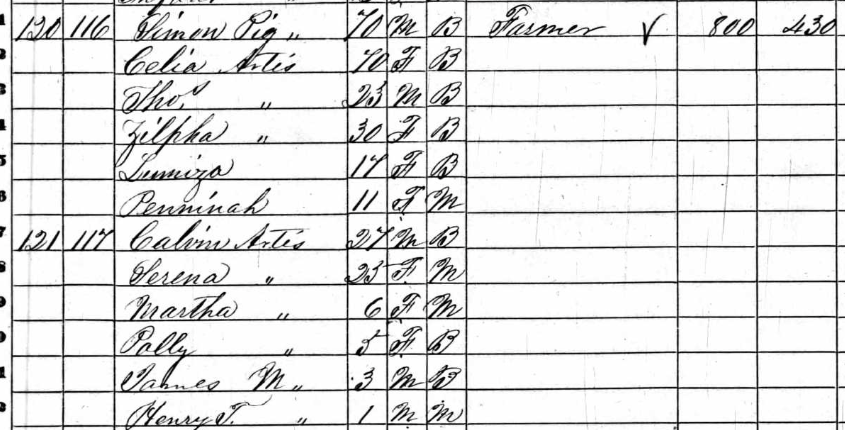
Jones’ explanation of Tom Artis’ nickname is unsatisfying. “Pig” from “Diggs”? In fact, Thomas and Calvin Artis took their name from their father, an enslaved man, who was called “Simon Pig.” Artis was the surname of their mother Celia, a free woman of color. Though I have found no other record that he was manumitted prior to Emancipation, Simon Pig Artis is listed as the head of his household in the 1860 census of Davis township, Wayne County. He reported (or was attributed with) $800 of real property and $430 of personal property. The land was almost surely his wife Celia’s; she is one of the earliest free colored property owners appearing in Wayne County deed books.

Screen Shot 2014-12-18 at 9.32.43 PM

Diggs, on the other hand, while a family surname, was that of Frances Artis Diggs, daughter of Tom and Calv’s oldest sister, Eliza Artis. Frances married Wilson (or William) Diggs in 1868 in Wayne County. (Two of Frances and Wilson’s granddaughters, Etta and Minnie Diggs, married a son, William M., and a grandson, Leslie, of Adam T. Artis. As discussed here, Adam and Celia Artis were not meaningfully related.)

Standard
Agriculture, Business, Free People of Color, Newspaper Articles, North Carolina, Paternal Kin

Tax trouble.

Gboro_Messenger_4_2_1877_tax_woes

Goldsboro Messenger, 2 April 1877.

Simmons & Aldridge??? I’m fairly certain that the Aldridge in this partnership was Robert Aldridge (though it could have been one of his older sons, George, Matthew and John) but which Simmons? Section 69 imposed penalties on “any manufacturer of tobacco or snuff” who failed to pay proper taxes on their products. Robert was said to have operated a brickyard near Dudley, but I’ve seen nothing else to suggest that he also had an interest in a tobacco cottage industry.

Standard
Agriculture, Free People of Color, Land, North Carolina, Other Documents, Paternal Kin

I never heard anything but “rent.”

The third in an occasional series excerpting testimony from the transcript of the trial in J.F. Coley v. Tom Artis, Wayne County Superior Court, November 1908. Paragraph breaks inserted for better readability.

Plaintiff introduces Jonah Reid who being duly sworn, testifies as follows:

I have heard Tom Artis say that he was going soon to pay his rent with cotton to [William S.] Hagans. I don’t know how often I have heard him speak of that, I have heard him say something about it several times when rent was due. I didn’t hear him say what lands. Some times he was cultivating the three pieces, sometimes the 30 acre piece. I am his son-in-law. I never lived with him. Live back of his house. Never heard him call it anything but rent cotton, not interest cotton. (Defendant objects.)

CROSS EXAMINED.

I told Hagans that I heard the old man say he was going to pay his rent, that was along in September, I think this past September. The only reason I told him was he asked me. He came by where I was working on the road. He asked me how long I had been in the family. I told him 16 years. He asked if I had ever heard anything but rent. I told him no. That’s why I told him. That’s all he asked me. Tom worked the three pieces, then afterwards the 30 acre piece. That’s all I remember Hagans said. I didn’t know there had been a suit about the land. Hadn’t had the suit yet. I said I didn’t like to say anything about my father-in-law. Hagans didn’t tell me that he Artis was claiming that he was paying interest. I just answered what he asked me. I told him I had never heard any thing but “Rents”.

——

Jonah Reid was married to Magnolia Artis (1871-1939), daughter of Thomas and Loumiza Artis Artis. Loumiza Artis was a sister of my great-great-great-grandfather Adam T. Artis. One of Adam Artis’ wives, Frances Seaberry, was William Hagans’ paternal aunt.


Standard
Agriculture, Land, North Carolina, Other Documents, Paternal Kin

I would be glad if you would wait a few days.

The second in an occasional series excerpting testimony from the transcript of the trial in J.F. Coley v. Tom Artis, Wayne County Superior Court, November 1908. Paragraph breaks inserted for better readability.

Plaintiff introduces H.S. REID who being duly sworn testifies as follows:

I know the Defendant Tom Artis. I had a conversation with him in reference to payment of cotton to [William S.] Hagans. This last fall I was on the road with Hagans and met Tom Artis carrying a bale of cotton. Heard conversation between Artis and Hagans. When we met in the road Tom said, “You are leaving home, and I have started to your house with a bale of lint cotton.” Hagans told Tom to carry it on as quick as he could, for he needed it about as bad as he ever saw anyone. He said that in a joking way. Hagans started off, and he said, “Hold on Captain!” He told him that he understood that he was going to sell the land down there. Hagans said yes, that it was for sale. Tom said, “I would be glad if you would wait a few days Captain, I think I can raise the money for that place, didn’t say what place just then. Hagans said he had rather sell it altogether. Tom said if he would give him a few days until he could see his boys, he thought he could raise the money for it all. Hagans said alright, it was all for sale. That was about the end of the conversation and we parted. Later then that one day, at Eureka, Artis asked me if I knew when Hagans would be out at his place. I told him about the day Hagans told me he would be out there. Artis said I wish I would deliver a message to Hagans for him, “ask him not to sell that place to Mr. Wright Cook. Said if he did, he would be out of house and home. He said he would rather Hagans sell it to Coley, for he thought he could get along better with Mr. Coley. I delivered the message to Hagans when he came out home. I think this is about the substance. That last conversation was a short while before the sale I think. Am not real sure when it was.

CROSS EXAMINED.

I told this conversation about Tom wanting Hagans to wait before he sold the land. I told several people, I don’t remember all. I am not able to tell. I think Hagans and I talked about Tom Wanting to buy the land. I am not positive. I heard Hagans say that the old man wanted to buy the land from him, as I remember. I think I told the lawyer about the first conversation.

HENRY S. REID recalled by Defendant.

I don’t know that on the occasion I met Tom Artis, that he forbid Hagans selling his land. It wasn’t mentioned that day. I have never admitted to Tom that he forbid Hagans selling that land.

Standard
Agriculture, North Carolina, Other Documents, Paternal Kin

Security for indebtedness.

Goldsboro, N.C. Sept 19, 1905. On the 1st day of Oct 1906 for value received, with interest from date until paid at 6 per cent, per annum, we, or either of us, promise to pay Bennett Live Stock Co. or order twenty seven 50/100 DOLLARS, for bal[illegible] 2 horse Hackney wagon years old which stands security for this note and remains their property till paid for. And as further security for said indebtedness I hereby sell and convey to ________ the following property, to-wit: ________________ with full power to close this lien as provided in Section 1800 of the Code. /s/ Napoleon Artis. Witness Don Scott.

——

Goldsboro, N.C. Octo 26, 1905. On the 10 day of Jany 1906 for value received, with interest from date until paid at 6 per cent, per annum, we, or either of us, promise to pay Edgerton & Edgerton or order One hundred & two DOLLARS, for One bay mare about 8 years old and said mare 9 years old which stands security for this note and remains their property till paid for. And as further security for said indebtedness I hereby sell and convey to ________ the following property, to-wit: It is understood that if $5.00 is paid in this note the balance is to stand until the 1st day of Octo 1906 with full power to close this lien as provided in Section 1800 of the Code. /s/ Robert E. Artis, June Scott Artis. Witness Walter Sasser.

——

Napoleon, Robert and June Scott were sons of Adam T. Artis. Napoleon’s mother was Frances Seaberry; his brothers’ was Amanda Aldridge.

From Lien Record Book 44, Register of Deeds Office, Wayne County Courthouse, Goldsboro NC.

Standard
Births Deaths Marriages, Newspaper Articles, North Carolina, Paternal Kin

Flimflammed?

Wilson_News_10_26_1899_Wm_COley_flimflam

Wilson Daily Times, 26 October 1899.

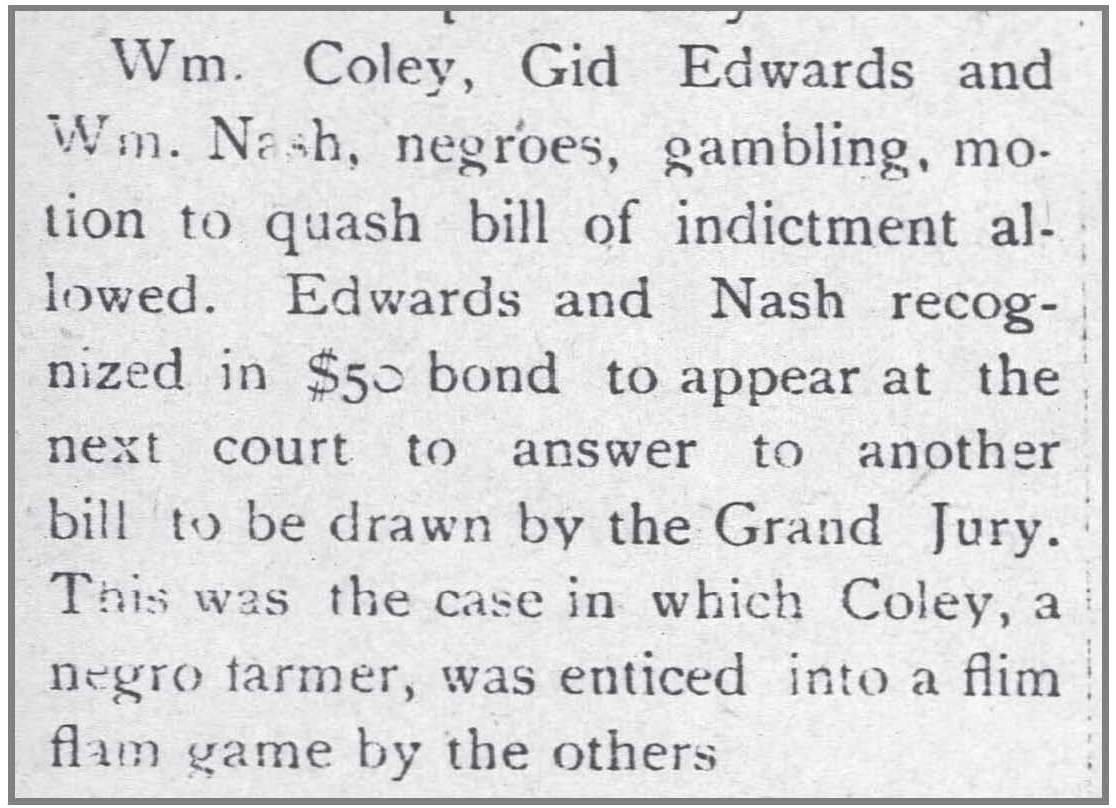
The whole sorry story appeared in the 27 October 1899 edition of the paper. William Coley was Napoleon Hagans‘ oldest (perhaps) son, born about 1867 in Wayne County to Winnie Coley, and I originally thought that he was the one bamboozled. With closer reading, though, I noticed that this William Coley was still living in Wayne County in 1899 and was described as an “old negro.” Napoleon’s son was in his early 30s and living in Wilson at the time, so I’ve revised my opinion.

While I’m at it, though, here’s what I know about “my” William Coley:

I can’t find him in the 1870 census, but in the 1880 census of Nahunta, Wayne County, Winnie Coley is listed with sons Nathan, 19, and Willie, 12.

On 25 Feb 1891, Cain Artis applied for a marriage license in Wilson County for William Coley, son of Napoleon Hagans and Winney Coley, both living, and Minnie Woodard, daughter of Alfred and Sarah Woodard.  The marriage was performed on 26 Feb 1891 by Presbyterian minister George Carson, with Cain Artis and Hilliard Ellis as witnesses.  Cain was William’s half-brother; his mother was also Winnie Coley.  Further, Cain’s father, Adam Artis, married Napoleon Hagans’ half-sister, Frances Seaberry.

In the 1900 census of Wilson, Wilson County, Willie Coley, 30, is listed with wife Minnie, 30, children Effie M., 8, and James M., 6, mother Winnie Coley, 65, and sister Zilley Coley, 38.

William seems to have been missed again in the 1910 census. Sometime between 1900 and 1920, his wife Minnie died, and he married a woman named Mary. It also seems likely that son James died during this period, as there is no World War I draft registration for him. Daughter Effie Mae married Arthur McCarter on 27 February 1910 in Wilson.

In the 1920 census of Wilson, Wilson County, living on Roberson Street: Will Coley, 50, wife Mary, 47, and granddaughters Ruth and Nannie Coley. Will worked as a public house mover. Minnie Ruth and Nannie Mae were actually McCarters, daughters of William’s daughter Effie (also known as Ethel) Coley McCarter. As I have not found Effie or her husband in the 1920 census, they may have died early as well.

Cain Artis died 23 March 1917 in Wilson County of pulmonary tuberculosis.  His death certificate, for which William “W.M.” Coley provided information, noted that Cain was colored, was born March 1851 to Adam T. Artis and Winnie Coley, was married, and was a farmer.

William Coley himself died 26 Jan 1928 at the age 61 of the same dread disease that killed his brother Cain. His wife Mary Coley informed the registrar that he was the son of Pole Hagans and Winnie Coley, was a farmer, and resided at Route 3, Wilson.

Standard
Free People of Color, Land, North Carolina, Paternal Kin

Timeline of Napoleon Hagans’ land transactions.

1860 – 18 January. Eliza Seaberry [Levisa Hagans Seaberry] purchased 3.5 acres in Wayne County from Bryan Minshew for the odd sum of $109.37. How (and why) did she make this purchase instead of her husband Aaron?

1860 – In the federal census of Wayne County, Aaron Seaberry reports owning $100 real estate. This is likely his wife’s purchase above.

1862 – The deed for Minshew-Seaberry sale was recorded in Wayne County.

186713 February. Aaron Seaberry filed a mortgage deed conveying to his stepson Napoleon Hagins a “tract of land lately conveyed by Bryant Minshew to Louisa Seabery, wife of Aaron, all interest therein, also one grey mare, four head of cattle, nine head of hogs, all household and kitchen furniture … and 12 barrels of corn, about one thousand two hundred pounds of fodder & about nine hundred pounds of pork, one wagon & cart, and all the farming implements of every description of the said Aaron Seaberry” for $500.  “The condition of this deed is such that whereas, the said Aaron Seaberry is justly endebted to the said Napoleon Hagins in the sum of one hundred & seventy dollars with interest from the first of February 1866, money paid by the said Hagins to William J. Exum for the said Seaberry and at his request and also the sum of two hundred dollars, loaned by the said Hagins to the said Seaberry, the precise date whereof is not remembered, but which the said Seaberry thinks was about eighteen months prior to the date hereof, and whereas the said Seaberry is justly indebted to the said William J. Exum as agent for J.M. Caho in the sum of thirty six dollars & twenty some cents, with interest from 1st January 1861 due by open account & also in the sum of sixty one dollars and thirty eight cents, due by note, the date of whereof is not now remembered by the said Seaberry, but supposed to have been given about two years ago…”  The deed carried a condition that Hagans sell the conveyed property to pay off Seaberry’s debts, with the balance to be paid to Seaberry.

1870 – Napoleon Hagans appears in the federal population census of Nahunta, Wayne County, with $3000 personal property, but no reported real property. Is this accurate? What personal property could Hagans have owned of such value?

18711 January. Hagans purchased two tracts, totaling 221 acres, in Wayne County for $3500 from William Bryant and wife Sarah. The first was on the east side of Aycock Swamp and bounded by Hooker, Fort, Caho and Rodgers; it contained 48 acres and had been conveyed by Ruffin Hooks to J.P. Rodgers in 1861. The second was on Aycock Swamp, contained 173 acres and had been conveyed by John V. Sherard, administrator of the estate of Jesse Coleman, in August 1859. Both tracts were conveyed by William J. Exum to William Bryant and wife Sarah in 1867.

18714 January. Aaron Seaberry purchased 91 ¼ acres for $700 from Eliza Sauls. The deed notes that Seaberry and Napoleon Hagans would pay the $700 on 1 January 1872.

1874 – 25 July. Adam and Frances Seaberry Artis purchased three tracts of land totaling about 109 acres from her half-brother, Napoleon Hagans. All three are on or near Watery Branch, an east-flowing tributary of Contentnea Creek. The first two documents are a mortgage deed and deed of sale for two tracts on the creek. The third is a deed of sale for an additional nine acres nearby. Notably, this last is land upon which Adam had lived in prior years, as it contained the graves of his first wife, Lucinda Jones Artis, and a child. Hagans purchased 9 ¼ acres for $275 from Adam Artis and wife Frances, who was Hagans’ half-sister.

1874 21 April. A justice of peace examined Celia Bailey, wife of William Bailey, to determine her consent to her husband’s sale of land to Hagans. Hagans’ records do not show a copy of the deed for the sale, and it does not appear in Wayne County deed books. Apparently, it was not filed.

1878 – No date. Hagans purchased 3 acres for $45 from William J. Exum and wife. The deed was not recorded until 3 Nov 1885.

1880 – The federal agricultural census of Wayne County shows N. Hagans with 75 improved acres and 200 unimproved, valued at $2000.

1880 – Hagans testified to a Senate Committee that he owned 485 acres purchased for $5500 and a town lot purchased for $500. All his property was acquired after the war. “I rented a farm and started on two government horses. I went to the tightest man I knew and got him to help me.  I rented from Mr. Exum out there.” [Why the discrepancy in acreage and value with what he reported to census takers? If his testimony was accurate, there were several deeds that went unfiled, including that for the town lot.]

18822 January. Hagans purchased 6 acres for $1 from W.J. Carr and wife Lizzie. The tract was situated at Sauls X Roads, beginning in “center of the road leading to Bul-head [in Greene County] near where the Wm Durden old hors stall stood,” along the road to a ditch, then to Fremont road, then to the cross roads, then back to Bullhead road. Sauls Crossroads was later known as the town of Eureka. “Bullhead road” is S. Church Street leading from Eureka, which becomes Faro Road and then Bullhead Road when it crosses the Greene County line. “Fremont road” is present-day Highway 222. This tract, then, was at the very heart of present-day Eureka (which remains, frankly, little more than a crossroads.)

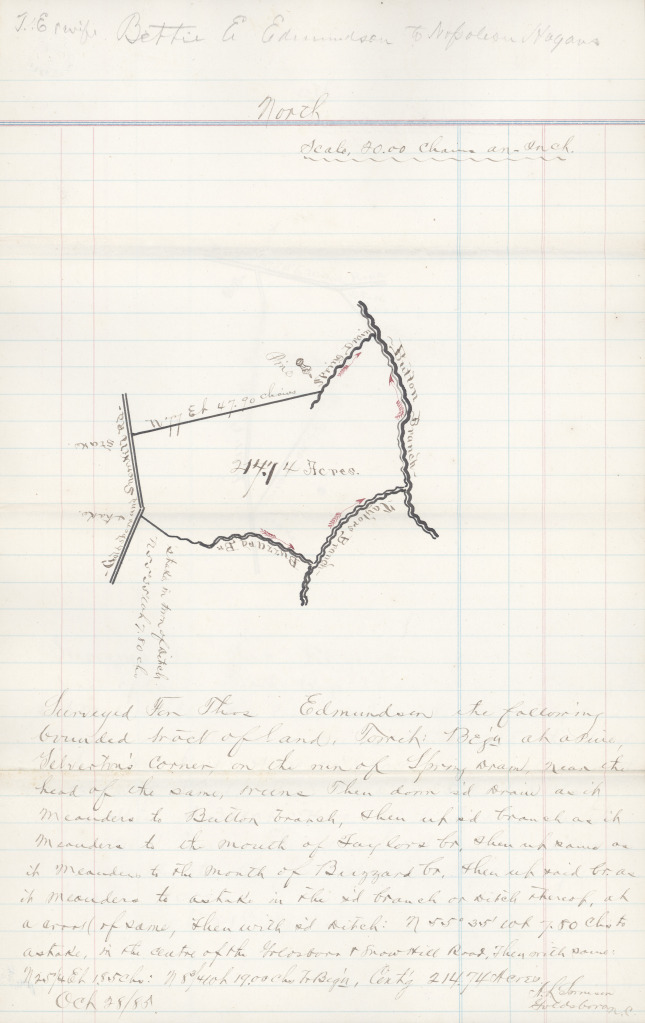
188529 October. Hagans purchased 307.74 acres for $5075 from Thomas Edmundson and wife.

1885 31 October. Hagans purchased 4 acres from Burden West and wife Martha and Freeman West and wife Elizabeth. The tract adjoined “Napoleon Hagins formerly William Bryant W.B. Fort.”

1886 — Hagans bought land in Greene County from G.A. Jones and others.

18882 February. Hagans purchased 71.23 acres for $1500 from Mary Exum. The tract was on the Spring-Bank road bounded by Thomas Edmundson, Hagans, Jack Yelverton, Beaver Dam Branch and Spring Branch.

188822 July. Hagans and wife Absala sold 24 acres to Essex Farmer for $650. The tract adjoined Thomas Artis, “the Jack Wilson land” and Zilphy Artis, bounded by road leading from Sauls X Roads to Stantonsburg, being lot #3 in division of lands of Celia Artis and containing 34 acres. “Absala” signed her name “Appie Hagans,” and Hagans signed with an X. This is the land purchased in 1879 from Celia Artis’ son Calvin. Zilpha Artis was Calvin’s sister. John “Jack” Wilson married another Zilpha Artis, the sister of Hagans’ brother-in-law Adam Artis. Farmer apparently never paid off his mortgage as tract included in 1899 partition of Hagans’ estate.

1889 — Hagans bought land in Greene County from T.F. Jones and others.

18933 March. Hagans purchased 25 acres for $270 from J.W. Aycock and wife.

18944 January. Hagans purchased a lot on Pine Street, measuring 26′ x 220′, in Goldsboro for $700 from A.A. Williams.

189624 August. Napoleon Hagans died, almost a year to the day after his wife. They are buried just west of their house near Fremont.

189921 March. Partition of Napoleon Hagans’ lands, consisting of two tracts in Nahunta township containing 173 and 48 acres, described in deed from William Bryant to Napoleon Hagans; a tract containing 3 acres described in deed from W.J. Exum to Hagans; two tracts containing 75 ¾ and 6 acres, described in deed from Patsey Hall et al. to Napoleon Hagans; three tracts containing 39 ¼, 30 and 8 1/3 acres, described in deed from O.L. Yelverton et al. to Hagans; a tract containing 4 1/8 acres, described in deed from [omitted] to Hagans; a tract containing 25 acres, described in deed from J.W. Aycock to Hagans; a tract containing 9 ¼ acres, described in deed from Adam Artis to Hagans; a tract containing 24 acres, described in deed from Calvin Artis to Hagans; and a tract containing 30 acres, described in deed from Mary A. Exum to Hagans. Total acreage, approximately 475 2/3.

Standard
Free People of Color, Land, Paternal Kin

Lisa Henderson Collection

Thanks to Will Robinson for his good work and to my cousin Bill Hagans for entrusting me with the preservation of these documents!

willrobinson3's avatarWilson County Public Library Local History and Genealogy Blog

lisa_henderson _collection_16 William and Sarah Bryant are selling land to the renowned (and maybe a little infamous) Napoleon Hagans in 1871.

lisa_henderson _collection_14 Plat of Edmundson land being sold to Napoleon Hagans.  Did you know I used to be a land surveyor?

Last week when Lisa Henderson was in town to give her presentation, she also brought by a collection of family deeds for me to digitize.  My focus at graduate school was in the digitization of historic, archival records so anytime someone brings me musty old documents, I am very happy. These deeds are records that may not be in the state archives and if they are they are not easy to access. Very few of North Carolina’s historical records have been digitized so anyone that wants access has to plop down at the archives and sort through them.  Hopefully, in the not too distant future, all of their holdings will be digitized…

View original post 133 more words

Standard
Births Deaths Marriages, North Carolina, Paternal Kin

Lewis Henderson’s Simmons branch.

Of all Lewis and Mag Henderson‘s children, descendants of only Ann Elizabeth and Loudie walk this earth.  Loudie had just two children in her brief life, Jack and Bessie, but their collective offspring number in the hundreds. Ann Elizabeth did not live long either, but her children Daniel and Dollie ensured her legacy. I have talked about Loudie’s children here and introduced a purported photograph of Ann Elizabeth here. Now, more about Ann Elizabeth’s life.

Ann Elizabeth Henderson was born about 1862, probably in northern Sampson County. Her sister Isabella J. died early, leaving Ann Elizabeth the oldest girl in her family. The 1870 census of Brogden, Wayne County, North Carolina, shows Lewis Henderson, farmer, with wife Margarett and children James L. [known by his middle name, Lucian], Ann E., Caswell, and Mary S. [called “Sudie.”] On 21 January 1879, William Freeman applied at the Wayne County courthouse for a marriage license for Hilery Simmons, of Wayne County, age 24, colored, son of George Simmons and Axy Jane Simmons, both living, and Ann E. Henderson, of Wayne County, age 17, colored, daughter of Louis Henderson and Margret Henderson, both living.  Hillary’s brother, R[iley] H. Simmons, a Methodist minister of the AME Zion Church, married the couple on two days later at Ann’s father Lewis’ home in Dudley.  Hillary’s father G.W. Simmons (or maybe his brother General W. Simmons,) Hatch Brooks, and Ann’s brother Lucian Henderson officially witnessed the ceremony.

In the 1880 census of Brogden township, Wayne County, 28 year-old tenant farmer Hillory Simmons, his 17 year-old wife Ann Elizabeth, and 7 month-old daughter Abraskry shared a housheold with Ann’s sister nine year-old Sarah Henderson and 22 year-old brother Lucian Henderson. [“Abraskry”?!? Should that have been “Nebraska”? Was she named for a new state much in the news during the previous decade’s battles with Cheyenne, Pawnee, Sioux and other Natives?] The bulk of Ann Elizabeth Henderson Simmons’ life played in the two decades bracketed by the 1880 and 1900 censuses. We can assume that she was enumerated in 1890 with her husband and young children, but that record does not survive.

More intriguingly, the entire family is missing from the 1900 census, most likely the result of oversight but doubly unfortunate because she died around that time. In between, there are just a few glimpses of Ann Elizabeth in membership rolls of the Congregational Church of Dudley and in the deeds by which she and Hillary repeatedly mortgaged their 28-acre farm. In 1900 — 1901, at the latest — Ann Elizabeth Simmons died. She is surely buried in Congregational Church cemetery, perhaps next to her husband’s grave, or maybe with the Hendersons. Wherever she is, her grave is unmarked. Only children Minnie, Daniel and Annie C. “Dollie” survived her. In June 1902, Celestial Manuel Kemp, herself newly widowed, stepped into Ann Elizabeth’s shoes. Her first child with Hillary was born in 1904, the same year that H.B. Simmons applied for a marriage license for Jesse Budd of Wayne County, age 20, colored, son of John and Lou Budd, and Minnie Simmons of Wayne County, 17, colored, daughter of H.B. Simmons and Annie Simmons (he living, she dead).  Rev. W.H. Mapp, a Pentecostal Holiness minister from Norfolk, Virginia, performed the ceremony on 27 May at H.B. Simmons’ residence in the presence of Edie Hunter,  Cora Budd, and Sarah Jacobs, all of Wayne County.  Sarah Henderson Jacobs, Minnie Simmons’ aunt, was the little girl who lived with Ann Elizabeth and Hillary just after they married, as recorded in the 1880 census.

Minnie and Jesse Budd’s first child, Jesse Manuel Budd Jr., was born 27 February 1905. Shortly after, the family moved to Philadelphia, where William Edward Budd was born in October 1906. Eddie died at home at 1652 North Darien Street at the age of nine months.  Jesse Jr. died in Goldsboro of complications from an appendectomy in August 1916. Her own children lost, Minnie sought to adopt my grandmother Hattie Mae, her first cousin’s child, who was being reared by Sarah Henderson Jacobs. Sarah, however, would not separate Hattie from her sister Mamie.
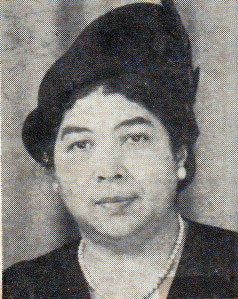
Minnie Budd 001

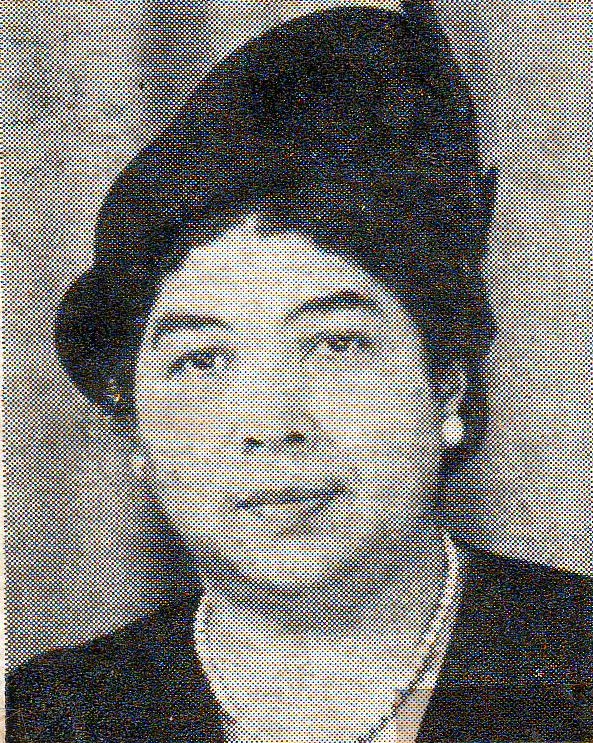
Minnie Simmons Budd, perhaps the 1940s.

In 1910, the censustaker found Hilory Simmons, wife Zalista, and children Daniel, Dollie, John, Susan A., Charles and Kajy living in Brogden township. The family remained in the Dudley area, and Hillary B. Simmons died 25 October 1941. On 24 Dec 1912, Hillery Simmons applied for a marriage license for Yancy Musgrave of Wayne County, age 21, colored, son of Alford and Pollie Musgrave, both living, and Annie C. Simmons, 17, colored, daughter of Hillery and Annie E. Simmons (he living, she dead).  Riley Simmons (now described as a Freewill Baptist minister) performed the ceremony the same day at Annie Simmons’ home in Dudley in the presence of Minnie Simmons of Dudley, Dave Budd of Mount Olive, and Liddie Winn of Dudley. Dollie’s children were Yancy Oliver (1913), Alfred Rudolph (1916), Bruce M. (1917), Marie Estelle (1920), Muriel (1922), Rossie Lee (1923), Ruth (1924), and Ralph Mordecai Musgrave (1926). Four months after Dollie’s marriage, on 10 April 1913, Daniel Simmons married Annie Irene Hogans, daughter of James and Annie Watson Hogans, in Goldsboro.

Daniel Simmons Annie I Hogans Wedding

The couple’s first two children, James Daniel (1914) and Hettie Louise (1915), died in infancy. The family then moved briefly to Rocky Mount, North Carolina, where daughter Harriet Latta Simmons (1916-1970) was born. Daniel and Annie Irene Simmons moved to Richmond, where a second James Daniel (1919-2001), Anna Bell (1921-2000) and twins Mary (1924-2004) and Martha (1924-2012) were born;  then to Philadelphia, where Hillary Bunn II (1926-2010), Stanley Armstead (1928-2000), and Matthew Dallas (1930-2009) were born; and finally Brooklyn, where twins Clement and Clifton (1931) died within a day of their birth. Annie Irene H. Simmons died soon after.
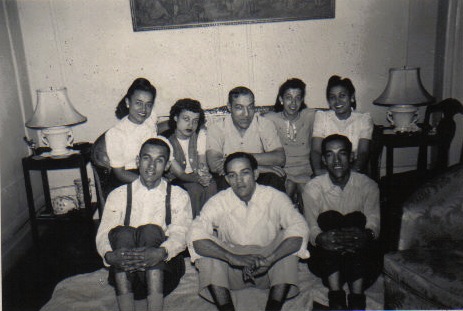
Annabelle Mary Daniel Martha Harriet Stanley Dallas Hillary Simmons

Top: Anna Bell, Mary, Daniel, Martha and Harriet. Bottom: Stanley, Dallas and Hillary.

Dollie Simmons Musgrave died in Norfolk, Virginia, in the early 1930s. Minnie Simmons Budd died in Philadelphia on 8 June 1961, and Daniel Simmons died in Farmingdale, New York, on 8 October 1964. Daniel Simmons in Dudley
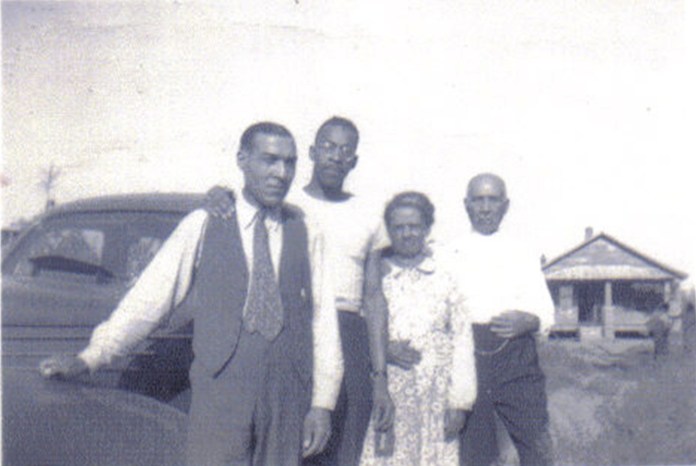
 Daniel Simmons at left, an unidentified man, and possibly his stepmother Celestial and father Hillary B. Simmons, perhaps late 1930s, Dudley, North Carolina.

Photo of Minnie S. Budd in collection of Lisa Y. Henderson; photos of Daniel Simmons and family courtesy of D. G. Campbell.

Standard