Births Deaths Marriages, North Carolina, Other Documents, Paternal Kin

North Carolina Marriage Records.

Ancestry.com recently launched North Carolina County Marriage Records, a date collection that includes images of marriage bonds, licenses, certificates and registers from 87 counties. (Including all of mine!) I’ve already stumbled across two previously unseen records for distant cousins, aunts or uncles, and I anticipate filling in gaps with many more that I managed to overlook over the years.

As a sample of the value of these records, here’s a single page from one Wayne County marriage register:
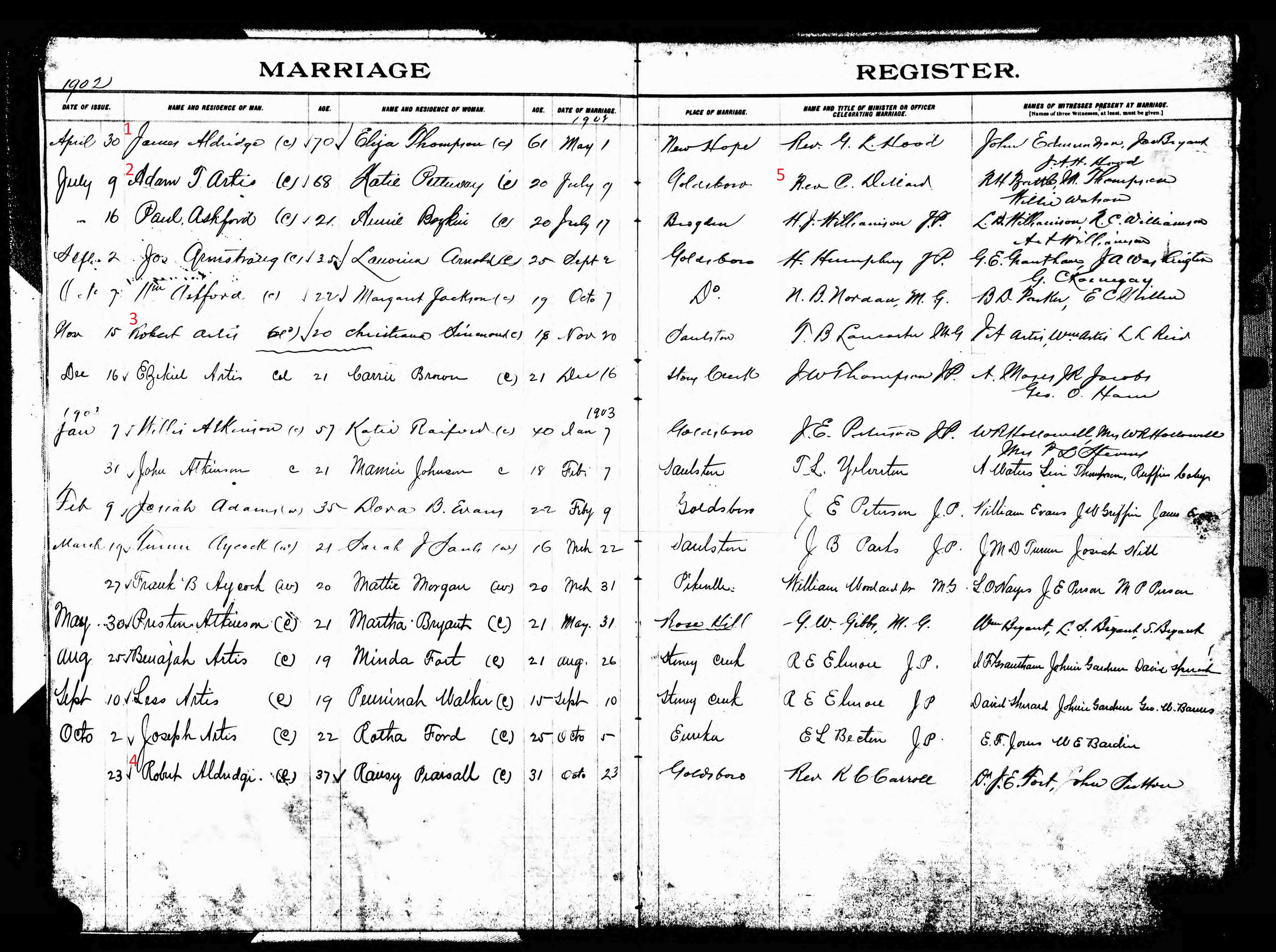
Wayne Marriage

1. James Aldridge, 70, married Eliza Thompson. Just about every “colored” Aldridge in 19th century Wayne County is a member of my extended family, but this one doesn’t seem to be one of mine. I can’t place a James born circa 1832. Perhaps this man came into the county from Lenoir or Duplin, which had slave-holding Aldridge families.

2. Adam T. Artis, 68, to Katie Pettiway, 20. This was my great-great-great-grandfather’s last marriage. He was actually 71, rather than 68, so Katie was more than 50 years his junior. (And her maiden name was actually Pettiford.) I’ve written about their family here. (By the way, more about their officiant, Rev. Clarence Dillard (5) here.

3. Robert Artis, 20, to Christiana Simmons, 18. Robert Artis was a son of Adam and Amanda Aldridge Artis. His witnesses may have been his cousin Jesse Anthony Artis, son of Jesse Artis, and uncle William Artis.

4. Robert Aldridge, 37, to Rancy Pearsall, 31. My great-great-grandfather John W. Aldridge‘s second youngest brother Robert finally married in 1903. He and Rancy (or Rannie) adopted a son, Bennie, born in 1908, and she died before 1916, when Robert remarried.

——

They’re not exactly brick walls, but this one data collection has revealed this and this and this and this… 

Standard
Births Deaths Marriages, North Carolina, Oral History, Paternal Kin

Collateral kin: McCullin.

In October 1998, I received an email from P.M., who was seeking information about her Simmons forebears. During the antebellum era, the Simmonses were a large free family of color in Duplin and Wayne Counties. Though I am not one, I’ve researched them both in my free people of color work and because several Simmonses have intermarried into my lines. I quickly identified P.M.’s great-grandfather, George Robert Simmons, as the son of George W. and Axey (or Flaxy) Jane Manuel Simmons and, accordingly, brother of Ann Elizabeth Henderson Simmons‘ husband Hillary B. Simmons. I was also able to provide information about her Artis line, but came up blank when she mentioned her great-grandmother, Mary McCullin Simmons. Then: “Mary’s sister Susie married a Lucien Henderson,” P.M. wrote. “I think they lived in Dudley. My mother remembers visiting her when she was a little girl. Does his name ring a bell?”

It did indeed. James Lucian Henderson, whom I’ve written about several times, including here and here, was my grandmother’s beloved great-uncle. In the hours I recorded her talking about her people, my grandmother mentioned Aunt Susie several times:

And A’nt Susie was real light, and her hair was all white, and she’d plait it in little plaits, and then tuck ’em up. It didn’t grow that much, ’cause it wasn’t long. And she had a rag on her head all the time. Only time she’d comb it was — when she’d be combing her head, you’d see it. And it was just about like this. [Indicates the length of two finger joints.] Shorter than this. I don’t know whether she cut it off or not. But it didn’t grow, and it was white, and she’d put that rag back around her head. After she’d comb her hair. And it was doing like that all the time. Shaking. Her head was shaking, and I asked Mama, “What’s wrong with her?” How come her head was shaking all the time? And she said, “Well, it’s a sickness.” She said, “I don’t remember what they call it.” So I didn’t say nothing else about that. I used to go down there.  She couldn’t cook. Like over the stove, like cook dinner, after twelve o’clock. Had to cook it before twelve o’clock before it got too hot. Because she couldn’t be over the stove, she’d fall out, if she was over the stove. So Uncle Lucian always got up and cooked breakfast.

So we come up there and stay, and Aunt Susie, she’d be out there in the yard to the pump or something. I never did see her with her hair. She’d always have a pocket handkerchief, look like, tied to the corner and out it up on her head and tuck it up under her hair. And it was white like cotton. And so, I don’t think she ever left the house. See Uncle Lucian always went to church right up there from the house. I don’t know what the name of Uncle Lucian’s church was.   It had a funny name, but I don’t know whether it was Methodist or Baptist, but she didn’t go to church. She never left the house that I know of. I told Mama, “She’s gon shake her head off.” She said, “It was a palsy, that’s how come.” I said to Mama, I said, “That thing’s gon shake her head off.” And I said, ‘Hmm, why she have a rag on her head all the time and her head just shaking like that?’ It be a white rag up there. I wanted to ask her so bad. But I didn’t. Didn’t never ask her.

I recently heard from P.M. again and pulled out our old correspondence. Here’s what I now know about the McCullins:

Rose (or Rosa) McCullin was an enslaved woman born perhaps 1825. She is believed to have been enslaved by Calvin J. McCullin or his brother Benjamin F. “Frank” McCullin in Buck Swamp township, Wayne County, and to have been the mother of at least four daughters – Jane, Mary, Susan and Virginia – by Frank McCullin. Rose McCullin appears in no census records and seems to have died before 1870. The only known references to her are on the marriage and death records of her children, as detailed below.

Jane McCullin

  • was born about 1850.
  • In the 1860 slave schedule of Buck Swamp township,Wayne County, B.F. McCullum is listed with five slaves, all female, aged 35, 12, 8, 7, and 4. The woman is described as black; the girls as mulatto. Are these Rose and her children? [Benjamin McCullin’s mother, Amy Ann “McCullum,” wife of C.J. McCullin, is listed with 12 slaves. C.J. McCullin is not listed.]
  • Jane McCullin married Irvin Manly on 20 January 1870 in Wayne County.
  • In the 1870 census of Brogden, Wayne County: Irvin Manly, 26, Jane, 20, Rachel, 54, and Hosea Manley, 6. The family lived within a cluster of households headed by white farmer Allen Manly, 60, Henry Manly, 32, and William Manly, 28.
  • In the 1880 census of Brogden, Wayne County: Irvin Manley, 40, Jane, 30, Fannie, 8, Joe, 7, Mary, 5, Nancy, 3, and Jesse Manley, 10 months, and sister-in-law Susan McCullen, 22.
  • In the 1900 census of Grantham Wayne County: Irvin Manly, 57, Jane, 58, and children Mary, 24, Jesse, 20, Nathan, 17, and Arthur, 16. Jane reported 5 of 7 children living.
  • In the 1910 census of Grantham, Wayne County: Irvin Manley, 65, and wife Jane, 64, with daughter Mary Flowers, 30, and her son Marshal C. Flowers.
  • In the 1920 census of Grantham, Wayne County, 75 year-old Jane Manley appears to have lived alone, but next to her son Arthur Manley and family. On the other side of Arthur was Irvin Manley, 75.
  • In the 1930 census of Grantham, Wayne County: Irvan Manley, 85, and Jane Manley, 88, were listed as in-laws in the household of Marshall and Mary Flowers on Grantham and Faison Road.
  • Jane Manley died 19 July 1931 in Brogden township, Wayne County. Her death certificate reports that she was colored and married to Irvin Manley and that she was born 14 July 1839 to an unknown father and Rose McCullen. She was buried the next day at an unnamed location in Wayne County.

Mary Ann McCullin

  • was born about 1853.
  • In a 1863 tax assessment of property and slaves in Wayne County, C.J. McCullen reported owning Hardy, 62; Dinah, 54; Fereby, 40; Toney, 26; Phillis, 20; Jimmy, 17; Henrietta, 15; Grace, 14; Ballard, 17; Liza, 38; Creasy, 2; Susy, 4; T[illegible], 12; Ollin, 14; Henry, 9; Isabell, 8; Mary, 6; Clarisy, 3; Rose, 3; Isaac, 50; and Fountin, 10. [The sex and age of several men and women correlate roughly with those listed with Amy Ann McCullin in the 1860 slave schedule. Does this  list show Mary McCullin? Susan McCullin? If so, where are Rose,  Jane and Virginia? Also, there is no entry for B.F. McCullen, though he reported five slaves in the 1860 census.]
  • In the 1870 census of Grantham, Wayne County: B.F. McCullin, 51, Penny, 28, Theophilus A., 9, Martha A., 6, Susan C, 5, Ordelia J., 3, Sarah B., 5/12, Mary, 17, and Susan, 15. Mary and Susan were described as black; the rest as white.
  • On 28 December 1871, Geo. R. Simmons and Mary A. McCullin were married by John Scott, M.G. Her mother was listed as Rosa McCullin; her father, unknown.
  • In the 1880 census of Brogden, Wayne county: Robt. Simmons, 33, Mary, 24, and children Nettie, 8, Stephen A., 6, and E. Robt. [Robert Elder], 2. [Mary’s last child, Bertha, was born in 1883.]
  • Mary McCullin Simmons seems to have died before 1900.

Susan McCullin

  • was born about 1855.
  • Per above, “Susy, age 4” is listed among C.J. McCullin’s slaves in an 1863 tax assessment.
  • In 1870, she and her sister Mary were listed in B.F. McCullin’s household in Grantham, Wayne County.
  • In the 1880 census of Brogden, Wayne County, she was listed in the household of Irvin and Jane Manley, her sister and brother-in-law.
  • On 4 April 1883, in Wayne County, Susan McCullin, 20, married Lucias [sic] Henderson, 24, son of Lewis and Margaret Henderson. She is listed as the daughter of F. McCullin and R. McCullin.
  • Susie and Lucian’s daughter Cora Q. Henderson was born 2 February 1887.
  • In the 1900 census of Dudley, Brogden, Wayne County: Lucious Henderson, wife Susan, and daughter Cora.
  • Susan’s daughter Cora died 20 March 1907. She is buried in the cemetery of First Congregational Church, Dudley, Wayne County.
  • In the 1910 census of Brogden, Wayne County, farmer Lucious Henderson, 52, and wife Susie, 50. Susie reported having had one child, but none living.
  • In the 1920 census of Brogden, Wayne County, farmer Luchon Henderson, 62, wife Susan, 61, with Mary Budd, 56, her son James, 28, and grandson Vernell, 11 mos.
  • In the 1930 census of Brogden, Wayne County, Luchion Henderson, 70, farmer, and wife Susie, 70.
  • Susan’s husband Lucian Henderson died 22 June 1934. His death certificate lists her as Susie Manly Henderson. The informant, Johnnie Carter, was the beneficiary of Lucian’s estate: “to John Wesley Carter, … my home place, 8 acres, provided that John W. Carter care for me and my wife Susan Henderson …”
  • An entry in my grandmother Hattie Henderson Ricks’ Bible states that Susie Henderson died 15 March, 1940. She lived briefly with my grandmother in Wilson before her death, but I assume that she died in Wayne County, but have not found her death certificate.

42091_343598-01165

Marriage license of Lucian Henderson and Susan McCullin, Wayne County Register of Deeds.

Virginia McCullin

  • Virginia was born about 1857.
  • On 3 January 1877, Virginia McCullen, 20, married Isaac Raynor, 21, in Wayne County.
  • In the 1900 census of Mount Olive, Wayne County: Isaac Rayner, 48, Virgina, 36, and children Mary, 20, Zekiel, 19, Florence, 16, and Grainger Rayner, 14; boarder Fountain Futrell, 20; and Sweena Rayner, 70, Isaac’s mother. The couple reported being married 21 years, and Virginia reported 4 of 4 children living.
  • In the 1910 census of Fork, Wayne County: washwoman Virginia Raynor, 43, widow, with daughters Mary, 28, and Florence, 24, and grandchildren Lillie M., 5, and William D., 4.
  • Virginia Bradley died 3 December 1914 in Fork township, Wayne County. Her death certificate lists her parents as Frank McCullen and Rosa (last name unknown.) [When did Virginia marry a Bradley?]
  • Ezekiel Raynor died 8 February 1940 in Mount Olive, Wayne County. He was born 1884 to Isaac Raynor of Duplin County and Virginia McCullin of Wayne County.
  • Daughter Florence Moore died 21 June 1945 in Goldsboro, Wayne County, aged 56. She was a widow and was born 30 March 1889 to Isaac Raynor and Virginia McCullens.
  • Daughter Mary Lane died 23 April 1960 in Goldsboro, Wayne County, aged 76. She was a widow and was born 9 September 1883 to Isaac Raynor and Virginia (last name unknown.)
  • Son Granger Raynor died 18 November 1964 in Goldsboro, Wayne County. He was born in August 1886 to Isaac Raynor and Virginia Manley.

Interview of Hattie Henderson Ricks by Lisa Y. Henderson, all rights reserved.

Standard
Births Deaths Marriages, Maternal Kin, Newspaper Articles, North Carolina, Other Documents

Investigation of death.

A coroner’s inquest is an official inquiry into the manner and cause of an individual’s death. Conducted by a county coroner when a cause of death is unknown, violent or otherwise suspicious, this legal inquiry is performed in public and often before a jury. The coroner does not establish why a death occurred, but rather determines who the deceased was and how, when and where death occurred. Here’s a link to a post about coroner’s reports in the North Carolina State Archives, where I obtained the documents below.

I searched Iredell County’s reports looking, in particular, for the inquest into the death of my great-grandmother’s sister, Elizabeth McNeely Kilpatrick Long, who burned to death in a suspicious fire. I was disappointed not to find one. However, I did find these for two men who died unexpected, but ultimately natural, deaths:

Coroners Reports_Page_1

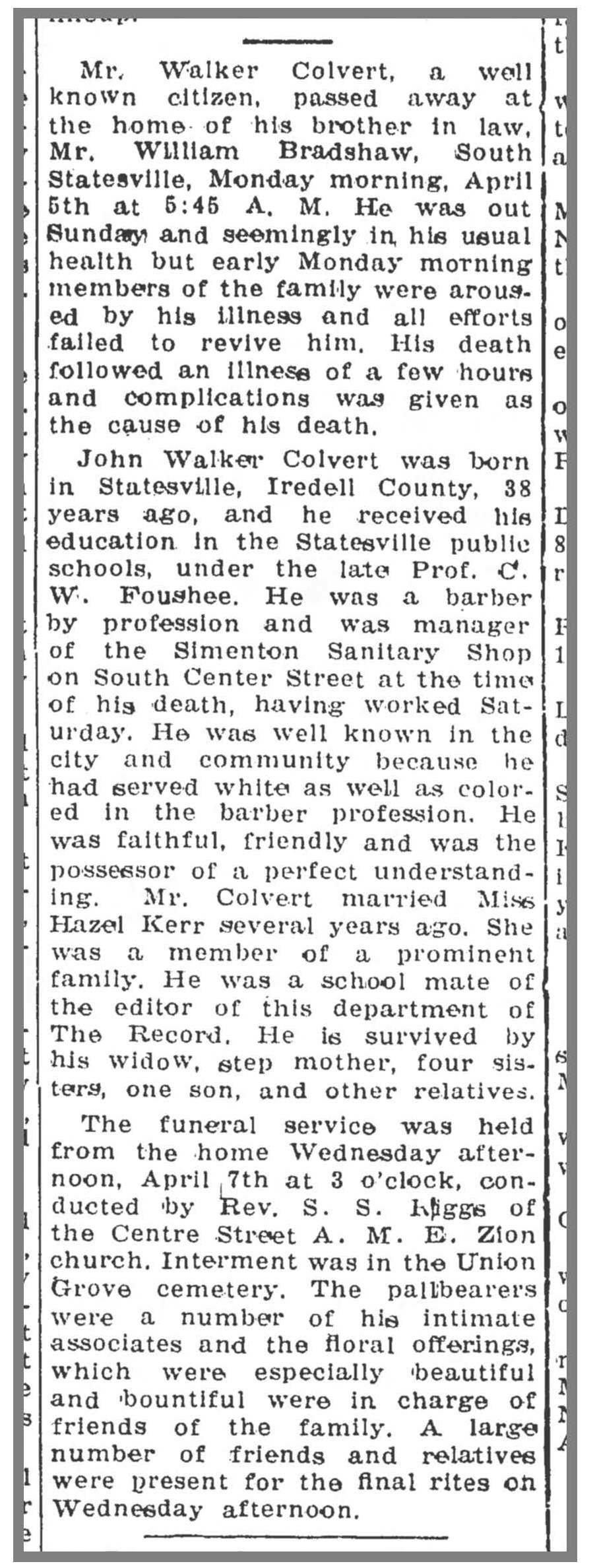
My grandmother’s half-brother, John Walker Colvert II. (One would expect an inquest to get the spelling of a surname right. Or at least consistently wrong.) Here’s his obituary in the 16 April 1937 edition of the Statesville Record & Landmark.

Sville_Rec__amp__Landmark_4_16_1937 WColvert Obit

(“Schoolmate”??? Simonton Sanitary Shop? This obituary sets forth some interesting facts that I intend to explore elsewhere.)

And then there was the notorious William “Bill Bailey” Murdock, husband of my grandmother’s aunt Bertha Hart Murdock. He died just over a year after her conviction for shooting a white man in the leg in their restaurant.

Coroners Reports_Page_2

Standard
Births Deaths Marriages, Maternal Kin, North Carolina, Oral History

Collateral kin: the Daltons.

Me: And you said he looked just like your dad. Your dad looked just like his father.

My grandmother: Papa looked just like him. And one thing, with all that white in him, he was brown like Grandpa.

Me: Unh-uh.

Grandma: And I don’t know who Mat and Golar and Walker’s mother was, but Walker was real dark. But handsome. Honey, he was one beautiful child and had this pretty hair. Curly. And it wouldn’t even keep a part or nothing in it. And he came home one time, and he had cut this part, cut this place through his hair. And he said his friends had parts in their hair, but his was so curly it wouldn’t stay. So he had to cut this part. Another time, that was just after Mama had married Papa. And she was just so crazy ‘bout him, he was such a pretty little boy. And she made him this velvet suit.

My aunt L.: Who, Walker?

Grandma: Walker. Fauntleroy. You know what a Fauntleroy suit is?

Me: Mm-hmm.

Grandma: She made him this Fauntleroy suit for commencement. And she said it had this little collar, you know [inaudible] collar. And said when Walker came out on the stage to do his part, he had stuffed all that collar on the inside of his coat and pulled them sleeves down. [Laughing.] Mama said, “See. Will you look at this young’un.” [Laughing.]

Me: ‘Cause they were fairly young, right, when —

Grandma: Yeah, they were six —  something like six, eight and ten. And they may have been younger than that.

Me: And their mother died?

Grandma: Yeah. I don’t know how she died. But her sisters were really nice to Mama. Oh, they were really nice to her. Mama loved them like her own sisters. They were so nice to her. And, see, they were sort of taking care of the children while Papa was in between two marriages you know.

COLVERT -- Walker Colvert Border

J. Walker Colvert II, perhaps in his early twenties.

——

So, who was Lon Colvert’s first wife? I know her name — Josephine Dalton — but little else.

In the 1880 census of Eagle Mills, Iredell County, one year-old Josapene Dalton is listed in the household of her parents, Anderson and Vincey Dalton, along with brother Andrew, 17; sister Mary B., 3; her great-grandmother, Mary Houston, 85; and a boarder named Joe Blackburn, 28. The family lived among a little cluster of Dalton households, the first headed by 67 year-old John H. Dalton, a white farmer. Dalton, born in Rockingham County, North Carolina, arrived in Iredell County in 1840’s. He married the daughter of Placebo Houston, a prominent planter, and is credited with introducing tobacco cultivation in Iredell County. According to a 8 April 1974 article in the Statesville Record and Landmark, by 1850 Dalton had established a tobacco plug factory that employed 17, but had to haul bright leaf tobacco from counties along the Virginia line. This scarcity drove his efforts to jumpstart local tobacco production. In 1858, John Hunter Dalton built Daltonia, described as “an imposing Greek Revival house whose richness and diversity of detail make it one of the most architecturally outstanding houses” in the county.  The 1860 census counted among Dalton’s possessions 57 slaves living in eight houses. Josephine Dalton’s father, and maybe her mother, were likely among them.

Josephine was born well after the Civil War — after Reconstruction even — but her family seems to have remained tethered to Daltonia for decades after Emancipation. [After I started this blog post, I traveled to Iredell County, met P.P., and visited Daltonia. That story, and more about Josephine’s family, is here.] Sometime around 1894 — I have not located a license — Josephine married Lon W. Colvert, an ambitious 19 year-old Eagle Mills native set to make his mark in the town of Statesville. [Update, 4/6/2015: license found.] The young family appears in the 1900 census of Statesville, Iredell County — Lon Colvert, 25, wife “Joseph,” 23, and children Gola, 5, Mattie, 4, and Walker, 2. No more than five years later, Josephine was dead.

Standard
Births Deaths Marriages, Migration, Newspaper Articles, North Carolina, Paternal Kin, Photographs, Virginia

Adam’s diaspora: Haywood Artis.

I’ve written here and here about the migration of Adam T. Artis‘ children Gus K. and Eliza to Arkansas. Though most of his 30 or so children remained in North Carolina, a few went in North. Or, at least, a little further north. One was Haywood Artis, born about 1870 to Adam and his wife Frances Seaberry Artis. He was my great-great-grandmother Vicey‘s full brother.

20150204_170518~2

                          Haywood Artis

In the 1880 census of Nahunta, township, Wayne County, North Carolina, Adam Artis, widowed mulatto farmer, is listed with children Eliza, Dock, George Anner, Adam, Hayward, Emma, Walter, William, and Jesse, and four month-old grandson Frank Artis.  (I’ve never been able to determine whose child Frank is.]

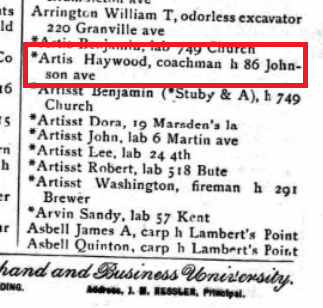
Haywood’s whereabouts over the next 15 years are unrecorded, though he was likely still living in his father’s home most of that time. However, at some point he joined the tide of migrants flowing into Tidewater Virginia, and, on 13 January 1897, in Norfolk, Virginia, Hayward Artis, age 26, born in North Carolina to A. and F. Artis, married Hattie E. Hawthorn, 23, born in Virginia to J. and E. Hawthorn. As early as 1897, Haywood began appearing in city directories for Norfolk, Virginia. Here, for example, is Hill’s City Directory for 1898:

Hartis

Haywood and Hattie and their children Bertha E., 3, and Jessie, 11 months, appeared in the 1900 census of Tanners Creek township, Norfolk County, Virginia. The family resided on Johnston Street, and Haywood worked as a porter at a jewelry store. Ten years later, they were in the same area. Haywood was working as a farm laborer, and Hattie reported four or her seven children living — Bertha, 12, Jessie, 11, Hattie, 8, and M. Willie, 2.

In the 1920 census of Monroe Ward, Norfolk, Haywood and Harriet Artis appear with children Elnora, 22, Jessie, 20, Hattie, 18, Willie Mae, 12, Haywood Jr., 8, and Charlie, 5.  Haywood was a farm operator on a truck farm, daughters Elnora and Hattie were stemmers at a tobacco factory, and son Jesse was a laborer for house builders.

By 1930, the Artises were renting a house at Calvert Street.  Heywood Artis headed an extended household that included wife Harriett, Haywood jr. (laborer at odd jobs), Charles, son-in-law Daniel Johnson (machinist for U.S. government) and his wife Hattie (bag maker at factory), cousins Henry Sample, Raymond G. Mickle, and Lois Sample, and granddaughters Mabel Johnson, 2, Olivia Washington, 15, and Lucille, 13, Bertha, 9, and Lois Brown, 6.

On 19 March 1955, Haywood Artis’ obituary appeared in the Norfolk Journal and Guide:

Haywood Artis, who has made his home in Norfolk for some 65 years, was buried following impressive funeral rites held at Hale’s funeral home March 7 with the Rev. W. H. Evans officiating.

Mr. Artis died March 4 at the home of his daughter, Mrs. Willie Mae Yancey, 2734 Beechmont avenue, after a long illness.

Mr. Artis, who was born in Goldsboro, NC, is survived by three daughters, Mesdames Elnora Brown, Hattie Johnson and Willie Mae Yancey, all of Norfolk, and a son, Hayward Jr., of New Jersey.

There are also 34 grandchildren, 33 great-grandchildren and other relatives and friends.

Interment was in Calvary Cemetery.

Thanks to B.G. for the copy of his great-great-grandfather Haywood Artis’ photograph.

Standard
Births Deaths Marriages, North Carolina, Paternal Kin, Photographs

52 Ancestors in 52 Weeks: 7. Love.

My parents celebrate 54 years of marriage in May, God willing. They have always been my model of deep and enduring love, and I have celebrated them here. For this week’s Ancestor Challenge, I’ve chosen to highlight a different kind of love.

My grandmother, Hattie Mae Henderson Ricks, and her sister, Mamie Lee Henderson Holt, were born into difficult circumstances. Their mother Bessie Lee Henderson, teenaged and unmarried, had been orphaned as a toddler. When Bessie died months after Hattie’s birth, the family gathered to decide who would rear the girls. Mamie remained in Dudley with their aged great-grandparents, Lewis and Margaret Henderson, and Hattie went to Wilson to live with their grandmother’s sister, Sarah Henderson Jacobs. They were not reunited until Grandma Mag’s death, when Mamie was 8 and Hattie, 5. They separated again just 7 years later, when Mamie married a young man she met while visiting relatives in Greensboro. Nonetheless, despite the short time they lived together in childhood, my grandmother and her sister were devoted to one another. Their fierce sisterly bond defied the uncertainty of their earliest years and the emotional neglect of their years with Mama Sarah. It knit their children and grandchildren in a web that continues to hold. Even my grandmother’s move to Philadelphia in 1958 did not shake it. Every Christmas, she visited us and my aunt’s family in Wilson, then my father drove her to Greensboro to bring in the New Year with the Holts. Eventually, Alzheimer’s began to claim Aunt Mamie’s mind and memories, and travel became too difficult for my grandmother, but her attachment did not waver. Only when Aunt Mamie passed did my grandmother begin to let go. Nine months later, almost to the day, she was gone.

After my grandmother passed in 2001, I found a note she wrote about her early life: Heart Broken Mother – Bessie Died age Nineteen Leaving two out of wedlock Girls arounds 3 years and 8 months old. … My sister and I always felt very close to each other as we had no real parents It had been a hard life for both of us

This is the love I celebrate in this week’s challenge. The first love that comes with family. The love that, if we are fortunate, endures the entire arc of life.

Mamie&hattie 001

Mamie and Hattie Mae Henderson, circa 1920.

Mamie&Margaret 002

The sisters, probably in Greensboro, 1940s.

Willow Road

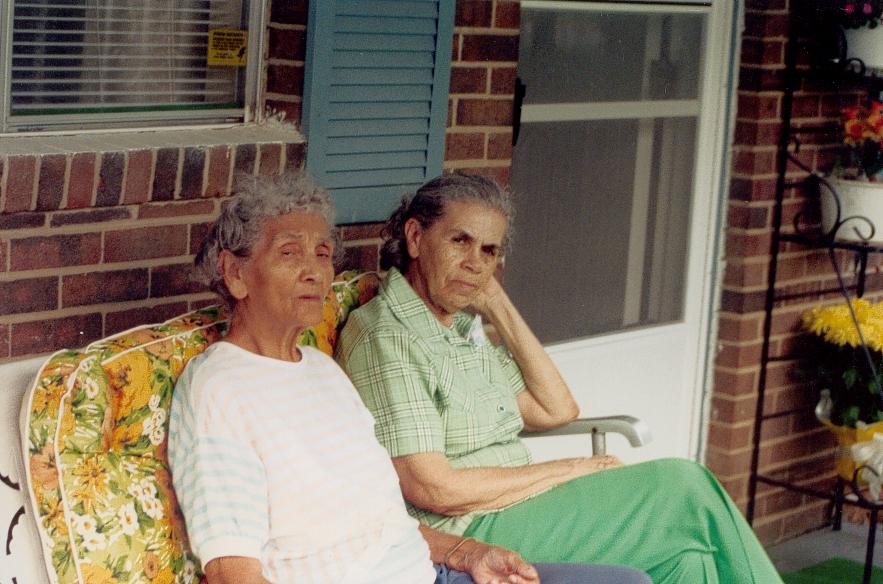
The sisters on Aunt Mamie’s porch in Greensboro, probably late 1980s.

Standard
Births Deaths Marriages, Maternal Kin, Newspaper Articles, North Carolina, Photographs

Roadtrip Chronicles, no. 1: Statesville cemeteries.

I made it to Statesville in good time Sunday and drove straight to the only place I really know there — South Green Street. My great-aunt, Louise Colvert Renwick, had lived there for decades, across from the street from the Green Street cemetery. As I approached her house, my eye caught a small memorial just off the curb.

IMG_5958

Funny what you see when you’re looking. (And look closely at the plaque. Committee member Natalie Renwick is my first cousin, once removed.)

It seems odd to me that, when we were all gathered at Aunt Louise’s for the first Colvert-McNeely reunion, no one mentioned that Colverts and McNeelys were buried across the street. (Or maybe my 14 year-old self just paid no attention?) I’ve only found three graves — those of John Colvert, his wife Addie Hampton Colvert, and their daughter Selma — but there are certainly many more. Lon W. Colvert, for one. (Or was it? His death certificate indicates “Union Grove,” but why would he have been buried up there?*) And his son John W. Colvert II. And Addie McNeely Smith and Elethea McNeely Weaver and Irving McNeely Weaver, who was brought home from New Jersey for burial.

The cemetery looks like this though:

IMG_5971

And not because it’s empty. Though closed to burials for 50 or more years, it is probably nearly full of graves either unmarked or with lost or destroyed markers. Here’s one that’s nicely marked, however, and that would I recall before 24 hours had passed:

IMG_5972

From Green Street, I headed across town to Belmont, Statesville’s newer black cemetery. I knew Aunt Louise, her husband and son Lewis C. Renwick Sr. and Jr. were buried in Belmont, and I was looking for several McNeelys whose death certificates noted their burials here. I found Ida Mae Colvert Stockton‘s daughter Lillie Stockton Ramseur (1911-1980) and her husband Samuel S. Ramseur (1912-1989). Then Golar Colvert Bradshaw‘s husband William Bradshaw (1894-1955) and son William Colvert Bradshaw (1921-1988). (William was buried with his second wife. Golar, who died in 1937, presumably was interred at Green Street.) No McNeelys though. I expected to find both Lizzie McNeely Long and Edward McNeely, who had a double funeral in 1950, but their graves seem to be unmarked.

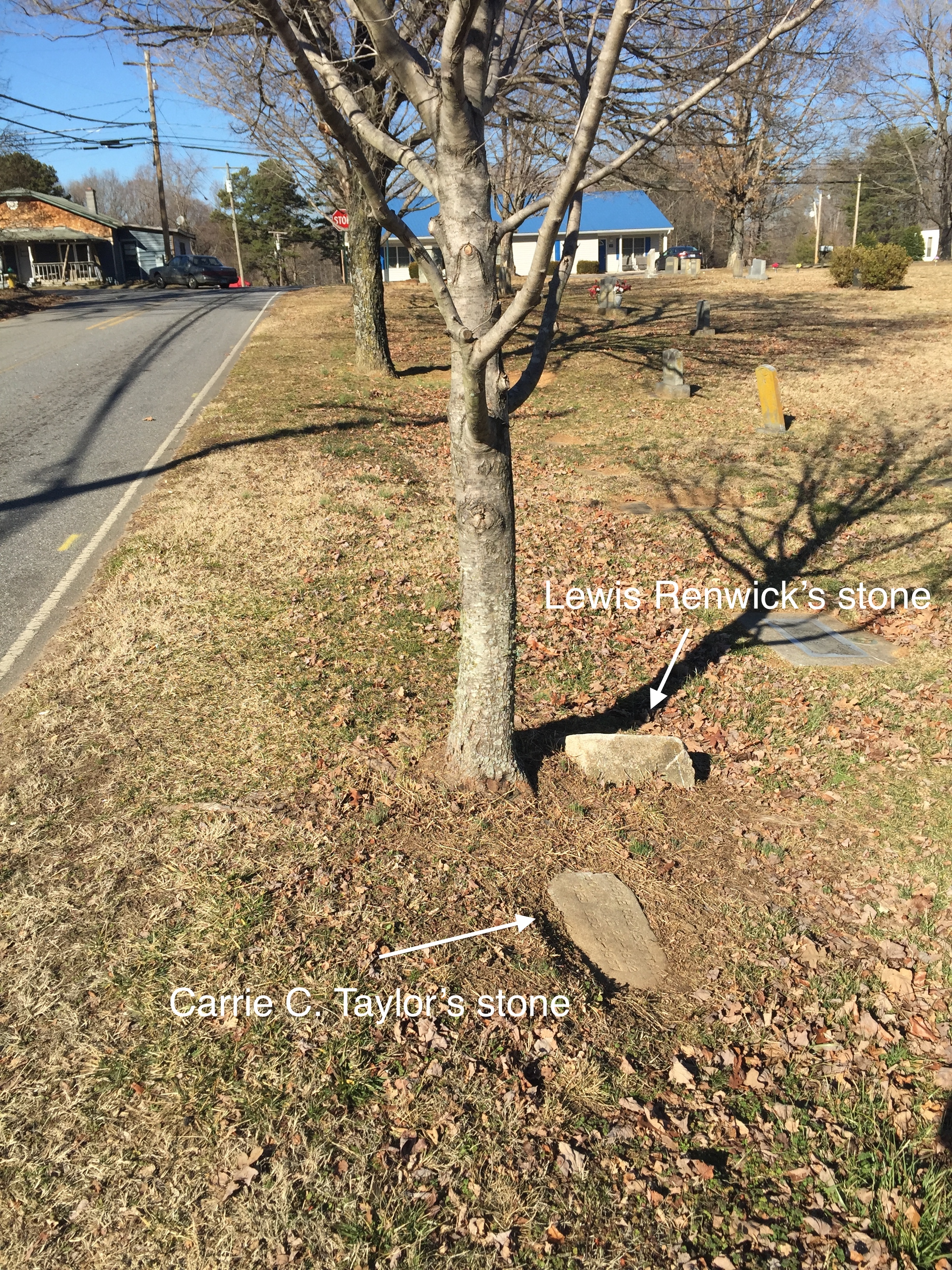
I was also looking for my great-grandmother, Carrie McNeely Colvert Taylor. The whole business was turning into a big disappointment. At street’s edge, I turned to head back to my car. And gasped. There, at my feet, wedged at the base of a tree:

IMG_5988

What in the world? This is clearly not a gravesite. And, on the other side of the tree, there’s an identical stamped concrete marker for Lewis C. Renwick Sr., who died almost exactly a year after Carrie. What’s odd, though, is that he has a granite marker a couple hundred feet away in another section of the cemetery with his wife (Carrie’s daughter Louise) and oldest son. Is Grandma Carrie actually buried in the Renwicks’ family plot? Were her and Lewis Renwick’s makeshift stones pulled up to be replaced by better markers? If so, where is Grandma Carrie’s? And why were both dumped at the edge of the cemetery?

IMG_5992

Here’s an overview of Belmont cemetery. (1) is the approximate location of Carrie M.C. Taylor’s broken marker. (2) is the approximate location of the Renwick plot.

IMG_6168

I’ll pose those questions to Statesville’s cemetery department. If Grandma Carrie has no permanent stone, she’ll get one.

* After noticing that Irving Weaver’s obit also mentioned Union Grove cemetery, though the McNeelys had no ties to that township in northern Iredell County, I searched for clues in contemporary newspapers. Mystery cleared. Green Street cemetery is Union Grove cemetery:

Stville_Evening_Mascot_4_3_1909

The Evening Mascot (Statesville), 3 April 1909.

Standard
Births Deaths Marriages, Land, Newspaper Articles, North Carolina

Dr. Ward’s empire.

Wilson_Advance__8_22_1889_DGW_Ward_estate_land_sale

Wilson Advance, 22 August 1889.

The Civil War set Dr. David G.W. Ward back, but not for long. When he died in 1887, he stood possessed of more than 1900 acres in Wilson and Greene Counties.

[As an aside, Ward’s administrator, Frederick A. Woodard, was elected Democratic Congressman to the U.S. House of Representatives in 1892. He lost his bid for re-election to George H. White, a visionary African-American who was the last black Southerner elected to Congress until the post-Civil Rights era. I attended a middle school named for Woodard.]

[As another aside — literally — I think it’s safe to say that Sarah Ward’s children received nothing from the doctor’s estate.]

Standard
Births Deaths Marriages, Enslaved People, Maternal Kin, Newspaper Articles, North Carolina, Other Documents

Lewis Colvert, son or stepson?

Something’s been bothering me about Lewis “Lou” Colvert. My grandmother knew his son Aggie (pronounced “Adgie”) Colvert as her cousin, but just whose son was Lewis?

The first irregularity: as shown here, when Walker Colvert and Rebecca Parks registered their 13-year cohabitation in 1866, they did not list six year-old Lewis among their three children. Why not?

In the 1870 census of Union Grove, Iredell County, he’s there: Walker Colvert, wife Rebecca and Lewis Colvert, 10.  I haven’t found him in the 1880 census, but a year later, on 13 October 1881, he married Laura Sharpe in Statesville. References to him over the next 30+ years though are few.

On 11 October 1895, the Statesville Landmark printed a short piece about Lou suffering a head injury after being thrown from a wagon.

The census taker again missed Lewis for the 1900 census, but found his wife Laura Colbert, born 1851, and son Aggie, born 1888, living on Valley Street in Asheville, Buncombe County. Laura worked as a cook and described herself as a widow. And though he eluded the enumerator, Lewis was still in Statesville, as this snippet from a court calendar report demonstrates:

Carolina_Mascot_Sville_2_8_1900

Carolina Mascot (Statesville), 8 February 1900.

(Lon was his nephew, my great-grandfather.)

Walker Colvert died in 1905. His will, made in 1901, directed that all his land and personal property go first to his wife Rebecca and, after her death, to his son John Walker Colvert. No mention of Lewis.

In 1910, Lewis again sidestepped the census taker. Laura remained in Asheville. Though she lived until 1926, and I’ve found no evidence of a divorce, in April 1913, Lewis married Quiller Ward in Statesville. The marriage was short-lived. Lewis “Lou” Colvert died 27 March 1915 in Statesville. Lon W. Colvert provided the information for his death certificate — mother, Rebecca Colvert; father, unknown.

Lew Colvert Death Cert

Unknown. Not Walker Colvert. Neither here nor anywhere else is there a claim that Walker was Lewis’ father.

Here is my speculation: Walker Colvert was born at 1815. He married Rebecca Parks about 1853. At that time, he had a two year-old son, John Walker, whose mother was named Elvira Gray. (At nearly 40, however, Walker surely had children older than John. If so, their identities may never be known.) Rebecca was 24 years Walker’s junior and almost certainly belonged to a different master. She was about 16 when she gave birth to her first child with Walker, a daughter named Elvira, and daughter Lovina followed. Then, in 1861, she bore Lewis. As with every enslaved woman, Rebecca’s body was not her own. Perhaps she willingly conceived a child outside her relationship with Walker. Just as likely, that relationship was not uniformly recognized, and she submitted to someone else’s will. Walker reared the boy with his own children and gave him his surname, but did not claim him as a son.


Standard