Births Deaths Marriages, Maternal Kin, Newspaper Articles, North Carolina, Other Documents

Aunt Ida May revisited.

Ancestry.com’s North Carolina Marriages data collection is not through demystifying my kin. A previously unknown marriage license clarified a question I had my great-great-aunt Ida’s life. If Eugene Stockton were her husband, I wondered here, why was she a Stockton in the 1910 and 1920 censuses, but referred to as his sister-in-law? In gaining an answer, I also uncovered a terrible tragedy.

Ida May Colvert‘s first marriage license was so hard to find because she married under her mother’s maiden name, as Ida May Hampton. The license lists her parents as John and Adline Colvert, but they did not marry until 1905, just over a month after Ida married Dillard Stockton on 27 December 1904. (Ida’s age is listed as 21 on the license, which is almost surely too high. Her birth year as recorded in various documents varies widely, but averages about 1885.) Dillard’s parents were listed as Henry and Frances Stockton, which seems to indicate that Dillard and Ida’s second husband Eugene shared a father and were half-brothers. (Eugene’s mother was Alice Allison [or maybe McKee] Stockton.)

42091_334850-01124

Ida was a Stockton Stockton then. But what happened to her first husband, Dillard? A quick Newspapers.com search turned up the awful story:

Statesville_Record__amp__Landmark_3_12_1907_Dillard_Stockton_killed

Statesville Record & Landmark, 12 March 1907.

A little over two years after they married, Dillard Stockton and five other African-American men were crushed by a cascade of soil and scaffolding in a Statesville ditch. [Surely my grandmother knew this story?]

Race STreet

The stretch of Race Street in which the cave-in occurred.

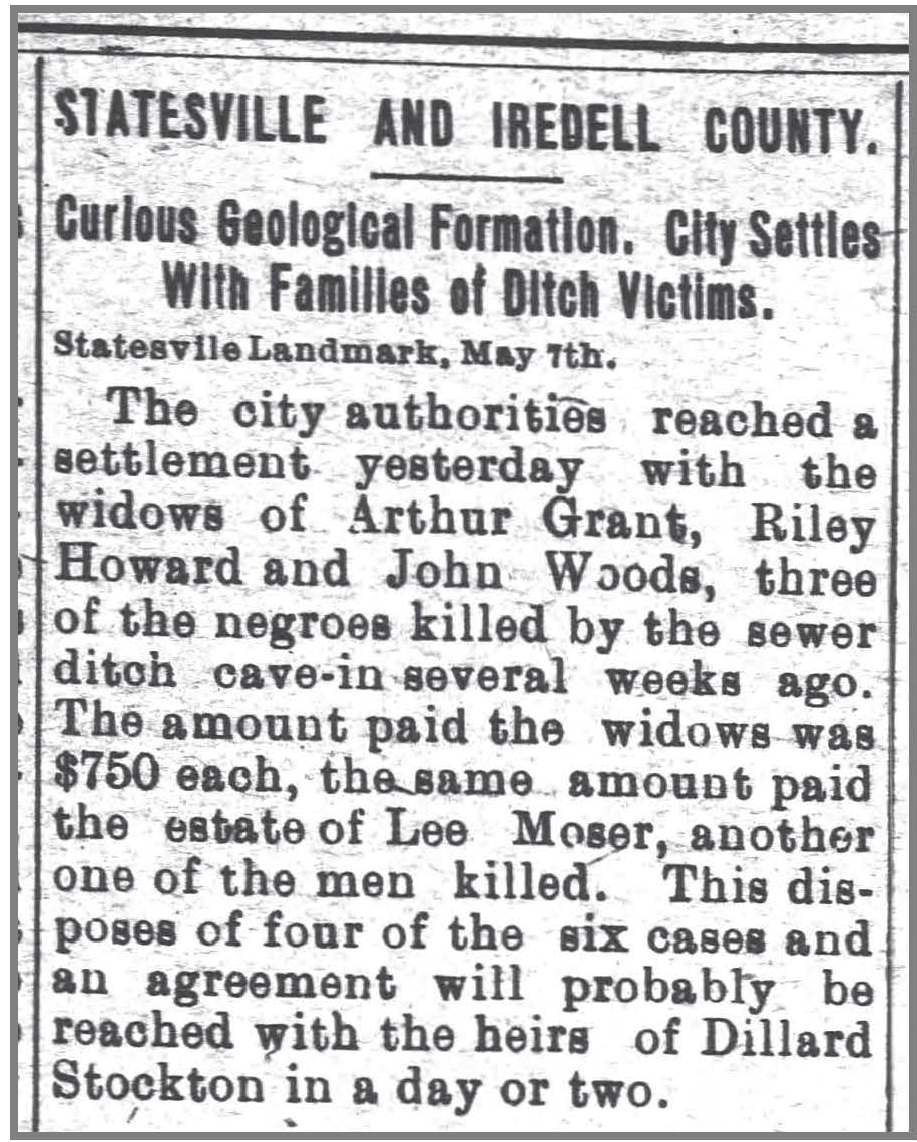
For all the breathless detail of the initial report of the tragedy, greater Statesville soon moved on. As reported in the local paper, within two months, the city had settled four of the deaths with payments of $750 (roughly $19,000 today) and were close to settling with the remaining survivors, including Ida May Colvert.

Carolina_Watchman_5_15_1907_Dillard_stockton_sett

Dillard Stockton is buried in Statesville’s Green Street/Union Grove cemetery. I snagged this photo from findagrave.com. I don’t recall seeing it during my recent visit and don’t know if it’s near the Colvert graves.

91759891_133944306122

A horrifying post script:

W_S_Union_Republican_5_12_1907_Harry_Stockton__039_s_death

Winston-Salem Union Republican, 12 May 1912.

Standard
Births Deaths Marriages, Land, Maternal Kin, Photographs, Virginia

Family cemeteries, no. 16: Holmes-Clark.

No one knows where Joseph R. Holmes is buried. It stands to reason, though, that it might be here.

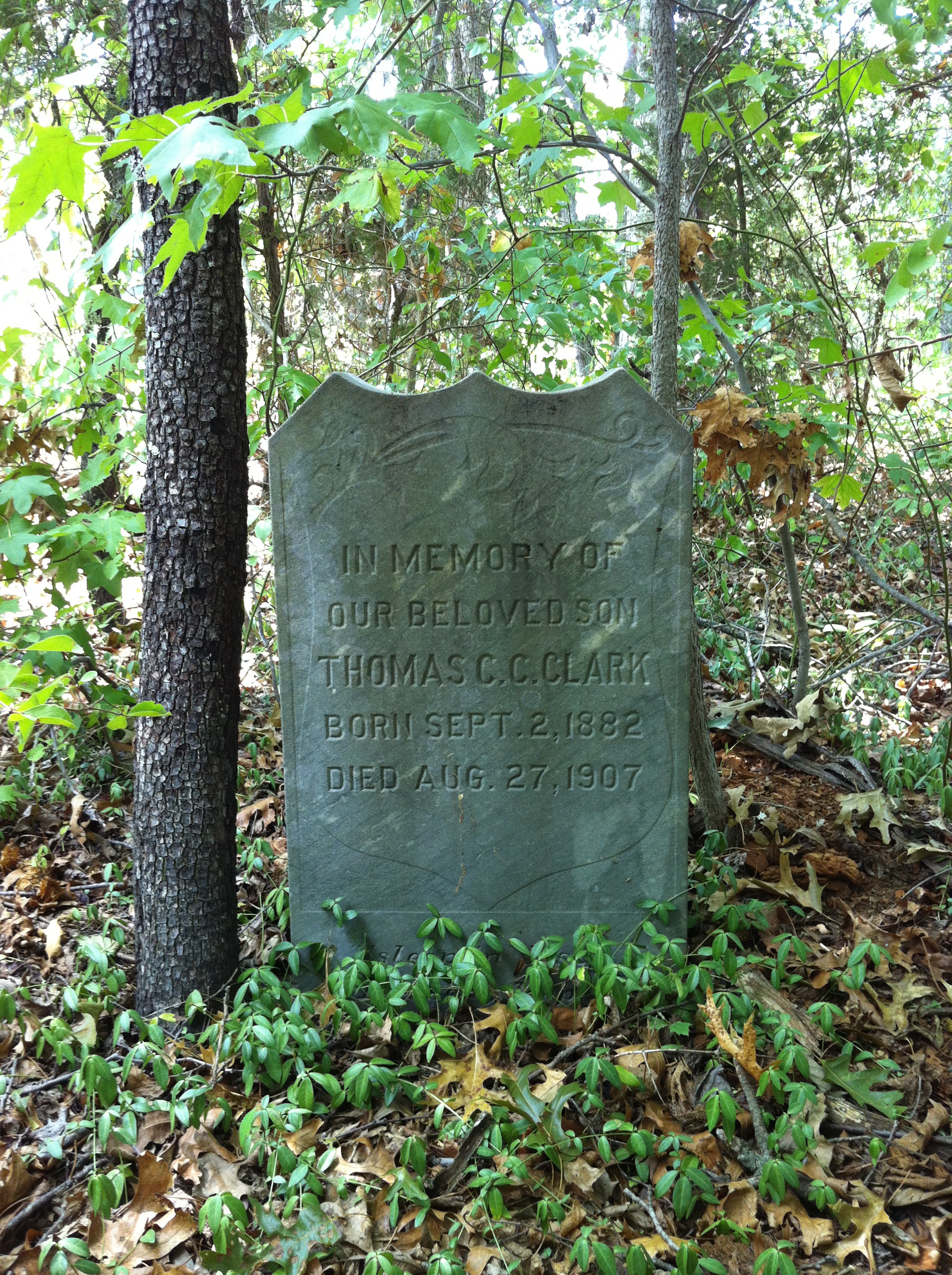
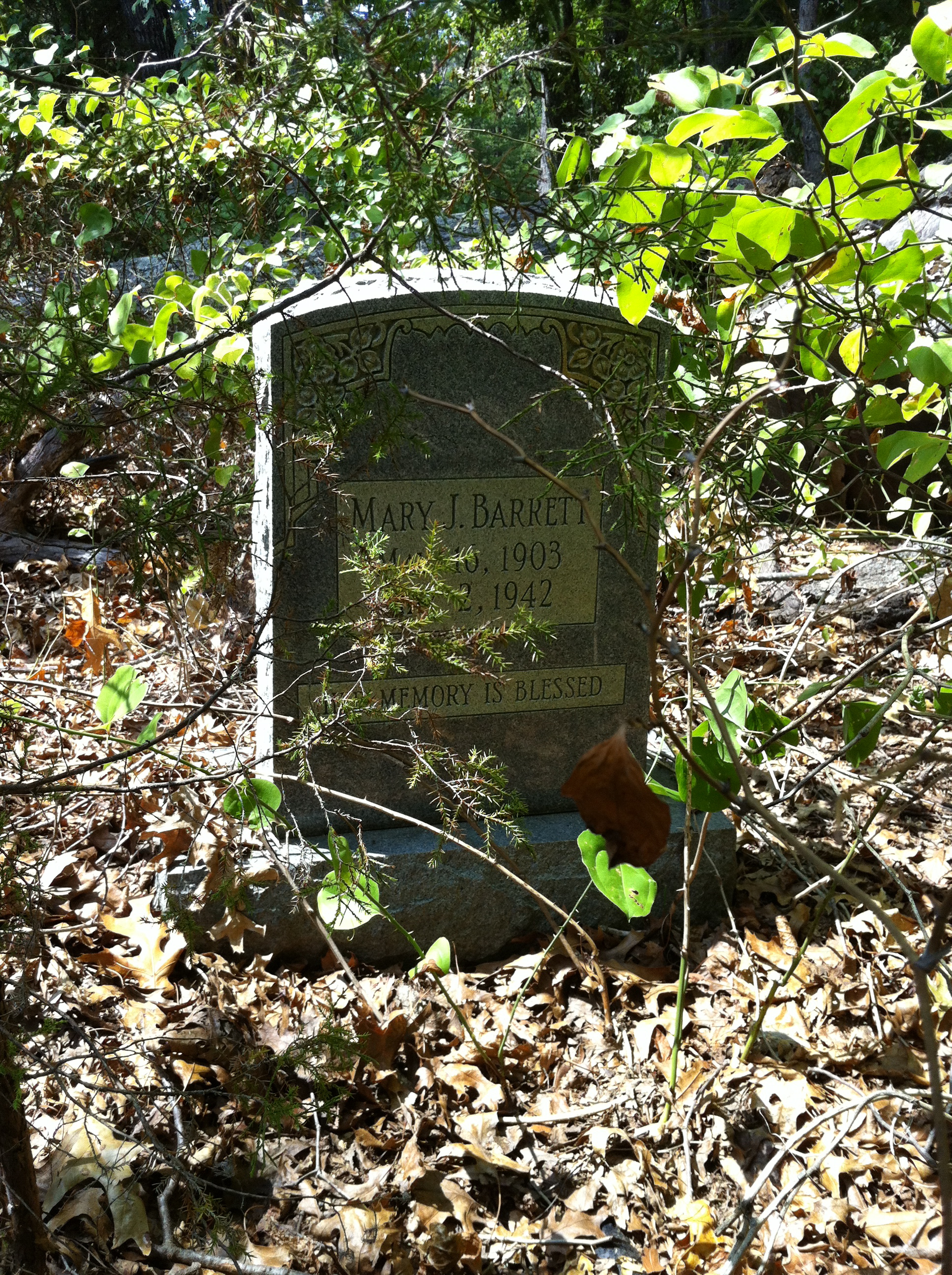
I owe this entire post to the inestimable Kathy Liston, a Charlotte County archaeologist who has immersed herself in the history of the area’s African-American families. She tracked down the location of Joseph’s small acreage near Antioch Church on Old Kings Highway near Keysville, Charlotte County,Virginia. And there, at edge of a clearing, now completely overgrown, is a small cemetery. Only four stones stand, but a number of unmarked or fieldstone-marked graves are visible:

Rev. Whitfield Clarke / Born July 15, 1840 / Died Aug. 21, 1916

In Memory of Our Beloved Son / Thomas C.C. Clark/ Born Sept 2, 1882 / Died Aug 27, 1907

William Jasper Almond / Virginia / Mess Attendant / 3 Class / USNRF / A[illegible] 2, 1934

Mary J. Barrett / May 16, 1903 / May 2, 1942 / Her Memory is Blessed

These folks are not Joseph’s family, per se. They are his wife’s and are evidence of the life she built after his assassination.

Joseph Holmes married Mary Clark toward the end of the Civil War. Their four children were Payton (1865), Louisa (1866), William (1867) and Joseph (1868). Mary was the daughter of Simon and Jina Clark, and Whitfield Clark was her brother. As detailed here, Joseph R. Holmes was shot down in front of the Charlotte County Courthouse on 3 May 1869.

When the censustaker arrived the following spring, Joseph and Mary’s children were listed in the household of a couple I believe to have been Joseph’s mother and stepfather: Wat Carter, 70, wife Nancy, 70, and children Mary, 23, Liza, 17, and Wat, 16; plus Payton, 4, Louisa, 3, and Joseph Homes, 2, and Fannie Clark, 60. (That Mary is possibly Mary Clark Holmes, but may also have been Mary Carter.)

On 3 January 1872, 24 year-old widow Mary Holmes married John Almond, a 35 year-old widower. In the 1880 census of Walton, Charlotte County, carpenter John Almond’s household includes wife Mary, 31, and children Payton, 14, Wirt H., 12, Ella M., 10, and Lemon Almond, 8. Payton, it appears, was in fact Joseph’s son Payton Holmes; Wirt and Ella were John’s children by his first wife; and Lemon was John and Mary’s son together. The family remained on the land that had been Joseph Holmes’.

The oldest marked grave in the little cemetery dates to 1907. It stands to reason, though, that Mary Holmes would have had her husband buried here, where she could watch over his grave and perhaps protect it from any who sought to punish him further. Who were the four whose stones still reveal their resting places? Thomas C.C. Clark was the son of Whitfield Clark and his second wife, Amanda. He appears in the 1900 census as a student at Hampton Institute in Hampton, Virginia. I’ve written a bit about Reverend Whitfield Clark here. William Jasper Almond (known as Jasper, which is interesting because that was the name of Joseph Holmes’ brother, my great-great-grandfather), born in 1896, was the son of Lemon Almond and his first wife, Rosa W. Fowlkes.  Mary J. Almond Barrett was Jasper’s half-sister, daughter of Lemon and Mary B. Scott Almond.

IMG_9958

Joseph R. Holmes’ land, near Keysville, Charlotte County, Virginia.

IMG_9959

IMG_9962

IMG_9968

Photos by Lisa Y. Henderson, July 2012. 

Standard
Births Deaths Marriages, Maternal Kin, North Carolina, Other Documents

Elvira.

I knew Rebecca Colvert was my great-great-grandfather John W. Colvert‘s stepmother. Until now, though, I’d seen his mother Elvira Gray‘s name listed only on his death certificate.

On 30 January 1905, six days before his father Walker‘s death, John married Adeline Hampton, mother of his four daughters. I’d seen the marriage register entry for their union, but not the actual license. Here it is, and there is the second reference to Walker’s first wife.

42091_334850-01229

Standard
Births Deaths Marriages, Maternal Kin, North Carolina, Other Documents

Uncle John’s first wife?

I am clearly getting my whole life in these marriage records, but I have to wonder. What in the world have I been doing? Why have I missed so many of these records? Have I just assumed that what was on the shelf or on-line was all that was available? Fie.

Here’s another.

42091_334849-01098

Lots about this license says it relates to a previously unknown first marriage for my grandmother’s uncle, John McNeely. First, the parents are named correctly, and they were the only Henry and Martha McNeely in Iredell County at the time. Second, the church is right, as the McNeelys were Presbyterians. (Except when they were being Episcopalians.) Third, that middle name, Alexander — the first I’ve heard of one for John! — is a family name, borne first by Alexander “Sandy” McNeely, son of Henry McNeely’s sister Alice. In fact, the only thing that throws me is John’s age. Uncle John was 27 in 1899, not 21. That’s a curious error, but not critical enough to trump the other details. I’ll update my tree to include John’s middle name and his first wife.

McNEELY -- John McNeely young w cigarette

John A. McNeely as a young man. (I think. Even as I post this, something is worrying me about the timeframe of this photo….)

Standard
Births Deaths Marriages, Maternal Kin, North Carolina, Other Documents

William emerges.

As I discussed here, my great-great-grandmother Harriet Nicholson Tomlin Hart had two half-brothers named William. I discovered her mother’s son, William H. Nicholson, in the 1900 census. The newly widowed Harriet and her young son Golar — the only one of her Tomlin children to see the 20th century — were living in her brother’s household in Charlotte, Mecklenburg County, North Carolina. With this information, I found William’s 1909 death certificate. Harriet was the informant, and she listed his parents as Burwell Carson and Lucinda Nicholson. Other than a few city directory listings, this was the only documentation of William that I had until last night, when I found this:

42091_333002-01075

It’s hard to read, but it’s a Mecklenburg County marriage license for William H. Nicholson. On 3 April 1884, he married 38 year-old Lizzie King of Charlotte.

… William had a wife?

I went back to the 1900 census and examined it more closely. At 611 East Stonewall, William “Nickolson,” age 51, plasterer; Harriet Tomlin, 38, his sister; and Golda, 6, his niece. (Actually, his nephew.) Harriet was described as a widow, with only one child of ten living. (This is not quite right either, as her oldest child Lon was also alive, but 80% mortality versus 90% is meaningless.) William, in fact, is described as married, but there is no wife in the household. Where was Lizzie Nicholson?

I searched further. More city directories have been digitized since last I looked, and I quickly found several entries from the latter half of the first decade of the 1900s. Here’s one:

Screen Shot 2015-04-05 at 9.25.48 PMWalsh’s City Directory for Charlotte, North Carolina, 1907.

If there had been a rough patch around 1900, it was smoothed over within a few years. William’s 1909 death certificate describes him as married (though his sister came all the way from Statesville to provide information.) Lizzie died just a year later.

I went back further. I’d seen city directory listings for William Nicholson in Charlotte in 1890 and 1891, but last night I found a couple like this:

Screen Shot 2015-04-05 at 9.32.50 PMA Directory of the City of Charlotte, North Carolina for 1896 and 1897.

Same occupation, same address, same wife. This appears to be William using his middle name, Henry. I found others: in 1889, Henry Nicholson, brickmason, and Lizzie Nicholson, cook at the Central Hotel, living at 611 East Stonewall. In 1897, Henry H. Nicholson, laborer, and Lizzie Nicholson at the Stonewall address. The entry below: Nicholson & Allen (c) [for “colored”] (Lizzie Nicholson & Richard Allen), proprs Northern Rest, 220 East Trade.  In 1904: Henry Nicholson (Isabella), plasterer, 611 E Stonewall.

A Newspaper.com turned up nothing on William Henry, but there were several notices published in late 1910 and early 1911 regarding Lizzie Nicholson’s estate, and a delinquent property tax listing in 1894 that reveals that she was the owner of the Stonewall address. Levine Museum of the New South’s People of 1911 Charlotte project depicts the Sanborn drawing of this one-story house on an unpaved street and lists its owner at that time as Montgomery Caesar. The Second Ward street is no longer residential, and 611 is just a block from the NASCAR Hall of Fame. East Boundary Street, William and Lizzie’s other address, is gone. And 220 East Trade is now the Epicentre.

When Northern Restaurant was, though, a small but confident ad:

Charlotte_Observer_9_16_1896_Northern_Rest

Charlotte Observer, 16 September 1896.

Then, less charitably:

Charlotte_Observer_3_14_1897_Northern_Rest

Charlotte Observer, March , 1897.

Charlotte_Observer_10_8_1897_Northern_Rest

Charlotte Observer, 8 October 1897.

So, to update what I know about Harriet’s brother:

William Henry Nicholson was born between 1842 and 1848 to Lucinda Nicholson and Burwell Carson. His whereabouts in 1870 and 1880 are unknown. He was trained as a brickmason and plasterer and plied both trades in Charlotte. In 1884, he married Lizzie King (whose first name was possibly Isabella). It was at least her second marriage. (Her parents’ names on the license are nearly illegible, but they are not “King,” and she is referred to as Mrs. in the document.) Lizzie worked as a cook at a hotel, and then at her own establishment, Northern Restaurant, which she co-owned with Richard Allen. Perhaps before her marriage to William, Lizzie bought or inherited a house at 611 East Stonewall in Charlotte. For a brief period around 1900, William’s half-sister Harriet lived at the Stonewall house. By 1907, William and Lizzie had moved to 200 East Boundary, and each of them died in the house there. William died in December 1909, and Lizzie not quite two months later in February 1019.

Standard
Births Deaths Marriages, Maternal Kin, Newspaper Articles, North Carolina, Other Documents

Investigation of death.

A coroner’s inquest is an official inquiry into the manner and cause of an individual’s death. Conducted by a county coroner when a cause of death is unknown, violent or otherwise suspicious, this legal inquiry is performed in public and often before a jury. The coroner does not establish why a death occurred, but rather determines who the deceased was and how, when and where death occurred. Here’s a link to a post about coroner’s reports in the North Carolina State Archives, where I obtained the documents below.

I searched Iredell County’s reports looking, in particular, for the inquest into the death of my great-grandmother’s sister, Elizabeth McNeely Kilpatrick Long, who burned to death in a suspicious fire. I was disappointed not to find one. However, I did find these for two men who died unexpected, but ultimately natural, deaths:

Coroners Reports_Page_1

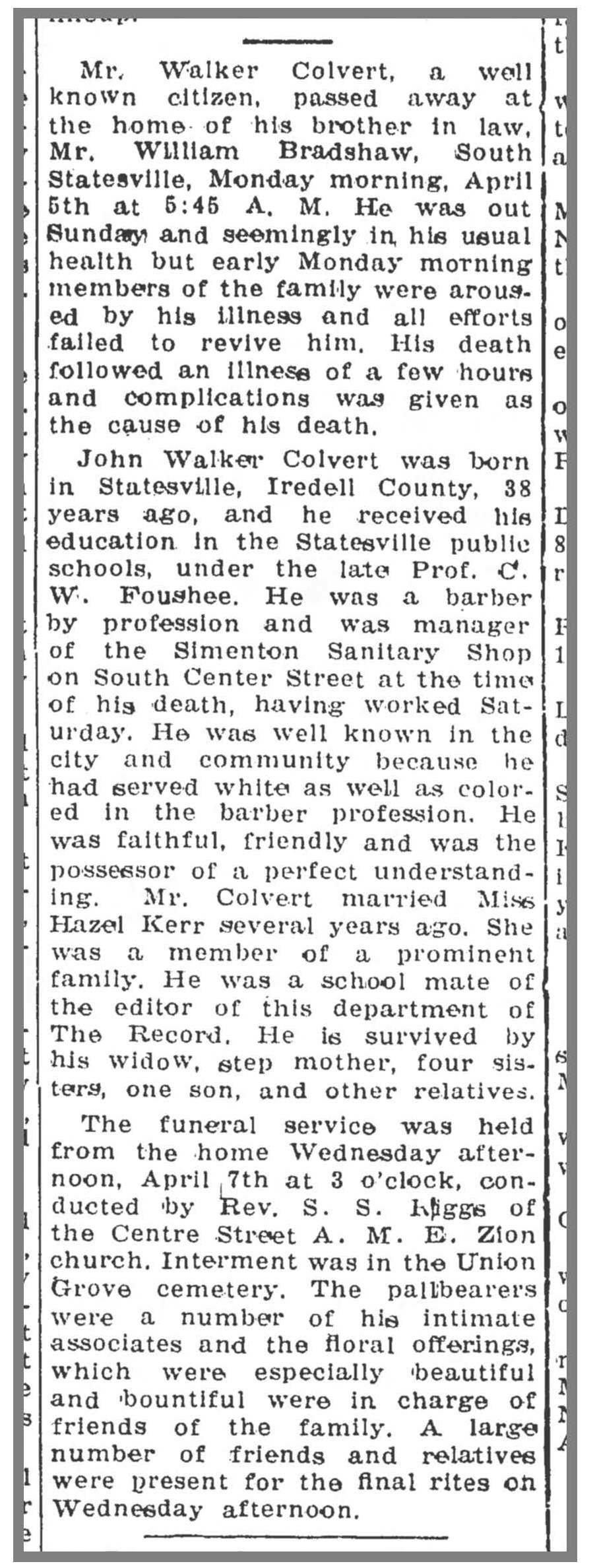
My grandmother’s half-brother, John Walker Colvert II. (One would expect an inquest to get the spelling of a surname right. Or at least consistently wrong.) Here’s his obituary in the 16 April 1937 edition of the Statesville Record & Landmark.

Sville_Rec__amp__Landmark_4_16_1937 WColvert Obit

(“Schoolmate”??? Simonton Sanitary Shop? This obituary sets forth some interesting facts that I intend to explore elsewhere.)

And then there was the notorious William “Bill Bailey” Murdock, husband of my grandmother’s aunt Bertha Hart Murdock. He died just over a year after her conviction for shooting a white man in the leg in their restaurant.

Coroners Reports_Page_2

Standard
DNA, Maternal Kin, North Carolina, Photographs

L2 Legacy. (And well wishes!)

My niece turned 18 today. She’s the only one of my grandmother Margaret Colvert Allen‘s great-grandchildren to carry her mtDNA haplotype — L2d1a. I’m feeling some kind of way about that, and I shared my wistfulness with a group of researchers with whom I’m fortunate to co-administer a Facebook genealogy group. J. immediately replied that I should consider taking an mtDNA Full Sequence test at FTDNA. Though in the immediate sense the test is of limited genealogical use, as she wisely pointed out, the mtDNA database will never grow if none of us contributes to it.

Arising approximately 90,000 years ago, L2 is one of the oldest of the matrilineal haplogroups and is the most common African lineage.  L2d1a, however, is a relatively rare subclade. Google it, and three of the top five references are to this blog. I have no children and will not pass along Martha M. McNeely‘s matrilineage in that way. However, I can contribute to the understanding of its history and keep Martha’s legacy alive otherwise. Stay tuned, and Happy Birthday, S.D.J.!

18557_306271948526_5300904_n

Martha Margaret Miller McNeely’s L2d1a progeny — my grandmother, my sister, my niece, my mother, 1998.

Standard
Births Deaths Marriages, Maternal Kin, North Carolina, Oral History

Collateral kin: the Daltons.

Me: And you said he looked just like your dad. Your dad looked just like his father.

My grandmother: Papa looked just like him. And one thing, with all that white in him, he was brown like Grandpa.

Me: Unh-uh.

Grandma: And I don’t know who Mat and Golar and Walker’s mother was, but Walker was real dark. But handsome. Honey, he was one beautiful child and had this pretty hair. Curly. And it wouldn’t even keep a part or nothing in it. And he came home one time, and he had cut this part, cut this place through his hair. And he said his friends had parts in their hair, but his was so curly it wouldn’t stay. So he had to cut this part. Another time, that was just after Mama had married Papa. And she was just so crazy ‘bout him, he was such a pretty little boy. And she made him this velvet suit.

My aunt L.: Who, Walker?

Grandma: Walker. Fauntleroy. You know what a Fauntleroy suit is?

Me: Mm-hmm.

Grandma: She made him this Fauntleroy suit for commencement. And she said it had this little collar, you know [inaudible] collar. And said when Walker came out on the stage to do his part, he had stuffed all that collar on the inside of his coat and pulled them sleeves down. [Laughing.] Mama said, “See. Will you look at this young’un.” [Laughing.]

Me: ‘Cause they were fairly young, right, when —

Grandma: Yeah, they were six —  something like six, eight and ten. And they may have been younger than that.

Me: And their mother died?

Grandma: Yeah. I don’t know how she died. But her sisters were really nice to Mama. Oh, they were really nice to her. Mama loved them like her own sisters. They were so nice to her. And, see, they were sort of taking care of the children while Papa was in between two marriages you know.

COLVERT -- Walker Colvert Border

J. Walker Colvert II, perhaps in his early twenties.

——

So, who was Lon Colvert’s first wife? I know her name — Josephine Dalton — but little else.

In the 1880 census of Eagle Mills, Iredell County, one year-old Josapene Dalton is listed in the household of her parents, Anderson and Vincey Dalton, along with brother Andrew, 17; sister Mary B., 3; her great-grandmother, Mary Houston, 85; and a boarder named Joe Blackburn, 28. The family lived among a little cluster of Dalton households, the first headed by 67 year-old John H. Dalton, a white farmer. Dalton, born in Rockingham County, North Carolina, arrived in Iredell County in 1840’s. He married the daughter of Placebo Houston, a prominent planter, and is credited with introducing tobacco cultivation in Iredell County. According to a 8 April 1974 article in the Statesville Record and Landmark, by 1850 Dalton had established a tobacco plug factory that employed 17, but had to haul bright leaf tobacco from counties along the Virginia line. This scarcity drove his efforts to jumpstart local tobacco production. In 1858, John Hunter Dalton built Daltonia, described as “an imposing Greek Revival house whose richness and diversity of detail make it one of the most architecturally outstanding houses” in the county.  The 1860 census counted among Dalton’s possessions 57 slaves living in eight houses. Josephine Dalton’s father, and maybe her mother, were likely among them.

Josephine was born well after the Civil War — after Reconstruction even — but her family seems to have remained tethered to Daltonia for decades after Emancipation. [After I started this blog post, I traveled to Iredell County, met P.P., and visited Daltonia. That story, and more about Josephine’s family, is here.] Sometime around 1894 — I have not located a license — Josephine married Lon W. Colvert, an ambitious 19 year-old Eagle Mills native set to make his mark in the town of Statesville. [Update, 4/6/2015: license found.] The young family appears in the 1900 census of Statesville, Iredell County — Lon Colvert, 25, wife “Joseph,” 23, and children Gola, 5, Mattie, 4, and Walker, 2. No more than five years later, Josephine was dead.

Standard