Land, North Carolina, Other Documents, Paternal Kin

Country roads, Nahunta.

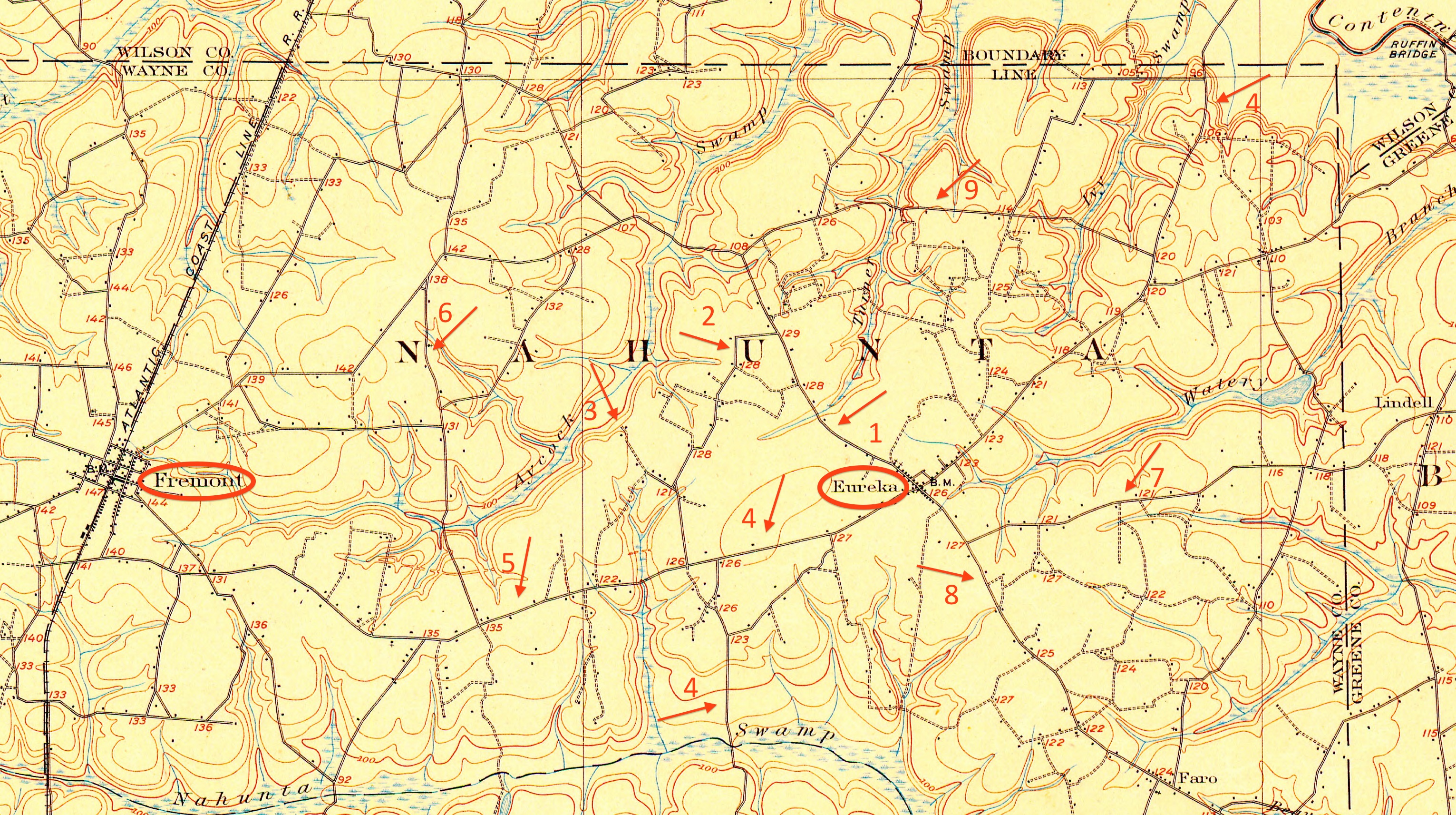
This is a section of a 1904 topographical map of parts of Wilson and Wayne Counties, North Carolina. I am amazed at how much of the blueprint, so to speak, of Nahunta, is the same. More than one hundred years ago, kinfolk traveling from Wilson to Eureka or Fremont would have taken the same roads that I drive now. Today these roads are paved, but the paths they cut over branches and through fields across the countryside have otherwise changed little.

wilson-1904_lnr copy 2

1. Turner Swamp Road runs from the crossroads at the center of Eureka northwest to dead-end at Davis Mill Road (9). Jonah Williams‘ church is on this road, and his brother Richard Artis’ family were among early members.

2. Reidtown Road arcs to connect Highway 222 and Turner Swamp Road. It is named for the community formed by the Reid family, free people of color who settled here as early as the 1830s and intermarried with Artises.

3. Napoleon Road, a spur off Reidtown Road, now cuts across Aycock Swamp to meet Davis Mill Road. It remains unpaved, and the only house standing on it is the one Napoleon Hagans built in the 1870s or ’80s. I believe the speck to the left of the road’s end on this map is Hagans’ house.

4. NC 111, which runs with NC 222 northeast to NC 58 at Stantonsburg in Wilson County.

5. NC 222.

6. Black Creek Road connects Fremont (via its Old Black Creek Road spur) and the town of Black Creek in Wilson County. (Black Creek was once the northernmost section of Wayne.) The road is called Frank Price Church Road in Wilson County.

7. Lindell Road runs from Faro Road (8), just south of Eureka, east into Greene County’s Bullhead district. Much of Adam Artis‘ land lay between NC 111 and Lindell Road.

8. Faro Road, the continuation of Turner Swamp Road, runs south from Eureka toward the unincorporated community of Faro, famous as the site where two hydrogen bombs dropped when a B-52 broke up in flight in 1961.

9. Davis Mill Road arcs from Fremont as the northernmost east-west artery across Nahunta.

Standard
Free People of Color, North Carolina, Paternal Kin

Greene County Artises.

By the early antebellum period, dozens of Artis families had drifted down from southern Virginia to form a large node in Wayne County. The 1840 census lists more than 40 Artis heads of household in that county. By contrast, there were never more than a handful of Artises recorded in neighboring Greene County in the antebellum era, and none at all before 1850. (This, of course, does not mean they were not there. Only that they did not qualify as heads of household.) Were the Greene County Artises an off-shoot of one of the many Wayne County Artis lines? Are they a single extended family? Were they all free prior to the Civil War? Or were some of them freedmen who adopted the surname of their free-born kin?

I’ve begun to pull together all sources of information about antebellum Artises in Greene County to try to find answers.

CENSUS RECORDS

In 1850, clustered:

  • at #429, Vicy Artess, 40, and her children Zilpha, 22, Louis, 8, Jonah, 7, Jethro, 5, and Richard, 1.  Vicey Artis with her oldest daughter and youngest children.
  • at #431, Sylvany Artess, 36, and children Daniel, 7, Mitchel, 5, Meriah, 4, Gui, 2, and Penny, 3 months.  As detailed here, I believe Vicey and Sylvania Artis were sisters. White farmer John Lane, who likely apprenticed Sylvania’s children and enslaved their father Guy, was listed at #430.

In 1860, in Bull Head district:

  • at #25, James, 16, and Jetherroe Artis, 14, farmhands, with Silas Bryant.  These boys appear to be Vicey’s sons Jonah and Jethro and have followed their siblings into service as Bryant’s. Vicey herself is listed a few miles over the line in Wayne County with daughter Charity and Charity’s children, an unnamed one year-old “infant” and 8 year-old son Jethro.
  • at #26, Dannel, 17, Mike, 13, Penney, 12, Dyner, 9, Juley, 7, and Washington Artis, 5, with John Lane. These children, of course, are Sylvania’s younger children. Sylvania (“Silvano”) herself is living next door to her sister Vicey in Wayne County with a one year-old boy named Hiram Artis.
  • at #36, Mary Artis, 27, servant in the household of Richard Baker. Who is Mary Artis, and where was she in 1850?

And in Tyson’s Marsh district:

  • Nancy, 17, Aron, 13, Richard, 11, Calvin, 9, and Rebecker Artes, 5, in the household of G.S. Peacock. Where had the oldest children been in 1850? In 1870, Calvin Artis, 20, is a farmhand in the household of Sarah Wooten, Snow Hill township, Green County. In 1880 Snow Hill township: Richard Artis, 29, Charlotte, 24, Hattie, 3, and Jessee Artis, 1. On 9 March 1876, Calvin Artis applied for a marriage license for Richard Artis, 24, son of Isom Heath and Matilda Artis, and Charlotte Ellis, 21. Matilda was said to be living at that time. Where was she in 1850 and 1860 then?
  • at #161, servant Percy Artes, 25, and her children Henry C., 1, and Thomas, 5, in the household of Murrhyer Best. In 1850, Persey Artice and Rufus Artice, both 17, were listed in the household of Martin Sauls in North Side of the Neuse, Wayne County. In 1870, Snow Hill, Greene County, Prissy Artice, 35, and son Thomas, 14.

DEATH RECORDS

Margaret Artis. Died 4 March 1920, Carrs township, Greene County, North Carolina. Age 70. Widow of Ed Artis. Born Greene County to Penny Speight. Buried Carr’s Farm. Informant, Tom Speight. Not found in census or other records.

Thomas Artis. Died 30 July 1941, Bullhead township, Greene County, North Carolina. Widower of Mary Artis. Born 21 December 1853 in Wayne County to John and Leathy Artis. Buried family cemetery, by C.E. Artis. Informant, F[illegible] Exum. In the 1860 census of Davis district, Wayne County: John Artis, 39, wife Lethy, 40, and children Sarah J., 13, Zachary, 11, Millie, 9, Wm. T., 7, and Betsey Artis, 4. He was the grandson of Celia Artis.

Fillis Artis. Died 28 October 1916, Ormondsville township, Greene County, North Carolina. Married. Born 1853 in Greene County to Charity Edwards. Informant, W.H. Phillips. Phyllis Artis was not free-born, but married a man whose parents were. Phyllis Lee, age 35, daughter of Jerry Edwards and Charity Coward, married Rom Artis, 27, son of Jordan Artis and Arley [Olive] Artis, in Greene County on 11 January 1897. (Romilus was born about 1868, perhaps in Lenoir County. Census records show that his father lived in Wayne.) In the 1900 census of Contentnea township, Pitt County: Rom Artis (born 1868); wife Filliss (born 1860); four sons-in-law [stepsons?] John (1885), Allen (1886), Milton (1889) and Charley Leary (1891); son-in-law(?) William Artis (1893); daughter-in-law(?) Mande Artis (1895); and mother Ollie Artis (1840.)

Henry Artis. Died 10 January 1935 in Paris, Edgar County, Illinois. Barber. Resided 437 East Court. Born 21 March 1835, Snow Hill [Greene County], North Carolina to Louis Artis and Elizabeth Bass. Widower of Gabreil Artis. In the 1870 census of Otter Creek, Vigo County, Indiana: Lewis Artis, 39, Elizabeth, 38, Lucy A., 33, Elie, 20, Peggy, 14, Thomas, 8, John, 5, and William Artis, 4 months; the first three born in North Carolina. In the 1880 census of Charleston, Coles County, Indiana: North Carolina-born Henry Artis, 41, Ohio-born Ellen Artis, 43, and others.

CEMETERY RECORDS

Olive Artis. 1832-22 May 1904, Artis cemetery, Artis Cemetery Road, Greene County.

Phillis Artis. Wife of Rom Artis. 12 March 1861-28 October 1916, Artis cemetery, Artis Cemetery Road, Greene County. See Fillis Artis, above.

——

Standard
Agriculture, Land, North Carolina, Other Documents, Paternal Kin, Photographs

Swamps and sandy loams.

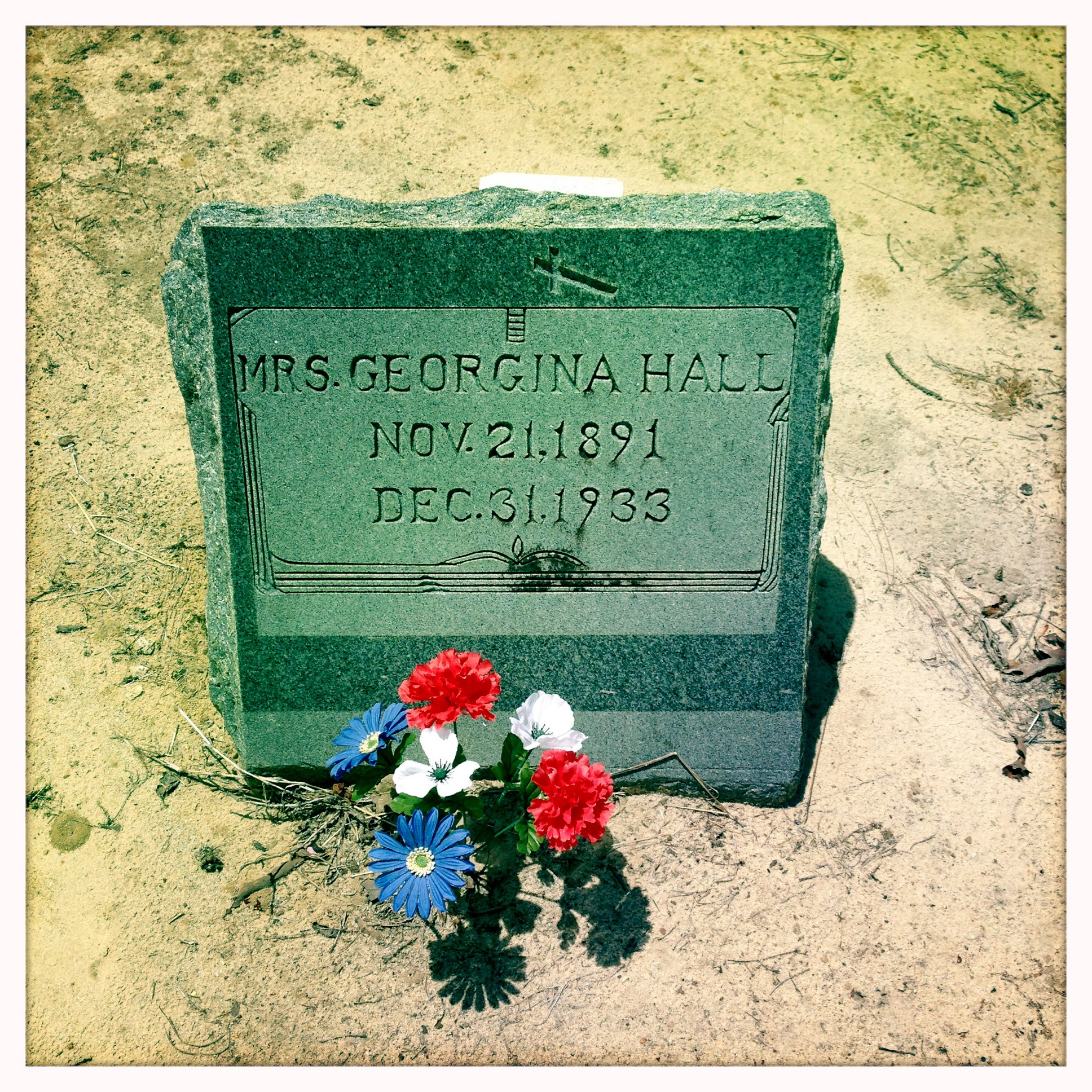
This is what dirt looks like where I’m from. It is not the plush black alluvial loam of the Mississippi Delta or the thin, rock-bedeviled soil of New England. It looks, mostly, like sand. Like in this graveyard, just south of Stantonsburg, Wilson County, where some of my Hall collateral kin lie. IMG_2195 The landscape of my childhood was level. Pine trees and flatness. Devoid, I thought, of any markers of geographical history. No boulder-strewn outcroppings, no foreboding hills, no deep-cut canyons. However, to the contrary, the most obvious relic of deep time was right under my feet.

I grew up on the western edge of North Carolina’s Coastal Plain, which was once the ocean floor. What looked like sand thrown up into the heels of my sneakers in fact was. The story wasn’t quite that simple though. I recall that patches of dirt in some places — like my parents’ back yard — are a pale gray, while others are the soft yellow of the Hall graveyard or, in veins here and there, the rusty-red of clay.

A few days ago, I found a soil survey map of Wayne County, North Carolina, dated 1916. Wayne, where my father’s mother’s people have lived since beyond memory, is just south of my home county. Seldom do I visit my parents that I don’t hop in the car for a quick dip down there. It’s a mere ten miles to the northern corner where my Artises and Haganses and Seaberrys lived, and just another 30 to get down to Dudley, where my Hendersons and Aldridges took root. What could this map, with its colorful camouflagey swirls of color, tell me about their land? The soil from which they pulled sweet potatoes and collards and the cotton and tobacco that put money in their pockets?

Screen Shot 2015-07-14 at 9.53.24 PM

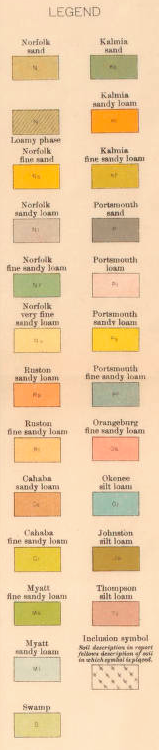
Here’s Nahunta, with Fremont at far left and Eureka at right. The road crossing from edge to edge is now known as Highway 222, and I have cousins that still live on it. That brownish sickle under N A H is marked S, which the key tells us is “Swamp.” Specifically, this is Aycock Swamp, upon whose banks Napoleon Hagans built his house. Another bit of S juts between U and N — that’s the tail end of Turner Swamp. And reaching in from Greene County is the swamp that envelops Watery Branch. Screen Shot 2015-07-14 at 9.49.48 PM Just below Eureka is a blob of Nv, “Norfolk very fine sandy loam.” The greenish Nf that dominates the frame is “Norfolk fine sandy loam.” This is Adam Artis territory. The pale lavender-gray that washes across the middle is plain “Norfolk sandy loam,” Nl. The only color left in the areas in which my family lived is the sliver of peach that hugs the south side of Aycock Swamp — Ps or “Portsmouth sandy loam.” What is all this?

From a very helpful PDF linked to the pittcountync.gov website: “The Norfolk series consists of well-drained, nearly level and gently sloping soils on uplands. These soils formed in Coastal Plain sediment. A seasonal high water table is below a depth of 5 feet. In a typical profile, the surface layer is dark grayish-brown and light yellowish-brown sandy loam about 10 inches thick. The subsoil is olive yellow and brownish yellow to a depth of about 84 inches. In the upper part, the subsoil is friable sandy clay loam mottled with red. In the lower part, it is friable sandy loam mottled with red and gray. Natural fertility and the content of organic matter are low, and available water capacity is medium. Permeability is moderate, and shrink-swell potential is low. In areas that have not received lime, reaction is strongly acid or very strongly acid. The Norfolk soils of Pitt County are important for farming. Slope is the major limitation to their use. Most of the acreage is cultivated or in pasture. The rest is chiefly in forest and in housing developments or other nonfarm uses. Where crops are grown, response is good to recommended applications of fertilizer and lime.” (Pitt County is on the other side of Greene from Wayne County.)

From the same source:  “The Portsmouth series consists of very poorly drained, nearly level soils on stream terraces. These soils formed in alluvial sediment. A seasonal high water table is at or near the surface. In a typical profile, the surface layer is very dark gray and very dark grayish-brown loam about 15 inches thick. The subsoil is about 24 inches thick. The upper part is grayish-brown, friable sandy loam mottled with grayish brown. The lower part is grayish-brown, friable, sandy clay loam mottled with yellowish brown. Below the subsoil and extending to a depth of about 68 inches is grayish-brown and light brownish-gray sand and coarse sand. Natural fertility is low, and the content of organic matter and available water capacity are medium. Permeability is moderate, and shrink-swell potential is low. In areas that have not received lime, reaction is strongly acid or very strongly acid. The Portsmouth soils in Pitt County are of only minor importance for farming. Major limitations to their use are the seasonal high water table and frequent flooding for brief periods. Most of the acreage is in forest, and the rest is chiefly in cultivated crops or pasture. Where crops are grown they respond well to recommended applications of fertilizer and lime.”

These flat acres of mostly Norfolk series soil, then, with liberal amendment, were much better quality farmland than I would have supposed.

The same was true in Brogden township, at the other end of the county. Today’s major roads, two-lane 117 Alternate and four-lane 117, which roughly parallel the railroad to the west, did not exist in 1916. (In fact, what is now Highway 117 was cut through well into my adulthood.) The railroad is still there, though, as is the road (now called O’Berry/Sleepy Creek Road) that crossed the tracks at Dudley’s little heart. Some of the little black specks you can barely see marked my people’s houses. I know, for example, that Aldridges lived along the railroad among the little dots marked opposite COAST. And the Congregational Church cemetery was just below Yellow Swamp, the shallow branch in which my people were baptized.

Soil_survey_of_Wayne_County_North_Carolina copyThe Hendersons and Aldridges and their related families, Simmonses, Wynns, Manuels, and Jacobses among them, lived within a few miles’ radius of Dudley. The soils they wrestled with included Norfolk sand (N), Norfolk sandy loam (Nl), Portsmouth sandy loam (Ps), and Ruston sandy loam (Rs). The same basic dirt as in the north of the county, with the addition of the Ruston, defined here: “The Ruston series consists of very deep, well drained, moderately permeable soils that formed in loamy marine or stream deposits. These soils are low in fertility and within the root zone have moderately high levels of exchangeable aluminum that are potentially toxic to some agricultural crops but are ideal for the production of loblolly, slash, and longleaf pine. The soils have slight limitations for woodland use and management.”

Standard
Education, North Carolina, Paternal Kin, Photographs

Cousin Mable meets Marian Anderson.

bhcp2520

I found this image in the digital Heritage of Black Highlanders Collection of the University of North Carolina-Asheville’s Ramsey Library. Taken in 1945, the photograph is entitled “Marian Anderson visits Stephens-Lee,” a high school in Asheville. Anderson was in town to give a recital at the City Auditorium. She is, of course, standing at middle, facing the camera squarely. Others on the front row, left to right, were Mable McCaine, teacher (in light-colored dress); an unidentified woman; Vernon Cowan, teacher; Frank Toliver, principal; J.D. Carr, editor of Carolina Times; and Isabell Jones, a music teacher at Allen High School.

Mable Williams McCaine was born 23 November 1912 in Goldsboro, North Carolina, to Clarence J. Williams and Daisy Aldridge Williams. Her maternal grandparents were Matthew W. and Fannie Kennedy Aldridge. The Williamses relocated to Asheville before 1920. Mable married Irvin L. McCaine, and the couple lived in Asheville with their two young sons in the 1940s.

Standard
Births Deaths Marriages, Free People of Color, North Carolina, Other Documents, Paternal Kin

Collateral kin: Celia Artis and family.

As noted previously, there is no known relationship between Celia Artis and my great-great-great-grandfather Adam T. Artis, though it is likely that most free colored Artises shared a common ancestor in the misty mists of time. Like, the late 17th century. Celia’s family and Adam’s family were among several sets of Artises living in northeastern Wayne County in the antebellum era, and they intermarried and otherwise interacted regularly. Here’s what I know of Celia Artis and her descendants.

Celia Artis was born just before 1800, presumably in Wayne County. Nothing is known of her parentage or early life. She married an enslaved man named Simon and gave birth to at least six children. In 1823, she gave complete control over her oldest children to two white neighbors, brothers (or father and son) Elias and Jesse Coleman, in a dangerously worded deed that exceeded the scope of typical apprenticeship indentures: This indenture this 16th day of August 1823 between Celia Artis of the County of Wayne and state of North Carolina of the one part, and Elias and Jesse Coleman of the other part (witnesseth) that I the said Celia Artis have for an in consideration of having four of my children raised in a becoming [illegible], by these presence indenture the said four children (to viz) Eliza, Ceatha, Zilpha, and Simon Artis to the said Elias and Jesse Coleman to be their own right and property until the said four children arives at the age of twenty one years old and I do by virtue of these presents give and grant all my right and power over said children the above term of time, unto the said Elias and Jesse Coleman their heirs and assigns, until the above-named children arives to the aforementioned etc., and I do further give unto the said Elias and Jesse Coleman all power of recovering from any person or persons all my right to said children — the [illegible] of time whatsoever in whereof I the said Celia Artis have hereunto set my hand and seal the day and year above written,    Celia X Artis.

Despite the “own right and property” language, Celia did not sell her children exactly, but what drove her to this extreme measure? Because she was not legally married, her children were subject to involuntary apprenticeship until age 21. This deed records her determination to guard her children from uncertain fates by placing them under the control of men she trusted, rather than those selected by the court.

Despite the deed’s verbiage, it is likely that the children continued to live with their mother during their indenture. Certainly, Celia, unlike many independent women of the era, had the wherewithal to care for them, as evidenced by her purchase of 10 acres from Spias Ward in 1833. Wayne County deeds further show purchases of 124 acres and 24 acres from W[illiam] Thompson in 1850 and 1855.

By 1840, Celia Artis was head of a household of eight free people of color in Black Creek district, Wayne County — one woman aged 36-54; three girls aged 10-23 [Eliza, Leatha, Zilpha]; one girl under 10 [unknown]; two boys aged 10-23 [Calvin and Simon]; and one boy under 10 [Thomas].

In the 1850 census, she was enumerated on the North Side of the Neuse, Wayne County, as a 50 year-old with children Eliza, 34, Zilpha, 28, Thomas, 15, and Calvin, 20, plus 6 year-old Lumiser, who was probably Eliza’s daughter. Celia is credited with owning $600 of real property (deeds for much of which went unrecorded), and the agricultural schedule for that year details her wealth:

  • Celia Artis.  50 improved acres, 700 unimproved acres, value $600. Implements valued at $25. 2 horses. 1 ass or mule. 1 ox. 21 other cattle. 40 sheep. 500 swine. 500 bushels of Indian corn. 100 lbs. of rice. 2 lbs. of tobacco. 100 lbs. of wool. 100 bushels of peas and beans. 200 bushels of sweet potatoes.

She also appears in the 1850 Wayne County slave schedule, which records her (and another free woman of color Rhoda Reed’s) ownership of their husbands:

1850 slave sched Celia ARtis

In 1860, in a surprise move, the census taker listed Simon Pig Artis, Celia’s husband, as the head of household. If he’d been freed formally, there’s no record of it. (Simon Pig’s nickname is explained here.) He is also listed as the 70 year-old owner of $800 of real property and $430 of personal property — all undoubtedly purchased by Celia. Their household included son Thomas, daughter Zilpha, and granddaughters Lumizah, 17, and Penninah, 11. On one side of the family: the widower Adam T. Artis, his three children, his sister and her child; on the other: Celia and Simon’s son Calvin, his wife Serena [maiden name Seaberry, and a cousin of Adam’s next wife Frances Seaberry], and their four children. Other neighbors included Lemuel Edmundson.

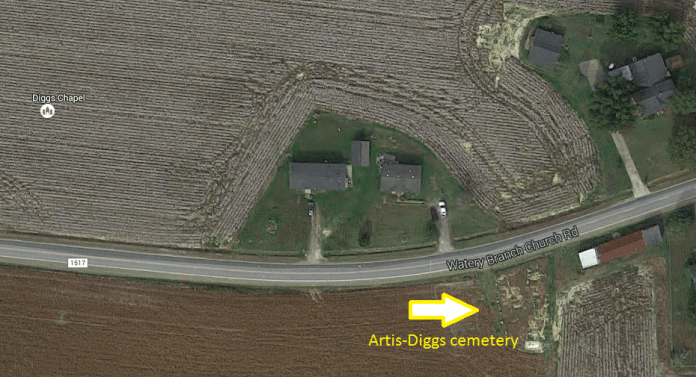
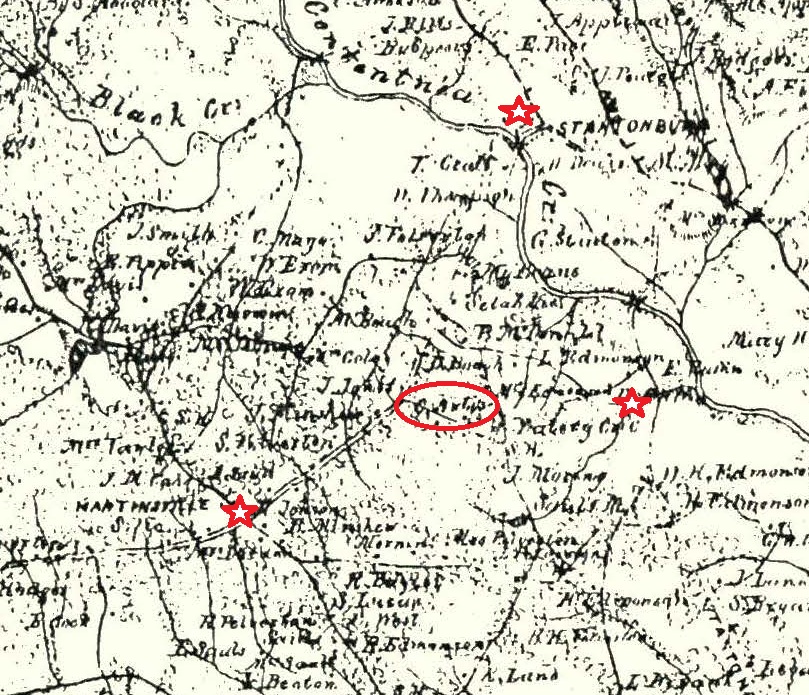
The 1863 Confederate field map below indicates “C. Artis” near Watery Branch and “L. Edmundson.” (The stars mark the creek and the towns of Stantonsburg and “Martinsville,” now Eureka.) The family’s cemetery remains on that land, as marked in the second map. (Watery Branch is perhaps a mile south along Watery Branch Road. And Diggs Chapel, presumably, is connected to the family. See Eliza Artis, below. The road visible below Celia’s name on the 1863 map was probably the precursor of Watery Branch Church Road.) Conf Field Map 2

Watery Branch

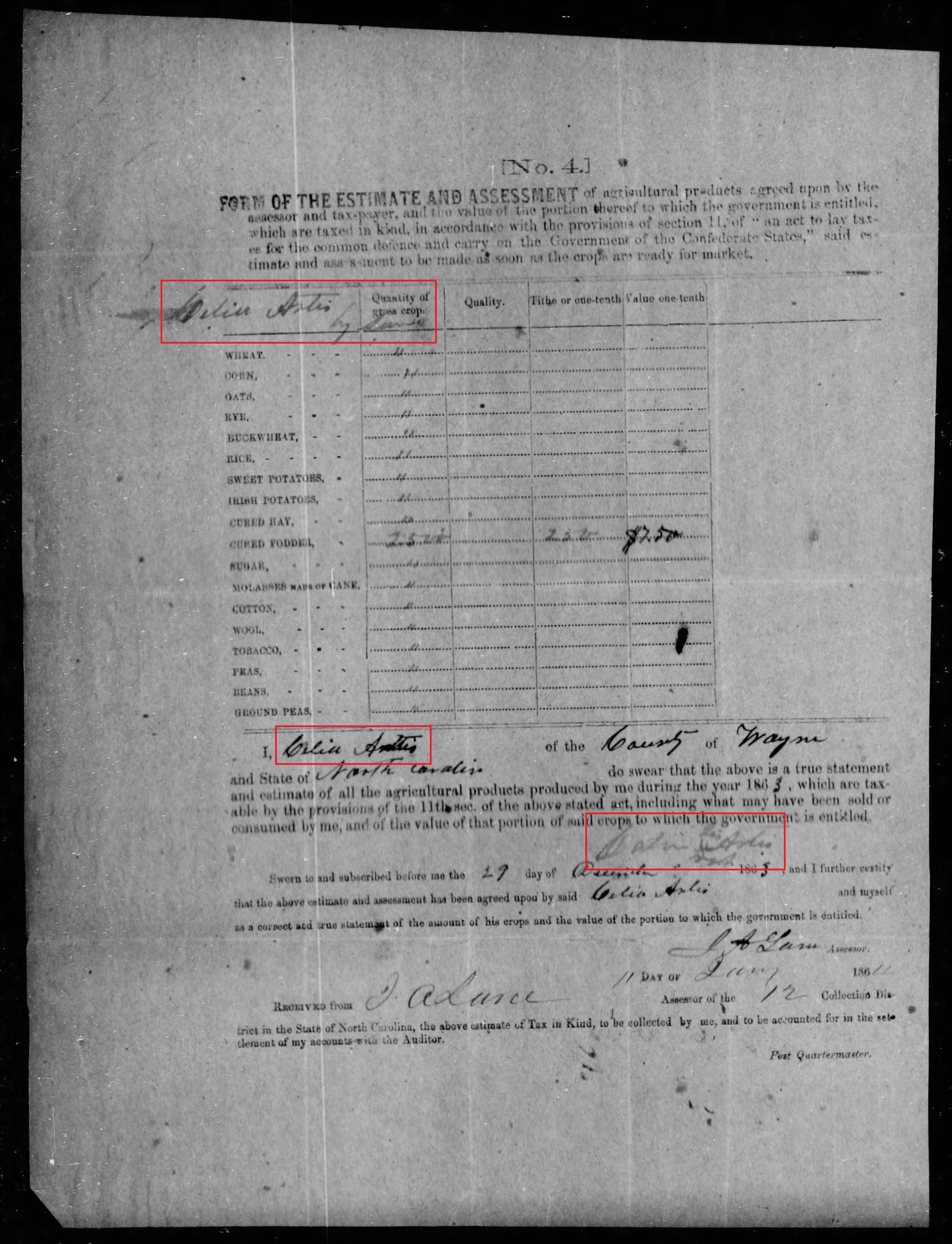
During the Civil War, both Celia Artis and her son Calvin were assessed taxes by the Confederate state government in the form of tithed crops. In December 1863, Celia had to hand over a tenth of her 2500 pounds of cured fodder to support the war effort.

celia artis conf

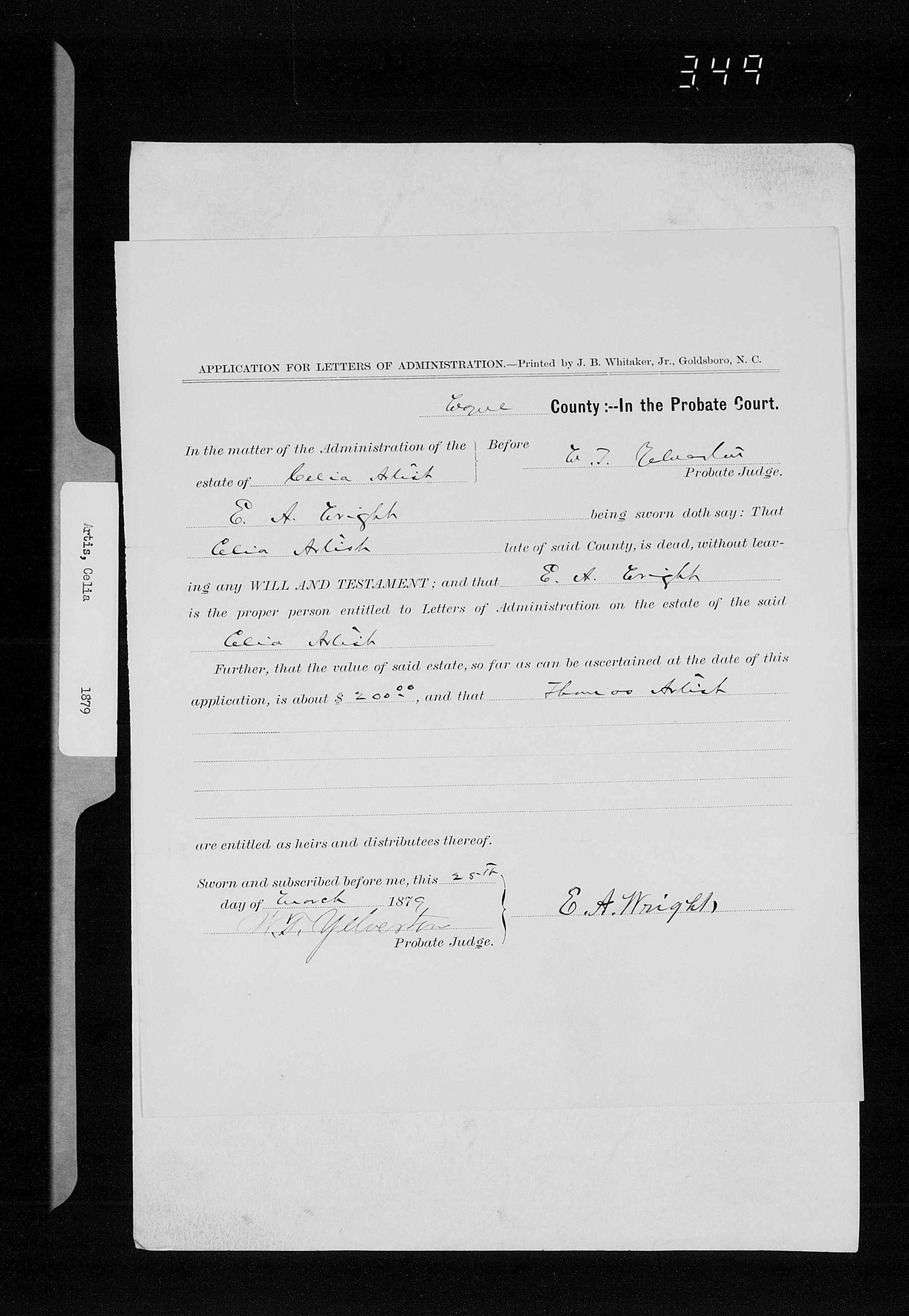
Neither Celia nor Simon appears in the 1870 census. It seems likely that Celia was alive for at least a few more years, however, as her estate was not opened until 1879. It was surprisingly small, suggesting that she had distributed most her land and valuables (or otherwise lost them) before her death. Son Thomas is listed as the sole heir to her $200 estate. I don’t know what became of Simon Pig.

record-image_TH-1971-35571-13786-29

Here’s what I know of Celia Artis’ children:

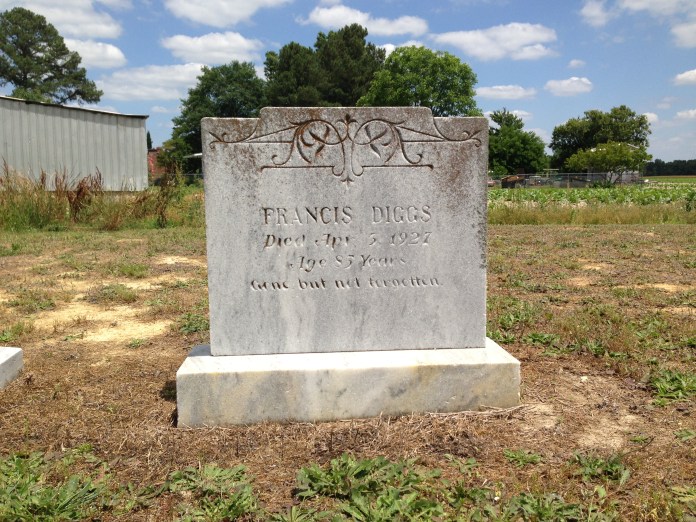
  • Eliza Artis was born circa 1816. She never married but had at least three daughters, Loumiza, Frances and Penina Artis. Descendants assert that the father of some or all of them was James Yelverton, a white farmer who lived nearby. Loumiza is known only from the 1850 and 1860 censuses. Frances was born about 1845. She never married but had at least two children, Sula and Margaret, allegedly by Wilson (or William) Diggs, whom she married in Wayne County on 15 October 1868. (Margaret’s daughters Etta and Minnie Diggs married William M. Artis and Leslie Artis, respectively, a son and grandson of Adam T. Artis. Sula’s daughter Lizzie Olivia married Leslie Artis’ brother Odell.) Penina, born about 1849, married James Newsome. Eliza’s will was filed in Wayne County:

In the Name of God Amen: I Eliza Artis of the County of Wayne and State of North Carolina being of sound mind and memory and considering the uncertainty of human life do therefore make Publish and declare this to be my last Will and testament: That is to say first after all my burial expenses are paid and discharged the residue of my estate. I give and bequeath and dispose of as follows to wit to John Newsom son of James Newsom and Penina Newsom Four Dollars to Francis Diggs all the balance of my personal and real estate that I may be in Possession of at my death during her Natural life and after the death of said Francis Diggs all of said Personal and real estate is to be equally divided between Francis Diggs’s three children Sula Artis Margrett Diggs and William Diggs Likewise I make constitute and appoint Noble Exum and George Exum to be my Executors to this my last Will and testament hereby revoking all former wills made by me In witness whereof I have hereunto subscribed my name and affixed my seal this the eleventh day of February in the year of our lord one Thousand eight hundred and Ninety  Eliza X Artice {seal} In the presence of Witnesses John H. Skinner, R.H. X Locus  Hand-written notation in margin: “See Book No 32 Page 320 Register of Deeds Office” [Wayne County Will Book 1, page 524]
IMG_2213

——

  • Letha Ann Artis (the “Ceatha” above) was born about 1820 and married John Artis. They lived in the Eureka area of Wayne County and their children included Sarah Artis, Zachary/Zachariah Artis, James Artis, Mildly Artis Baker (whose grandson Richard V. Baker married Lillie Odessa Artis, daughter of Henry J.B. Artis and granddaughter of Adam T. Artis), William Thomas Artis, Elizabeth Artis Brantham, and Jackson Artis. Letha Ann died circa 1896.

I Lethy Ann Artice of Nahunta Township, State of North Carolina being of sound mind and memory, do declare this to be my last will and testament. I give and bequeath to my son James Artice Five acres of land known as my fathers place to have to hold through his natural life, after his death to Maggie Artis his daughter. But should she want to live on said land before his death, I give her a right, so to do. I give and bequeath to Luby Baker and Anna Baker the children of Mildly Baker Four acres provided Mildly Baker shall be guardian for said children until they reach their majority. I give and bequeath to Bettie Bradford and Brantham Five acres land to have and to hold their natural life afterwards to their heirs. I give and bequeath to Zachary Artice Five acres land. I give and bequeath to John and Octavius the sons of Thomas Artis my son Four acres land if they should want to sell each other all right but no one else. I give and bequeath to Zachary his fathers chest. All heirs to pay Zachary Artice for burial expenses Sarah & Jackson, before coming in possession of the property I give. I also give to Zachary the big pot, I also give him his house, no matter on whose land it falls on. Be it understood I have already given Zachary ½ acre during my life time. I also gave Thomas Two Dollars and a Bull. I also give Baker a cow and calf, Betsey two Dollars I say this to show what I have given. Betsey and Mildly I give one bed a piece, my large bed to be divided between Tom & Zachary. I also give Maggie Artice James daughter, Sarahs chest. I also give the [illegible] and gear to Scintha Ann Artice. All the heirs, with Scintha Ann take my wearing clothes also House furniture also. But should Zachary want any particular thing, as he been my protector let him have it I appoint I.F. Ormond Executor of this will. In witness whereof I Letha Ann Artice have herewith set my hand and seal This 9th day of Oct 1892   Letha Ann X Artice Subscribed by the testator in the presence of each of us and declared by her to be the last will testament Witnesses   J.H. Skinner, Noble Exum  [Wayne County Will Book 2, page 184; proved 2 January 1897, Superior Court, Wayne County]

——

  • Zilpha Artis was born in the 1820s. She never married and had no known children. She died in 1882, leaving this will:

Know all men by these presents that I Zilpha Artis of the County of Wayne and State of North Carolina being of sound mind and memory but considering the uncertainty of life do make and declare this my last will and testament in manner and form following that is to say. That my Executor Philip Fort shall provide for my body a decent burial according to the wishes of my relatives and friend and pay all funeral expenses together with my just debts to whomsoever due out of the money that may first come into his as a part or parcel of my estate. I give and devise to my niece Francis Diggs all of my entire lands and all my household and Kitchen furniture to have and to hold to her the said Francis Diggs for and during the time of her natural life and after her death to be equally divided between her two children Sula Artis and Margaret Diggs their heirs and assigns forever I give and bequeath to my Sister Eliza Artis the sum of fifty cents I give and bequeath to my Sister Leatha Artis the sum of fifty cents I give and bequeath to Brother Calvin Artis the sum of fifty cents And I give and bequeath to my brother Thomas Artis the sum of fifty cents And lastly I do hereby appoint and constitute Phillip Fort my lawful executor to all intents and purposes to execute this my last will and testament according to the true intent and meaning of the same and every part and clause therein hereby revoking and declaring utterly void all other wills and testaments by me heretofore made. In testimony whereof I the said Zilpha Artis do hereunto set my hand and seal this 19th day of November A.D. 1881    Zilpha X Artis {seal} Signed and sealed in the presence of B.J. Person, John B. Person [Wayne County Will Book 1, page 245; proved 20 September 1882, Probate Court, Wayne County]

——

  • Simon Artis. I’ve found no record of Simon after his 1823 indenture to the Colemans.

——

  • Calvin Artis, known as Calv Pig, was born about 1830. In 1853, he married Serena Seaberry, daughter of Theophilus and Rachel Smith Seaberry and a cousin of Adam Artis’ wife (and my great-great-great-grandmother) Frances Seaberry Artis. Their children were Martha Artis Locus, Polly Artis, James Madison Artis (who married Adam T. Artis’ oldest daughter Caroline Coley), Henry T. Artis, Nettie Artis Exum, Ellen Artis, Talitha Artis, Simon Artis, and Jeffersonia Artis. Calvin seems to have died between 1880 and 1900.

——

——

Federal population, agricultural and slave schedules;Confederate Papers Relating to Citizens or Business Firms, 1861-1865, National Archives and Record Administration; Deeds, Register of Deeds Office, Wayne County Courthouse, Goldsboro; Will Books, Office of Clerk of Superior Court, Wayne County Courthouse, Goldsboro.

Standard
Births Deaths Marriages, Newspaper Articles, Paternal Kin, Photographs

In memoriam: Louise Daniel Hutchinson.

Louise Daniel Hutchinson, scholar of black history, dies at 86

By Emily Langer, The Washington Post, 26 October 2014.

WASHINGTON — Louise Daniel Hutchinson, who gathered, documented and preserved African-American history during 13 years as director of research at the Smithsonian Institution’s Anacostia Community Museum in Southeast Washington, died Oct. 12 at her home in Washington. She was 86.

The cause was vascular dementia, said a daughter, Donna Marshall.

Mrs. Hutchinson spent much of her adult life working to collect and share with others the richness of African-American history in Washington and beyond. In 1974, after years of community activism, she joined the Anacostia Neighborhood Museum, as it was then known. She retired in 1987.

Under the leadership of founding director John Kinard, she oversaw exhibits covering years of history in the Anacostia community, the movement of blacks from Africa to overseas colonies, and the life and accomplishments of Frederick Douglass, the former slave, abolitionist and distinguished writer.

She took particular interest in documenting the lives of African-American women such as Anna Cooper, who was born into slavery and became a noted educator and equal rights advocate. “Even black history hasn’t given black women their proper place,” Hutchinson once told the New York Times.

Gail Lowe, the Anacostia Community Museum’s senior historian, credited Mrs. Hutchinson with elevating the work of the research department and using individual life stories to illuminate broader history. “In telling the local stories,” Lowe said in an interview, “she validated community experiences.” Mrs. Hutchinson was “a stickler for accuracy and authenticity,” Lowe said, and insisted researchers keep magnifying glasses on hand for the close inspection of old photographs. Hutchinson, Lowe recalled, spotted Harriet Tubman and W.E.B. Du Bois in previously unidentified images.

“Because of the level and depth of her work,” Lowe said, “she was able to … provide accurate, documented information that other researchers and scholars relied on.”

Louise Hazel Daniel, one of nine children, was born June 3, 1928, in Ridge, Maryland, and raised in the Shaw neighborhood of Washington. Her parents, Victor Hugo Daniel and Constance E.H. Daniel, were teachers and friends of the African-American intellectuals and educators George Washington Carver and Mary McLeod Bethune.

After graduating in 1946 from the old Armstrong Technical High School in Washington, Mrs. Hutchinson attended colleges including Howard University and did secretarial work before beginning her career in historical preservation. In the 1970s, she assisted curators at the Smithsonian’s National Portrait Gallery with the selection of paintings featuring prominent African-Americans, her daughter said.

Mrs. Hutchinson’s writings included the books “The Anacostia Story, 1608-1930″ in 1977, “Out of Africa: From West African Kingdoms to Colonization” in 1979 and “Anna J. Cooper: A Voice from the South” in 1981.

Mrs. Hutchinson’s daughter Laura Hutchinson died in infancy, and her son Mark Hutchinson died in 1974, at age 8, of a brain tumor.

Survivors include her husband of 64 years, Ellsworth Hutchinson Jr. of Washington; five children, Ronald Hutchinson of Fort Washington, Maryland, David Hutchinson of Clifton Park, New York, Donna Marshall of Laurel, Maryland, Dana McCoy of Washington and Victoria Boston of Clinton, Maryland; two brothers, John Daniel of Washington and Robert Daniel of Atlanta; a sister, C. Dorothea Lawson of Bay City, Texas; five grandchildren; and two great-grandchildren.

In addition to her museum work, Mrs. Hutchinson participated in such initiatives as the development of D.C. public school curriculum in the 1980s, which incorporated the roles of black leaders in local events.

“I have real concerns about accuracy of history,” she told The Washington Post. “I believe it must reflect [the] participation of all.”

——

I met my Dudley cousins in the fall of 1985, just in time to be invited to the first (and last, as it were) Henderson-Aldridge Reunion in July 1986. That weekend turned out to have been a fortuitous window of time, in which I was privileged to meet so many elders not long for this world. Had I been more conscientious and intentional, I could have learned so much more than I did, but that’s a genealogist’s perennial regret. So many kin I saw only that one time — Johnnie “Dink” Henderson, Freeman Aldridge Sr., H.B. Wynn, Evelyn Williams McKissick, Virginia Aldridge Oldham. With others, however, I built relationships that lasted years.
Last night, I found Louise Daniel Hutchinson’s obituary. Her husband Ellsworth Hutchinson Jr., my cousin, sent me a copy of her work on Anna Julia Cooper shortly after the 1986 reunion. It was my introduction to the incredible Cooper, though she is from my home state. It was also an introduction to the wonderful work that Cousin Louise did as a researcher and historian. As we traded information about our Aldridge links — Cousin Ellsworth’s grandfather Zebedee Aldridge was my great-grandfather Thomas Aldridge‘s brother — she challenged me to take seriously and document diligently the stories of everyday families. In 2001, I spent a few days with her and Ellsworth at their home in Anacostia, poring over and copying family photos and lapping up her wisdom and knowledge of D.C.’s African-American history. We had lost contact as her health declined, but I have always treasured her warmth and encouragement and hope that in some small way, Scuffalong:Genealogy honors her memory.
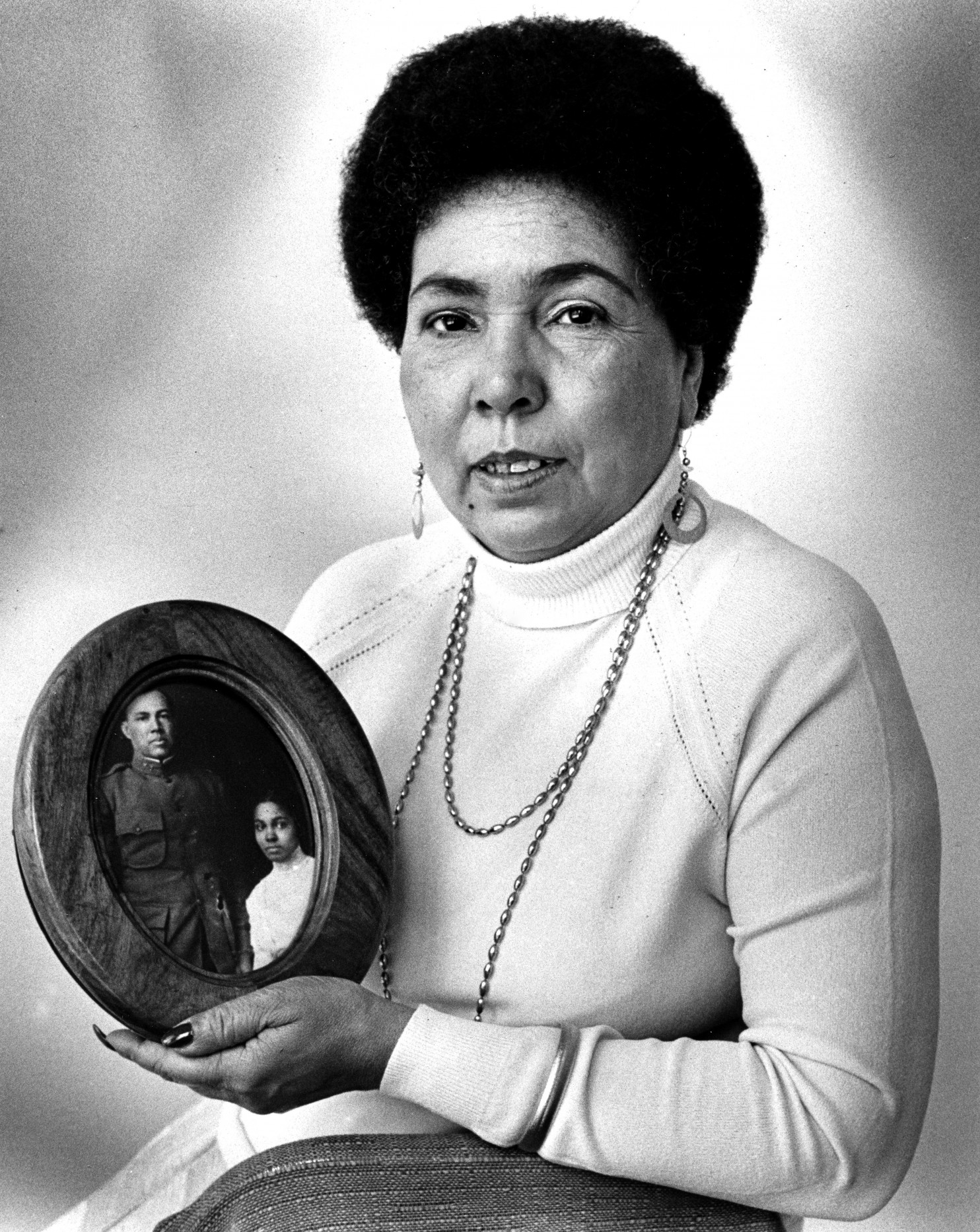
ob-main-hutchinson25-0011414257190
Louise Daniel Hutchinson holding a photo of her parents. Courtesy of The Washington Post.
Standard
Education, Other Documents, Paternal Kin

Bison.

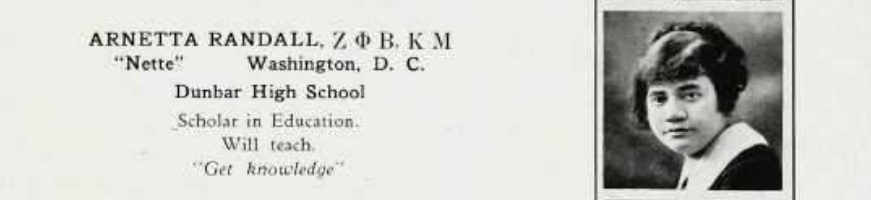
I’ve been striking gold with the Randalls. A number of Howard University’s yearbooks have been digitized, and searches of random years yielded these Randall collegians, as well as a cousin descended through their grandmother Fannie‘s brother Matthew: Screen Shot 2015-07-05 at 8.13.44 PM

Arnetta L. Randall, Class of 1925.

Arnetta was the second daughter and seventh child of George and Fannie Aldridge Randall. (Oscar and Fred Randall were among her brothers.) A teacher and lifelong resident of the District, she never married.

——

Screen Shot 2015-07-12 at 1.38.01 PM

Screen Shot 2015-07-12 at 1.45.27 PM

Mable Margaret Williams, Class of 1933.

Screen Shot 2015-07-05 at 8.24.02 PM

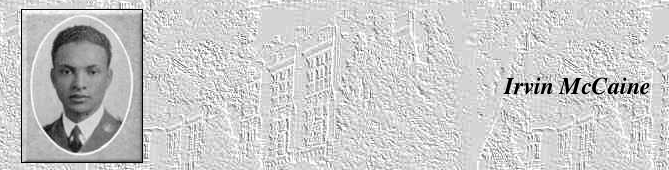
Irvin LeFetus McCaine, Class of 1934.

Irvin L. McCaine married Mable Margaret Williams, daughter of Clarence J. and Daisy B. Aldridge Williams of Goldsboro and later Asheville, North Carolina. Mable’s maternal grandparents were Matthew W. and Fannie Kennedy Aldridge. Here’s Cousin Irvin in high school (Class of 1929), courtesy of an Oakland High School memorial website:

Screen Shot 2015-07-05 at 11.00.51 PM

——Screen Shot 2015-07-05 at 8.02.52 PM

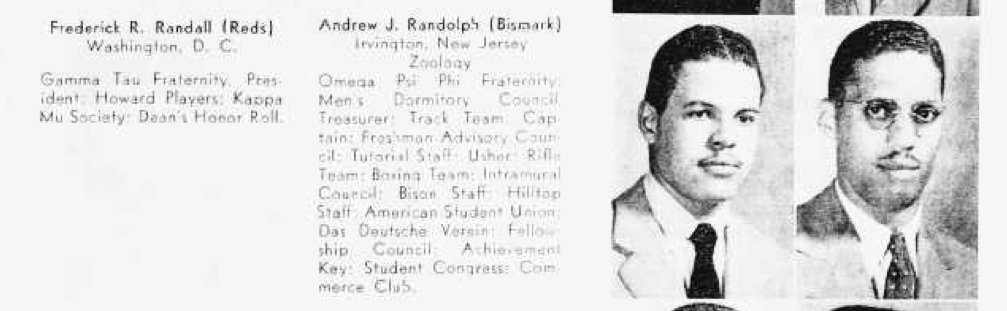
Frederick Russell Randall, Class of 1942.

Son of Fred R. and Lucille Stewart Randall, Frederick Randall also attended medical school at Howard and briefly practiced at the hospital there before moving to New York City. (Ada Randall Reeves was his sister.)

Screen Shot 2015-07-05 at 10.10.03 PM

The Crisis, December 1962.

Ten or 15 years ago, I received an email message from a professional genealogist in New York who had been hired to research Dr. Frederick Randall’s family. Through her I learned what had become of my great-great-grandfather’s youngest sister Frances Aldridge Locust — Cousin Frederick’s grandmother — whom I’d lost track of after her marriage. She and her husband had changed their surname to Randall, it turns out, and moved to Washington DC. The genealogist and I exchanged information over the course of several emails and letters, and I spoke with Cousin Frederick by phone — among other things, about his interaction with his cousin, and my great-grandfather J. Thomas Aldridge — but I never got the opportunity to meet him. I Googled his name tonight and found this:

RANDALL–Frederick R., MD. 91. Former Surgeon and Professor of Surgery at Columbia-Presbyterian Medical Center. He had compassion for his patients; and wisdom for his students. A devoted husband and loving father, he leaves Elizabeth [W. Glover], his wife of over 68 years and his sons, Derek and John. A bereaved family is consoled by cherished memories. What be it worth the life of a man, but that which he himself has given to it? This strong man gave much. Published in The New York Times on Apr. 6, 2014.
Standard
Land, North Carolina, Other Documents, Paternal Kin

Cousins and covenants.

“In November of 1945, Ada Reeves bought a charming little bungalow at 1303 Kearny St. NE in Brookland. She expected to move in without any problems, but instead was sued by her neighbors. The cause? The color of her skin. Ada Reeves was African American, and her new home’s deed contained a covenant that said the house was not to be sold to a black person.”

While running a Google search for Fred R. Randall, I happened upon a blog dedicated to the history of Brookland, a neighborhood in northeast Washington DC. A December post on racially restrictive covenants opened with the sentences above. Further down: “As for the case of Ada Reeves: her father, Fred Randall, contacted Charles Hamilton Houston in 1945 to look into the case,” and copies of a letter from Randal to Houston. Charles Hamilton Houston, called “The Man Who Killed Jim Crow” was an early African-American civil rights lawyer and mentor to Thurgood Marshall. And Fred Randall is Cousin Fred.

Many thanks to Bygone Brookland, and for the full post, see here.

Standard
Other Documents, Paternal Kin, Photographs

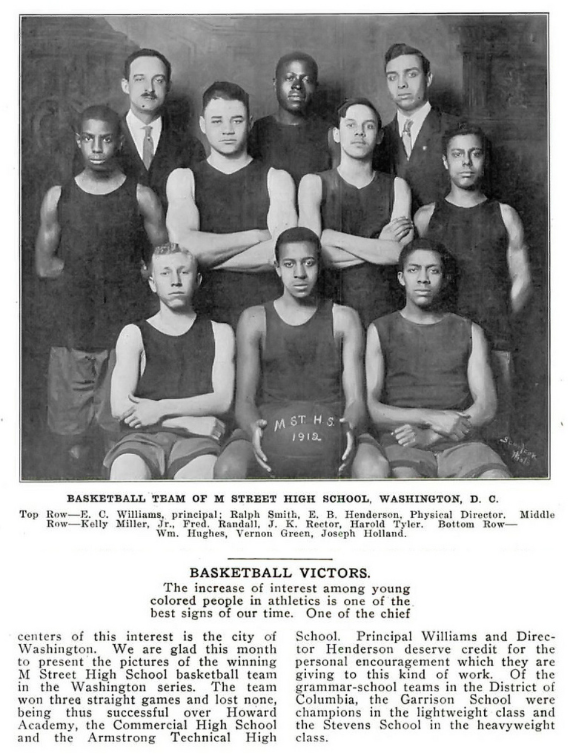
Basketball victors.

Screen Shot 2015-07-04 at 10.00.37 PM

Many thanks to Dena Banks for pointing out this post in Vieilles Annonces’ Flickr feed. It’s from the March 1912 issue of the NAACP’s The Crisis. (The first 25 years of which I have on CD; I need to study this thing more carefully.) Fred Randall was the 17 year-old son of George and Fannie Aldridge Randall, who migrated from Wayne County to Washington DC in the late 1890s. (Fannie Aldridge Randall, formerly known as Frances Aldridge Locust, was the sister of my great-great-grandfather John W. Aldridge.) Randall’s interest in athletics did not end in high school. As just posted here, he went on to become director of the city’s Cardozo Playground.

Standard