Education, North Carolina, Photographs

Spaulding remembers.

Last night, the C.C. Spaulding High School Class of 1965 honored my father at their 50th reunion banquet. He began his coaching and teaching career at this little school in Spring Hope, North Carolina, newly married and fresh out of Saint Augustine’s College. Seven years past Brown v. Board of Education, Nash County schools were still segregated, and the children of Spaulding were mostly from struggling farm families. Neither slender resources at home nor paltry county funding could tamp down a spirit of camaraderie and pride in achievement that lasts even to this day.  Occasionally, when I’m home, we will run into one of my father’s old students or players — now in their late 60s — and they always beam to see him, the first of generations of young men and women who benefitted from his tough, but unstinting, guidance.

I took these photos of Spaulding’s gymnasium on a road ramble in November 2011. The school, now a community center, still anchors little Spring Hope. I have no independent memory of Spaulding — my father left for Rocky Mount City Schools in the late ’60s — but I was cradled there. My mother tells me that, at basketball games, teenaged girls would volunteer to change my diaper while she cheered the team on. The class of ’65 was the first to know me, and I thank them.

IMG_6721

IMG_6734

Little has changed.

Spaulding 65

Spaulding High School Class of 1965.

Standard
Births Deaths Marriages, Maternal Kin, North Carolina, Photographs

The things you overcome and master.

Sville_R_amp_L_417_1944_JWStockton_poem

Statesville Record & Landmark, 17 April 1944.

John Walker Stockton was the oldest son of Eugene and Ida May Colvert Stockton, who named him for his grandfather, John Walker Colvert. Born in February 1910, he was just over a year younger than my grandmother and just ten months older than her sister Launie Mae — his first cousins. However, though they lived blocks apart, the families were not close. My grandmother never mentioned him in her recollections and, if he or any of the Stocktons were invited to reunions, they did not come. I was stunned to learn, then, that John Stockton lived until 2000. And he was in Statesville that whole time.

In the 1930 census of Statesville, Iredell County, at 214 Garfield Street (owned and valued at $4000), the census taker found  brick mason Eugene Stockton, 57, wife Ida M., 45, and children John, Lili M., Sara, Alonzo, Winifred, and Eugene Jr. Ten years later, John was working as a hospital orderly and living at 429 Harrison Street with “Lilly” Colvert, 48, and her son George, 23. Though John was described as Lillie Mae’s cousin, he was in fact her nephew. (Ida May named her daughter Lillie Mae Stockton after her sister Lillie Mae Colvert.) Lillie, who worked as a maid, indicated that she had had two years of high school, and George, a hotel bellhop, four. John, to my surprise, had had a year of college. (Where? Johnson C. Smith — where his younger brothers Alonzo and Eugene matriculated? Nearby Livingston? Why did he leave?)

Later that year, John registered for the World War II draft. He was 30 years old; I don’t believe he ever served.

32892_1821100519_0081-03359

The back of the card noted that he had brown eyes and black hair and a mole on his nose, that he had a dark brown complexion, and that he stood 5’8 1/2″, 157 lbs. (Slighter than I thought. The Colverts were not big people, but I somehow envisioned him taller.) Davis, the hospital at which he worked, is still in operation, but in a different location. The original building, now a moldering wreck, attracts urban explorers and mystery seekers who believe it haunted.

On 1 April 1945, almost exactly a year after “Hero or Heel” was anthologized, John Stockton married Nera Clemons Sharpe, daughter of Hobart and Mary James Sharpe. The couple had no children, but were married 54 years before John’s death and are buried together at Iredell Memorial Gardens.

Picture_016

John Walker Stockton. (I love everything about this photograph.)

Standard
Education, Migration, Oral History, Paternal Kin, Photographs

Back to school.

Atlanta has begun its new school year, and my Facebook timeline feed is dotted with pictures of beaming children. Just about a hundred years ago, my grandmothers started school for the first time. I have no photos of my father’s mother at that age, but she spoke to me of her anxious first days at an elementary school in New York City. She’d gone there with her great-aunt and adoptive mother, Sarah Henderson Jacobs, who occasionally traveled North for short stints of domestic work:

The first day I ever went to school, Frances [Aldridge Newsome, her paternal aunt] took me and her son Edward to school. And the building – I don’t remember what the building looked like inside – but I know we went in, and they had little benches, at least it was built around in the room. And you could stand there by it and mark on your paper if you wanted to or whatever. I didn’t see no seats in there. You sit on the same thing you were writing on.   It’s in that, it seem like, from what I remember, it was down in the basement. You had to go down there, and the benches was all the way ‘round the room. And the teacher’s desk — and she had a desk in there. And the children sat on the desk, or you stand there by it, or kneel down if you want to mark on it. First grade, you ain’t know nothing ‘bout no writing no how. And I went in, and I just looked. I just, I didn’t do nothing. I just sit there on top of the desk. And I was crying. I went back to Frances’ house, and then after they come picked us up, I said, well, “Frances, I want to go home.” Go where Mama was. So Frances said, “We’ll go tomorrow.” I said, “How come we can’t go today?”   She said, “Well, it’s too far to go now.” I said, “Well, can you call her?” And she said, “I don’t know the phone number, and I don’t know the name it’s in.” And so that kind of threw me; I finally went on to bed. But anyway before long they all took me back over to Brooklyn.

My mother’s mother also spoke of her early school days:

I never shall forget, we went to Golar’s school when there was a flu epidemic at home, and the schools were closed for months, you know. I don’t know how or why they closed them like that, but anyway, they were closed. And the county schools were open. And Papa used to take us down there to [her sister] Golar’s school. She had a school down there below Belmont. It wasn’t called Belmont. What’s the other one called? She had a little school in Williams Grove. And taught me so much more than them city schools. Girl, I’m telling you, I was in second grade, I never shall forget, she taught me how to crochet. She taught me how to crochet. She taught me how to do divisions. She taught me how to do fractions.

Morningside School 2

Margaret Colvert Allen, seated far right, third row. Circa 1915, Statesville.

Morningside School 3

Margaret C. Allen, second from right, second row from top. Her sister Launie Mae Colvert Jones, at left, first row of middle section. Circa 1916, Statesville.

Interviews of Hattie Henderson Ricks and Margaret Colvert Allen by Lisa Y. Henderson; all rights reserved.

Standard
Births Deaths Marriages, North Carolina, Paternal Kin, Photographs

The brothers.

Yesterday would have been Cousin Snook’s 92nd birthday. My grandmother spoke of him and his oldest brothers in tandem — “Snook, Dink and Jabbo.” They were her double cousins, the sons of her second cousin once removed Henry Lee Henderson and her aunt Nora Aldridge Henderson. Jabbo died early, without children, but my relationships with Dink and Snook’s descendants, as well as with their surviving youngest brother, are deeply cherished.

Dink and Snook

Johnnie D. “Dink” Henderson (1925-1992) and Horace B. “Snook” Henderson (1923-1984).

Aaron Henderson

Aaron H. “Jabbo” Henderson (1922-1944).

Standard
North Carolina, Paternal Kin, Photographs

Bessie, in color.

I’ve talked about Bessie Henderson‘s portrait before. It is perhaps the most cherished of the original photographs I hold, likely the only picture taken in her short life.

I recently asked my cousin J.G., great-grandson of Bessie’s first cousin Daniel Simmons, if he would take a shot at colorizing Bessie’s photograph. She died at 19 in early 1911, and no one now living ever saw her alive. (In fact, I’ve known only five people — my grandmother, her sister Mamie, Beulah Aldridge CarterFannie Aldridge Randolph, Jessie Mae Jacobs — who did. The last of them passed in 2001.) So I just wanted to see her as she might have looked. See her in something other than sepia tone.

And here she is.

Bessie Henderson 001 - before after side by side-2

I was struck on two fronts. First, there is Bessie’s beauty anew. And then … the detail. The lacy ruffles of her blouse, the tiny collar pin bar, the pleats of her skirt. And the background? It was years before I saw the white bird swooping past Bessie’s wrist. But trees? A pool of water? Ducks? Who knew?

Here’s a little video of Bessie’s progression. Thank you again, J.G.!

Standard
Births Deaths Marriages, Maternal Kin, Photographs

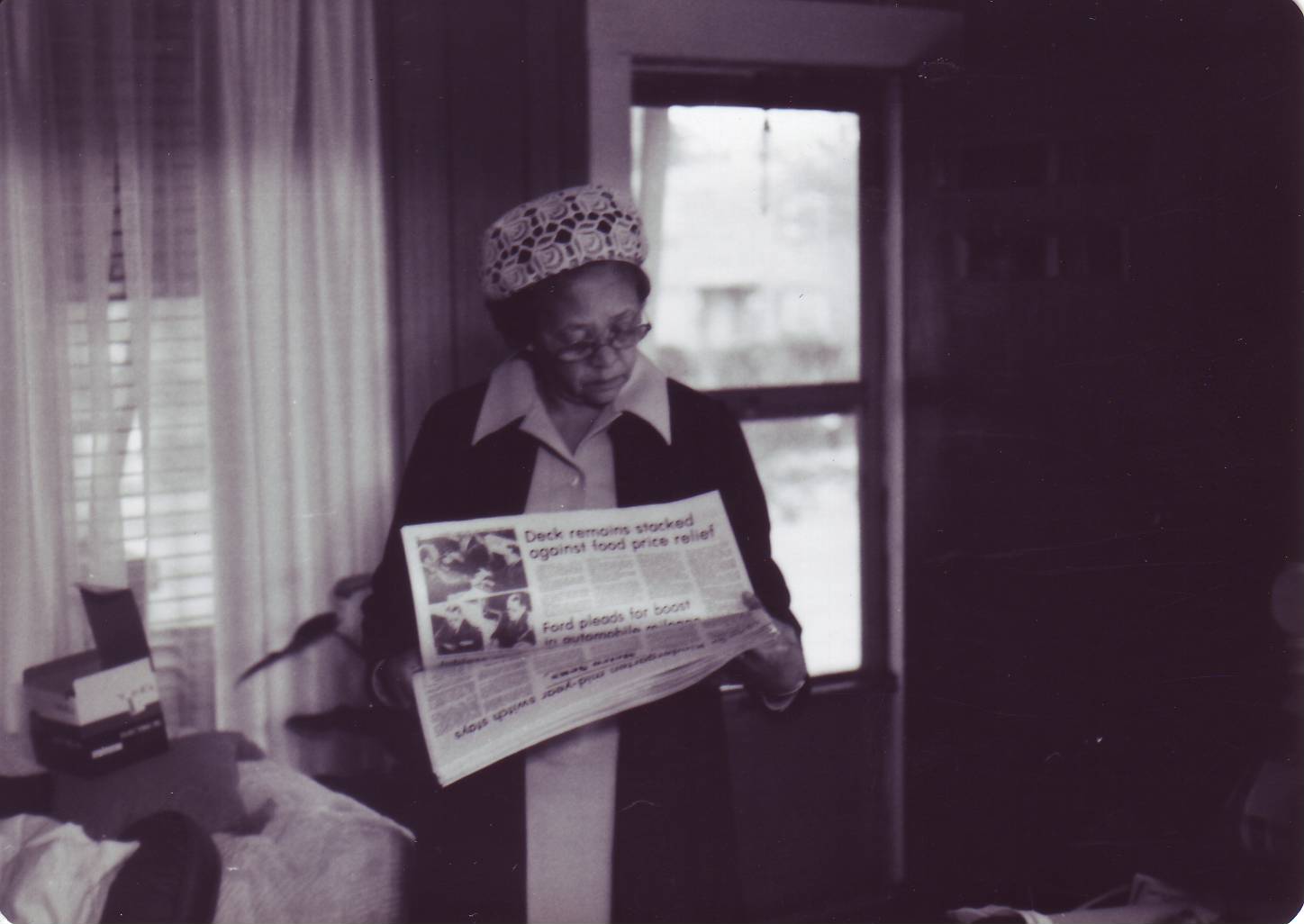
MY grandmother.

Every time I see you as a little girl, I think of one time you came, and I was going Overtown and you said you were going with me. You wanted to go with me. So I carried you with me, and I saw a lady I had been working with, and she had a granddaughter named Lisa, too. And so she said, “Oh, hello, Grandmother, you have your Lisa, too!” And I said, “I have my Lisa, too.” And you said, “Don’t call her Grandmother ‘cause she is not your grandmother.” That lady just laughed about that thing. You said, “Don’t call her Grandmother. She is not your grandmother. She is my grandmother.” Yes, sir. But you were ‘sleep before I got to Orcutt Avenue.

Margaret Allen newspaper

Margaret Colvert Allen (2 August 1908-11 February 2010)

Missing my grandmother on her birthday.

Standard
Births Deaths Marriages, Maternal Kin, Migration, North Carolina, Oral History, Other Documents, Photographs, Vocation

His name was Golar, and we called him “Doc.”

My grandmother:  He had a brother that was a barber. His name was Golar, and we called him “Doc.” Papa had him in there. Papa had a chair, and Doc had the second chair, and Walker had the third chair. 

Harvey Golar Tomlin was the only one of Harriet Nicholson Tomlin Hart‘s second set of children to see the twentieth century. Harriet and Abner Tomlin had as many as six children together, but I only know the names of three — Milas, Lena and Harvey Golar.

After Ab’s death about 1899, and perhaps Lena’s around that time, too, Harriet packed up her youngest son and took him to Charlotte, where they are found in the 1900 census living at 611 East Stonewall with Harriet’s half-brother William H. Nicholson. This photo may have been taken there:

NICHOLSON -- Doc Tomlin

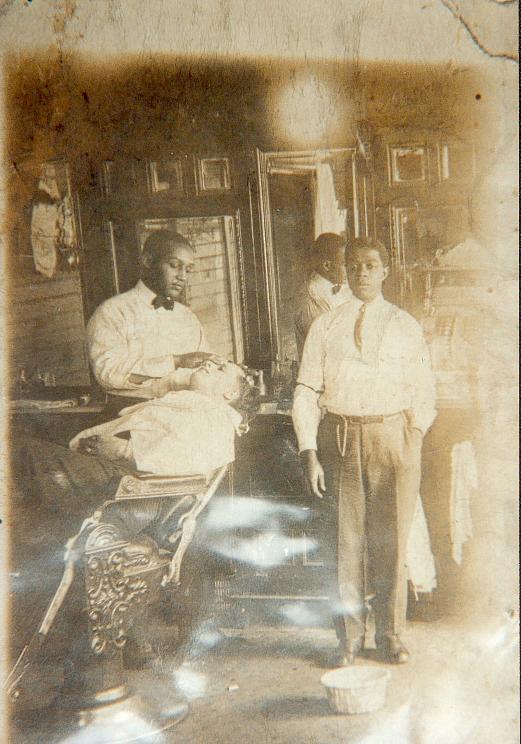
They did not stay long. In 1902, Harriet gave birth to Bertha Mae Hart, whose father Alonzo she married in 1904. By 1910, Harvey Golar, called “Doc,” had left his mother and stepfather’s household and was living in the Wallacetown neighborhood of Statesville with his half-brother and family: Lon W. Colvert, a barber, wife Caroline, and children Mattie, Gola, Walker, Louise, and Margaret (my grandmother). He trained under Lon and went to work in his shop. In the photo below, which can be dated to 1917 by another taken at the same time and showing a calendar, Doc appears with Lon’s son Walker and a client.
COLVERT -- Barbershop 1

On 11 Jan 1917, H.G. Tomlin sold a parcel of land to L.W. Colvert and wife Carrie Colvert for $10.  In a deed filed at Iredell County Courthouse, the land was described as “Beginning at a stake at a post oak, Ramsour’s old corner, running North 88 W. 16 1/2 poles to a stake on road East of the track of the A.T. & O. R.R.; thence S. 8 W. 9 1/2 poles to a stake Pearson’s corner; thence S. 88 E. 16 1/2 poles to a stake; thence N. 8 E. 9 1/2 poles to the beginning, containing one acre more or less and being the identical lands conveyed by William Pearson and wife to Abb. Tomlin by deed, dated 19th day of June, 1891 and recorded in deed Book No. 17 at page 101 of the Records of Deeds of Iredell County.”  Doc apparently had inherited the property from his deceased father, though I’ve found no estate file.

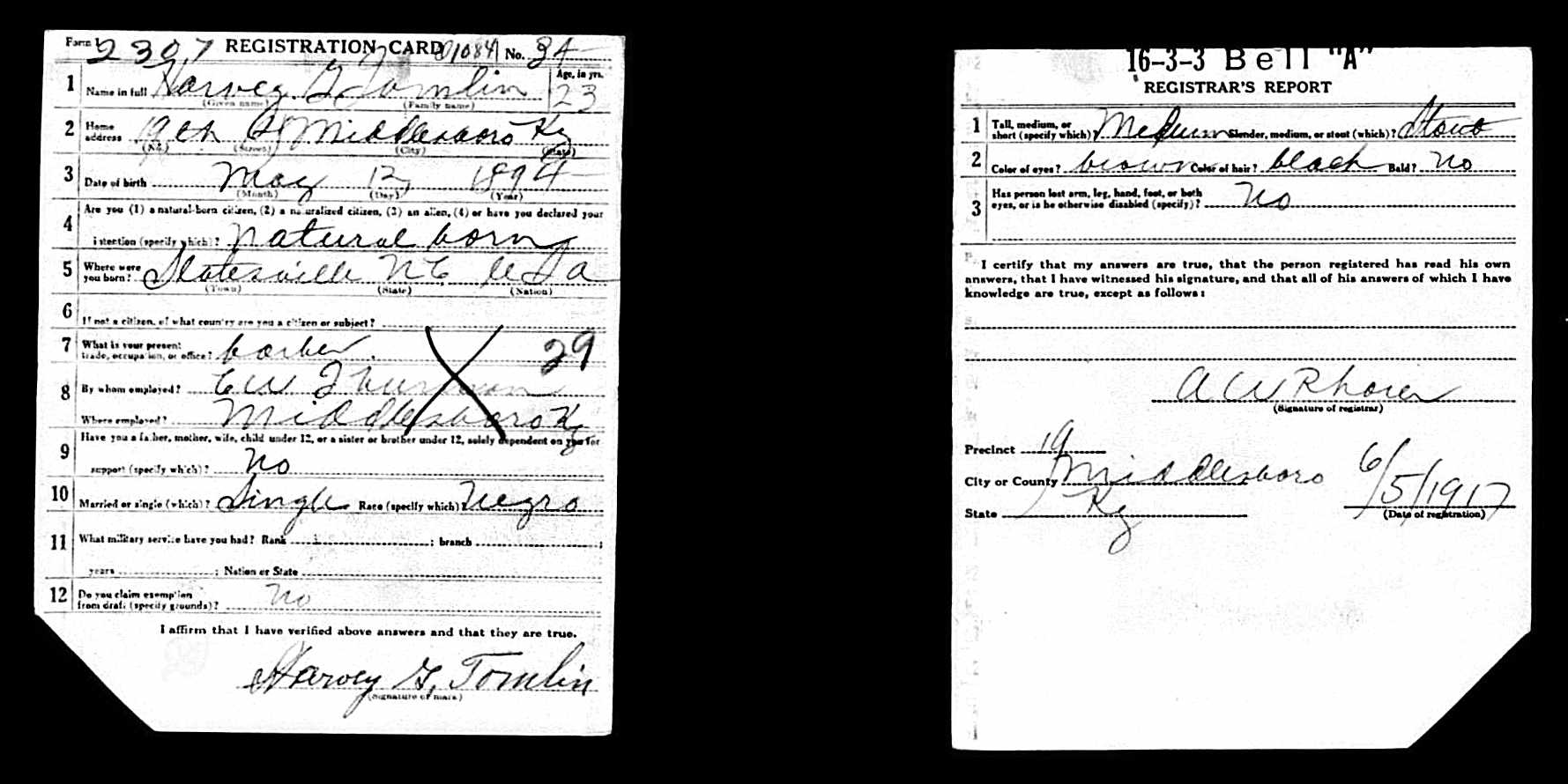
Doc was possibly liquidating his assets as he pulled up stakes in Iredell County. Five months later, he registered for the World War I draft in Middlesboro, Bell County, Kentucky. (Middlesboro, Kentucky? What was the pull? The push?) Though he was prime age and had no infirmities, I have no evidence that he ever served in the military.

005150645_02349

In any case, Doc seems not to have stayed gone for long. On 7 September 1918, Harvey Golar Tomlin applied for a marriage license for himself, of Iredell County, age 24, colored, son of Ab Tomlin (dead) and Hattie Hart (living), and Flossie M. Stockton of Iredell County, age 24, colored, daughter of Mr. and Mrs. Henry Stockton, both dead.  L.W. Colvert witnessed the application, and W.O. Carrington, minister of the A.M.E. Zion Church, married the parties on 8 September 1918 before L.W. Colvert, N.S. Allison, and Eugene Stockton.  (Flossie was the sister of Dillard and Eugene Stockton, both of whom married Lon Colvert’s half-sister Ida Mae Colvert.)

42091_334854-00723

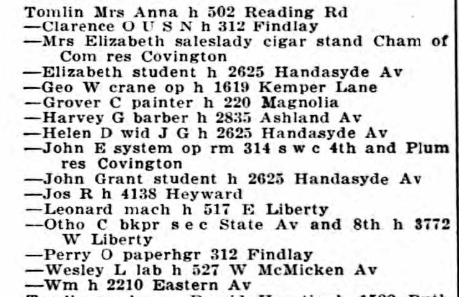
The couple’s only child, Annie Lavaughn Tomlin, was born 9 August 1919 in Statesville. At least part of that year, however, Doc was in Louisville, Kentucky, as shown in the city’s 1919 directory:

Screen Shot 2015-07-24 at 3.37.52 PM

The 1920 census shows the family in the north Statesville suburbs: Jessie Stockton, age 28; his sister Flossie Tomlin, age 25, a public school teacher; niece Anna L. Tomlin, 4 month; and brother-in-law Havey Tomlin, age 26, barber. Doc’s last-place listing in the household is telling. Was he really there? Or tacked on as an afterthought because, after all, he was Flossie’s husband?

There are clues. Both Flossie and Doc were enumerated twice in the 1920 census. On Garfield Street in Statesville, public schoolteacher Flossie Tomlin and her daughter Annie L. appear in the household of Flossie’s brother Eugene Stockton, his sister-in-law (technically, but in reality his common law wife) Ida M., and their four children. The enumerator recorded this household in January 6, 1920. Seven or eight days later, however, 200 miles away in Lynch, Harlan County, Kentucky, another censustaker recorded 26 year-old North Carolina-born barber Harvie Tomlin as a roomer in the household of barbershop manager Alex R. Simpson and his wife, Lina. Then on March 3, Flossie and Annie were recorded in Jesse’s house, above. I’d bet money that Doc was actually in Kentucky.

I don’t know where Doc spent the 1920s, but it was more likely that he drifted around the Appalachian Plateau than returned to Statesville. There are glimpses.

For example, in the 1925 Dayton, Ohio, city directory:

Screen Shot 2015-07-24 at 9.28.55 PM

And then the 1926 Portsmouth, Ohio, city directory:

Screen Shot 2015-07-24 at 9.31.39 PM

Doc did not stay long at the Play House. On 19 May 1927, the barbershop ran an ad in an announcement of the grand re-opening of the Play House building and its businesses. Harvey G. Tomlin is not among the barbers listed:

Portsmouth_Daily_Times_Thu__May_19__1927_

The 1930 census found barber Harvey Tomlin in Carnegie, Allegheny County, Pennsylvania, living at 205 Broadway in the household of Sabry Goldsmith, a 35 year-old Florida-born barbershop proprietor. He was described as single.

Perhaps he was.

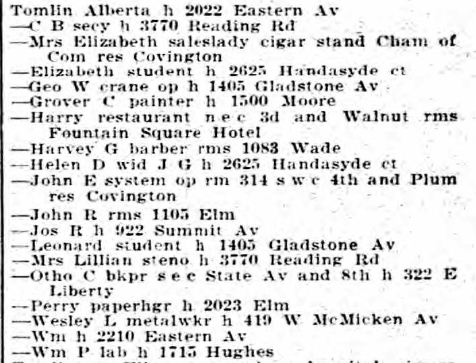
The 1932 city directory of Cincinnati, Ohio, shows Doc living in a boarding house on Wade Street:
Screen Shot 2015-07-24 at 3.35.59 PM

However, on 6 July 1933, in Newport, Campbell County, Kentucky, Harvy G. Tomlin, 40, colored, divorced, born in North Carolina to Ab and Harriett Tomlin and a resident of “Cin. O.” married Lena R. Simpson, 49, colored, widowed, born in Kentucky to John and Elizabeth [no last name reported]. Thomas Hanly, J.P., performed the ceremony before Helen Peddiford and Helen Byers. The couple had applied for the license in neighboring Kenyon County, Kentucky. Lena Simpson, you may recall, was married to Doc’s employer and landlord at the time of the 1920 census.

The 1936 Cincinnati city directory shows Doc living in a house, presumably having found SROs unsuitable to married life:
Screen Shot 2015-07-24 at 3.37.14 PM

In the 1940 census of Cincinnati, Hamilton township, in a rented two-family house at 943 Monastery Road, the census taker encountered Harvey G. Tomlin, 48, and Lena R. Tomlin, 58. Harvey apparently had put down his barbering tools and worked as a butler for a private family. The couple are erroneously described as white, and their birthplaces are reversed. (Harvey’s is listed as Kentucky; Lena’s, as North Carolina.)

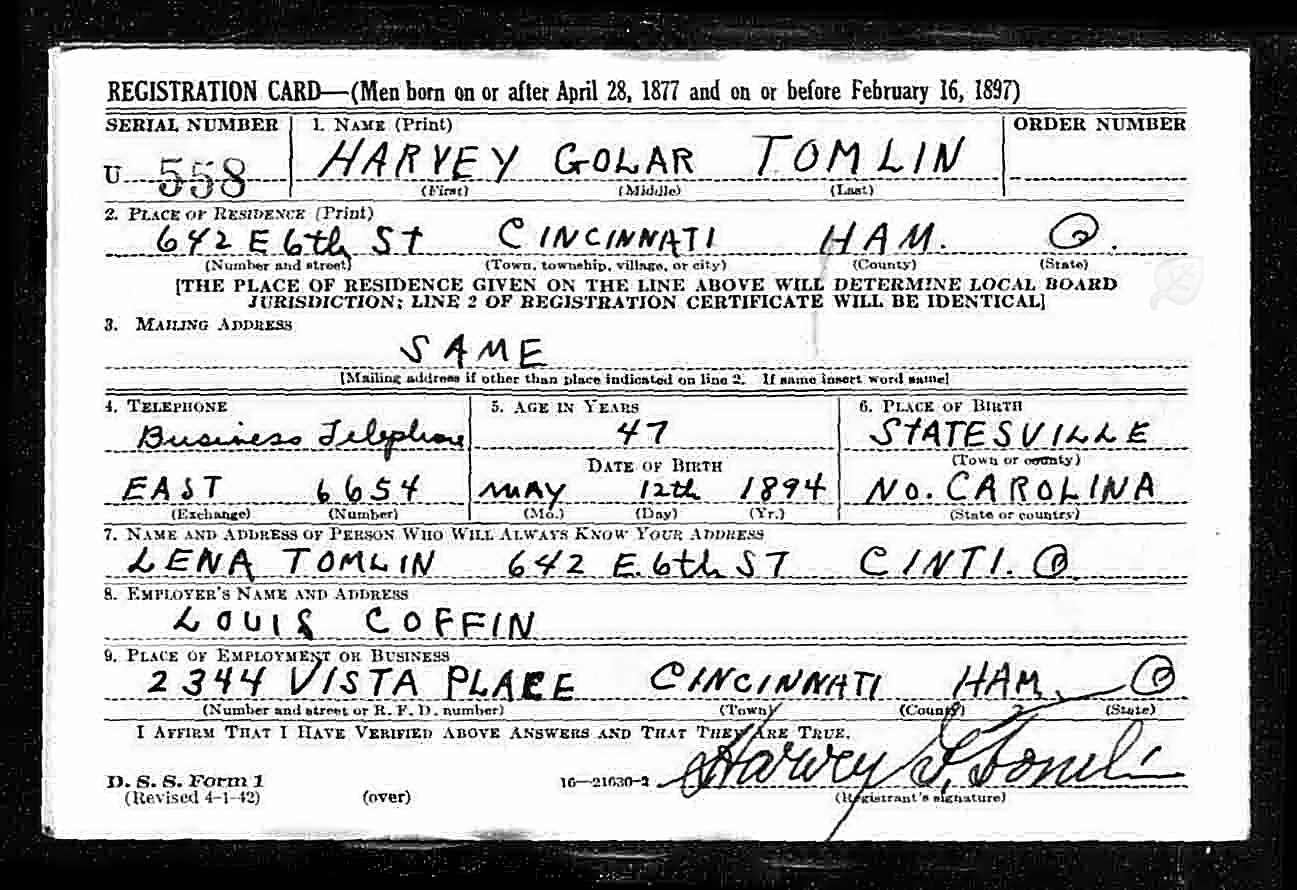
Two years later, despite a negligible chance of being called up, Harvey Golar Tomlin registered for the World War II draft in Cincinnati.

004151102_00088

The back of the card noted that he was 5’4″ tall and weighed 198 pounds and that he had brown eyes, black hair and dark skin.

The following year, Doc returned to Statesville to obtain a so-called delayed birth certificate. It was filed on 31 July 1943, showing that Harvey Golar Tomlin was born 12 May 1894 in Statesville, that his birth was attended by Dr. Long, and that his parents were Abb Tomlin, colored, born 1852 in Iredell County, and Harriet Nicholson, colored, born 1862 in Iredell County NC.

I lose sight of Doc for more than a decade until the Statesville Record & Landmark posted a brief article on 8 June 1955 mentioning that Bertha Hart Murdock had left half-interests in a lot to her brother “Harry” G. Tomlin and niece LaVaughn Schuyler.

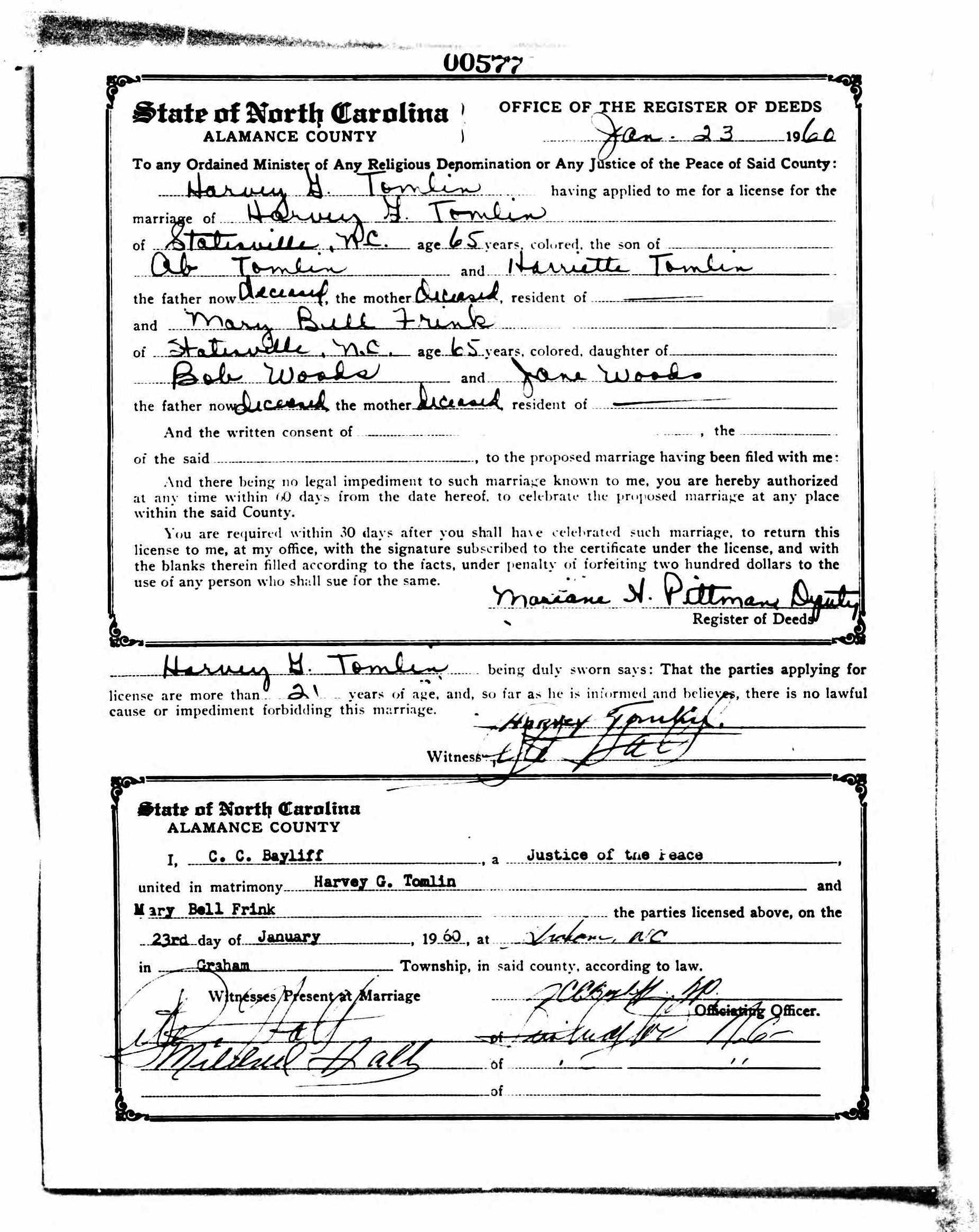
Lena Tomlin died 17 July 1959 in Cincinnati. Doc did not grieve long for he was back in Statesville getting married six months later. In another small-world, keep-it-in-the-family moment, Doc’s third wife, Mary Bell Frink, was the widow of William Luther McNeely, whose sister Caroline married Doc’s brother Lon Colvert.

42091_327534-00581

It was a short-lived union. On 8 May 1961, Harvey G. Tomlin, son of Abbe Tomlin and Harriet last-name-unknown, died in Statesville of coronary thrombosis. He had been living at 229 Garfield Street (Ida Colvert Stockton lived at 214 Garfield) and working as a butler.

I’ve been able to find very little about Doc’s only child. Social Security records indicate that Lavaughn Tomlin married a Scruggs in about 1943 and a Schuyler about 1953. She lived in Jamestown, New York, in the 1940s and died 30 May 1997 in Salisbury, North Carolina. An abstract of her death certificate reveals that she had worked as a registered nurse. She was my grandmother’s first cousin. Did she know her at all?

[Follow-up, 5 August 2015: I just found this snippet in which my grandmother mentions Doc being in the Midwest:

My grandmother: And he [her brother Walker Colvert] got a girl pregnant, and Papa sent him to Kentucky rather – so that he wouldn’t have to marry that girl.

Me: Really?

Grandma: Yes, he did.

Me: What did he do in Kentucky?

Grandma: He was a barber out there.

Me: Oh, okay.

Grandma: And I had, I had an uncle. Uncle – I don’t know if you’ve seen Doc or not. … Doc was out there. In Louisville. And he sent for Walker. And Papa sent him out there ….]

Interview of Margaret C. Allen by Lisa Y. Henderson; all rights reserved.

Standard
Agriculture, Land, North Carolina, Other Documents, Paternal Kin, Photographs

Swamps and sandy loams.

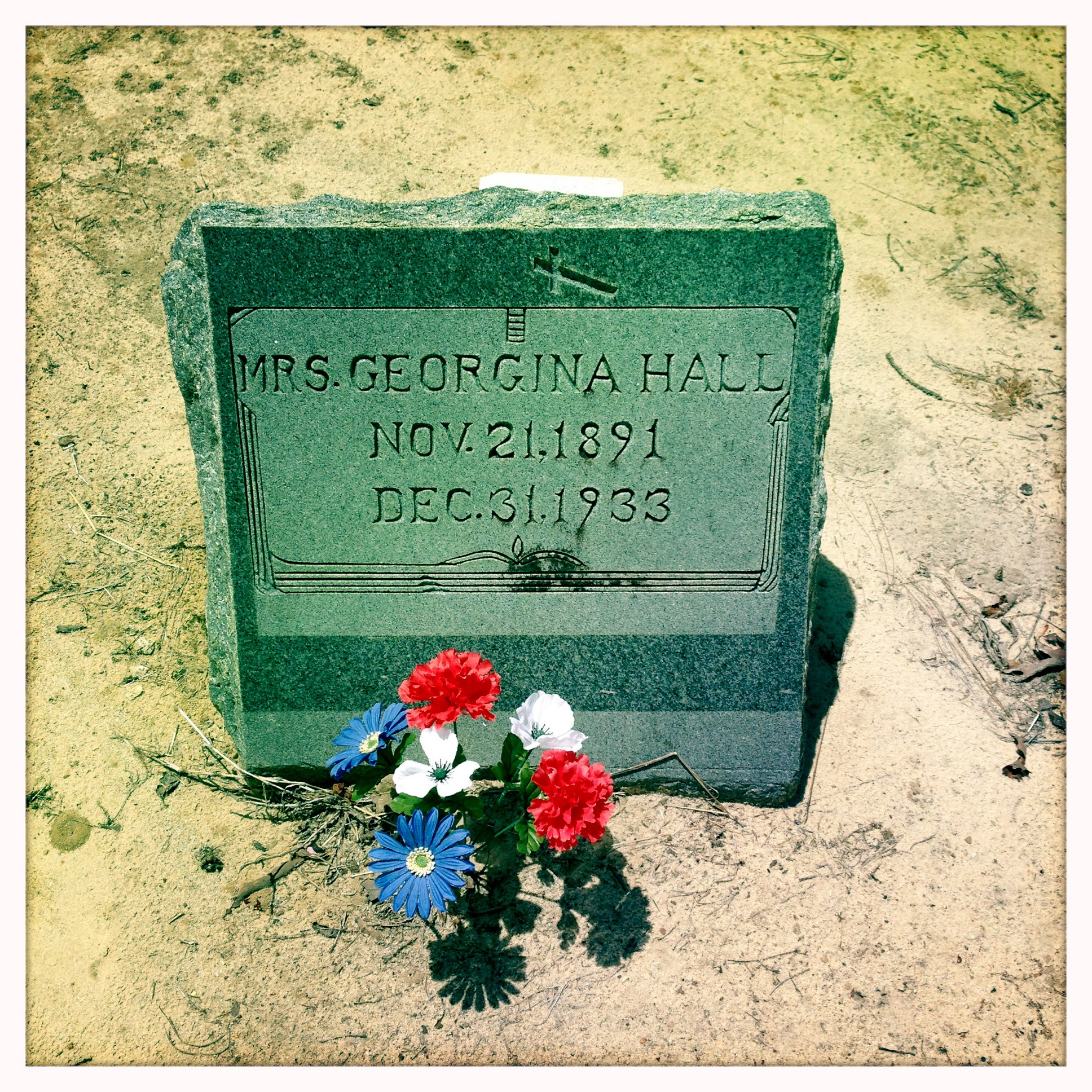
This is what dirt looks like where I’m from. It is not the plush black alluvial loam of the Mississippi Delta or the thin, rock-bedeviled soil of New England. It looks, mostly, like sand. Like in this graveyard, just south of Stantonsburg, Wilson County, where some of my Hall collateral kin lie. IMG_2195 The landscape of my childhood was level. Pine trees and flatness. Devoid, I thought, of any markers of geographical history. No boulder-strewn outcroppings, no foreboding hills, no deep-cut canyons. However, to the contrary, the most obvious relic of deep time was right under my feet.

I grew up on the western edge of North Carolina’s Coastal Plain, which was once the ocean floor. What looked like sand thrown up into the heels of my sneakers in fact was. The story wasn’t quite that simple though. I recall that patches of dirt in some places — like my parents’ back yard — are a pale gray, while others are the soft yellow of the Hall graveyard or, in veins here and there, the rusty-red of clay.

A few days ago, I found a soil survey map of Wayne County, North Carolina, dated 1916. Wayne, where my father’s mother’s people have lived since beyond memory, is just south of my home county. Seldom do I visit my parents that I don’t hop in the car for a quick dip down there. It’s a mere ten miles to the northern corner where my Artises and Haganses and Seaberrys lived, and just another 30 to get down to Dudley, where my Hendersons and Aldridges took root. What could this map, with its colorful camouflagey swirls of color, tell me about their land? The soil from which they pulled sweet potatoes and collards and the cotton and tobacco that put money in their pockets?

Screen Shot 2015-07-14 at 9.53.24 PM

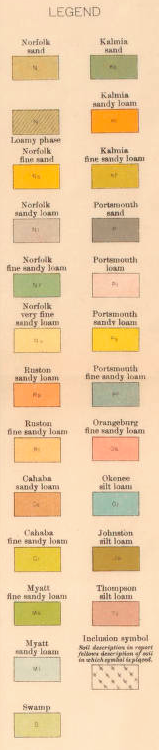
Here’s Nahunta, with Fremont at far left and Eureka at right. The road crossing from edge to edge is now known as Highway 222, and I have cousins that still live on it. That brownish sickle under N A H is marked S, which the key tells us is “Swamp.” Specifically, this is Aycock Swamp, upon whose banks Napoleon Hagans built his house. Another bit of S juts between U and N — that’s the tail end of Turner Swamp. And reaching in from Greene County is the swamp that envelops Watery Branch. Screen Shot 2015-07-14 at 9.49.48 PM Just below Eureka is a blob of Nv, “Norfolk very fine sandy loam.” The greenish Nf that dominates the frame is “Norfolk fine sandy loam.” This is Adam Artis territory. The pale lavender-gray that washes across the middle is plain “Norfolk sandy loam,” Nl. The only color left in the areas in which my family lived is the sliver of peach that hugs the south side of Aycock Swamp — Ps or “Portsmouth sandy loam.” What is all this?

From a very helpful PDF linked to the pittcountync.gov website: “The Norfolk series consists of well-drained, nearly level and gently sloping soils on uplands. These soils formed in Coastal Plain sediment. A seasonal high water table is below a depth of 5 feet. In a typical profile, the surface layer is dark grayish-brown and light yellowish-brown sandy loam about 10 inches thick. The subsoil is olive yellow and brownish yellow to a depth of about 84 inches. In the upper part, the subsoil is friable sandy clay loam mottled with red. In the lower part, it is friable sandy loam mottled with red and gray. Natural fertility and the content of organic matter are low, and available water capacity is medium. Permeability is moderate, and shrink-swell potential is low. In areas that have not received lime, reaction is strongly acid or very strongly acid. The Norfolk soils of Pitt County are important for farming. Slope is the major limitation to their use. Most of the acreage is cultivated or in pasture. The rest is chiefly in forest and in housing developments or other nonfarm uses. Where crops are grown, response is good to recommended applications of fertilizer and lime.” (Pitt County is on the other side of Greene from Wayne County.)

From the same source:  “The Portsmouth series consists of very poorly drained, nearly level soils on stream terraces. These soils formed in alluvial sediment. A seasonal high water table is at or near the surface. In a typical profile, the surface layer is very dark gray and very dark grayish-brown loam about 15 inches thick. The subsoil is about 24 inches thick. The upper part is grayish-brown, friable sandy loam mottled with grayish brown. The lower part is grayish-brown, friable, sandy clay loam mottled with yellowish brown. Below the subsoil and extending to a depth of about 68 inches is grayish-brown and light brownish-gray sand and coarse sand. Natural fertility is low, and the content of organic matter and available water capacity are medium. Permeability is moderate, and shrink-swell potential is low. In areas that have not received lime, reaction is strongly acid or very strongly acid. The Portsmouth soils in Pitt County are of only minor importance for farming. Major limitations to their use are the seasonal high water table and frequent flooding for brief periods. Most of the acreage is in forest, and the rest is chiefly in cultivated crops or pasture. Where crops are grown they respond well to recommended applications of fertilizer and lime.”

These flat acres of mostly Norfolk series soil, then, with liberal amendment, were much better quality farmland than I would have supposed.

The same was true in Brogden township, at the other end of the county. Today’s major roads, two-lane 117 Alternate and four-lane 117, which roughly parallel the railroad to the west, did not exist in 1916. (In fact, what is now Highway 117 was cut through well into my adulthood.) The railroad is still there, though, as is the road (now called O’Berry/Sleepy Creek Road) that crossed the tracks at Dudley’s little heart. Some of the little black specks you can barely see marked my people’s houses. I know, for example, that Aldridges lived along the railroad among the little dots marked opposite COAST. And the Congregational Church cemetery was just below Yellow Swamp, the shallow branch in which my people were baptized.

Soil_survey_of_Wayne_County_North_Carolina copyThe Hendersons and Aldridges and their related families, Simmonses, Wynns, Manuels, and Jacobses among them, lived within a few miles’ radius of Dudley. The soils they wrestled with included Norfolk sand (N), Norfolk sandy loam (Nl), Portsmouth sandy loam (Ps), and Ruston sandy loam (Rs). The same basic dirt as in the north of the county, with the addition of the Ruston, defined here: “The Ruston series consists of very deep, well drained, moderately permeable soils that formed in loamy marine or stream deposits. These soils are low in fertility and within the root zone have moderately high levels of exchangeable aluminum that are potentially toxic to some agricultural crops but are ideal for the production of loblolly, slash, and longleaf pine. The soils have slight limitations for woodland use and management.”

Standard
Education, North Carolina, Paternal Kin, Photographs

Cousin Mable meets Marian Anderson.

bhcp2520

I found this image in the digital Heritage of Black Highlanders Collection of the University of North Carolina-Asheville’s Ramsey Library. Taken in 1945, the photograph is entitled “Marian Anderson visits Stephens-Lee,” a high school in Asheville. Anderson was in town to give a recital at the City Auditorium. She is, of course, standing at middle, facing the camera squarely. Others on the front row, left to right, were Mable McCaine, teacher (in light-colored dress); an unidentified woman; Vernon Cowan, teacher; Frank Toliver, principal; J.D. Carr, editor of Carolina Times; and Isabell Jones, a music teacher at Allen High School.

Mable Williams McCaine was born 23 November 1912 in Goldsboro, North Carolina, to Clarence J. Williams and Daisy Aldridge Williams. Her maternal grandparents were Matthew W. and Fannie Kennedy Aldridge. The Williamses relocated to Asheville before 1920. Mable married Irvin L. McCaine, and the couple lived in Asheville with their two young sons in the 1940s.

Standard